
- Enforcement
- Financial Crime
- Governance & Accountability
One control defect, twenty-three million times over.
Westpac admitted to breaching Australia's money-laundering law on more than 23 million occasions. That number is not 23 million separate mistakes. It is a handful of broken controls, running on automated, high-volume channels, failing the same way every time. The AML fine was A$1.3 billion. Then a second regulator looked at what the breach revealed about the bank itself.
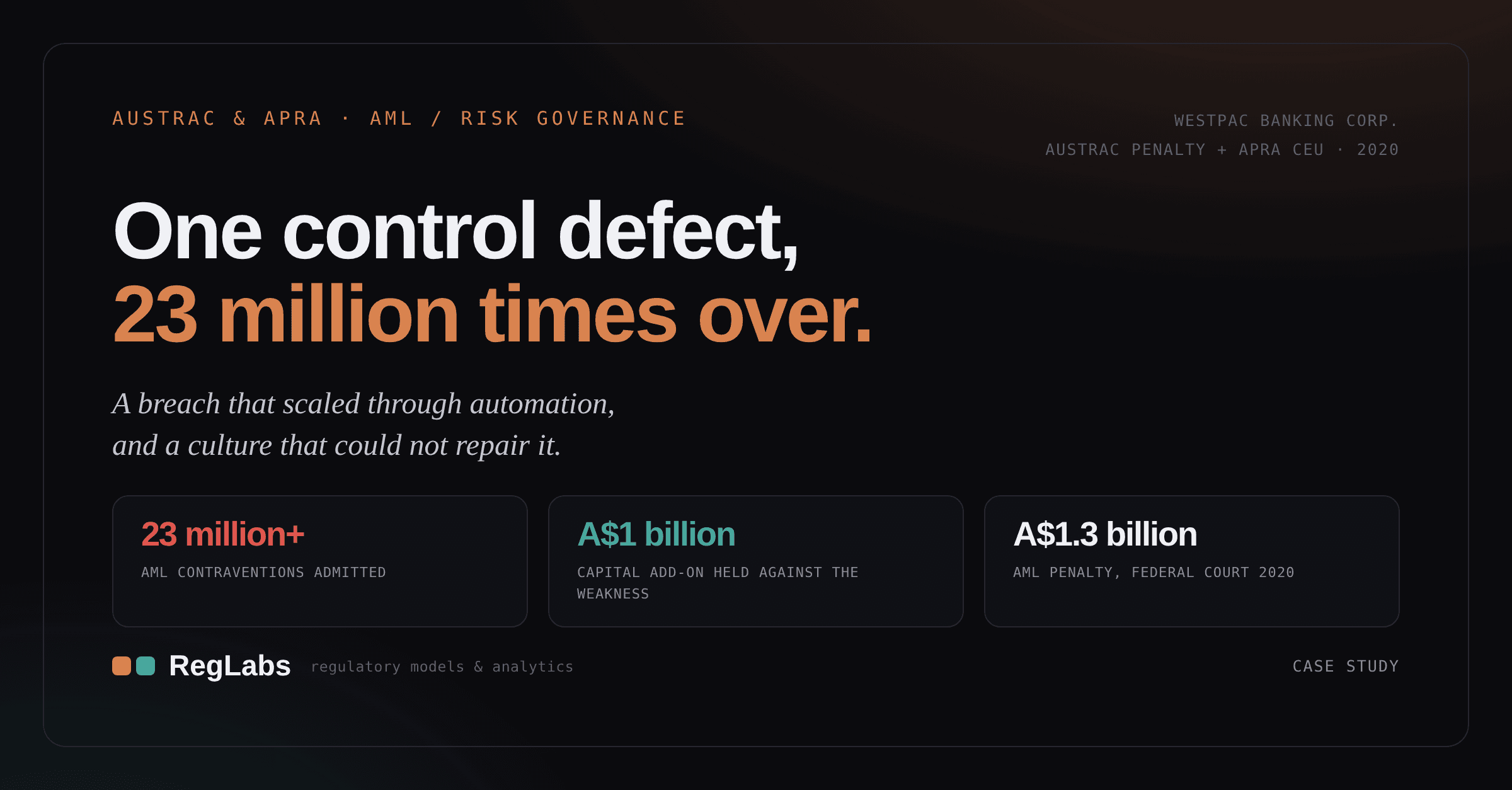
A$1.3 billion for the breach, and a second reckoning for the cause
In November 2019, the Australian Transaction Reports and Analysis Centre, AUSTRAC, the country's financial-crime regulator, filed Federal Court proceedings against Westpac Banking Corporation, one of Australia's largest banks, alleging widespread breaches of the Anti-Money Laundering and Counter-Terrorism Financing Act. On 24 September 2020 Westpac agreed to a proposed penalty of A$1.3 billion and admitted to contravening the Act on more than 23 million occasions, and on 21 October 2020 the Federal Court declared the contraventions and ordered the penalty under section 175(1) of the Act. It was, at the time, the largest civil penalty in Australian corporate history.1
But the A$1.3 billion AML penalty is only half the story, and the half most firms stop at is the less instructive one. The AUSTRAC proceedings prompted a second regulator, the Australian Prudential Regulation Authority, APRA, which supervises the safety and soundness of banks rather than their financial-crime compliance, to open an extensive review of Westpac's risk governance, because a failure of this scale, APRA reasoned, was not merely an AML problem but a symptom of something wrong with how the bank managed non-financial risk altogether. APRA's reviews, and Westpac's own reassessment, found the bank's non-financial risk culture to be, in APRA's words, immature and reactive, and found its remediation slow, repeatedly reset, and lacking momentum. In December 2020 Westpac entered a Court Enforceable Undertaking with APRA, committed to an integrated risk-governance remediation program under independent review, and agreed not to seek the removal of a A$1 billion capital add-on, capital the bank was already required to hold against its operational-risk weaknesses, until it had completed the remediation to APRA's satisfaction.1
One event, two regulators, two kinds of failure
The AML fine punished the breach. The prudential regulator addressed what the breach proved about the bank. The second reckoning was about the cause.
Source: APRA, Westpac Banking Corporation Court Enforceable Undertaking , 3 December 2020, and AUSTRAC v Westpac Banking Corporation (Federal Court of Australia, NSD1914/2019).
This study treats the Westpac matter as two linked lessons that most AML commentary separates and loses. The first is about scale: what it actually means for a bank to breach a law 23 million times, and why that staggering number is best understood not as 23 million discrete failures but as a small number of control defects running on automated, high-volume channels and failing identically every time, which reframes both the cause and the fix. The second is about aftermath: why a financial-crime failure of this magnitude is, correctly read, evidence of a risk-governance and risk-culture failure beneath it, why a reactive culture fixes incidents and never the system that produces them, why a self-assessment that names a firm's problems is worthless without the execution to resolve them, and why remediation is itself a program that requires governance, funding, accountability, and controls, so that slow and slipping remediation is a second-order failure regulators will now penalize in its own right, up to and including a capital charge. It lifts each into a discipline, and it closes on why the enduring risk for large institutions is not only the control that fails but the culture that cannot fix it once it has.
What 23 million contraventions actually means
The number at the center of this case, 23 million contraventions, is so large that it resists comprehension, and the instinct is to read it as a measure of how negligent or how vast the misconduct was. That reading is misleading, and getting the number right is the first key to the case. A bank does not make 23 million separate bad decisions. What produces a number like that is a small set of control obligations that attach to very high-volume, automated processes, failing systematically, so that each individual transaction the broken control touches becomes its own contravention. The magnitude is a function of transaction volume multiplied by a persistent defect, not of 23 million acts of wrongdoing.1
The nature of the obligations makes this concrete. A large bank's core financial-crime duties include reporting certain transactions to the regulator, particularly international funds transfer instructions, the messages that accompany cross-border payments, and monitoring transactions for suspicious patterns, especially across correspondent-banking relationships, where the bank moves money on behalf of other banks and their customers. These are not obligations a human discharges one at a time; they are automated, applied to every qualifying transaction as it flows through the bank's systems at enormous volume. When the control that is supposed to generate a required report, or apply the required monitoring, is missing, misconfigured, or fails for a category of transactions, it does not fail once. It fails for every transaction in that category, automatically, continuously, for as long as the defect persists, and at a major bank's transaction volumes that is how a handful of control gaps become a number in the tens of millions. The public proceedings described exactly this shape: large populations of unreported cross-border transfer instructions and monitoring gaps on specific channels, each affected transaction a separate statutory contravention.1
Understanding the number this way changes everything about how to think about the failure. If 23 million contraventions were 23 million decisions, the problem would be impossibly diffuse and the fix unimaginable. Because they are instead a small number of control defects replicated across a huge transaction base, the problem is actually concentrated: a few specific controls, on a few specific channels, were wrong, and they were wrong in a way that no one caught and corrected for years, during which the automation faithfully reproduced the error millions of times. The scale is terrifying and the cause is narrow, and that combination is the signature of the modern control failure, where automation is both what lets a bank process billions of transactions and what turns a single design defect into a violation of historic magnitude. The lesson is not that Westpac did 23 million wrong things; it is that a few of its automated controls were broken, and automation does not make mistakes in ones.
The failure that defined the case
Among the many contraventions, one category gave the Westpac case its moral weight and its public notoriety, and it is essential to the lesson because of what it reveals about which transactions a monitoring system most needs to watch. AUSTRAC's proceedings alleged that Westpac failed to adequately monitor a group of customers whose transaction behaviour, frequent, low-value transfers to recipients in parts of South-East Asia, matched known patterns associated with child exploitation, and that the bank did not act on that activity as its obligations required. The failure that most defined the case was not about large or obviously criminal sums; it was about small, repetitive payments that a properly designed and attentive monitoring system should have flagged and a bank should have escalated.1
The significance of this, beyond its gravity, is what it teaches about monitoring design, and it is a hard and counterintuitive lesson. The transactions in question were individually unremarkable: small amounts, of a size that no value-based threshold would catch, sent to a region to which many entirely legitimate transfers flow. Nothing about any single payment, viewed alone, would trip an alert keyed to transaction size, which is how a great deal of monitoring is primarily calibrated. The signal lived not in any transaction's amount but in the pattern, the frequency, the repetition, the combination of low value and high regularity and specific corridors and recipient characteristics, that, taken together, matched a known typology of harm. A monitoring system built mainly to catch large or unusual single transactions is structurally blind to a harm whose signature is a pattern of small, regular, individually ordinary ones, and that blindness is exactly what the most serious allegation in the Westpac case exposed.
This inverts a common intuition about where financial-crime risk concentrates. The instinct is that the dangerous transactions are the large ones, the unusual ones, the ones that stand out, and much monitoring is built on that instinct, with thresholds and alerts oriented toward size and anomaly. But some of the gravest harms, including the one at the center of this case, move through small, frequent, patterned transactions that are designed, whether deliberately or by the nature of the activity, to stay beneath exactly those thresholds. The transaction that most needs to be caught can be the one that looks most trivial, because its danger is in the pattern it belongs to, not in its own face, and a bank whose monitoring cannot see patterns in low-value, high-frequency activity has left its most important blind spot precisely where the most serious harm travels.
The pattern that matters hides in the transaction that looks trivial
The low-value, high-frequency failure crystallizes a discipline that runs against the grain of how most monitoring is built: the money-laundering and financial-crime harms that matter most are often carried by small, regular, individually unremarkable transactions, so a monitoring program oriented primarily toward large or anomalous single transactions is blind to exactly the typologies whose signature is a pattern rather than a magnitude. The Westpac transactions that mattered most were small; the danger was in their frequency and shape, and a size-oriented control could never see it.1
Where a size-based control looks, and where the harm lives
Low-value, high-frequency transfers matching a known typology: individually invisible, collectively a confession.
Source: APRA, Westpac Banking Corporation Court Enforceable Undertaking , 3 December 2020, and AUSTRAC v Westpac Banking Corporation (Federal Court of Australia, NSD1914/2019).
The reason this discipline is so often violated is that size-based thresholds are the easiest controls to build and to defend. A rule that flags transactions over a certain amount is simple to implement, simple to explain, and produces a manageable volume of alerts, and it catches the crude, large-value laundering that is the archetype in most people's minds. But sophisticated and serious financial crime, including the trafficking and exploitation typologies that carry the greatest human harm, frequently operates deliberately below those thresholds, in streams of small payments whose individual amounts are chosen precisely to avoid notice. Catching those requires monitoring that is pattern-based rather than size-based: controls that look at frequency, regularity, corridor, recipient characteristics, and the match to known behavioural typologies, aggregating across many small transactions to see a shape that no single transaction reveals. Building that kind of monitoring is harder, generates more complex alerts, and requires maintaining a library of typologies and the analytics to detect them, which is exactly why firms under-invest in it and over-rely on thresholds, leaving the pattern-shaped harms unseen.
Monitor for the pattern and the typology, not only the amount
The discipline is that a monitoring program must be built to detect behavioural patterns and known typologies, not only large or anomalous single transactions, with explicit coverage for low-value, high-frequency activity whose danger lies in its shape rather than its size, and with a maintained, current library of the typologies, including the most serious human-harm typologies, that the firm's channels could carry. This means a firm should map the harms its products and corridors are exposed to, including trafficking and exploitation, identify the transaction patterns that signal each, and build monitoring that aggregates across small transactions to surface those patterns, rather than assuming that size thresholds will catch what matters. The test is whether the firm's monitoring could detect a harm whose signature is a pattern of individually unremarkable transactions, and a firm whose alerts are driven mainly by transaction size has left uncovered precisely the typologies that stay small on purpose. Westpac's most serious failure was a monitoring program that could not see the pattern because it was looking at the amounts, and the discipline is to look at the pattern, because the transaction that most needs catching is so often the one that looks like nothing at all.
One defect, replicated at machine scale
Returning to the scale of the case with the right frame makes its deepest structural lesson visible: the 23 million contraventions were the output of automation faithfully reproducing a small number of control defects, and that is a fundamentally different kind of failure from 23 million independent errors, requiring a fundamentally different response. A broken automated control does not fail occasionally or randomly; it fails deterministically, the same way, for every input in the affected category, as fast and as often as the automation runs. The magnitude of an automated control failure is therefore the defect multiplied by the volume, and at a bank's volumes the multiplier is enormous.1
How a few broken controls become a record penalty
The number is not the measure of how many choices were made wrong. It is the measure of how many times a few wrong controls ran.
Source: APRA, Westpac Banking Corporation Court Enforceable Undertaking , 3 December 2020, and AUSTRAC v Westpac Banking Corporation (Federal Court of Australia, NSD1914/2019).
This reframing is not an excuse; it is the key to both diagnosis and prevention, and it cuts in a direction uncomfortable for firms that take comfort in automation. Automation is usually presented as a control strength, and it is: automated controls are consistent, tireless, and scalable in a way human controls are not. But that same consistency is a liability when the control is wrong, because automation removes the human friction that, in a manual process, would eventually catch a persistent error. A human performing a reporting task 23 million times would, somewhere in the millions, notice that something was off; an automated control performs the task identically every time, including identically wrong, with no one in the loop to notice, which means an automated defect can run undetected for years and across tens of millions of transactions precisely because the automation is doing exactly, and only, what it was built to do. The strength of automation, flawless replication, becomes the mechanism of catastrophe when what is being replicated is a flaw. Westpac's 23 million contraventions are the monument to that inversion: a few controls built wrong, run perfectly, for a very long time.
The diagnostic consequence is that the response to an automated control failure must target the defect and the detection, not the individual instances. You cannot remediate 23 million contraventions one transaction at a time, and you do not need to; you need to find and fix the small number of broken controls that generated them, and, more importantly, build the meta-controls that would have detected the defect, the testing, the reconciliation, the completeness checks, that ask whether the automated control is actually doing what it should across its whole population. The failure that allowed the defect to run for years was not only the broken control itself but the absence of any control over the control, any mechanism asking whether the automated reporting and monitoring were complete and correct. Automation without assurance is a machine that will reproduce your errors at scale, and the only defense is a layer of controls whose job is to verify that the automated controls are working, continuously, across everything they touch.
Automate a control, and you automate its defect
The replication at the heart of the Westpac scale crystallizes a discipline that every institution running automated controls over high-volume processes must internalize: automation replicates whatever it is given, including defects, so an automated control must be matched by automated assurance that continuously verifies the control is complete and correct across its entire population, because a defect in an automated control is not an isolated error, it is an error machine. Westpac's automation reproduced its control defects 23 million times, and nothing was checking whether the automation was doing the right thing.1
The reason firms miss this is that automation feels like the end of a control problem rather than the beginning of a new one. Once a reporting or monitoring process is automated, it is easy to regard it as solved, running reliably in the background, producing its outputs, requiring no further attention, and that perception is exactly backwards for risk purposes. An automated control that is working is indeed low-maintenance; an automated control that is subtly broken is a silent, continuous, high-volume failure that produces no friction to alert anyone, because it is running smoothly, just smoothly wrong. The absence of errors, complaints, or breakdowns is not evidence the control is correct; a broken automated control often runs just as smoothly as a working one, which is why defects in automated controls can persist for years. The firm sees a process running without incident and concludes it is fine, when running without incident is exactly what a broken automated control also does. Assurance cannot be inferred from the absence of visible failure; it has to be positively established by checking the control's outputs against what they should be.
Put a control over every automated control
The discipline is that every automated control over a high-volume process must be paired with ongoing, automated assurance, completeness checks, reconciliations, sampling, and testing that continuously verify the control is operating correctly across its full population, because the scale that makes automated controls valuable is the same scale that makes their defects catastrophic and invisible. Concretely, for an automated reporting obligation, a firm needs a reconciliation that confirms every transaction that should have generated a report did; for automated monitoring, a firm needs testing that confirms the monitoring actually covers every channel and typology it should, including by deliberately probing for the patterns it is meant to catch. The test is whether, for each automated control, the firm has an independent mechanism continuously confirming it works across everything it touches, and a firm that has automated its controls but not its assurance has built exactly the configuration that produced Westpac: controls that could fail silently and at scale with nothing watching. Automation does not reduce the need for assurance; it multiplies it, because it multiplies the consequence of a defect, and the 23 million contraventions are the measure of what happens when a firm automates the control and forgets to automate the check.
Two regulators, two failures
What makes the Westpac case singular among major AML matters is that it provoked two distinct regulatory responses, from two regulators with two different mandates, and the second is where the more transferable lesson lives. AUSTRAC, the financial-crime regulator, pursued the breach itself, the contraventions of the AML/CTF Act, and obtained the A$1.3 billion penalty. But APRA, the prudential regulator, whose job is the safety, soundness, and sound management of banks rather than their AML compliance specifically, looked at the same events and saw something that fell squarely within its own mandate: a failure of this scale, APRA concluded, was evidence that the bank's management of non-financial risk, its risk governance, was itself deficient, and that deficiency was a prudential concern in its own right.1
The distinction between the two regulators' concerns is the whole insight. AUSTRAC asked: did the bank break the AML law, and how much should it pay. APRA asked a different and deeper question: what does a failure this large tell us about whether this bank can manage its risks at all. To APRA, the 23 million contraventions were not primarily an AML matter; they were a demonstration that Westpac's systems, structures, policies, processes, and people for identifying, measuring, monitoring, and controlling non-financial risk had failed on a massive scale, and a bank whose risk governance can fail that badly in one area is a bank whose risk governance is a prudential problem generally. APRA announced its review program in December 2019, conducted prudential and risk-governance reviews, and concluded that the weaknesses ran deeper than the AML breach, prompting the Court Enforceable Undertaking, the integrated remediation program, and the retention of the A$1 billion capital add-on until the governance problems were fixed. The AML penalty addressed what the bank did; the prudential response addressed what the bank was.
This two-regulator structure is becoming the norm rather than the exception, and it is why firms can no longer treat a compliance failure as a contained, payable event. A large control failure in one domain, AML, conduct, operational resilience, is increasingly read by prudential and conduct regulators as a window into the firm's overall risk management, and the firm can find itself answering not only for the specific breach but for what the breach reveals about its governance, culture, and ability to manage risk at all. The second inquiry is often the more consequential, because it is open-ended, it reaches the firm's capital and its leadership, and it is not discharged by a payment but only by demonstrating, over years and under independent scrutiny, that the underlying governance has genuinely changed. Westpac paid A$1.3 billion to AUSTRAC for the breach and then spent years, and a held capital charge, answering APRA for the governance the breach exposed.
A breach at scale is a governance symptom, not just an event
The APRA response crystallizes a discipline that firms resist because it is uncomfortable: a control failure of significant scale is almost never an isolated event, it is a symptom of a deeper weakness in the firm's risk governance and culture, and both the firm and its regulators will, correctly, treat it as evidence about the whole system rather than as a contained incident to be paid for and closed. Westpac's 23 million contraventions were the symptom; the disease APRA diagnosed was a risk governance that could allow such a failure to develop, persist, and go undetected.1
The reason this matters is that firms strongly prefer to treat a major failure as an event, because events are bounded, payable, and closable. Characterizing the Westpac breach as an AML problem, a specific set of control defects that have now been identified and are being fixed, is comforting: it localizes the failure, caps the exposure, and promises a return to normal once the fix is done. But a failure of that scale is almost definitionally not localized, because for a few control defects to run undetected across tens of millions of transactions for years requires that the firm's broader systems of assurance, oversight, escalation, and culture also failed, because a healthy risk-governance system would have caught the defect long before it reached that magnitude. The scale of the failure is itself the proof that the governance around it was not working, which is precisely why APRA read 23 million contraventions as a prudential signal rather than an AML footnote. The depth of a failure is a measure of the depth of the governance weakness that allowed it, and a firm that treats a large failure as a narrow event is misdiagnosing the thing it most needs to fix.
Read every large failure as evidence about the system
The discipline is that a firm must treat any control failure of significant scale as a diagnostic signal about its entire risk-governance and risk-culture system, asking not only how do we fix this control but what does the fact that this failure was possible, and persisted, and went undetected, tell us about the health of our governance overall, and remediating the system rather than only the symptom. This means that when a firm discovers a large failure, the inquiry cannot stop at the proximate control defect; it must extend to why the assurance, oversight, escalation, and culture that should have caught the defect did not, because those are the generative causes, and leaving them unaddressed guarantees the next large failure in some other domain. The test is whether a firm responds to a major failure by fixing the specific control and declaring victory, or by asking what the failure proves about the system and remediating that, and a firm that does only the former, as Westpac's own reactive culture was found to do, will keep producing large failures because it keeps treating each as an event. APRA forced the systemic inquiry that Westpac's culture had not undertaken on its own, and the enduring lesson is that a failure big enough to make the news is always big enough to be about the system, and the firms that recover are the ones that read it that way before a regulator makes them.
Immature and reactive
When APRA and Westpac's own reviewers looked beneath the breach at the bank's culture, they reached a judgment stated in two words that capture the generative cause of the entire affair: the bank's non-financial risk culture was immature and reactive. Westpac itself acknowledged that it had significant work to do to improve its risk-management capability and risk culture. APRA went further, expressing concern that the bank's poor risk culture and slow progress in remediation had allowed, and would continue to allow, new and significant prudential concerns to surface. The culture was not a soft backdrop to the control failures; it was named, by the regulator and the bank alike, as the thing that produced and perpetuated them.1
The two words repay close attention because each names a distinct failure. Immature describes a risk-management capability that had not developed the systems, discipline, and sophistication appropriate to an institution of Westpac's size and complexity, a bank managing non-financial risk with practices beneath the standard its scale demanded. Reactive describes the operating mode: a culture that responded to risk issues as they surfaced, incident by incident, rather than proactively identifying and addressing the systems and conditions that generated them. A reactive risk culture is one that is always fighting the last fire, remediating the specific problem that just blew up while the generative conditions remain, so that problems keep surfacing because the culture treats each as a discrete event to be closed rather than as evidence of a system to be fixed. The combination is self-perpetuating: an immature capability lacks the tools to be proactive, so it is reactive by necessity, and a reactive mode never builds the mature capability that would let it get ahead of risk, so the two reinforce each other, and new issues keep emerging, which is exactly what APRA observed. The 23 million contraventions were the product of this culture: a control defect that a mature, proactive risk function would have caught early was allowed to run, because the culture was not looking for it and lacked the capability to find it.
Risk culture is a control, and a reactive one never fixes the system
The "immature and reactive" finding crystallizes a discipline that firms treat as intangible and regulators increasingly treat as concrete: risk culture is itself a control, arguably the most important one, because it determines whether every other control is built well, maintained, and improved, and a reactive risk culture is a defective control because it responds to incidents without ever addressing the systems that generate them. Westpac's culture was named as the root cause, and the regulator held the bank accountable for it as it would for any other control weakness.1
The reason culture functions as a master control is that every specific control a firm operates is the product of the culture that built and maintains it. A proactive, mature risk culture builds controls that anticipate risks, tests them for defects, and improves them before they fail; a reactive, immature one builds controls to the minimum, leaves them untested, and improves them only after they break. The quality of a firm's risk culture therefore determines the quality of its entire control environment, which is why a cultural weakness is not one problem among many but the generative source of many problems, and why a regulator diagnosing a cultural failure is diagnosing the thing most likely to produce the next failure. The specific pathology of a reactive culture is that it mistakes incident resolution for risk management: it closes each problem as it arises and experiences that closure as success, while the conditions that produced the problem persist and produce the next one, so the firm is perpetually busy with remediation and never actually safer. A reactive culture can look diligent, lots of issues identified, lots of fixes underway, while being fundamentally broken, because it is treating symptoms at a rate that keeps pace with their generation and never addresses the generator.
Build a proactive risk culture, and treat a reactive one as a finding
The discipline is to treat risk culture as a measurable, governable control that must be deliberately built toward maturity and proactivity, and to treat a reactive culture, one that resolves incidents without addressing the systems that produce them, as a serious control finding in its own right rather than an intangible attribute, because the culture determines whether every other control succeeds. This means a firm must assess its risk culture honestly, maturity of capability, proactivity of mode, whether issues are closed as events or addressed as systems, and whether the same kinds of issues keep recurring, and must invest in moving it toward maturity and proactivity, with the leadership, capability, and accountability that requires. The test is whether the firm's risk function is getting ahead of risks or perpetually responding to them, and whether the recurrence of similar issues suggests that generative causes are going unaddressed, and a firm whose culture is reactive, like Westpac's, should treat that as among its most serious findings, because it is the control that governs all the others. Westpac's immature and reactive culture built and maintained the controls that failed 23 million times, and the deepest remediation the case required was not of any control but of the culture that produced them.
The self-assessment that went nowhere
One of the most instructive details in the case is that Westpac had, before the breach became public, already examined itself and identified many of its own weaknesses, and it had not fixed them. In November 2018, the bank completed a Culture, Governance and Accountability self-assessment, and in January 2019 it commenced a Culture, Governance and Accountability program to implement the self-assessment's recommendations. By the time APRA reviewed it, that program, in APRA's words, had delivered only incremental progress and had lacked sufficient momentum. The bank had looked in the mirror, written down what was wrong, started a program to fix it, and then not fixed it, and the self-knowledge sat on the shelf while the control defects kept running.1
This is a distinct and underappreciated failure, and it is in some ways more damning than not knowing at all. A firm that has not identified its weaknesses can at least claim ignorance; a firm that has identified them, documented them, and announced a program to address them has removed that defense entirely, because it now has a written, dated record of knowing exactly what was wrong, against which its subsequent inaction is measured. Westpac's self-assessment was, in retrospect, a contemporaneous admission of the governance weaknesses that would produce the AUSTRAC breach, and the fact that the bank had the self-knowledge and did not act on it with sufficient momentum converts the failure from one of blindness to one of inertia. The self-assessment did not fail because it was wrong; by APRA's account it had correctly identified the issues. It failed because identification was treated as if it were resolution, as if writing down the problem and launching a program were the accomplishment, when the only accomplishment that matters is the problem actually being fixed. The gap between the self-assessment's insight and the program's incremental progress is the gap in which the 23 million contraventions continued to accrue.
Naming the problem is not fixing it
Westpac's inert self-assessment crystallizes a discipline that organizations violate constantly because the two things feel so similar: identifying a problem and resolving it are entirely different achievements, and a firm that produces assessments, reviews, and remediation plans without the execution and momentum to actually close the issues has not managed its risk, it has documented it, and the documentation, absent action, becomes evidence against the firm rather than for it. Westpac knew what was wrong and the knowing did not fix it, and the record of its knowing made the inaction worse.1
The reason firms conflate naming with fixing is that identification is satisfying and visible in a way that execution is not. Completing a self-assessment, producing a thorough review, and launching a named remediation program all feel like significant accomplishments, they involve real work, they produce documents, they can be reported to boards and regulators as progress, and they generate the sensation of having addressed the problem. But none of them changes anything about the actual risk until the underlying issues are genuinely closed, and the distance between a launched program and closed issues is exactly the distance Westpac failed to cover: the program existed, was reported on, showed activity, and delivered only incremental progress against the problems it was meant to solve. An organization can sustain, for a long time, the activity of remediation without its result, mistaking motion for progress, and a reactive culture is especially prone to this because it values the visible response over the invisible resolution. The danger is that this produces a documented trail of identified-but-unresolved problems, which is the worst possible posture: the firm has proven it knew, and proven it did not fix, which is precisely the posture APRA found and precisely why the self-assessment aggravated rather than mitigated the bank's position.
Measure remediation by closure, not by activity
The discipline is to measure risk remediation by the genuine closure of issues, verified and sustained, rather than by the production of assessments, plans, and activity, and to treat an identified issue that remains open as a live, accruing exposure rather than a managed one, because naming a problem creates an obligation to fix it and a record against which failure to fix it is judged. This means a firm's remediation must be governed by outcomes, is this issue actually, verifiably resolved, not by inputs, have we assessed it and launched a program, with momentum and completion as the metrics that matter and a documented issue treated as unresolved until it is demonstrably closed. The test is whether, for every weakness a firm has identified in itself, it can show genuine, verified resolution rather than ongoing activity, and a firm with a drawer full of self-assessments and reviews whose findings remain substantially open, as Westpac's did, has not managed those risks, it has catalogued them. The painful lesson of Westpac's self-assessment is that self-knowledge without execution is not a mitigant but an aggravant, because it establishes that the firm knew, and the only thing that discharges the obligation that knowledge creates is the problem actually being fixed, which identification, however thorough, never is.
The remediation that kept slipping
Even once the breach was public and the pressure was maximal, Westpac's attempts to fix itself continued to struggle, and the character of that struggle is a lesson in its own right about why remediation so often fails. APRA observed that Westpac's past attempts at remediation had often resulted in ongoing delays and, in some cases, a reset of programs, and that the firm was not actively managing the significant interdependencies between its major remediation efforts. The flagship CORE program's overall completion timeframe had already slipped six months, from March 2022 to September 2022, and APRA was concerned that actions contingent on one another, overlapping efforts with common purposes, and continually shifting timeframes were undermining the whole remediation agenda. The bank was trying to fix itself and the fixing kept slipping.1
The specific failures APRA named are the characteristic failure modes of large remediation programs, and they are worth isolating because firms encountering a major failure almost always underestimate them. Remediation of a deep governance problem is not a single project but a portfolio of interdependent efforts, and that interdependence is where it founders: actions that are contingent on others being completed first create critical paths where a delay anywhere cascades everywhere; overlapping efforts with common purposes waste resources and create confusion about ownership; and shifting timeframes, each slippage reasonable in isolation, compound into an agenda that never completes. Westpac's remediation exhibited all of these, and APRA's concern was not that any single program was failing but that the firm was not managing the program-of-programs as an integrated whole, with the governance, sequencing, and interdependency management that a remediation of that scale requires. The CORE program's six-month slip was not just a delay; it was a symptom that the remediation lacked the integrated governance to hold its own timeline, which is the same kind of governance weakness that produced the original failure, now manifesting in the attempt to fix it.
Remediation is a program that itself needs controls
Westpac's slipping remediation crystallizes a discipline that firms learn too late and regulators now enforce directly: remediation of a significant failure is itself a major program that requires its own governance, funding, accountability, sequencing, and interdependency management, and a remediation that lacks those controls will slip, reset, and fail, which is a second-order failure that regulators will penalize in its own right, independently of the original breach. APRA's Court Enforceable Undertaking was, in large part, a set of controls imposed on Westpac's remediation itself, an integrated plan, governance forums, independent review, success metrics, accountability, because the bank's remediation had demonstrated it could not govern itself.1
The reason remediation fails for want of its own controls is that firms treat it as cleanup rather than as the complex program it actually is. After a major failure, the instinct is to launch fixes, many of them, in parallel, each owned by whoever is closest to the relevant control, and to report activity as progress. But a portfolio of parallel fixes with shared dependencies, competing for the same scarce expertise, against shifting deadlines, is one of the hardest things an organization can execute, and treating it as a collection of independent cleanup tasks rather than as an integrated program with its own governance guarantees the failure modes APRA named: delays, resets, unmanaged interdependencies, and a timeline that perpetually recedes. The remediation needs the same disciplines as any major program, a single integrated plan, clear sequencing, active management of interdependencies, adequate and protected funding, named accountability, independent assurance of progress, and success metrics defined in terms of outcomes, and a firm that does not impose those on its own remediation will find a regulator imposing them instead, as APRA did, because a remediation that cannot govern itself is not reducing the firm's risk on any reliable timeline. The modern regulatory reality is that slow, slipping remediation is now its own enforceable failure, and a firm can be penalized, including through capital, not only for the breach but for its inability to fix it with momentum.
Govern remediation as rigorously as the business it fixes
The discipline is to run remediation of a significant failure as a governed program in its own right, with an integrated plan, active interdependency management, protected funding, named accountability, independent assurance, and outcome-based success metrics, and to recognize that the capability to remediate with momentum is itself a capability regulators now assess and penalize, so that a slipping remediation is treated as a serious failure rather than an understandable delay. This means that when a firm faces a major remediation, it must stand up the governance of the remediation itself, not just the fixes, treating the program-of-programs as requiring the sequencing, resourcing, and oversight of any strategic undertaking, and measuring it by verified completion rather than reported activity. The test is whether a firm's remediation has an integrated plan with managed interdependencies and is completing against it with momentum, or whether it is a collection of parallel efforts that keep slipping, and a firm in the latter state, as Westpac was, has a second failure layered on its first. APRA's undertaking supplied Westpac with the remediation governance the bank had not supplied itself, and the lesson is to build that governance before a regulator makes you, because the ability to fix a failure quickly and completely is now as much a part of risk management as the ability to prevent it.
The price of a governance weakness
The most concrete expression of how seriously the prudential regulator took Westpac's governance weakness is a number that sits apart from the A$1.3 billion AML penalty: a A$1 billion capital add-on that the bank was required to hold, and could not have removed, until it fixed the problem. Since 30 September 2019, under the prudential standard governing operational-risk capital, APRA had required Westpac to hold an additional A$1 billion of capital against its heightened operational risk, and in the Court Enforceable Undertaking Westpac agreed not to even apply for the removal of that add-on until it could demonstrate, to APRA's satisfaction, both compliance with the undertaking and completion of the remediation. The governance weakness was not only a reputational and legal matter; it was a direct charge against the bank's balance sheet.1
The capital add-on is a profoundly important mechanism because it translates an intangible-seeming governance weakness into the hardest possible currency. Capital is the scarcest and most expensive resource a bank has; requiring a bank to hold an extra billion dollars of it, unproductively, against an operational-risk weakness is a continuous, quantified, balance-sheet cost of that weakness, and it converts "your risk governance is poor" from a qualitative criticism into a measurable financial penalty that persists for as long as the weakness does. The design is elegant and coercive: the add-on gives the firm a direct, ongoing financial incentive to complete its remediation, because the capital is released only when the problem is fixed to the regulator's satisfaction, so the cost of poor governance is paid every day until it is cured. This is a different and in some ways more powerful tool than a one-time fine, because a fine is paid and gone while a capital add-on is a recurring cost that the firm can end only by actually fixing the underlying problem, aligning the firm's financial interest with the regulator's remediation objective in a way a penalty cannot. Westpac's A$1 billion add-on meant that its immature and reactive culture and its slipping remediation were not just embarrassing; they were expensive, continuously, until genuinely resolved.
A governance weakness has a balance-sheet cost, and accountability has to bite
The capital add-on, together with the undertaking's accountability provisions, crystallizes a discipline that firms are slow to internalize: governance and culture weaknesses carry real, quantifiable costs, in capital, in constraints, and in individual accountability, and regulators increasingly make those costs bite directly, so that a firm cannot treat risk governance as a soft overhead but must regard it as a driver of capital and a matter of personal consequence. Westpac held A$1 billion against its weakness and agreed to reflect remediation accountability in its executives' remuneration scorecards and accountability statements, because accountability that does not touch capital and pay is not accountability.1
The reason this matters is that governance and culture have historically been the easiest things for firms to treat as aspirational, because their weaknesses were hard to quantify and their costs diffuse and deferred. A firm could acknowledge that its risk culture needed work, launch a program, report incremental progress, and face no immediate, concrete consequence for the gap between its stated intentions and its actual state, which is precisely the dynamic that let Westpac's self-assessment sit substantially unactioned. The capital add-on and the accountability provisions are regulatory answers to exactly that softness: they attach a hard, present cost to the governance weakness, a billion dollars of capital and named executive accountability tied to remuneration, so that the weakness cannot be treated as a someday problem because it is a today cost. Accountability in particular has to reach individuals and their incentives to function, because an accountability that is purely organizational, the firm is responsible, diffuses until no one feels it, whereas accountability reflected in specific executives' scorecards and statements creates individuals with a personal, financial stake in the remediation actually completing. The combination makes the governance weakness expensive to the institution and consequential to the people who must fix it, which is what converts a reactive culture's indefinite incremental progress into something that gets done.
Treat governance as capital, and make accountability personal
The discipline is to recognize that risk-governance and culture weaknesses carry concrete costs, potentially including capital charges and business constraints, and to make accountability for them personal and tied to real incentives, so that the firm treats its risk governance as a driver of its financial position and its leaders bear individual consequences for its state rather than diffusing responsibility across the organization. This means a firm should understand that a serious governance weakness can translate into a capital add-on and other hard constraints, and should therefore invest in governance as it would in anything that affects capital, and it means accountability for risk and remediation must reach named individuals and their remuneration, not rest as an organizational abstraction. The test is whether the costs of a firm's governance weaknesses are made real and present, to the institution and to specific people, or allowed to remain diffuse and deferred, and a firm that treats risk governance as a soft matter without balance-sheet or personal consequence, as the industry long did, is operating under an increasingly obsolete assumption. Westpac learned that its culture and governance had a price measured in billions of held capital and in executive accountability, and the broader lesson is that governance is no longer free to get wrong, because regulators now ensure it is paid for, continuously, until it is fixed.
The broader lesson: the control that fails, and the culture that cannot fix it
The enduring lesson of the Westpac case is that it is really two lessons, and the second is the one most firms never reach: a control can fail at catastrophic scale through a small defect replicated by automation, and a firm can then prove unable to fix itself because the same culture that allowed the failure also prevents its remediation, so that the deepest risk a large institution faces is not the control that breaks but the culture that cannot repair it. Westpac's 23 million contraventions were the breakable control; its immature and reactive culture, its inert self-assessment, and its slipping remediation were the unrepairing culture, and the second is what kept the bank in difficulty long after the first was understood.1
The disciplines this study has drawn out address both halves. Monitor for patterns and typologies, not only amounts, because the harms that matter most, including the gravest, travel through small, frequent, individually trivial transactions, and Westpac's most serious failure was a monitoring program that could not see the pattern. Put a control over every automated control, because automation replicates defects at scale and a broken automated control runs as smoothly as a working one, so the only defense is continuous assurance that the automation is doing the right thing. Read every large failure as a governance symptom, because a failure big enough to matter is always evidence about the system that allowed it, which is why a second regulator saw a risk-governance crisis where the first saw an AML breach. Treat risk culture as a control, and a reactive one as a finding, because the culture determines whether every other control is built well and improved or merely patched after it breaks. Measure remediation by closure, not activity, because naming a problem is not fixing it and a documented, unactioned self-assessment is an aggravant. Govern remediation as rigorously as the business it fixes, because a remediation that slips is a second failure that regulators now penalize. And treat governance as capital with personal accountability, because its weaknesses now carry hard, present costs. Together they describe a firm that can both avoid the failure and, when one occurs, actually fix it.
The forward view: scale, automation, and the governance to match
The reason the case only grows more relevant is that both of its halves are intensifying. The scale and automation that turned a few Westpac control defects into 23 million contraventions are increasing across the industry, as banks process ever more transactions through ever more automated systems, which means the potential magnitude of an undetected automated control defect is growing, and the premium on continuous, automated assurance of those controls is growing with it. At the same time, regulators are becoming more sophisticated and more coordinated in reading a large failure as a governance symptom, attaching hard costs, capital, constraints, personal accountability, to the governance and culture weaknesses a failure reveals, and demanding governed, momentum-bearing remediation rather than the indefinite incremental progress a reactive culture produces. The firms that will navigate this are the ones that invest ahead of it, in assurance that can verify automated controls at scale, in a risk culture mature and proactive enough to catch defects before they replicate and to fix them with momentum when they occur, and in treating governance as the capital-affecting, personally-accountable matter it has become. The Westpac case is the template for the failure that modern scale makes possible and the governance crisis that modern regulation makes of it, and its lasting warning is that the control which fails is survivable, but the culture that cannot fix it is the thing that turns a breach into a reckoning.
What this case is really about
A control defect replicated 23 million times, and a culture that could not repair it
Westpac admitted more than 23 million contraventions of Australia's AML law, a handful of control defects on automated, high-volume reporting and monitoring channels, failing identically every time, including a monitoring gap on the small, frequent transfers that carried the gravest harm. The AML penalty was A$1.3 billion. Then APRA, the prudential regulator, read the breach as a risk-governance symptom, found the culture "immature and reactive" and the remediation slow and slipping, imposed a Court Enforceable Undertaking, and held a A$1 billion capital add-on against the weakness until it was fixed.
Where it broke
- 23 million+ contraventions from a few control defects on automated, high-volume channels, with no assurance over the automation
- A monitoring program that missed the small, frequent, patterned transfers carrying the most serious harm
- An "immature and reactive" risk culture that resolved incidents without fixing the systems producing them
- A 2018 self-assessment that identified the weaknesses, followed by a program delivering only incremental progress
- Remediation that repeatedly slipped and reset, with unmanaged interdependencies and a CORE program delayed six months
- Governance weakness serious enough to draw a second regulator, a A$1 billion capital add-on, and executive accountability measures
What risk governance requires
- Pattern- and typology-based monitoring that catches low-value, high-frequency harm, not just large or anomalous transactions
- Continuous, automated assurance over every automated control, verifying completeness and correctness across its full population
- A mature, proactive risk culture treated as a measurable control, with a reactive culture recorded as a finding
- Remediation measured by verified closure, not by assessments, plans, and activity
- Remediation governed as an integrated program with managed interdependencies, funding, and momentum
- Governance treated as capital-affecting, with personal, incentive-linked accountability
AML Governance Analyst
Reviews the AML programme end to end against global enforcement and the typologies each control must catch: whether transaction monitoring covers behavioural patterns and serious-harm typologies including low-value, high-frequency activity, not only size thresholds; whether automated reporting and monitoring controls have the completeness checks and reconciliations that would catch a defect before it replicates across millions of transactions; and whether the programme's governance, escalation, and remediation are mature and proactive rather than reactive. A monitoring blind spot, an automated control with no assurance over it, a self-assessment whose findings remain open, or a remediation that is slipping is surfaced as a program-design finding, with a remediation target and a health score, before a defect becomes 23 million contraventions and a prudential regulator becomes involved.Five ways RegLabs keeps a defect from becoming 23 million of them
This case study is an independent analysis prepared by RegLabs for educational and informational purposes, based on the public APRA Court Enforceable Undertaking concerning Westpac Banking Corporation (3 December 2020) and the public AUSTRAC proceedings. It is not legal advice and does not reproduce those documents in full. All figures and quotations are drawn from the public record; any characterizations are those of RegLabs. Company and regulator names are used for identification and commentary only.