500+
Global Regulators
Prudential, market, SRO, and 60+ exchange regulators


Stay ahead in a complex regulatory world and reduce compliance costs and unwanted risks.
Firms spend over 25% of their time and millions annually just to keep up with regulatory changes, which can exceed 800 updates per day. This burden is intensified by cross-border complexity, rising enforcement actions, and examinations that can exceed two years—all within a global regulatory environment fragmented between principles-based and enforcement-driven approaches.
Regulatory compliance need not be complex. In today’s fragmented and shifting regulatory landscape, compliance is a data management challenge—not a legal checkbox exercise. RegLabs’ groundbreaking Agentic AI technology, ATLAS (Agentic Technology for Legal Alignment and Simplicity), redefines compliance as a data-centric solution. Embedded in RegLabs Studio®, our real-time compliance hub, ATLAS synthesizes activities from 500+ global regulators into actionable insights, systematically performing lessons-learned analyses, compliance risk assessments, and audit automation.
By continually learning from a vast and expanding dataset of 300,000+ US securities rules, 20,000+ regulator viewpoints, and 305,000+ enforcement cases, ATLAS cuts through regulatory noise in seconds. It mirrors how regulators think and enforce and serves as your compliance co-pilot. This allows you to redirect resources toward growth and speed-up the review and approval of business initiatives, while staying a step ahead of regulatory changes instead of merely surviving them.
Take command at every compliance touchpoint with RegLabs Studio®+ ATLAS and the world’s largest regulatory database, comprising:
500+
Prudential, market, SRO, and 60+ exchange regulators
550+
Compliance rules, procedures, responsibilities and guidance.
275+
Market abuse, negligence and vulnerabilities resulting in fraud.
305K+
Enforcement actions and penalties imposed by regulators.
13+
Broker Dealers, Hedge Funds, Private Equity, Energy and Utilities, Insurance, Money Service Transmitters, State & Commercial Banks, Data Privacy & Cybersecurity, Gaming & Prediction Markets, Aerospace & Defense, Trade Import/Export, Pharmaceuticals & Medical Devices
20+
Spanish, French, Japanese, Mandarin, Italian, Swedish, Danish, Norwegian, Portuguese, Korean, Polish, German, and much more.
RegLabs’ ATLAS synthesizes global regulatory data into actionable insights through continuous learning and reasoning. Solutions include:
Don’t Just Comply- Anticipate.
Stay ahead with comprehensive horizon scanning that continually monitors global regulations, enforcement cases, regulatory speeches, exchange notices, and more—all in one place.
Analyzing enforcement cases for our business used to take over 20 hours. RegLabs does this under 1.
-CCO global Investment Bank
Complete disclosure
In today’s fast-evolving regulatory landscape, staying ahead of compliance risks is a constant challenge. ATLAS’ Horizon Scanning function delivers real-time global monitoring of regulatory developments and enforcement trends. It identifies emerging risks, tracks historical patterns, and offers tailored insights, enabling your business to proactively navigate regulatory changes. The analysis is customizable to your specific industry, policies, and compliance priorities, empowering your organization to make informed decisions, enhance compliance strategies, and allocate resources efficiently—turning regulatory intelligence into a competitive advantage.
Turn regulatory uncertainty into strategic advantage.
Our algorithms predict regulatory questions across 550+ compliance topics, speeding approvals, eliminating surprises and saving hundreds of hours during reviews.
It’s like having a crystal ball for compliance – much less stress and way fewer surprises.
-CCO mid-sized Asset Manager
Complete disclosure
Our Agentic AI technology, ATLAS, emulates how regulators examine firms and brings significant efficiency and foresight to the regulatory response process. By mirroring the structure, focus areas, and methodologies used in actual exams and inquiries, ATLAS helps firms anticipate what regulators are likely to review across hundreds of compliance and risk topics. This allows teams to proactively surface relevant evidence, validate controls, and organize documentation in alignment with regulatory expectations. As a result, firms can approach exams with clarity and confidence, avoiding surprises while accelerating their ability to respond with precision and completeness.
Additionally, expanding trading to a new market, launching a new product or asset class, or deploying a new trading strategy or algorithm can take 9+ months in most financial firms – often longer for complex or cross-border initiatives. A significant portion of this timeline is driven not by technology readiness or business planning, but by legal, compliance, and risk reviews, which are essential to ensure regulatory alignment, internal policy adherence, and sound risk governance. ATLAS surfaces the most likely regulatory questions and focus areas from the outset. Instead of starting from scratch or relying on generic checklists, teams receive a tailored, regulator-aligned perspective on what needs to be addressed—across 500+ compliance and risk topics. This enables legal, compliance, and risk functions to target their reviews, anticipate examiner concerns, and quickly identify where additional controls or disclosures may be needed. The result is faster alignment, reduced back-and-forth, and quicker go-to-market execution, all while maintaining regulatory readiness and risk rigor.
Predict. Prevent. Protect.
Prevent violations before they occur by learning from industry-specific regulatory failures—systematically examining enforcement cases to proactively identify your compliance vulnerabilities.
Its gap analysis ability is a perfect example of how AI can enhance real-world compliance practices.
-CCO large Asset Manager
Complete disclosure
Regulatory missteps can be costly, but learning from past enforcement actions provides a powerful advantage. ATLAS’ Gap Analysis function enables you to identify and address compliance vulnerabilities by leveraging an extensive database of over 70,000 regulatory cases from more than 100 global regulators. It benchmarks compliance frameworks against historical enforcement trends, highlights regulatory pitfalls, and extracts actionable lessons from past violations. This proactive approach enables you to strengthen controls, mitigate risks, and refine compliance strategies—enhancing regulatory readiness, operational efficiency, and stakeholder confidence.
Automate risk assessment. Accelerate compliance confidence.
Automate comprehensive risk assessments across compliance, market abuse, cybersecurity, trading practices, and regulatory reporting using 15+ years of data from the world’s largest enforcement database.
We compare different regulator risks to deploy our resources most efficiently across our global offices.
-CCO Asset Manager
Complete disclosure
Performing comprehensive risk assessments is an enormous undertaking, requiring significant time, effort, and coordination across multiple teams. For firms trading diverse products across numerous offices and regulatory jurisdictions worldwide, this complexity multiplies exponentially. Each jurisdiction comes with its own evolving regulatory demands, making it essential that risk assessments remain continuous and current – not stale snapshots. Yet, risk, compliance, and front-office teams often find themselves stuck in a relentless cycle: by the time one assessment is finalized, a new one must immediately begin, forcing them into a constant inefficient race to keep pace with emerging risks and regulatory expectations.
This “dog chasing its tail” scenario drains resources and limits firms’ ability to focus on strategic risk mitigation. Without automation and scale, staying ahead of years of evolving enforcement trends and regulatory priorities is virtually impossible – especially when risk must be evaluated across dozens of topics simultaneously.
Raise the Bar – Lead the Industry.
Leverage the world’s largest regulatory database to evaluate your compliance program, comparing your performance against industry best practices through comprehensive enforcement activity analysis.
Automated compliance tracking frees our people to better support our business objectives.
-CCO large Broker-Dealer
Complete disclosure
In an increasingly scrutinized regulatory environment, understanding how your compliance program stacks up against industry peers is essential. ATLAS’ Benchmarking function leverages the world’s largest regulatory database and advanced comparison tools to provide organizations with a clear, data-driven view of enforcement trends, competitor strategies, and industry best practices. By evaluating compliance performance against established standards and incorporating real-world case studies through its “lessons learned” program—aligned with Department of Justice best practices—this helps you refine your compliance frameworks, enhance training, and strengthen stakeholder trust. With benchmarking insights, you can proactively improve compliance strategies, reduce regulatory risk, and gain a competitive edge.
Swift Screening – Safer Investments.
Use advanced investigative tools to accurately assess a firm’s regulatory profile, enabling informed business decisions through comprehensive risk intelligence integrated across multiple risk exposures.
RegLabs uncovered critical regulatory risks in our due diligence that our usual screening missed.
-CCO large Hedge Fund
Complete disclosure
Effective due diligence is essential for mitigating risk and ensuring informed decision-making in business relationships and investments. ATLAS’ Due Diligence function provides AI-powered investigative tools to assess a firm’s regulatory profile, disciplinary history, and compliance track record. By integrating regulatory intelligence into broader risk frameworks—including KYC, counterparty, credit, reputational, and operational risk assessments—this enables you to identify potential compliance liabilities before they escalate. With comprehensive due diligence capabilities, you can enhance investment confidence, strengthen risk mitigation strategies, and streamline compliance checks for greater operational efficiency.
Compliance Without Complications.
Simplify your regulatory change management with timely updates, impact assessments, and streamlined implementation tracking that help you efficiently adapt to evolving compliance requirements and standards.
Tracking regulatory changes used to be a nightmare. RegLabs made it seamless.
-CCO large RIA & BD
Complete disclosure
Regulatory landscapes are constantly evolving, making it crucial for organizations to stay ahead of compliance changes. ATLAS’ Change Management function acts as a centralized regulatory intelligence hub, delivering timely updates on rule changes and their potential impact. With built-in impact assessment capabilities, it helps you evaluate regulatory shifts, plan proactive responses, and streamline compliance implementation across business units. Additionally, its archiving facilitates a historical record of changes and organizational responses, enabling you to track progress and demonstrate adherence over time. By simplifying change management, this enhances preparedness, fosters cross-team collaboration, and ensures regulatory compliance remains a strategic priority.
Global compliance at your fingertips.
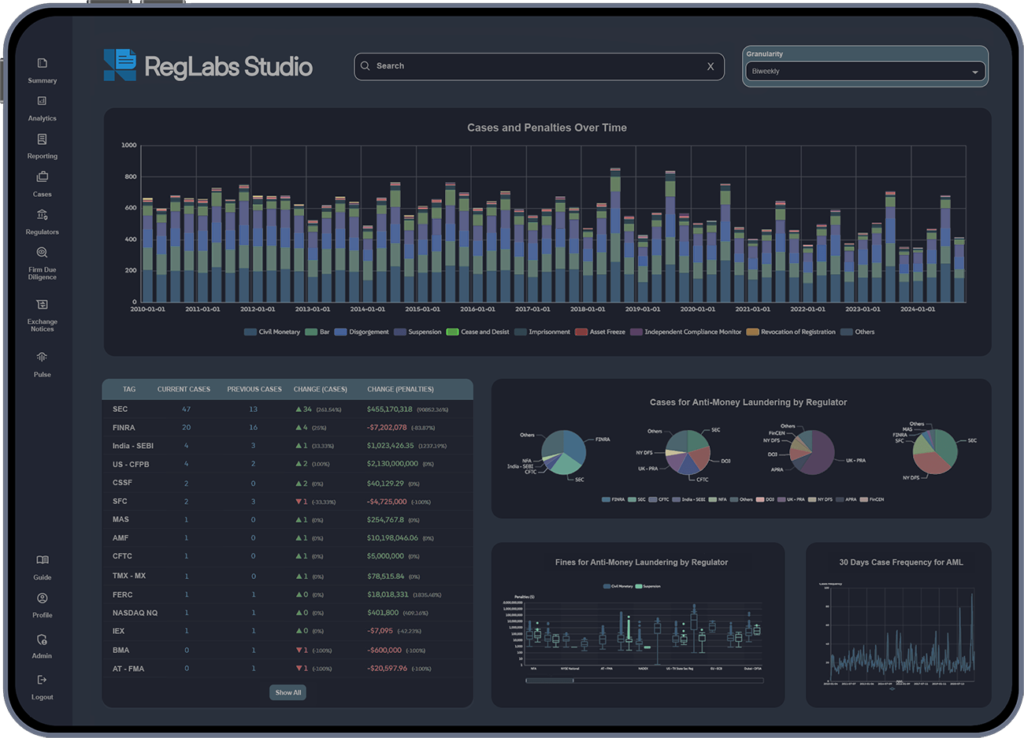
RegLabs Studio® is your intelligent hub for real-time compliance analytics. At its core is ATLAS, your regulatory co-pilot that transforms vast volumes of regulatory data into actionable insights within seconds. ATLAS mirrors regulatory thinking by continuously learning and reasoning from the world’s largest regulatory enforcement database comprising 300,000+ U.S. securities rules, 20,000+ regulator viewpoints, and 305,000+ global enforcement cases. Our technology is built on a doctrine we call the Compliance Triangle.
Powered by Rules. Piloted by Guides. Proven by Cases.
01Ruleswhat’s written
02Guideswhat’s said
03Caseswhat’s enforced
Effective compliance goes beyond merely following written regulations. It requires a comprehensive, data-driven approach that encompasses:
Adopting a compliance strategy that incorporates Rules, Guides, and Cases provides a more effective and resilient framework for regulatory adherence. Rules offer the foundational legal framework, but without proper interpretation and enforcement insights, compliance efforts may be misdirected or incomplete. Guides help firms understand regulatory expectations and evolving priorities, while Cases reveal real-world enforcement trends, ensuring firms align with what regulators actively monitor and penalize.
Combining these dimensions enhances proactive and accurate compliance, enabling your organization to dedicate more time and resources to business growth objectives.
Integrating Rules, Guides, and Cases creates a complete picture of what regulators expect. It covers both the clear-cut requirements and the subtle nuances, so decisions are made with full knowledge of the compliance landscape. This breadth of insight ensures a compliance program aligned with how rules are actually enforced in the real world.
Focusing on a single dimension can create blind spots and gaps. Rules alone may not reflect evolving interpretations, guides may overlook enforcement trends, and cases without regulatory context can lead to reactive compliance. A three-dimensional approach greatly lowers the risk of violations and the costly fines or enforcement penalties that follow.
By unifying rules, guidance, and case insights, compliance work becomes far more efficient. Teams eliminate duplicate work and focus their training on high-risk areas, which helps them respond faster to new requirements. The result is a nimble compliance culture that’s always one step ahead and quick to adapt, driving peak performance across your organization.
A three-dimensional compliance strategy keeps you ahead of the curve as regulations evolve. You can swiftly adapt your compliance efforts to match shifting enforcement priorities, all while earning trust and credibility with regulators. This forward-looking strategy ensures resources are allocated optimally and gives your organization a competitive edge in an ever-evolving compliance environment.

AI-driven automation delivered 60% cost reduction and eliminated regulatory update misses, saving 120hrs monthly.
Complete disclosure
A global investment bank operating across North America, Europe, and Asia faced significant challenges tracking regulatory enforcement changes. Their compliance team manually monitored dozens of regulators, but the volume and frequency of updates made this process unmanageable. Important updates risked being missed, creating potential compliance gaps. Leadership feared overlooking critical regulatory changes that could result in fines or damage to their reputation, underscoring their need for a more effective monitoring solution.
ATLAS’s Horizon Scanning function delivered automated monitoring of regulatory changes across more than 100 global regulators. The system provided real-time alerts for relevant updates, eliminating manual tracking requirements. By distributing this information seamlessly to team members worldwide, the firm effectively initiated necessary remediation and enhancement projects.
The firm achieved a 60% reduction in compliance monitoring costs and time, as the automated system freed about 120 hours per month, and reported 0 missed regulatory updates (down from 5+ annually).

Compliance reviews were 80% faster with greater accuracy, finding missed information while freeing-up staff.
Complete disclosure
A Broker-Dealer specializing in trading and market-making wanted to understand the compliance risks pertaining to Regulation SHO: short selling requirements, order marking, aggregation units, and use of locates, believing that regulators would initiate a sweep on these topics in the upcoming year. The compliance team would historically seach for some cases online, sift through law firm emails over the years and compile their own documents and spreadsheets in an effort to centralize the information in one place. The team needed a systematic way to pinpoint gaps and vulnerabilities in competitor firms that could be applicable to its own firm, while having the justification behind why these risk areas were chosen for scrutiny.
The team used RegLabs’ regulatory database to identify any enforcement actions pertaining to Reg SHO and used the gap analytics features to compile risk areas for internal examination. RegLabs ATLAS’ analytics and reporting capabilities, sitting on top of the largest database for enforcement actions, pinpointed specific Reg SHO topics and enforcement trends.
Compliance reviews were conducted ~80% faster and more accurately – having identified information previously missed by other service providers – freeing staff for higher-value activities.

Training with practical case studies significantly improved business transparency and compliance escalations.
Complete disclosure
A global bank needed to upgrade its training program as the organisation was growing substantially in its investment operations. Previously, it utilized a vendor training solution with some customization, but this solution largely focused on regurgitating rules and regulations. The organisation was particularly focused on training during employee onboarding, where it wanted to ensure that newcomers, especially in the trading and quantitative research divisions, were familiar with key issues involving risk management, technology governance, change management, web scraping, and other topics. The organisation also wanted the ability to highlight important industry developments as they occurred throughout the year and improve the engagement of its front office employees with its legal, compliance, and governance functions.
RegLabs ATLAS’ algorithmic dissection of enforcement actions gave the organisation ready-made case studies for training purposes that clearly explained applicable rules and regulations in a practical way. The content was naturally aligned to training.
Front office personnel remarked that the case study practicalities made it the most relevant training they had received in their careers (of 15+ years experience) and that ‘this is how all compliance training needs to be conducted.’ Legal & Compliance personnel remarked that the updated approaches to training improved the transparency and escalation of questions by the business to compliance.

Due diligence time and effort cut by 50%, accelerating the investment allocation decision-making.
Complete disclosure
In determining whether to award an investment allocation to an Investment Manager, an Allocator wanted to ensure the Investment Manager had proper controls, governance, and compliance best practices in place. The Allocator had traditionally used standard due diligence questionnaires and review processes, but this allocation was larger than previous investments and the Investment Manager employed more emerging technology (e.g., alternative data, AI) in its investment processes which carried new regulatory risks. The Allocator wanted to sharpen its due diligence approach on these areas and compare peer funds, to ensure the prospective Investment Manager was exercising the highest duty of care.
RegLabs ATLAS function delivered a comprehensive compliance risk profile. It reviewed enforcement records, flagging past fines, ongoing investigations, and possible control gaps. This gave the Allocator the specific areas of scrutiny it needed to deep-dive as part of its operational due diligence prior to making any investment decisions.
The Due Diligence module neatly organized targeted risk areas in minutes, including alternative data, web scraping, algorithmic trading governance and risk controls, hedge and liability clauses, and valuation methodologies on illiquid assets. The analysis significantly reduced the compliance due diligence time and effort by 50%, accelerating the investment allocation decision-making.

Outside counsel spend reduced by 85% and compliance assessment completed in one week.
Complete disclosure
A hedge fund manager wanted to expand its trading strategies to India and Dubai. The firm hadn’t previously traded in these markets and wanted to know what regulatory requirements and compliance risks it needed to account for in its expansion. The firm already operated a compliance program and wanted to understand which areas it could scale as well as whether any new developments were needed to ensure compliance in the new regions. The firm’s APAC operations were operated out of the US and UK primarily, as it was resource-conscious, so it wanted to ensure it was prudently applying a risk-based approach toward the expansion efforts while enabling a go-to-market as quickly as possible.
RegLabs’ database enabled the hedge fund manager to easily identify enforcement actions by SEBI in India and DFSA in Dubai applicable to its business type (investment adviser, hedge fund). The regulator comparison analytics simplified identifying which topics both regulators prioritized, assessed monetary risks across these topics compared to existing regulatory regimes (SEC, FCA), tracked evolving regulatory risks, and guided necessary adjustments to the compliance program to meet SEBI’s and DFSA’s requirements.
RegLabs’ analytics minimized outside counsel spend by 85% and enabled the compliance risk assessment as well as the resource allocation review to be completed within a week.
Chief Compliance Officers & Compliance Personnel
Chief Risk Officers & Enterprise Risk Personnel
Business Controls & Front Office Supervisory
General Counsels & Legal Personnel
Surveillance Personnel
Internal Audit
RegLabs Insights
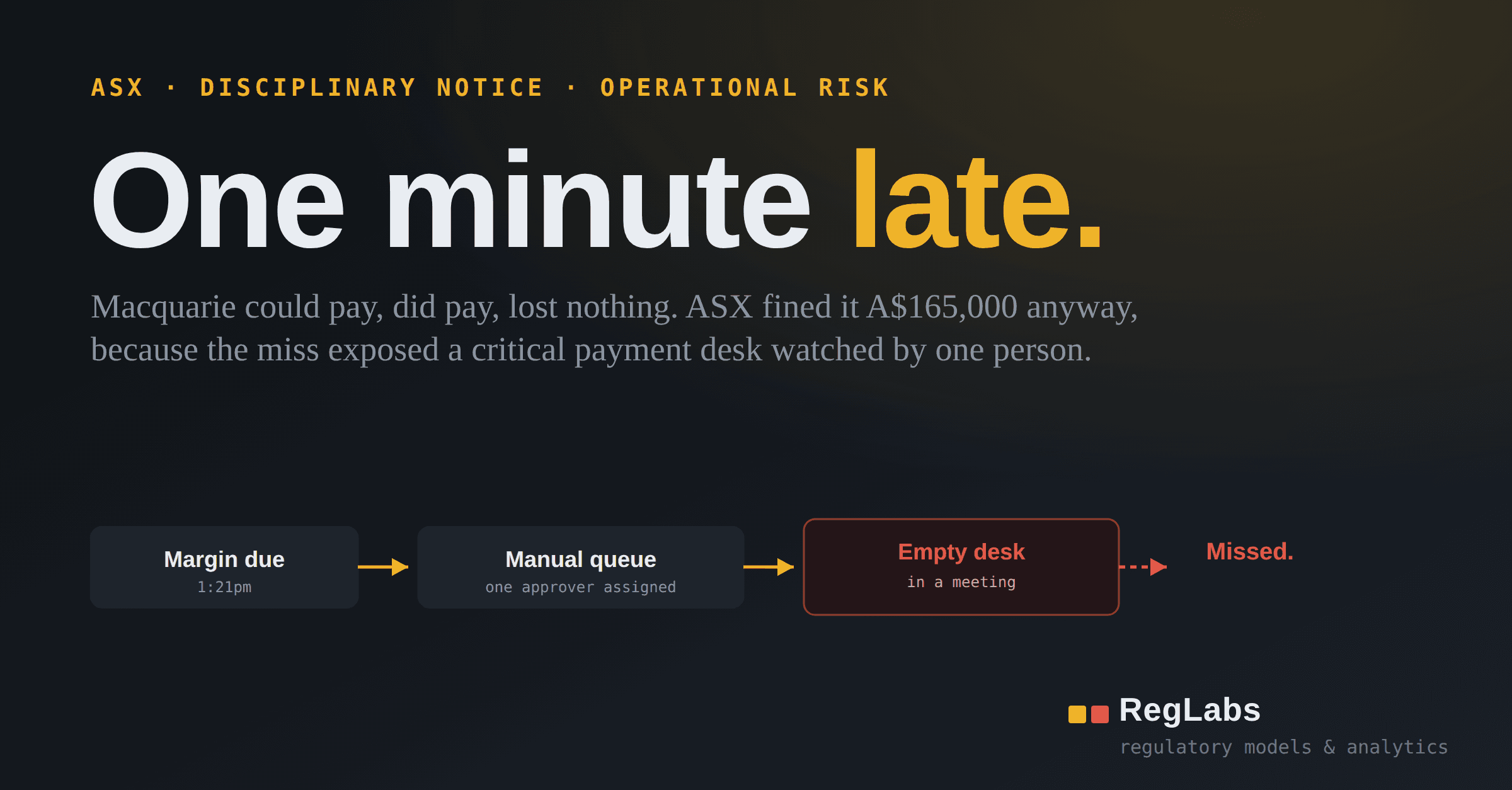
Macquarie could pay, did pay, and lost nothing. ASX still fined it, because a one-minute miss and a 24-minute miss three days apart exposed a critical payment desk watched by one person, with no cover and no fix in between.
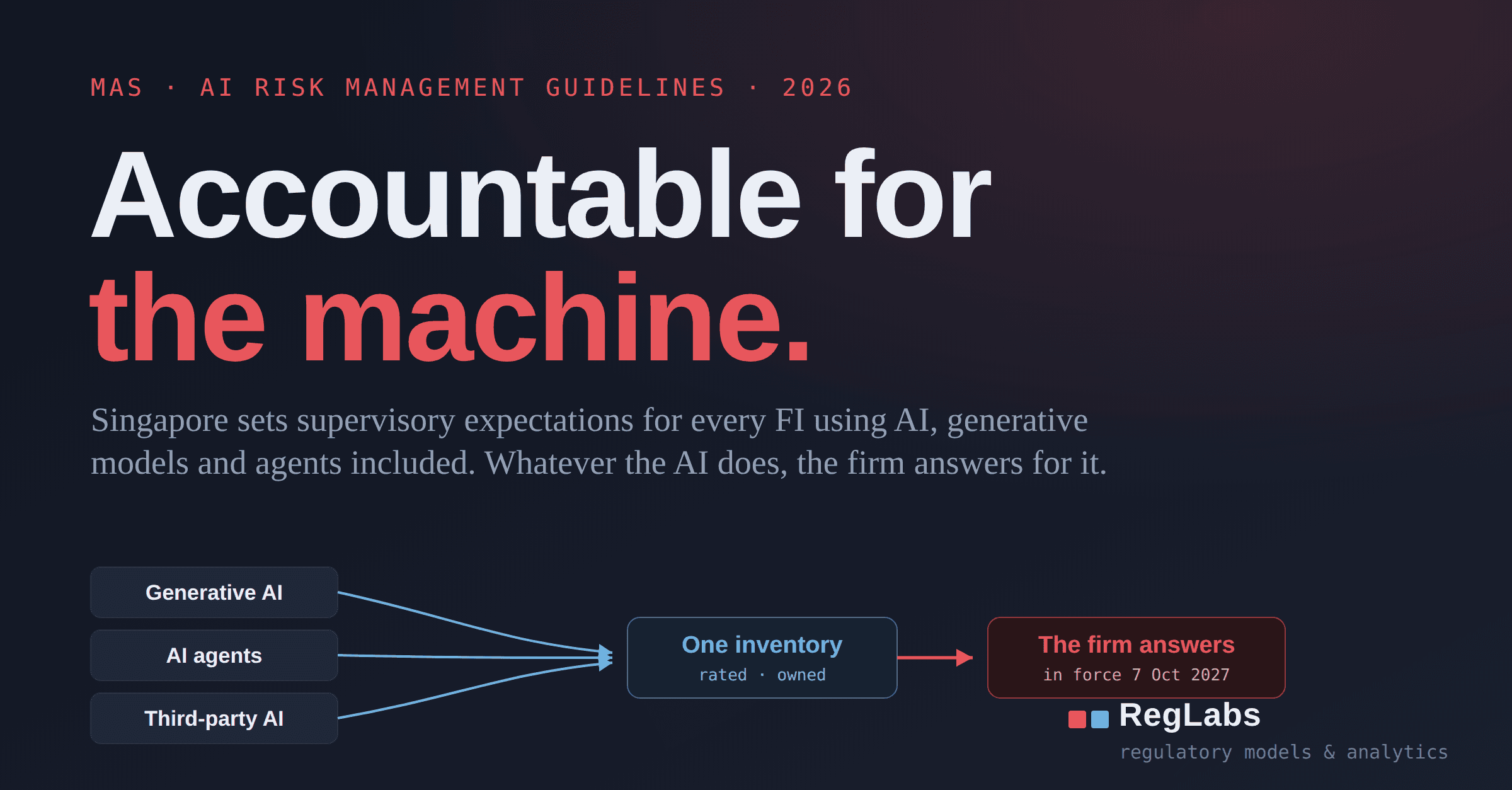
Singapore has set supervisory expectations for every financial institution that uses AI, generative models and autonomous agents included. The through-line is simple: whatever the AI does, the firm answers for it.
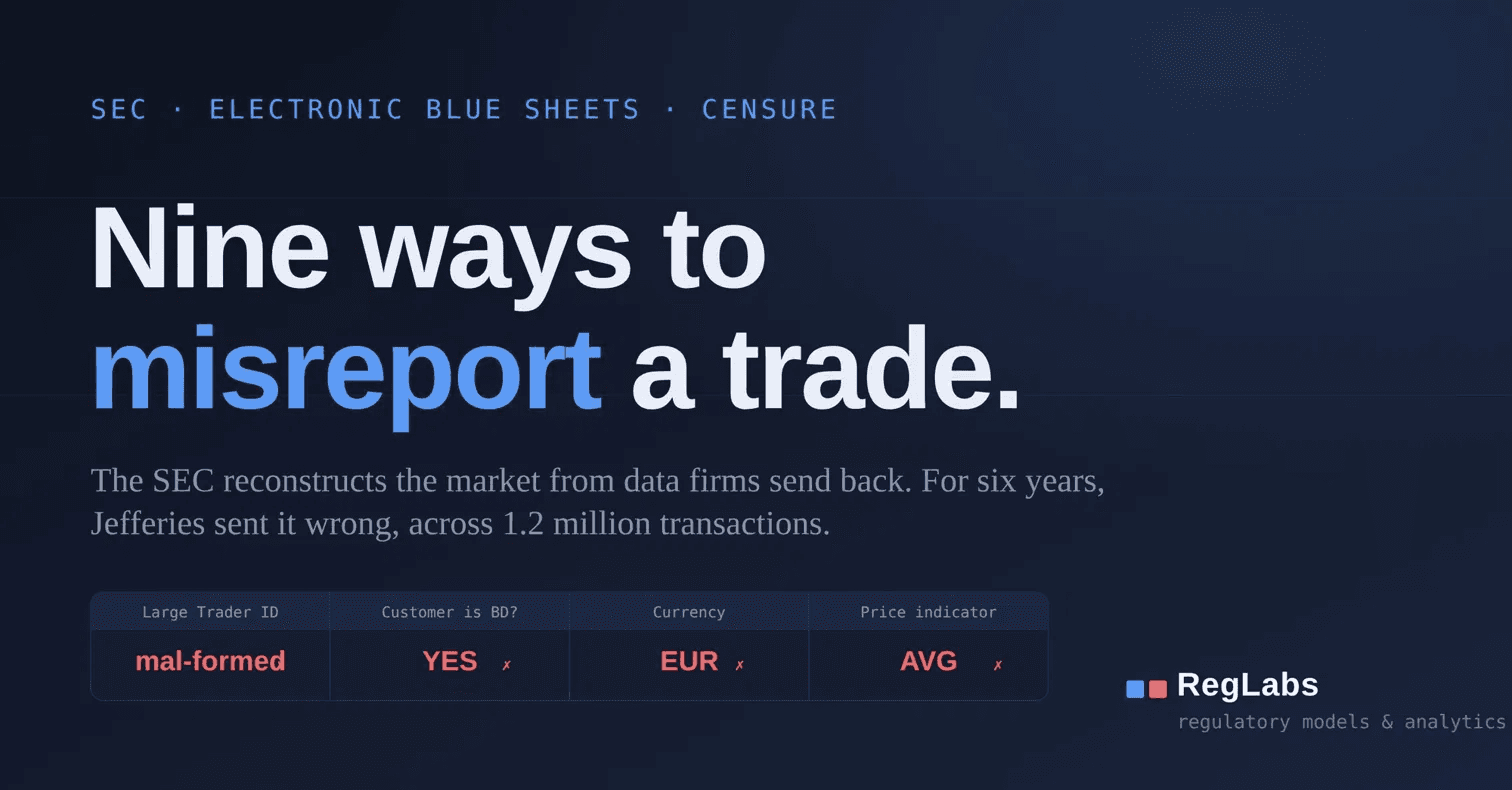
The data the SEC uses to reconstruct the market came from the firms it polices. For six years, Jefferies sent it back wrong, across 1.2 million transactions, and no one caught it.