
- Enforcement
- Markets & Trading
- Governance & Accountability
The exchange that went dark
A futures exchange is a source node in the market's surveillance system. This one stopped feeding it, let its own safeguards hollow out, and won regulatory relief on a representation it should have known was false.
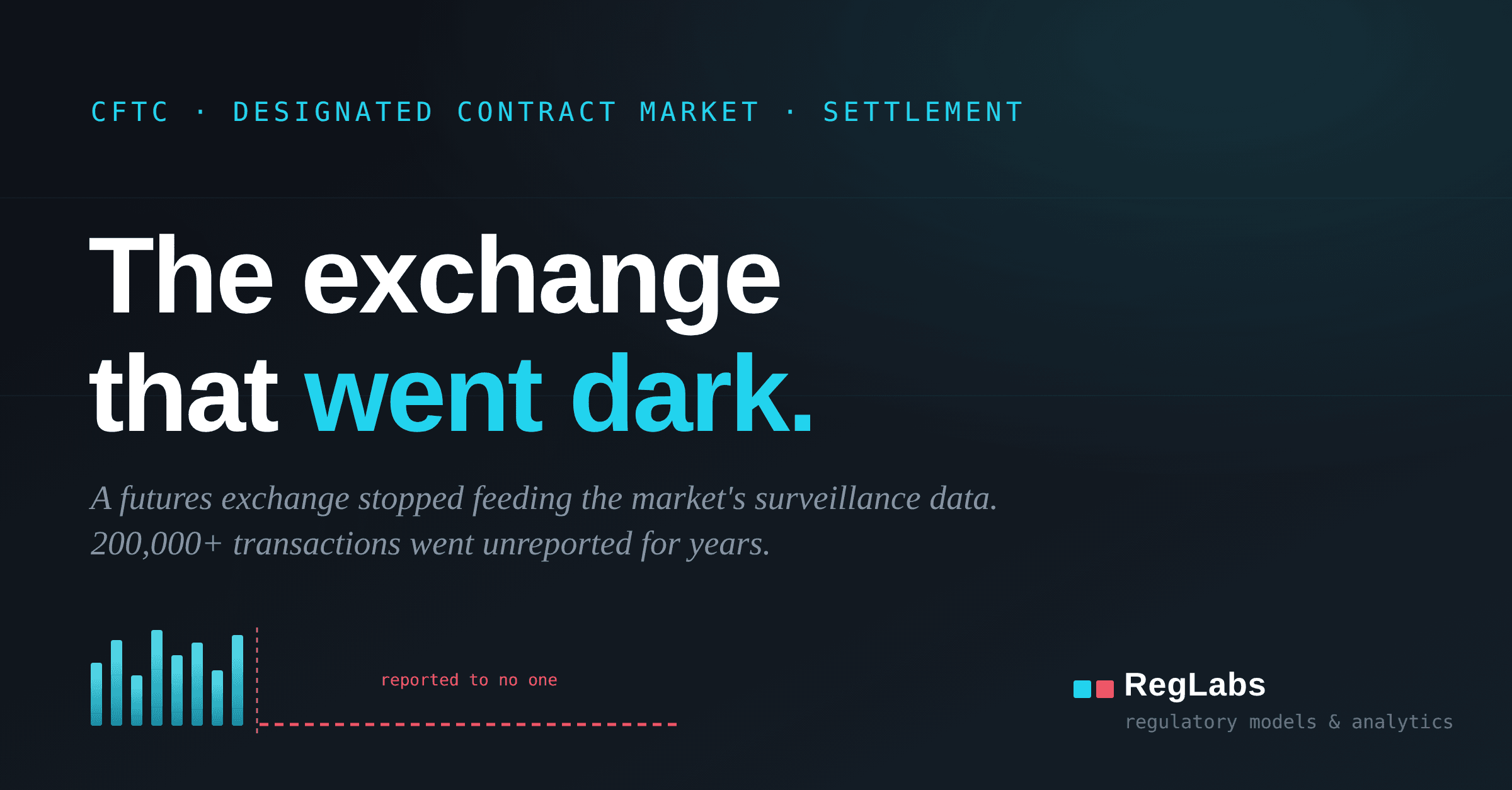
CFTC · Designated Contract Market · Settlement
The reporting signal, 2013–2022
Reporting to the Commission & the SDR · 2013 → No-Action Letter · 2017 → 200,000+ transactions unreported · reported to no one, 2017 to 2022 → back-reported.
Reconstructed from the CFTC order: CX reported to a swap data repository from 2013, stopped reporting binary-option transactions in November 2017 while relying on a no-action letter, and left more than 200,000 options and swaps transactions unreported before back-reporting began. Illustrative, not a transaction count over time.
Source: CFTC order against CX Futures Exchange, 29 September 2022.
The settlement and visibility gaps
$6.5M CFTC civil monetary penalty; 200,000+ transactions left unreported; 3 risks the entire tech risk assessment named; 0 board reviews of that assessment or testing.
Source: CFTC order against CX Futures Exchange, 29 September 2022.
When a reporting node stops reporting
On 29 September 2022, the Commodity Futures Trading Commission settled with CX Futures Exchange, L.P., a designated contract market then being renamed FMX Futures Exchange, for $6.5 million. The order reads as three faults braided together, but they share a single consequence. A designated contract market is not just a venue where people trade; it is a source node in the apparatus the Commission uses to see the market. When it stops feeding that apparatus, the regulator goes blind in exactly the places the exchange was supposed to illuminate.
The core of it is a reporting failure of unusual duration. Beginning in 2017 and running for years, CX failed to report more than two hundred thousand options and swaps transactions, both to the Commission directly under one rule and to a swaps data repository under another. For a stretch, the same transactions were invisible to both. The order records that reporting to the repository had not resumed even as of the date it was signed, roughly five years after it stopped.
Around that sit two more faults. The exchange's system-safeguards program, the regime meant to keep critical market infrastructure resilient and secure, was largely a shell: a risk assessment that identified only three risks and none specific to the exchange, a board that reviewed none of it, a migration of the entire platform to the cloud with no penetration testing and no advance notice to the Commission. And at the origin of the reporting gap was a representation CX had made to Commission staff, to obtain relief from one reporting duty, that it was satisfying another, when it should have known it was not.
Three faults, one settlement
The reporting failures span two separate regimes. Under Regulation 16.02, a designated contract market must report transaction data on its options to the Commission so that the Commission's market and financial surveillance can function. From 2017 through June 2020, CX failed to report more than two hundred thousand of its binary-option and pari-mutuel weather-contract transactions under that rule. Separately, under Parts 43 and 45, swaps must be reported to a registered swaps data repository. CX had done so since 2013, but in November 2017 it stopped reporting its binary-option transactions to the repository, and it had not resumed by the time of the order in 2022. The Commission describes why this matters in plain terms: without accurate and complete data, its ability to detect and prevent market disruptions, to enforce speculative position limits, and to measure the financial risk large positions pose is compromised.
The system-safeguards findings describe an oversight regime that existed mostly on paper. Between 2017 and 2020, neither CX nor its outside administrative-services provider kept a library of the automated systems and controls that were supposed to be the subject of its risk oversight, and neither ran controls testing to confirm those controls worked as intended. The enterprise technology risk assessments were generic: the 2020 assessment identified only three risks applicable to CX and analyzed no CX-specific threats at all. The board of directors received and reviewed none of those assessments, and none of the IT testing results, across that entire period. When CX migrated its systems to a cloud platform between September 2019 and April 2020, a material change to critical infrastructure, it conducted no internal or external penetration testing in connection with the move, contrary to its own provider's policy, and it did not tell Commission staff about the change until after it had happened.
The third fault is the one that colors the rest. In 2017, CX asked Commission staff for a no-action letter regarding its repository-reporting obligations. Staff granted the relief, relying in part on CX's representation that it was providing the transactional information required under Regulation 16.02. That representation was contrary to the facts: CX should have known it was not reporting that data. The false statement violated Section 6(c)(2) of the Commodity Exchange Act. CX settled all of it without admitting or denying the findings, and the Commission credited its cooperation and its remediation, which included back-reporting the Commission data and committing to provide the missing swap data to a repository.
Why reporting is a market-integrity control
It is tempting to file transaction reporting under back-office hygiene, a box to be ticked after the real work of running a market is done. This case is a clean argument against that view. The Commission's surveillance of manipulation, its enforcement of position limits, and its measurement of systemic risk all run on data that the regulated firms themselves supply. When a designated contract market stops reporting, it does not simply fall out of compliance with a technical rule; it removes a whole category of activity from the regulator's field of vision. Two hundred thousand transactions reported to no one is not a paperwork lapse. It is a surveillance outage, and the firm that caused it was the one entity positioned to know the outage existed.
The duration is what elevates the matter. Reporting systems break all the time, and the enforcement record is full of firms that misfired a feed, backreported, and moved on. What distinguishes CX is that the gap persisted for years and, for the repository channel, had not been closed even when the order was signed. A short outage is an incident. A multi-year silence is a control that was never really owned. Somewhere in the organization, the question of whether the firm was actually reporting had no owner who checked, which is the same pathology that let a risk assessment ship with three generic risks and a board that reviewed none of it.
That points at the deeper theme, which is the hazard of inherited, outsourced assurance. CX relied on an administrative-services provider for much of its safeguards program, and what it received was an enterprise-wide risk assessment that did not analyze CX's specific threats, applied to CX without adaptation. This is the same failure mode that recurs across financial-crime and controls cases: a firm accepts a generic artifact produced by a third party as if it were its own tailored analysis. Responsibility for system safeguards, like the responsibility to report, stays with the licensed entity. A provider can do the work; it cannot hold the obligation.
The false representation is the hinge, and it carries the sharpest governance lesson. CX obtained regulatory relief on a premise that was not true, and a no-action letter resting on a false premise is not the shield it appears to be. Representations to a regulator are themselves controls: the comfort a firm receives is only as sound as the facts it asserts to get it. When those facts are wrong, the relief does not merely evaporate, it becomes an independent violation, and the exposure compounds rather than contains. Any firm that seeks interpretive relief, no-action comfort, or an extension should treat the accuracy of its representations as a first-order control, verified before it is asserted, not after.
None of this required bad intent, and the Commission did not find a market was harmed. It found an exchange that had quietly stopped doing the things that let the market be watched, and had told the regulator otherwise. The remediation, back-reporting and new daily-confirmation processes, is the tell: the fix for a silent failure is a control that makes the silence impossible to miss.
Six gaps, one blind regulator
Each finding removed a different kind of visibility, whether into the market, into the exchange's own systems, or into the truth of what it had told the Commission.
The six visibility gaps
More than 200,000 binary-option and pari-mutuel contract transactions were not reported to the Commission between 2017 and June 2020.
Reporting to a swaps data repository stopped in November 2017 and had not resumed as of the order, years later.
The enterprise technology risk assessment identified only three risks applicable to CX and analyzed no CX-specific threats.
The entire platform migrated to the cloud with no penetration testing in connection with the change, and no advance notice to staff.
Between 2017 and 2020 the board received and reviewed no risk assessment and no results of the IT systems testing it was owed.
A no-action letter was granted partly in reliance on CX's representation that it was reporting data it was not, violating the Act.
Each finding removed a different kind of visibility, whether into the market, into the exchange's own systems, or into the truth of what it had told the Commission.
Source: CFTC order against CX Futures Exchange, 29 September 2022; Regulations 16.02, 43 and 45, and the system-safeguards and candor findings.
What this case asks every reporting firm
The first and most portable lesson is that reporting completeness needs an owner and a heartbeat. The failure here was not a wrong field or a late file; it was a channel that simply went quiet and stayed quiet for years. Firms guard against that with a positive confirmation that reporting happened each day, a reconciliation of what was executed against what was reported, and an alert when the count drops to zero. CX's own remediation, implementing processes to confirm that data is reported each trading day, is the control that should have existed all along. Silence should be the loudest alarm in a reporting program, not the quietest.
The second is that regulatory relief is conditional, and the conditions are controls. A no-action letter, an exemption, or an interpretive comfort almost always rests on representations the firm makes and conditions it agrees to keep. Those are not one-time statements; they are ongoing obligations that need an owner, a periodic re-verification, and a trigger to revisit the relief if the underlying facts change. A firm that relies on relief without tracking whether it still qualifies is building on a foundation it has stopped inspecting.
The third is that outsourced assurance is not assurance. CX leaned on a service provider whose enterprise-wide risk assessment never analyzed CX's own threats, and treated that as sufficient. Any firm that receives a risk assessment, a control test, or a safeguards review from a third party should ask whether it actually analyzes this entity, this infrastructure, these threats, or whether it is a template with a different name on the cover. The licensed firm owns the obligation regardless of who holds the pen.
The fourth is that change management is where safeguards are won or lost. A migration of critical systems to the cloud is precisely the moment to test, because it is the moment most likely to introduce a vulnerability or break a control. Running that change with no penetration testing, against the firm's own stated policy, and without notifying the regulator, is the kind of decision that looks like speed in the moment and like a finding in hindsight. Material changes to market infrastructure deserve the most testing, not the least.
- Does each regulatory reporting channel have a daily positive confirmation and a zero-count alarm, so a silent stoppage cannot persist unnoticed?
- Is every piece of no-action, exemptive, or interpretive relief tracked to an owner, with periodic re-verification that the firm still meets its conditions?
- Do risk assessments and control tests received from a service provider actually analyze this entity's own systems and threats, or are they generic artifacts?
- Does the board receive and review the technology risk assessments and systems-testing results it is owed, with a record that it did?
- Are material infrastructure changes, especially cloud migrations, gated on penetration testing and timely regulator notice before they go live?
Each maps to a specific gap in the finding map above, and each is a question a firm can answer about its own program today, well before an examiner asks it.
The CFTC's long line on reporting
Swap and transaction reporting is one of the most heavily enforced corners of the CFTC's docket, and the cases rhyme: a reporting system that was incomplete, inaccurate, or silent, usually for years, usually discovered late. These three are drawn from that line and, between them, cover the parts of the CX story that are not unique to it.
The scale benchmark. The CFTC found Goldman had inaccurately reported more than 18 million swaps, failed to report roughly 286,000, and reported more than 1.8 million late, over a span of years, and that even its remediation underestimated the true scope. It is a reminder that reporting completeness is treated as a first-order obligation at the largest firms, not a clerical one.
The closest analog to a reporter going dark. A five-day platform outage left Deutsche Bank unable to report swap data across asset classes, compounding problems that had already breached a prior 2015 order and drawing an independent monitor. As with CX, the lesson is that the reporting pipe itself is the control, and when it fails there has to be something watching the pipe.
The candor parallel. Alongside swap-reporting failures, Commerzbank filed reports with the Commission that omitted material facts about its own compliance deficiencies, including an external consultant's findings. The through-line to CX is direct: when reporting failures are paired with inaccurate statements to the regulator, the second problem is treated as the graver one.
CX's $6.5 million sits comfortably inside this line, and the comparison makes the point that size of penalty tracks scale and candor, not the type of firm. A designated contract market, a global swap dealer, and a foreign bank all answer to the same expectation: report completely, report accurately, and tell the regulator the truth about whether you are doing so.
A line of CFTC reporting actions
Selected CFTC swap and transaction reporting settlements, civil monetary penalty
Across all regulators, RegLabs holds 1,729 cases with transaction or swap reporting findings. On the CFTC's side, reporting completeness has become a standing enforcement theme, cutting across exchanges, banks, and swap dealers alike.
Source: CFTC orders for Goldman Sachs (2023), JPMorgan Chase Bank (2023), Commerzbank (2018), Deutsche Bank (2020), Bank of America / Merrill Lynch International (2023), CX Futures (2022), BNP Paribas (2022), and Morgan Stanley Capital Services (2020); reporting-case total from the RegLabs enforcement database.
Where the scrutiny is moving
Two themes in this case are getting hotter, not cooler. The first is reporting completeness as a market-integrity priority in its own right. For years, data-reporting enforcement was seen as a secondary concern next to manipulation and fraud. That has changed. Regulators have come to treat the integrity of the data feed as foundational, because every other form of surveillance depends on it, and they have shown they will bring significant actions where the data is incomplete even absent any proven market harm. A firm that regards its regulatory reporting as a cost center is misreading where enforcement attention now sits.
The second is system safeguards and technology resilience at market infrastructure. Exchanges, clearinghouses, and the large intermediaries that connect to them are increasingly judged on whether their risk assessments are real, their change management is disciplined, and their boards actually see the technology risk they are accountable for. The CX findings, a generic risk assessment, an untested cloud migration, a board that reviewed nothing, read like a checklist of what examiners are now trained to look for as critical systems move to the cloud and as cyber risk climbs the supervisory agenda. The rarity of system-safeguards enforcement to date makes each such case a louder signal of intent.
Underneath both sits the oldest theme of all, which is candor. The detail that turned a set of operational failures into a Section 6(c)(2) violation was a representation to the regulator that was not true. Across regimes and borders, the one thing supervisors treat as non-negotiable is the honesty of what firms tell them, and relief obtained on a false premise is a fault that outlasts the operational problem that produced it. For any firm reading this case as a forecast, the message is layered: report completely, build safeguards that are genuinely your own, and above all, make sure that everything you have told your regulator is still true.
Make silence the loudest alarm
The CX failures were failures of visibility: a reporting channel that went quiet, a risk assessment that saw almost nothing, a board that was shown nothing, a representation that was not checked. Those are exactly the blind spots regulatory analytics are built to surface. RegLabs regulatory models let a firm test its reporting completeness, its safeguards program, and the standing of its regulatory relief against the full enforcement record, so the gaps a regulator would find show up as review items first.
CX Futures Exchange, L.P. settled without admitting or denying the findings, and the CFTC credited its cooperation and remediation. The order identifies reporting, system-safeguards, and false-statement violations; it does not find that any market participant was harmed. Penalty figures for parallel cases are the civil monetary penalties recorded for those matters. The hero diagram is an illustrative reconstruction of the reporting timeline described in the order, not a count of transactions over time. This post is informational and is not legal advice.
Sources
- CFTC order instituting proceedings against CX Futures Exchange, L.P., dated 29 September 2022. Case record and analytics: RegLabs Studio.
- Parallels: CFTC v. Goldman Sachs & Co. LLC, 2023 (RegLabs).
- Parallels: CFTC v. Deutsche Bank AG, 2020 (RegLabs).
- Parallels: CFTC v. Commerzbank AG, 2018 (RegLabs).
- Chart figures: those orders plus CFTC v. JPMorgan Chase Bank (2023), Bank of America / Merrill Lynch International (2023), BNP Paribas (2022), and Morgan Stanley Capital Services (2020); reporting-case total from the RegLabs enforcement database.
- Rules referenced: Commodity Exchange Act Sections 5(d)(20) and 6(c)(2); Regulations 16.02, 38.1050, 38.1051, 43.3, and 45.3.