
- Enforcement
- Markets & Trading
- Governance & Accountability
Nine ways to misreport a trade
The data the SEC uses to reconstruct the market came from the firms it polices. For six years, Jefferies sent it back wrong, across 1.2 million transactions, and no one caught it.
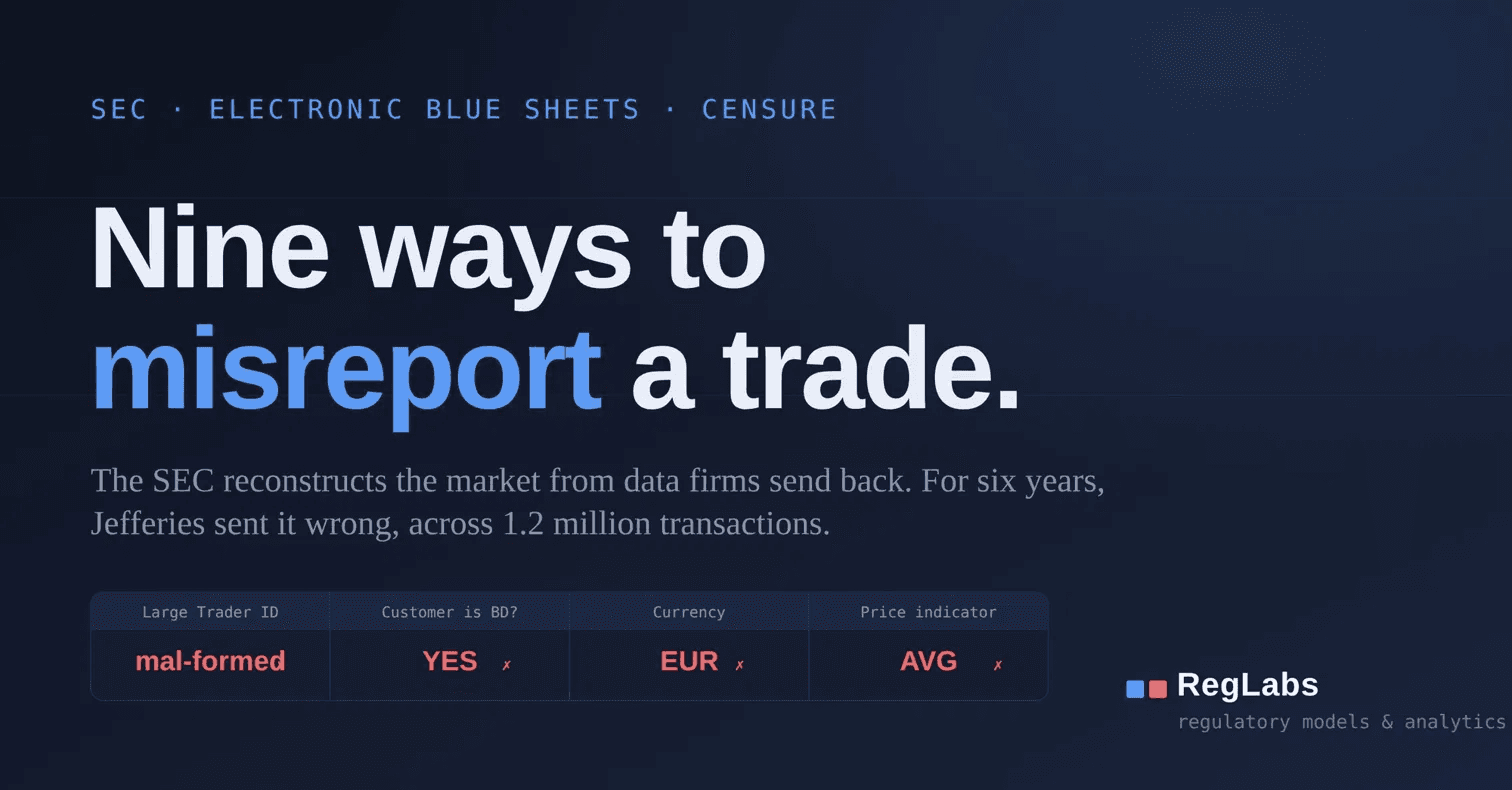
Electronic blue sheet → submitted to the SEC
- Large Trader ID
- mal-formed ✗wrong format
- Customer is BD?
- YES ✗not a broker-dealer
- Currency
- EUR ✗should be USD
- Price indicator
- AVG ✗single-execution trade
7,700+ submissions · 1.2M transactions misreported · 9 error types
The four named error types from the SEC order, shown as fields on a single blue-sheet record. The order cites at least nine types of manual, coding, or programming errors in total. Illustrative, not an actual submission.
Source: SEC order against Jefferies LLC, Release No. 106641, 9 October 2026.
Six years of inaccurate submissions
$650,000 SEC penalty, plus censure; 1.2 million transactions misreported; 7,700+ inaccurate EBS submissions; 9 types of error, over six years.
Source: SEC order against Jefferies LLC, Release No. 106641, 9 October 2026.
The data the regulator trades on
On 9 October 2026, the SEC censured Jefferies LLC and imposed a $650,000 penalty for a failure that sounds clerical and is anything but. From at least July 2018 through July 2024, the firm made at least 7,700 electronic blue sheet submissions to the Commission that contained inaccurate information or omissions, and those errors misreported data for at least 1.2 million transactions. The SEC found that Jefferies willfully violated the recordkeeping and reporting requirements of Exchange Act Section 17(a)(1) and Rules 17a-4(j) and 17a-25.
Electronic blue sheets are not a routine filing that disappears into an archive. They are the raw material the SEC uses to reconstruct who traded what, when, through whom, and for whom, and they are central to how the Commission investigates insider trading, manipulation, and other market abuse. When a regulator suspects misconduct, it asks firms for blue sheets and rebuilds the trading picture from the data those firms return. The integrity of that picture depends entirely on the accuracy of what the firms send back.
That is why a data-quality lapse rises to a willful violation of federal securities law. Jefferies did respond to the Commission's requests; it did not go dark. But for six years it returned data that was wrong in at least nine distinct ways, quietly and at scale, and the errors flowed out to the regulator as if they were correct. The modest penalty, reduced in light of the firm's self-reporting and remediation, understates what the case is actually about: when the surveillance data is wrong, the surveillance is wrong, and no one may know until someone checks.
What a blue sheet carries
A blue sheet is a standardized record of securities transactions that a broker-dealer must produce, electronically, when the SEC or a self-regulatory organization requests it. Each record ties a trade to its essential facts: the security, the date, the side, the quantity and price, the account and capacity in which it was executed, the identity of the customer, and identifiers such as the large trader ID that let the regulator link activity across firms and accounts. The name is a holdover from the era when these reports were submitted on blue paper; the function is thoroughly modern, because the electronic format is what makes large-scale, cross-firm reconstruction possible.
The value of the data is entirely a function of its fields being correct. A large trader ID in a nonconforming format cannot be matched to the trader it belongs to. A customer wrongly flagged as a broker-dealer is placed in the wrong category of market participant. A trade reported in euros when it settled in dollars distorts the size of the position. An average-price indicator applied to a single-execution trade misrepresents how the trade was done. Each of these is a small error in one field, and each quietly breaks the regulator's ability to see the market accurately. These four are exactly the error types the SEC named in the Jefferies order, drawn from at least nine in total.
That is the deeper point. Blue sheets fail silently. A missing report is conspicuous; the regulator asks and nothing arrives. A wrong report is invisible, because the data arrives, looks complete, and is ingested as truth. The only way to know a blue sheet is inaccurate is to compare it, field by field, against the firm's own authoritative records, and the Jefferies case is in large part a case about the absence of that check.
Nine kinds of wrong
The order attributes the inaccurate submissions to a combination of manual errors and, in large part, coding errors or programming issues in the reporting systems of Jefferies or the vendors that assisted its EBS process. In other words, these were not a few typists making mistakes. They were systematic defects in how trade data was extracted, mapped, and transmitted, which is why a single flaw could misreport the same way across many thousands of submissions and more than a million transactions. The four named error types show the range of what can go wrong in a single record.
The four named error types
Large trader IDs were reported in a nonconforming format for certain clients, breaking the link the regulator uses to track a trader's activity across firms and accounts.
Customers were misreported as to whether they were broker-dealers, placing them in the wrong category of market participant in the Commission's reconstruction.
Certain trades were reported in a foreign currency rather than in U.S. dollars, distorting the apparent size and value of the transactions.
An average-price indicator was incorrectly applied to single-execution trades, misrepresenting how those trades were actually executed.
The order cites at least nine types of manual, coding, or programming errors in total. These four are exactly the error types the SEC named in the Jefferies order.
Source: SEC order against Jefferies LLC, Release No. 106641, 9 October 2026.
To its credit, and reflected in the penalty, Jefferies did not simply wait to be caught. The order records that the firm hired a consultant, implemented data-validation and governance controls, self-reported seven of the errors, and resubmitted corrected reports. That remediation is the template for what the controls should have been all along: validate the fields before they go out, and reconcile what was sent against what actually happened.
A pipeline no one reconciled
The structural lesson of the Jefferies order is that regulatory reporting is a data pipeline, and a data pipeline without reconciliation is a pipeline that cannot know when it is wrong. Trade data starts in the firm's authoritative books, is extracted, mapped into the blue-sheet specification, transformed, and transmitted, often with a vendor somewhere in the chain. Every one of those steps can corrupt a field, and the corruption is invisible at the far end because the output still looks like a valid blue sheet. The only reliable way to catch it is to compare the submitted output back to the source population, field by field. For six years, nothing in Jefferies' process did that at sufficient scale, which is why nine error types could persist across 1.2 million transactions.
The error types themselves point to the usual culprits. Nonconforming large trader IDs and misclassified counterparties are reference-data problems: the mapping between a client and its regulatory attributes was wrong or stale. Reporting in the wrong currency is a normalization failure: the pipeline did not consistently convert to the required unit. Applying an average-price indicator to a single-execution trade is a logic error: the code that sets the flag did not correctly distinguish the trade type. None of these is exotic, and that is precisely the danger. They are the ordinary failure modes of any reporting system, and without validation and reconciliation they go unnoticed because each one is individually small and collectively enormous.
The vendor dimension sharpens it. The order notes that some of the coding or programming issues sat in the systems of vendors that assisted the EBS process. Outsourcing the mechanics of reporting does not outsource responsibility for its accuracy; the registered firm answers for what it submits regardless of whose code produced it. A firm that cannot independently verify a vendor's output against its own source data has, in effect, delegated the integrity of its regulatory reporting to a third party it is not checking.
There is one more feature worth naming: the asymmetry of silence. A firm that fails to respond to a blue-sheet request learns of the problem quickly, because the regulator follows up. A firm that responds with wrong data gets no such signal. The request is answered, the file is accepted, and the matter appears closed. That asymmetry is what lets a wrong-data problem run for years while a no-data problem would be caught in weeks, and it is why the defense against it has to be internal. The firm has to be its own checker, because nothing downstream will raise the alarm.
Building a blue-sheet pipeline that checks itself
The first and most important control is source-to-submission reconciliation. Before a blue sheet goes out, and again after, the firm should compare the submitted population back to the authoritative transaction records that the request scoped, matching on stable identifiers and comparing the required fields: security, date, side, quantity, price, capacity, and the account and identity fields. Unmatched, duplicated, or differing records are flagged and resolved before the response is treated as complete. This single discipline is what would have surfaced most of the Jefferies errors, because every one of them is a mismatch between the source truth and the submitted value.
The second is field validation at the point of submission. A blue-sheet pipeline should reject, not transmit, records with missing mandatory fields, invalid formats, or internally inconsistent values: a malformed large trader ID, an impossible currency, an average-price flag on a trade with a single execution. Validation rules encode the specification so that a known-bad record cannot leave the building, and they turn silent corruption into a visible, blocking exception.
The third is change and regression control over the reporting code. Because the errors were largely coding and programming issues, the pipeline needs the same discipline as any production system: material changes to extraction, mapping, or vendor configuration go through documented approval, and a regression suite of golden test cases runs before any release, comparing output against independently approved expected results. A reporting change that silently alters a field is exactly the event this control exists to catch.
The fourth is post-submission surveillance and a periodic lookback. Even with pre-submission checks, defects can slip through or arise in transmission, so the firm should monitor submission outcomes, record counts, and field distributions for anomalies, and periodically reperform source-to-submission testing on a risk-based sample of past responses. Jefferies' own remediation included exactly this kind of lookback and resubmission, and a program that runs it routinely finds its errors before a regulator does.
- Is every blue-sheet response reconciled, field by field, against the authoritative source population before and after submission, with exceptions resolved before closure?
- Does the pipeline validate and block records with malformed identifiers, wrong currency, or inconsistent flags, so a known-bad record cannot be transmitted?
- Are changes to EBS extraction, mapping, and vendor configuration gated on documented approval and a regression suite that compares output to expected results?
- Is reference data, such as large trader IDs and counterparty classifications, governed and current, so identifiers and categories are not silently wrong?
- Does the firm independently verify vendor-produced reporting against its own source data, and run a periodic lookback across past submissions?
Each maps to one of the failure modes the order describes, and each is a question a firm can answer about its own reporting pipeline now, rather than discovering the answer in a six-year lookback forced by an examination.
A long line of inaccurate blue sheets
Blue-sheet enforcement is a settled and recurring category, and the cases rhyme with Jefferies: a coding or mapping defect, discovered late, that misreported data across a large population of transactions over years. These three, all SEC orders, show the pattern across very different kinds of firm.
The landmark EBS matter. The SEC found that Citigroup failed to provide complete and accurate trade data in response to blue-sheet requests because of a coding error that persisted for years and affected a very large number of transactions. It established the principle the Jefferies order applies: a long-running coding defect in a reporting pipeline is a willful recordkeeping violation, not a harmless glitch.
The most recent large comparator before Jefferies, and proof the category is live. The SEC found Goldman had failed to provide complete and accurate EBS data, and FINRA brought a companion action the same day. It is a reminder that even the most sophisticated firms struggle to keep a reporting pipeline accurate, and that the SEC and FINRA will pursue the failure in tandem.
The SEC found that Citadel Securities submitted incomplete and inaccurate blue-sheet data over a multi-year period. That the violation reached one of the market's most technically advanced firms underlines the Jefferies lesson: blue-sheet accuracy is not a function of a firm's sophistication, but of whether its pipeline is validated and reconciled.
The through-line is that none of these turned on intent to deceive. Each was a data-quality failure in a reporting pipeline that ran, uncorrected, until someone finally reconciled the output against the truth. The penalties scale with the duration and the number of transactions affected, and they are imposed because the data matters: it is what the regulator uses to police everyone else.
Selected blue-sheet penalties
Civil penalties in notable SEC electronic blue sheet matters, as recorded in RegLabs
Across all regulators, RegLabs holds 108 electronic blue sheet cases carrying roughly $217 million in penalties, led by FINRA with 51 and the SEC with 20. Jefferies' lower figure reflects its self-reporting and remediation, not a smaller category of failure.
Source: RegLabs case records for SEC v. Citigroup Global Markets, Inc. (2016), Goldman Sachs & Co. LLC (2023), Credit Suisse Securities (USA) LLC (2015), Citadel Securities LLC (2018), Cantor Fitzgerald & Co. (2020), and Jefferies LLC (2026). Thematic figures: RegLabs enforcement database, cases tagged Electronic Blue Sheets Reporting.
Why regulators keep returning to reporting data
The Jefferies order fits a clear and durable supervisory priority: the integrity of the data firms report to their regulators. For years, data-quality enforcement was treated as a lesser concern than conduct, but that has changed, because regulators have come to understand that their entire surveillance apparatus runs on data the regulated firms supply. Blue sheets are the clearest example, but the same logic drives enforcement of swap data reporting, transaction reporting, and the consolidated audit trail. If the inputs are wrong, every downstream analysis, every investigation, every reconstruction of a suspicious episode is built on a flawed foundation. Regulators now treat the accuracy of those inputs as a first-order obligation, and they will bring willful-violation charges for a sustained failure even absent any intent to mislead.
There is a technological current underneath it. As trading has grown faster, more automated, and more fragmented across venues and vendors, the reporting pipelines that feed the regulators have grown more complex, and complexity is where silent data errors breed. A field that is mapped once and never reconciled, a vendor transformation no one validates, a currency convention that holds until a new product breaks it: these are the modern failure modes, and they scale instantly. The firms that stay out of trouble are the ones that treat regulatory reporting as a production data system deserving validation, reconciliation, change control, and monitoring, rather than as a compliance formality.
For any firm that submits blue sheets, or any other regulatory data, the forward-looking reading is simple. The enforcement record, from Citigroup in 2016 to Goldman in 2023 to Jefferies now, is a standing notice that the regulator will check the data, and that discovering a multi-year error during an examination is far more expensive than finding it yourself. The durable defense is to build the check into the pipeline: reconcile the output to the source, validate every field, control the changes, and look back periodically. Silence from the regulator is not confirmation that the data was right. It is only confirmation that no one has looked yet.
Reconcile the data before the regulator does
The Jefferies failure was not misconduct. It was a reporting pipeline that no one reconciled against the truth, running wrong for six years because wrong data fails silently. That is exactly the kind of gap regulatory analytics are built to surface. RegLabs regulatory models let a firm test its reporting accuracy, its reference data, and its validation controls against the full enforcement record, so the errors a regulator would find show up as review items first.
Jefferies LLC accepted the SEC's order and acknowledged that its conduct violated the federal securities laws. The order describes recordkeeping and reporting violations arising from data errors; it does not find intent to deceive. The penalty reflects the firm's self-reporting and remediation, and the order restricts Jefferies from offsetting the penalty in certain related investor actions. Penalty figures for parallel cases are the civil penalties recorded for those matters in RegLabs. The hero diagram is an illustrative depiction of the named error types, not an actual submission. This post is informational and is not legal advice.
Sources
- SEC order instituting administrative and cease-and-desist proceedings against Jefferies LLC, Release No. 106641, 9 October 2026. Case record and analytics: RegLabs Studio.
- Parallels: SEC v. Citigroup Global Markets, Inc., 2016 (RegLabs).
- Parallels: SEC v. Goldman Sachs & Co. LLC, 2023 (RegLabs).
- Parallels: SEC v. Citadel Securities LLC, 2018 (RegLabs).
- Chart also draws on SEC v. Credit Suisse Securities (USA) LLC, 2015, and SEC v. Cantor Fitzgerald & Co., 2020. Thematic figures: RegLabs enforcement database, cases tagged Electronic Blue Sheets Reporting.
- Rules referenced: Securities Exchange Act of 1934 Section 17(a)(1); Rules 17a-4(j) and 17a-25.