
- Enforcement
- Markets & Trading
- Governance & Accountability
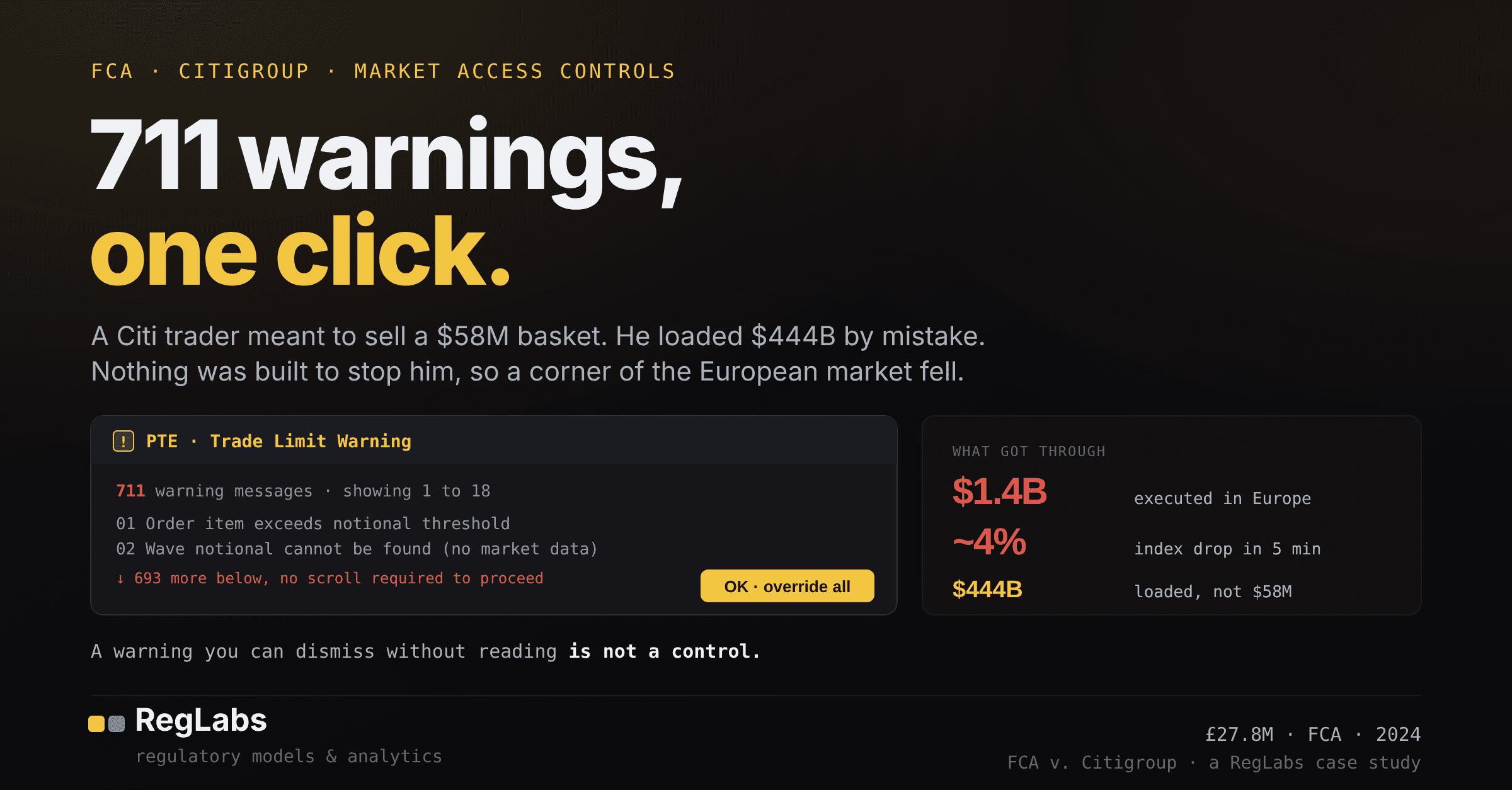
711 warnings, one click.
A Citi trader meant to sell a $58 million basket. He loaded $444 billion by mistake. Nothing in the system was built to stop him, so he clicked OK, and a corner of the European market briefly fell.
A $444 billion mistake that cleared every gate
On 17 May 2024, the FCA fined Citigroup Global Markets Limited £27,766,200 for a trading incident on 2 May 2022. A trader on the Delta 1 Desk meant to sell a basket of equities worth about US$58 million. Through an input error he created and began to execute a basket of 349 stocks worth US$444 billion, and the firm's controls did not stop it from reaching the market.1
The order was not malicious. It was a mistake, the kind a human makes every day, which is precisely the kind of event a trading firm's control stack exists to catch. Instead, the error passed through missing hard blocks, a soft block the trader cleared with a single click, a basket check that could not compute, a downstream price limit left at an emergency setting from two years earlier, and a real-time monitoring function that escalated the event twenty minutes after the trader had already cancelled it. About US$1.4 billion of sell orders executed across European exchanges, several indices dipped for a few minutes, and Citi lost about US$48 million. It could have been far worse, and the FCA's penalty reflects the risk that was run, not merely the harm that landed.
The surface story, a fat-finger error on a quiet bank holiday, is the least interesting part. This study treats the Citigroup incident as what it really is: a clean, well-documented anatomy of how a layered market-access control framework fails as a system rather than at a single point. It walks the history that should have warned the firm, the architecture that turned one instruction into a cascade, the ten distinct points at which the order could have been stopped, and then lifts each of those failures into the discipline it violated: the difference between a control that blocks and one that merely rings a bell, the trap of a control calibrated so loosely it never fires, the danger of a control that fails open rather than closed, the quiet drift of an emergency setting into a permanent one, the question of where in the order path a control belongs, the human reflex to override a warning under pressure, and the unglamorous truth that staffing and coverage are themselves controls. Every one of these is a lesson that outlives the particular typo that exposed it.
The event in three numbers
A trader on the Delta 1 Desk meant to sell a basket of equities worth about US$58 million. Through an input error he created and began to execute a basket of 349 stocks worth US$444 billion, and the firm's controls did not stop it from reaching the market.
Source: Financial Conduct Authority, Final Notice , Citigroup Global Markets Limited (17 May 2024).
A firm that had been told, more than once
Control catastrophes are rarely a first offense, and this one was not. The most uncomfortable feature of the Citigroup case is that the firm had been told, repeatedly and across nearly two decades, that its systems and controls were not adequate, and the FCA treated that history as an aggravating factor rather than mitigation. In 2005 the firm was fined £10 million in connection with trading conduct that engaged the very same high-level Principles at issue here. In 2019 the Prudential Regulation Authority imposed a penalty of £43.89 million for failings in its regulatory reporting systems and controls. And in August 2022, while the May 2022 incident at the center of this case was already under investigation, the FCA fined the firm more than £12.5 million for trade-surveillance and systems failings that the regulator itself described as corresponding with those in this case.1
Read that sequence slowly, because the pattern matters more than any single entry in it. A firm does not accumulate a 2005 conduct fine, a 2019 reporting-systems penalty, and a 2022 surveillance-systems penalty in the same category of weakness by accident. It accumulates them because the remediation after each one was narrow, treating the specific symptom that had surfaced rather than the underlying condition, which is that the firm's control environment was not keeping pace with the scale and automation of the business it was running. The August 2022 fine is the sharpest illustration. The firm was penalized for a corresponding class of systems failing at almost the same moment it was being investigated for this one, which is as close to a contemporaneous admission that the problem was systemic as an enforcement record ever provides.
Remediated too literally
The discipline this history points to is one that every firm running automated systems at scale lives or dies by: the post-incident review that asks the general question rather than the specific one. After any control failure, there are two questions a firm can ask. The narrow one is "how do we stop this exact thing from happening again," and it leads to a point fix: tighten this parameter, retrain this desk, patch this report. The broad one is "what does this failure tell us about the class of risk we are carrying, and are our controls adequate to that whole class regardless of which system or which desk produces the next instance." The narrow question is faster, cheaper, and almost always the one that gets answered under deadline and budget pressure. The broad question is the one that actually prevents the next event, because the next event is never an exact repeat of the last.
A firm that had genuinely dissected its earlier systems-and-controls findings, rather than patching their narrowest causes, would have been forced to confront the questions that went unanswered on 2 May 2022: do our hard blocks sit at every level where risk aggregates, or only where they were convenient to build; are our warnings designed to be read or designed to be cleared; do our temporary calibrations ever get restored; is our real-time monitoring actually staffed and actually fast. None of these are exotic questions. They are the obvious generalizations of failures the firm had already been penalized for. That they went unasked is itself the finding, and it is why the regulator read the May 2022 incident not as a fresh accident but as the latest expression of a condition the firm had been warned about for years.
The firm and the system
Citigroup Global Markets Limited is one of the large broker-dealers operating out of London, and the desk at the center of this case was its Delta 1 Desk. Delta 1 trading is the business of giving clients synthetic exposure to a basket of equities, packaged as swaps, futures, or exchange-traded products, so that the client gets the economics of owning the basket without owning the underlying shares. To manage the risk it takes on from those products, the desk buys and sells the underlying equities itself, often in large baskets, and it does so through automated execution.1
Mechanically, an order begins in an order-management system the Notice refers to as PTE, where a trader constructs or amends the basket and sends it on. From there it can be routed into Citi's execution algorithm, CitiSmart, which takes a large "parent" instruction and slices it into many smaller "child" orders, working them into the market over time against a volume benchmark so that the firm's own trading does not move prices against it. A single instruction entered at the top of this chain becomes, at the bottom, a stream of live orders hitting multiple venues automatically, with no further human action required.
That architecture is both the source of the desk's efficiency and the source of its danger. The entire purpose of the pre-trade control stack is to ensure that an obviously wrong instruction never starts the cascade, because once the cascade starts it runs at machine speed and human intervention is a race against an algorithm that does not pause. The controls are not a bureaucratic overlay on the trading system. They are the part of the trading system that decides whether an instruction is allowed to become orders at all, and in a business where one basket can be worth hundreds of millions of dollars, they are the only thing standing between a mistyped number and the market. On 2 May 2022, a UK bank holiday on which liquidity was thinner than usual, that stack had holes at every level.
Anatomy of the error
The trigger was mundane, which is exactly why it is worth taking seriously. The trader intended to sell a basket worth about US$58 million. Through an input error, what he actually created was a basket of 349 stocks worth about US$444 billion, roughly 7,600 times the intended size. He then attempted to execute it. There was no rogue strategy, no bad market call, no attempt to manipulate anything. A person typed the wrong thing into a system, as people do, and the system's job was to notice that the thing was wrong.1
It is tempting to file this under "human error" and move on, but that framing quietly misassigns the fault, and the FCA did not accept it. Human error is not an anomaly to be designed out of existence; it is a permanent, predictable input to any system operated by people. Traders mistype. Fingers slip. A quantity meant for one field lands in another, or a multiplier is applied twice. A control framework that assumes its users will not make mistakes is not a control framework; it is a hope. The correct design posture is the opposite: assume the erroneous instruction will arrive, regularly, and build the stack so that when it does, it is caught by the number it carries rather than by the alertness of the person who entered it.
Size is the signal, not intent
This is the first and most important reframing the case demands. A well-built pre-trade control does not and cannot know whether a US$444 billion basket is a typo, a deliberate manipulation, a system glitch upstream, or a genuine order from the largest client in the world. Nor does it need to. It needs to recognize that US$444 billion is wildly outside any plausible envelope for this desk, this client, and this day, and to refuse to let the instruction proceed on the strength of that fact alone. The control operates on the size, because the size is knowable in the moment and the intent is not. Any design that routes the decision through a human's judgment about intent has already lost, because the human who would make that judgment is the same human who just made the error, acting under the same time pressure that produced it.
Seen this way, the input error is not really the story at all. It is the test input, the known-bad order that every serious control framework should be able to stop in its sleep. The story is what the stack did when the test input arrived, and the answer is that it waved the order through at level after level, each failure independently knowable in advance. The rest of this study is an account of those levels.
Minute by minute
The error was created and executed in the space of a few minutes on a thin holiday morning. Every stage had a point where a control should have intervened, and at every stage the control was absent, blind, overridden, or too slow.
The single most telling fact in this timeline is that the control that finally stopped the runaway was the trader's own recognition of his mistake, not the firm's system. Every engineered safeguard in the path either did not exist, could not compute, had been loosened, or arrived after the event was over. The firm was saved from a far larger loss by the alertness of the very person whose error the controls were supposed to catch, and by the fact that he happened to notice in time. That is not a control framework. That is luck wearing the costume of one.
Ten points where it could have been stopped
No single gap caused this. As with every control catastrophe, the event required a chain of independent failures, each of which, working, would likely have reduced a near-miss to a non-event. The FCA's Notice lets us enumerate them, grouped by the layer they belong to. The sections that follow take the most important of these and examine the discipline each one violated.1
Ten gaps, across four layers, every one of them open on the same morning. The uncomfortable gift of a case like this is that it was over-determined on the way down and would have been stopped by almost anything on the way up. A single working hard block at the basket level ends the story at 08:56. A warning that could not be cleared without being read ends it a moment later. A monitoring desk that was watching and empowered ends it minutes later, before most of the US$1.4 billion executed. The engineering task was never to build one perfect control. It was to ensure that on the worst day, on a thin holiday with the usual team away, at least one layer was solid. None was.
711 warnings, one click
At 08:56, as the trader tried to proceed, PTE did something right: it generated a warning. In fact it generated 711 of them, bundled into a single pop-up. Then it undid its own good work. Only the first 18 of the 711 warnings were visible without scrolling, the system did not require the trader to scroll through the rest, and every warning was a soft block, meaning all 711 could be overridden at once with a single action.1
The control that fired, and folded
The trader clicked OK. About US$196 billion of orders routed into CitiSmart for execution.
Source: Financial Conduct Authority, Final Notice , Citigroup Global Markets Limited (17 May 2024).
A warning you can dismiss without reading is not a safeguard; it is a formality that produces a record. And 711 warnings should have been, if anything, a louder signal than one, because a flood of alerts on a single instruction is itself diagnostic: it means the order has tripped not one threshold but hundreds, which is the statistical signature of something badly wrong rather than a single borderline parameter. Presented well, 711 warnings would have been impossible to clear. Presented the way PTE presented them, bundled, truncated, and overridable in one stroke, they were as easy to clear as one, and the sheer number of them, which should have been the alarm, became instead the reason the alarm was ignored.
Design the alert for the responder, not the logger
This is a specific and recurring failure of control design, and it is worth naming precisely, because it is one of the most common ways that a firm with "controls" turns out to have none that work. An alert exists to produce an action, not to create a record that an alert was shown. If the message does not tell the person what is wrong, how serious it is, and what to do about it, in a form they can absorb in the moment, it is not a control; it is liability theater, a mechanism whose real function is to let the firm say afterward that the trader was warned. The PTE pop-up is almost a caricature of this. It warned 711 times and communicated nothing, because its design optimized for the completeness of the log rather than the comprehension of the human.
Two design principles fall straight out of this. The first is severity triage: a control framework must distinguish the alert that means "this parameter is slightly outside guidance" from the alert that means "this order is three orders of magnitude outside any plausible size," and it must present the latter in a way that cannot be cleared by reflex. Burying the catastrophic signal in a list of 710 routine ones is the same failure as having no signal at all. The second is friction proportional to risk: the effort required to override a control should scale with the danger of overriding it. Clearing a single minor warning can reasonably be one click. Clearing 711 warnings, several of which indicate a notional breach of enormous scale, should require acknowledging each material one, should refuse to proceed while the system cannot even compute the basket's value, and for an order this far outside the envelope should not be overridable by the trader at all. A control whose override costs the same whether the stakes are trivial or existential has quietly delegated the firm's most important risk decision to the least deliberate human action there is, the reflexive click.
The hard blocks that were not there
Beneath the warning sits the deepest distinction in the whole case, the one every other failure is a variation on: the difference between a control that stops an action and a control that merely tells someone the action happened. A hard block cannot be overridden; it rejects the order and the order does not proceed. A soft block warns, and relies on a human to act on the warning. The first is preventative, a machine in the path authorized to say no. The second is detective, a message to a person who may or may not read it, understand it, and act in time. On 2 May 2022, the controls that would have caught the basket were almost all of the second kind, and the few hard blocks that existed were placed or calibrated so that this order slipped past them.1
Citi is often described as having lacked controls on the basket. The more precise and more useful truth is that it had controls, and they were overwhelmingly bells rather than blocks. There was no basket-level notional hard block and no average-daily-volume hard block; the Wave Notional check was a soft control; the 711 warnings were soft blocks; the price-on-arrival limit was a throttle that reacted after orders were already working, not a gate that stopped them from starting. The only true pre-trade hard block in the path, the per-item notional limit, applied to each stock individually and is examined in the next section. Laid out side by side, the imbalance is stark.
Bells · warned, did not stop
- The 711-warning soft block, overridable in one click
- The Wave Notional basket check (could not even compute)
- The information alerts on orders above US$25 million
- The real-time monitoring desk, watching after the fact
Blocks · would have stopped it
- A basket-level notional hard block → did not exist
- An ADV hard block → did not exist
- A per-item notional hard block → existed, set at US$2bn
The exercise that produces this table is the single most clarifying thing a trading firm can do with its own control inventory, and almost none do it honestly: take every limit and safeguard the firm believes it has, and sort each one into "block" or "bell." Does it stop the action in the order path, automatically, or does it tell a human the action is happening. Then count the blocks, and ask whether, placed where they are and calibrated as they are, they would actually reject the specific catastrophic order you are afraid of. Firms that do this honestly almost always discover that their defenses against a runaway or erroneous order are overwhelmingly bells, that the number of true automated in-path blocks is far smaller than the risk committee believes, and that several of the blocks they do have are calibrated so loosely that they would sleep through the event.
Why a bell cannot save you at machine speed
The reason the distinction is not academic is speed. A soft control delegates the stop decision to a human, and a human operates at human speed: seconds to read, seconds to understand, seconds to decide, seconds to act. The system that human is supervising operates at machine speed, routing US$196 billion into an execution algorithm the instant the OK is clicked and beginning to hit venues in milliseconds. There is no human on earth who can watch a basket of 349 stocks begin to execute, recognize the error, and intervene inside the window the algorithm needs to do its damage. The only control fast enough to stop a machine is another machine, sitting in the path, authorized in advance to reject. A firm that places human-in-the-loop monitoring as its last line of defense against a machine-speed system has made a category error, and it is the same category error whether the system is a 2012 order router or a 2024 execution algorithm or a future trading agent that acts without any human at the keyboard at all.
A control calibrated never to fire is not a control
The one true pre-trade hard block in the path did exist, and it still did nothing, which makes it the most instructive control in the case. Citi applied a notional hard block, but it applied per individual stock and it was set at US$2 billion. For a basket of 349 names worth US$444 billion in total, that means each stock would have had to average more than US$1.2 billion before any single one tripped the limit, so the basket could be enormous in aggregate while every component slipped comfortably underneath the only hard gate in its way.1
This is a subtler and more dangerous failure than the plain absence of a control, and it deserves to be understood as distinct. A missing control is at least visible as a gap; an honest inventory finds it. A control that exists but is calibrated so that it will never realistically fire is worse, because it manufactures false confidence. The risk committee ticks the box: yes, we have a notional hard block. The regulator sees the control documented. The audit that asks "do you have a hard notional limit?" gets a truthful yes. And the firm believes it is protected by something that will, in practice, sleep soundly through exactly the event it was nominally built to catch. The question that matters is never whether a control exists. It is whether it is calibrated at a level that would actually stop the thing you are afraid of, and for the US$2 billion per-item block the honest answer was no.
Calibration drifts loose, never tight
There is a second, structural reason calibration deserves to be treated as a control in its own right: thresholds drift in only one direction. The path of least resistance, whenever a limit proves inconvenient, is to loosen it. An alert that fires too often is annoying, so the threshold is widened until it stops firing. A hard block that occasionally catches a legitimate large order generates complaints from the desk, so it is raised. Each individual loosening is defensible in the moment and documented, if at all, as a minor parameter change. But the cumulative effect, over years, is a control environment that has quietly relaxed itself toward the point of uselessness, one reasonable-sounding adjustment at a time, with no corresponding force ever pulling the thresholds back toward caution. A per-item block at US$2 billion did not start life as an obviously useless number; it became one, almost certainly, through exactly this kind of accretion, in an environment where nothing systematically challenged a limit for being too loose.
The discipline that answers this is to treat every limit's calibration as a reviewable control with a documented rationale. Each threshold should be set explicitly against the event it is meant to catch, the reasoning recorded, and every proposed loosening challenged with the question: after this change, would the control still stop the scenario it exists for. And the review has to run in both directions, because a framework that only ever asks "is this limit too tight" and never "is this limit too loose to matter" is a framework with a built-in drift toward failure. The US$2 billion block is the quiet proof: a control present on every org chart and in every audit, and absent from the only moment it was needed.
The control that could not count
There was, in principle, exactly the right control for this exact error. A basket-level soft control called the Wave Notional check was meant to flag the total value of a basket, which is the single number that would have made the error unmistakable: not 349 separate item warnings, but one line reading, in effect, "this basket is worth US$444 billion." On the morning it mattered, it could not do its one job. Because the system lacked the market data needed to value the index, the Wave Notional control returned a message that belongs in the permanent record of control failures: Due to lack of market data, Wave notional cannot be found.1
So the one check that might have surfaced the US$444 billion total in a single legible number instead surfaced an error about missing data, and that error was itself just one more line buried among 710 others in a pop-up nobody had to read. The control did not misjudge the risk. It never computed it, and, crucially, nothing in the system treated its inability to compute as a reason to stop. The order proceeded as though the check had passed, when in fact the check had not run at all.
The difference between failing open and failing closed
This is the fail-open failure, and it is one of the most important and least appreciated principles in the design of any safety-critical system. When a control cannot do its job, for whatever reason, the data is missing, the service is down, the calculation times out, there is a market-structure gap it cannot handle, the system must decide what to do with the instruction in front of it. A control that fails open lets the instruction proceed when it cannot evaluate it: the default, when the safeguard is blind, is to permit. A control that fails closed refuses the instruction when it cannot evaluate it: the default, when the safeguard is blind, is to deny. The entire safety of the system can turn on which of these two defaults is wired in, and the Wave Notional control was wired to fail open. Deprived of the data it needed, it did not stop the order and demand that someone look; it emitted an error and stepped aside.
The reasoning behind fail-closed design is uncomfortable but correct: the moment a control cannot evaluate an instruction is precisely the moment of maximum uncertainty, and maximum uncertainty is exactly when you least want to default to "allow." An unknown is not a zero. A basket whose value the system cannot calculate is not a safe basket; it is a basket about which the firm is flying blind, and the right response to flying blind on an instruction of unbounded potential size is to stop and require a human to establish the value by hand before anything proceeds. Fail-open controls are seductive because they never get in the way: they are invisible on every normal day, when the data is present and the calculation runs, and they only reveal their true setting on the abnormal day, when the data is missing, which is the one day you needed them most. A control that is silently absent exactly when conditions are abnormal is not a partial control. It is an absent control with good day-to-day manners.
Set for COVID, and never reviewed
Downstream of the order entry, inside the CitiSmart execution algorithm, sat a control that should have limited the damage even after everything upstream had failed. A price-on-arrival control was designed to suspend orders that would move a stock too far from its price at the moment the order arrived, which is exactly the kind of throttle that should bite when a flood of erroneous sell orders starts pushing prices down. It would have bitten harder on 2 May 2022, except that its threshold had been loosened from 5 percent to 15 percent in March 2020, to cope with the extreme volatility at the onset of the COVID pandemic. That was a reasonable temporary adjustment at the time. What was not reasonable is that, more than two years later, no one had reviewed it. The emergency setting had silently become the permanent setting, and the control tolerated three times the price dislocation it was originally built to catch.1
The tell is in the remediation: within days of the incident, the firm moved the threshold straight back to 5 percent. The correct calibration was known, had always been known, and was restored the moment the loosened one caused a problem. Nothing had changed about the markets between 2020 and 2022 that justified a 15 percent tolerance in ordinary trading; the only thing that justified it was a crisis that had long since passed, and the only reason it persisted was that no process existed to notice that it had outlived its reason.
The emergency setting that becomes the baseline
This is a failure mode that lives in essentially every control environment, because every control environment responds to crises by loosening controls, and crises are, by definition, the moments when there is no time to build the machinery that would later tighten them back. A threshold is widened, a check is suspended, an approval step is waived, an alert is muted, all to let the firm keep functioning through an extraordinary period. Each of these is a deliberate, defensible decision. And each of them, unless it carries an expiry date and an owner, becomes permanent by inertia, because restoring a control requires someone to remember it exists, to notice the crisis has ended, to decide the moment is right, and to take positive action to tighten something that is, at that moment, causing no visible problem. Nothing forces any of those steps, so they do not happen. The emergency setting does not revert; it simply ages into the baseline, and years later the firm is running on crisis-era tolerances in calm markets, defended by a control that has quietly been disarmed.
The discipline is almost embarrassingly simple to state and almost never implemented: every temporary change to a control carries an explicit expiry and a named owner, and the system actively flags a recalibration that ages past its review date rather than waiting for a human to remember. A loosened threshold should, in effect, announce itself: this control was relaxed on this date, for this reason, and that reason is now two years old, so confirm it or restore it. The COVID adjustment should have expired itself, or raised its hand, long before May 2022. Instead it sat silent and weakened in the order path until the one order arrived that needed it at full strength, which is the general shape of every control that is loosened in an emergency and governed by nothing afterward.
Controls belong where the risk is
Run back through the gaps and a single structural pattern connects most of them: the controls were placed at the wrong level of aggregation. The hard block was per item, but the risk was the basket. The warnings were per item, so a single oversized basket generated 711 of them rather than one clear basket-level refusal. The checks that ran were component checks; the number that would have caught the error was the aggregate. The firm had, in effect, built its controls to catch a large individual order, and then met an event whose danger lived entirely in the sum, not in any of its parts.1
This is the placement problem, and it is distinct from both calibration and the block-versus-bell distinction, though it compounds them. A control is only meaningful in relation to the specific risk of the thing it guards, which means controls cannot be generic and cannot all sit at one convenient layer. Different points in the order path carry different risks. The per-item layer carries the risk of one wildly oversized line, and a per-item notional block is the right control for that risk. The basket layer carries a different risk entirely, the risk that many individually unremarkable items sum to something catastrophic, and no amount of per-item control addresses it, because each item is, by construction, unremarkable. The desk layer and the firm layer carry risks of their own again, around cumulative exposure across many baskets and many traders. A control that is correct and vital at one level can be completely blind to the risk that lives at another, and Citi's stack was blind at exactly the level, the basket, where this particular event lived.
Map the risk at every level of aggregation, then place a control there
The discipline this demands is to map the risk at each level of aggregation separately, and to place a control designed for that level's specific risk at that level, rather than assuming that controls at one convenient layer protect the others. Pre-trade checks belong at the item level, the basket level, the desk level, and the firm level, because an erroneous or runaway instruction can be catastrophic at any of them and benign at all the others. The right question is not "do we have a notional limit," which invites the comforting but useless answer that yes, there is one somewhere in the path. The right question is "at every level where exposure aggregates, is there a control sized to the risk at that level, and is there any level where a dangerous instruction could pass because the only controls sit above or below it." For Citi, the honest answer was that the basket level, the very level on which a Delta 1 desk does its business, had no hard control sized to its risk, so an instruction that was absurd as a basket and unremarkable as 349 items walked straight through the gap between the two.
Placement failures are particularly treacherous because they survive audits that calibration and existence failures do not. A firm asked "do you control notional exposure" can point to a real, reasonably-calibrated per-item block and answer yes in good faith, and the auditor, checking for the existence of a notional control, moves on. The gap at the basket level is invisible to any review that does not explicitly ask the aggregation question at every level, and most reviews do not, because the natural unit of a control audit is the control, not the level of aggregation at which risk can hide between controls. The lesson generalizes well beyond Delta 1 desks: wherever a system can combine individually-acceptable actions into an unacceptable aggregate, the controls have to live at the level of the aggregate, not only the level of the action.
The override reflex, and why it is so hard to resist
Return to the single most consequential human action in the whole event: the trader clicked OK and overrode 711 warnings at once. It is easy to read that as carelessness, and easy to resolve never to be the person who does it. That reading is comfortable and mostly wrong, because the override reflex is not a personal failing; it is a structural feature of how soft controls interact with human beings under time pressure, and a control framework that depends on people reliably resisting it has misunderstood the humans it is built for.1
Consider the position of a trader clearing a soft block. On the overwhelming majority of days, the warning that fires is a routine one: a parameter slightly outside guidance, a check that flags a large-but-legitimate order, a message that means nothing is actually wrong. The trader learns, through thousands of repetitions, that the warning is noise to be cleared so the real work can proceed, and clearing it becomes an automatic motor action rather than a deliberate judgment. This is not laziness; it is the only way to function in a system that cries wolf hundreds of times for every genuine threat. The soft control, by firing constantly on non-events, actively trains the very reflex that defeats it on the one event that matters. The 711-warning pop-up is the extreme case: a system that had conditioned its users to treat warnings as obstacles to be cleared, meeting the one instruction where clearing the warning was catastrophic, and getting from the trader exactly the trained response it had spent years instilling.
The everyday version: the soft limit waved through
The override reflex is not confined to dramatic events. Its everyday form is the daily texture of trading under a soft-limit regime: an order hits a pre-set limit, and instead of being hard-blocked and properly evaluated, a trader raises or overrides the limit to keep trading, without a genuine assessment of why it tripped. Every one of those overrides is a small risk decision made badly, a stop ignored because stopping is inconvenient and the last hundred stops turned out to be nothing. Most of the time nothing goes wrong, which is exactly what makes the reflex so durable: it is positively reinforced on a daily basis and punished only once, catastrophically, on a day that feels like all the others until it is not. A firm that relies on traders not overriding soft limits is relying on a behavior it is simultaneously training out of them.
The design answer is to stop depending on the reflex being resisted and instead remove the option where the stakes are high enough. For instructions inside the normal envelope, a soft block the trader can clear is a reasonable, efficient control. For an instruction three orders of magnitude outside any plausible size, there should be no OK button at all: the system should hard-block it and require a separate, senior, deliberate authorization through a different channel, so that proceeding is not the path of least resistance but a conscious act by someone other than the person who made the error, under no time pressure to clear the screen. The deeper principle, familiar from the design of every other machine-speed safety system, is that the decision to override a serious control must be pre-made and structurally hard, not left to a human to summon the judgment and the nerve in the exact moment they are least equipped to. A stop that a busy person can clear with one reflexive click to get on with their day is not a stop. It is a speed bump that has been paved over.
Coverage is a control, and it was thin
The last line of defense should have been human eyes watching in real time, and it was the weakest line of all, for reasons that had nothing to do with technology and everything to do with staffing. That morning, because of scheduled staff leave, responsibility for monitoring the firm's internal-desk executions had been handed from the specialist Algorithmic Service Desk to a desk whose normal job was watching external-client flow, not internal-desk suspensions. The monitoring function was understaffed, with an open role that had gone unfilled for about a year. And the day itself was a UK bank holiday, a thin-liquidity session in which the usual depth of experienced coverage was at its lowest.1
The consequences were exactly what thin, unfamiliar coverage produces. The covering desk did not escalate 284 information alerts flagging incoming orders above US$25 million, nor the suspension alerts. A separate first-line monitoring system filtered out all but 8 of the relevant alerts, missing 226 message-rate suspensions and the vast majority of the notional value at stake. When the independent monitoring team did finally escalate, it was at roughly 09:31, about twenty minutes after the trader had already cancelled the order, and when that escalation drew no response the team followed up some four hours later. The firm's real-time safety net was neither real-time nor, on the evidence, a net.
Staffing and timing are risk factors, not background conditions
The lesson here is one that control frameworks almost never write down, because staffing feels like an operational matter rather than a control: the people watching, their number, their experience, and their familiarity with what they are watching, are themselves a control, and they have to be managed with the same rigor as any limit or threshold. A monitoring capability that exists on the org chart but is handed on a given morning to a desk unfamiliar with the flow, short a person, and covering a thin holiday session, is not the same control on that morning as it is on an ordinary Tuesday with the specialist team fully staffed. The control degraded, silently, because of a staffing decision that no one analyzed as a change to the control environment, and it degraded on precisely the kind of day, quiet, thin, lightly covered, when an erroneous order is both more likely to move the market and less likely to be caught.
There is a deeper and slightly counterintuitive point buried in the choice of day. Firms often treat quiet periods, holidays, and thin sessions as low-risk, and staff them accordingly, because low volume feels like low danger. The logic is backwards. A thin session is a low-liquidity session, which means a given erroneous order moves prices further and faster, and it is a low-coverage session, which means the firm is least able to catch the error and least able to contain it once caught. The danger and the thinness of the watch move together in the wrong direction. The same structure explains why so many control events cluster on holidays, around handovers, and in the summer: the moment the firm's ability to respond is at its lowest is not a safe moment to relax the watch; it is the moment the watch matters most. Coverage during thin periods should be heightened, not reduced, and any handover of a monitoring responsibility should be treated as a material change to a control, with the receiving team confirmed to have the familiarity, the staffing, and the authority to act, not merely the nominal duty.
This seasonal, staffing-dependent fragility also points forward, to a world in which the systems being watched increasingly run outside human hours entirely. An execution algorithm does not take the bank holiday off, and an autonomous trading agent may act overnight with no one at the desk at all. The thin-coverage morning that caught Citigroup out is, for such systems, simply the normal operating condition rather than the exception. The answer in both cases is the same, which is why it matters: the controls that actually stop a runaway cannot assume a capable, experienced human is watching and empowered at the moment it counts, because on a thin holiday morning, or at three in the morning, or during a handover to an unfamiliar desk, that human will not be there. The stop has to be built into the machine.
What reached the market, and the risk that was run
Enough reached the market to be visible in prices. Of the roughly US$196 billion routed into CitiSmart when the trader clicked OK, not all was cancelled in time, and about US$1.4 billion of sell orders executed across European exchanges. The effect showed up immediately: within five minutes of the erroneous basket beginning to trade, the MSCI Europe ex-UK index fell just over 4 percent, and several European indices dropped for a few minutes before recovering. Citi absorbed a loss of about US$48 million on the trades it could not unwind.1
It is important to be clear-eyed about what contained this. The realized harm was limited not because the control stack worked, but because the trader himself noticed his error and cancelled within minutes, and because the thinly-traded holiday market, for all that it amplified the price move, also meant there was less total volume for the erroneous orders to execute against before the cancel took effect. The firm was rescued by the alertness of the person who made the mistake and by the arithmetic of a quiet day, neither of which is a control the firm designed, owned, or could rely on. Change one variable, a trader slower to notice, a slightly deeper market that let more of the US$196 billion execute before the cancel, an error on a busy session rather than a holiday, and the US$1.4 billion and US$48 million become much larger numbers, with a correspondingly larger market dislocation.
The penalty is for the exposure, not the outcome
This is why the FCA's concern, and its penalty, attached to the risk that was run rather than only the harm that landed, and it is a point of regulatory philosophy worth drawing out because it is easy to misread. A firm tempted to argue "the loss was only US$48 million, the market recovered in minutes, no real damage was done" has misunderstood what it is being penalized for. It is being penalized for operating, on any given day, one input error away from a potentially far larger disorderly event, with a control stack that would not reliably catch that error. The US$48 million outcome was a draw from a distribution whose tail was catastrophic, and the regulator prices the distribution, not the single favorable draw. A firm that runs an unacceptable risk and gets lucky has still run an unacceptable risk, and in a market-access regime the absence of the control is itself the violation, independent of how the particular day happened to resolve. The controls had been missing or disarmed long enough that the only genuinely open question was not whether an erroneous order would eventually hit them, but when, and how large it would be when it did.
Why this was a systems-and-controls case
The FCA did not charge Citigroup with manipulation, or with any intent to disrupt the market. It charged the firm under high-level Principles and the market-access rules: the requirement to conduct its business with due skill, care and diligence, and the requirement to take reasonable care to organize and control its affairs responsibly and effectively, with adequate risk-management systems, together with the specific algorithmic-trading and market-access obligations of the FCA's market conduct rules. The violation, in other words, was not the loss. It was building and operating a system that could produce the loss, and having no reliable way to stop it.1
Those market-access obligations are the United Kingdom's version of a now-global regulatory consensus, the same consensus that produced the pre-trade control, kill-functionality, real-time-monitoring and annual-self-assessment requirements that sit in the European Union's algorithmic-trading standards and in the United States' market-access rule. The common thread across all of them is that the regulator treats the control as mandatory and treats its absence as the offense. A firm does not have to cause a disorderly market to be in breach; it has to fail to maintain controls reasonably designed to prevent one. Citigroup's stack, on 2 May 2022, was not reasonably designed to prevent the entry and execution of a wildly erroneous order, and that, not the four-percent dip or the US$48 million, is what the Notice is about.
The aggravation: a pattern treated as a pattern
What moved this from a serious case to an aggravated one was the history set out at the start of this study, and it is worth returning to here in its regulatory light. The FCA weighed the 2005, 2019, and August 2022 actions not as unrelated prior incidents but as evidence that the firm had been on notice, repeatedly, that its systems and controls were inadequate, and had not generalized the lessons. The August 2022 surveillance-and-systems fine, imposed for failings the regulator described as corresponding with those in this case while this case was already under investigation, is the detail that removes any room for an argument that the May 2022 incident was a one-off. A single control failure can be an accident. A control failure that follows a documented series of control failures in the same category, remediated narrowly each time, is a condition, and the penalty reflected the difference.
The forward-looking discipline this points to closes the loop with the opening section. The market-access rules do not only require controls to exist; they require the firm to review their adequacy and, in most regimes, to certify that review at a senior level, which is a mandated post-incident and assurance loop. A functioning version of that loop asks, after every control event, not "have we fixed this specific thing" but "does this tell us our controls are inadequate to a whole class of risk, and what will we change across the stack so that the next event, which will not look like this one, is caught anyway." A firm that answers the narrow question each time will keep appearing in enforcement records, because the narrow fixes never add up to an adequate framework. The only thing that does is the generalizing review, applied with discipline after every warning, and it is precisely the thing the record shows was missing.
The broader lesson: controls work on the number, not the story
The defining lesson of this case is the gap between the appearance of a control and the function of one. Citigroup had controls. It had a notional hard block, a warning pop-up, a basket check, a price-on-arrival limit, and a real-time monitoring team. Every one of them was present, and every one of them failed in a way that was knowable in advance: a hard block placed per item rather than per basket and calibrated too high to bite, a warning designed to be dismissed, a check that could not compute and failed open, a limit relaxed for a crisis and never restored, a monitor handed to the wrong desk, understaffed, and too slow. Not one of these failures required hindsight to foresee. Each was a standing property of the stack, true for a long time before the morning it mattered, waiting for the instruction that would expose it.
Gathered in one place, the disciplines the case teaches are not advanced, and that is the uncomfortable part. Classify every control as a block or a bell, and count the blocks. Calibrate every limit against the event you actually fear, and challenge every loosening. Make controls fail closed, so that a safeguard which cannot compute its input stops the order rather than waving it on. Give every temporary recalibration an expiry and an owner, so an emergency setting cannot age into the baseline. Place controls at every level where risk aggregates, not only where they were convenient to build, because a basket can be absurd while each of its items is unremarkable. Design warnings for the responder, not the logger, and make the friction of overriding a control scale with the danger of overriding it, so that the one instruction that must not be cleared by reflex cannot be. Treat staffing, coverage, and handovers as controls, and reinforce them on exactly the thin, quiet days when the watch matters most. None of it is novel. All of it was missing on 2 May 2022.
And the deepest point is the one the trader's typo makes for free: the controls must work on the number alone, because they cannot know the story. A well-built pre-trade stack does not ask whether a US$444 billion basket is a mistake, a manipulation, an upstream glitch, or a genuine order. It recognizes that the number is impossible for this desk on this day and refuses it, and it would refuse it identically whether the cause was a slipped finger or a deliberate attack. This is what makes the market-access disciplines durable as the technology underneath them changes. The order router that nearly ended a market maker a decade ago, the execution algorithm that briefly dropped a European index in 2022, and the autonomous trading agent that will act without any human at the keyboard tomorrow are the same problem in successive costumes: a system that turns an instruction into orders at machine speed, and a firm whose only real protection is a control sitting in the path, calibrated against the event it fears, authorized in advance to say no, and fast enough to say it before the damage is done. Citigroup's stack could not, and the lesson belongs to every firm whose systems now act faster than any human can watch.
What this case is really about
Controls that existed on paper and failed in design, calibration, and operation
Citi was not fined for a trader's error; it was fined because nothing was built to catch one. The hard blocks that stop an order were absent at the basket level and calibrated too high per item, the soft block that warns was designed to be waved away, the basket check failed open when it could not compute, a crisis-era limit had never been restored, controls sat at the wrong level of aggregation, and the human monitor was handed to the wrong desk, understaffed, and twenty minutes too slow. Layered defenses exist so that one failure is caught by the next. Here they failed as a set, on a thin holiday morning when the watch was weakest. And a documented history of the same category of failure made clear this was a pattern, not an accident.
Where it broke
- No basket-level or ADV hard block; the per-item notional block set too high to catch a US$444bn basket
- A 711-warning soft block showing 18 lines, overridable in a single click
- The basket notional check failed open when it could not compute for lack of market data
- A price-on-arrival limit loosened for COVID in 2020 and never restored
- Controls placed per item, blind to the risk that aggregated at the basket
- Real-time monitoring handed to the wrong desk, understaffed, escalating after the fact
What a trading-control stack requires
- Non-overridable hard blocks at every aggregation level: item, basket, desk, and firm
- Every limit calibrated against the event it exists to catch, with loosenings challenged
- Fail-closed behavior: a control that cannot compute its input stops the order
- Expiry and mandatory review on every temporary recalibration
- Warnings designed for the responder, with override friction that scales with risk
- Monitoring that is owned, adequately staffed, and reinforced on thin-coverage days
Three ways to make sure a typo cannot reach the market
This case study is an independent analysis prepared by RegLabs for educational and informational purposes, based on the FCA's public Final Notice concerning Citigroup Global Markets Limited (17 May 2024). It is not legal advice and does not reproduce the notice in full. All figures and quotations are drawn from the public record; any characterizations are those of RegLabs. Company and regulator names are used for identification and commentary only.