
- Enforcement
- Financial Crime
- Governance & Accountability
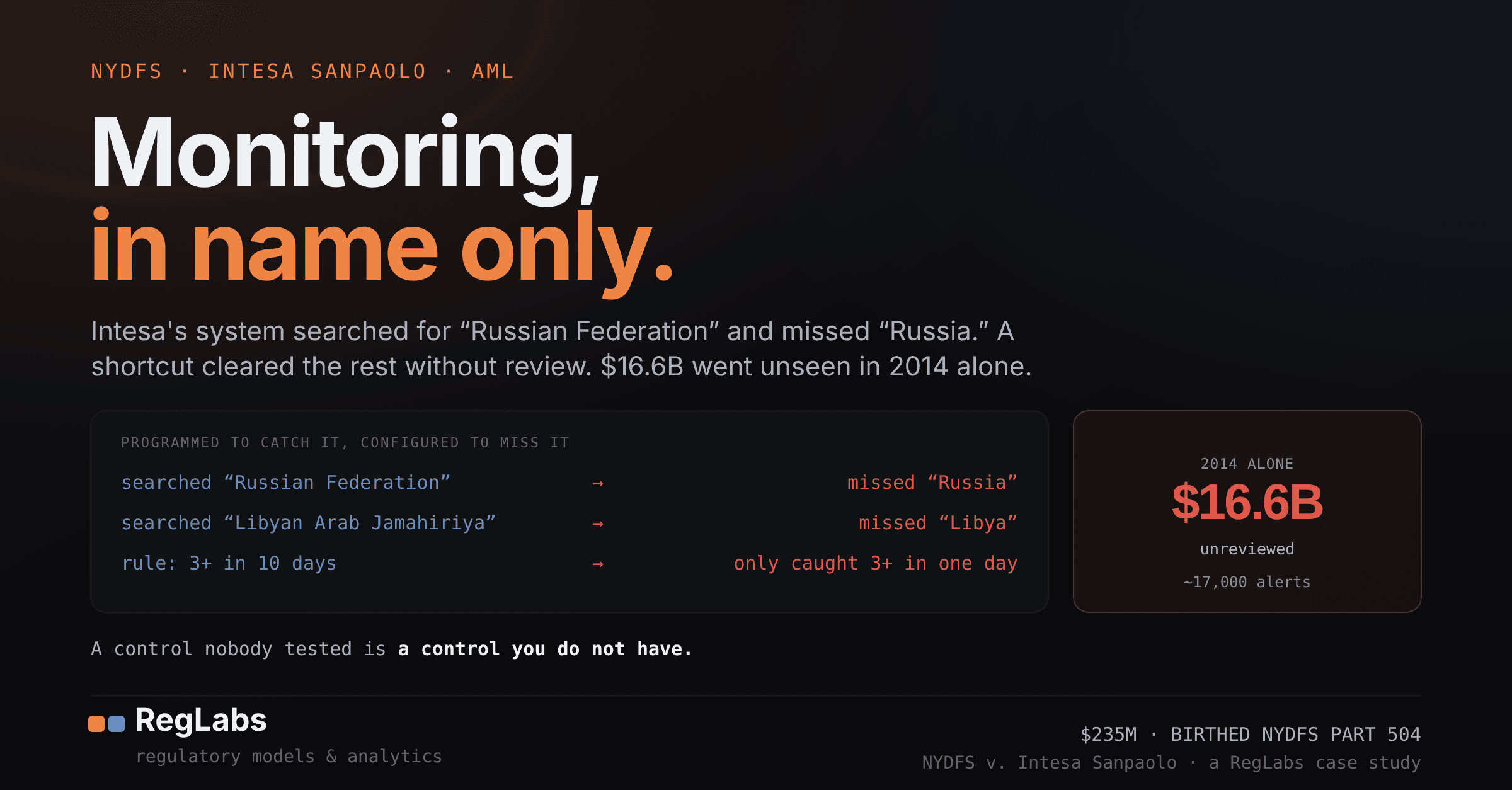
Monitoring, in name only.
Intesa Sanpaolo had a transaction-monitoring system. A stray space, a few naming mismatches, and a quiet shortcut meant it barely worked. In 2014 alone, $16.6 billion in transactions went unreviewed.
A $235 million penalty for a system that looked fine
On 15 December 2016, the New York Department of Financial Services fined Intesa Sanpaolo and its New York Branch $235 million for failing to maintain an effective anti-money-laundering and sanctions compliance program, in violation of New York's rules, and for failing to keep true and accurate books and records. The New York Branch is a correspondent bank that clears roughly $4 trillion a year. Its defense against illicit flows was a transaction-monitoring system that, on inspection, was barely functioning.1
What makes the case a permanent teaching example is how mundane the failures were. The system was not defeated by sophisticated criminals. It was defeated by a stray character in a query, a handful of naming mismatches, a date window set to the wrong number, and a staff shortcut that cleared alerts without review or any record of having done so. Each is trivial. Together, in 2014 alone, they let at least 17,000 alerts, covering about $16.6 billion in transactions, go unreviewed. And the institution behind the branch was not small: Intesa holds more than $761 billion in assets and is one of the central banks of the Italian financial system. The failure was not a resource problem. It was an assurance problem.
This study treats the order as what it really is: a complete anatomy of how an automated compliance control fails silently, and a specification for the discipline that would have caught it. It walks the configuration bugs that blinded the filter, the shortcut that cleared alerts in the dark, and the decade of warnings the bank received and remediated too narrowly, and then lifts each failure into the discipline it violated: why a control that is never tested against known-bad inputs cannot be trusted no matter how sophisticated it looks; why alerts that die in the gap between two systems reveal the need for reconciliation as a control; why clearing an alert without a record is a books-and-records failure that makes the whole program unauditable; why "risk-based" monitoring is not a licence to accept missed alerts; and why oversight that notes a deviation without escalating it is not oversight at all. The closing sections place it in the sanctions half of the case, the regulation it produced, and the forward problem of testing and governing AML monitoring as it moves from rules to models.
What a monitoring system is actually for
A correspondent bank moves money for other banks, often across borders, at enormous volume. It cannot manually inspect every payment, so it relies on an automated system to flag the suspicious ones. At Intesa's New York Branch the pipeline had two stages: a detection engine, GIFTS-EDD, generated alerts from keywords, from sanctions and politically-exposed-person lists, and from patterns such as repeated round-dollar payments; and a case-management system, Casetracker, was where each alert was supposed to be loaded, reviewed, and either cleared or escalated into an investigation and, if warranted, a suspicious activity report.
That pipeline is the shield, and it only works if two things are true: the alerts that should fire actually fire in the first system, and the alerts that fire actually reach and get reviewed in the second. Intesa's system failed on both counts, silently, for years. And because the failures were silent, nothing in the day-to-day looked wrong. Alerts were being cleared. Reports were being filed. The dashboard was green. The shield was full of holes nobody had measured, because the one thing nobody did was test whether the shield stopped anything.
It is worth naming the structural feature that makes this kind of control so prone to silent failure, because it is what the rest of the case turns on. A transaction-monitoring system is a negative control: its job is to find the small fraction of bad activity hidden in an enormous volume of legitimate activity, and on any ordinary day the correct output is almost entirely "nothing to see here." That makes its failure invisible in a way that a positive control's failure is not. If a payment system stops processing payments, everyone notices immediately, because the expected output stops. If a monitoring system stops detecting suspicious activity, nothing visible changes, because the expected output on most transactions was already "no alert." A broken detector and a working detector looking at a clean day produce the same observable result: silence. The only way to tell them apart is to feed the detector something it should catch and confirm that it does, and that act of deliberate testing is precisely what Intesa never performed, which is why its system could be broken for years while every surface indicator said it was fine.
What the filter couldn't see
The first failure was in the configuration. The system was programmed to catch certain things and, through a series of small errors, simply did not. The examples from the order are almost comic until you remember the volume behind them.
Programmed to catch it, configured to miss it
an extra spaceRussian FederationRussiaLibyan Arab JamahiriyaLibya10 dayssingle dayEach rule read as if it were working. None of them was tested against what it was supposed to find.
Source: New York State Department of Financial Services, Consent Order under New York Banking Law , In the Matter of Intesa Sanpaolo S.p.A. and Intesa Sanpaolo S.p.A. New York Branch (15 December 2016).
Each of these is a one-character or one-word mistake with a vast blast radius. A rogue space turned an important alert into one that fired for years on nothing. Country-name rules that searched only for the formal name, "Russian Federation" and "Libyan Arab Jamahiriya," sailed past every payment that used the common name, which is to say almost all of them. A pattern rule meant to catch three or more transactions over a ten-day window was coded to require them within a single day, so the structuring pattern it existed to detect, deliberately spread out over days, was exactly the pattern it could not see.
On top of the misconfigurations, the record describes two further leaks. Some algorithms were removed from the system entirely, based on a mistaken understanding of how it worked, so whole categories of behavior stopped being screened at all. And many of the alerts the detection engine did generate were never migrated across into Casetracker, so they died in transit, in a gap between two systems that nobody was reconciling. The net effect was a screen that scanned for the wrong strings, over the wrong windows, with some filters switched off, and then dropped much of what it did find before a human ever saw it.
A control you don't test is a control you don't have
Pause on the configuration bugs, because they carry the single most important and most generalizable lesson in the entire case, and it is one every firm running an automated control should treat as a law: a control that is never tested against known inputs cannot be trusted, no matter how sophisticated it looks or how large the institution that runs it. Intesa's system was not a cheap tool, and Intesa was not a small or careless bank. It was a real monitoring platform, fed real data, producing real alerts, run by one of the largest banks in Europe. It was also searching for Russian Federation and missing Russia, and in years of operation no one had ever run a transaction through it to check whether the rules caught what they were written to catch.1
The reason this matters so much is that every one of the configuration bugs was trivially detectable by the most basic test imaginable, and would have been invisible to any amount of review that did not perform that test. Reading the rule configuration would not reveal the bug: the rule for Russia correctly named Russia's formal title, and a reviewer checking that the system searched for Russia would see "Russian Federation" and tick the box. Auditing that the system existed, was documented, and was generating alerts would not reveal the bug: it was generating alerts, just not the right ones. The only thing that reveals a bug like this is an input test: construct a payment that references "Russia," push it through the system, and confirm that the rule fires. It does not. The test takes minutes; it requires no sophistication; and it is the one form of assurance that distinguishes a rule that works from a rule that merely exists. Intesa performed every kind of review except that one, and so it had a monitoring system that passed on paper and failed on every transaction that used a common country name.
Feed the detector the thing it is supposed to catch
The discipline this demands is the simplest in all of compliance and the most neglected: test the control the way you would test any safety-critical system, by feeding it the thing it is supposed to catch and confirming that it catches it. For transaction monitoring this means above-the-line and below-the-line testing, seeding the system with transactions carrying the sanctioned names, the common and formal spellings, the structuring patterns spread over the real time window, the round-dollar typologies, and verifying that the expected alerts fire, on a schedule, not just once at implementation. It means maintaining a library of known-bad scenarios drawn from real typologies and real enforcement cases, and running them against the live configuration regularly, because a rule that worked at go-live can be broken by a later change, a data-format shift, or a tuning adjustment, and silent failure can re-enter at any time. A firm that does this catches its "Russia" bug in an afternoon. A firm that does not has no idea whether its monitoring works, and will not find out until a regulator reconstructs the gap, which is exactly how Intesa found out, at a cost of $235 million. The sophistication of the system is irrelevant to this discipline. An untested control, however advanced, is a hope, and a hope is not a defense against money laundering.
The alerts that fired, and were cleared in the dark
The second failure was human, and in some ways worse, because it was a choice rather than a bug. The New York Branch's written policy was clear and unambiguous: every alert had to be loaded into Casetracker for formal review. The branch's AML Officer did not enforce it. Instead, from sometime in 2012 until at least mid-2014, he allowed the staff he supervised to decide for themselves how to move keyword alerts into the system, leaving it to each reviewer to use whatever process worked best for them, without standardization. In practice, a large share of alerts were simply cleared outside Casetracker altogether: no formal investigation, no reviewable record, no audit trail.
The work was done by compliance staff, by interns, and at times by the AML Officer himself. There was no training on the unauthorized process, because officially it did not exist. In 2014, roughly 10,000 keyword alerts, about 92 percent of the total generated, were never loaded for formal review. They were ignored, or waved through, and left no trace that anyone could later re-examine. And the practice did not stop on its own: it continued until approximately March 2016, when the independent consultant then reviewing the branch discovered it and brought it to the Department, which immediately ordered the bank to cease.
The detail that an unauthorized process existed, used by interns, without training, is worth dwelling on, because it reveals how a control degrades in practice as opposed to on paper. The written policy was correct; it said every alert goes into Casetracker. The degradation happened in the gap between the policy and its operation, where a supervisor, facing a volume of alerts and a preference for efficiency, quietly permitted a faster path that the policy did not authorize and no one documented. Because the shortcut was never formalized, it was never trained, never reviewed, and never surveilled, and because the people using it included untrained interns, the quality of the dispositions was whatever each individual happened to produce, with no standard and no check. This is how controls fail in the real world: not by a dramatic decision to abandon them, but by the accretion of small, locally-reasonable deviations that a supervisor tolerates and no one above notices, until the documented control and the actual practice have diverged so far that the documented control describes a system that no longer exists.
The leak at every stage
Put the two failures end to end and the pipeline leaks at every joint. The order's own numbers trace the drain through 2014.
The 2014 alert pipeline, stage by stage
Of the alerts that were improperly closed, the independent consultant found 41% were real, not false positives.
Source: New York State Department of Financial Services, Consent Order under New York Banking Law , In the Matter of Intesa Sanpaolo S.p.A. and Intesa Sanpaolo S.p.A. New York Branch (15 December 2016).
That 41 percent figure is the one to sit with. It means the discarded alerts were not noise that a sensible reviewer would wave through. Nearly half were genuine flags that warranted further investigation, and some may have warranted escalation to a filed report. The bank was not over-alerting and triaging sensibly, the defense a firm would want to offer. It was dropping real signals on the floor, at a rate that would be alarming in a single month and ran for years.
The 41 percent is also, read correctly, a performance metric the bank should have been computing on itself and never was. Any monitoring program disposes of alerts, and the central question of whether it is working is what fraction of the alerts it closes were actually benign. A healthy program samples its own closed alerts, re-reviews them independently, and measures the false-closure rate, because a high rate of real alerts being closed as non-suspicious is the clearest possible signal that the disposition process is broken. Had Intesa run that simple quality-assurance loop on its own cleared alerts, it would have found the 41 percent itself, years before the consultant did, and the finding would have been an unmistakable alarm. That the figure was discovered by an outside reviewer rather than produced by the bank's own assurance process is itself a finding: the bank was not measuring the one number that would have told it its monitoring was failing.
Reconcile, or lose the alert in transit
One of the quietest failures in the record is also one of the most instructive, because it describes a kind of gap that exists in almost every multi-system control pipeline and is almost never watched: many alerts the detection engine generated were never migrated into the case-management system at all. They did not fail to be reviewed; they failed to arrive at the place where review happens. Between GIFTS-EDD, which produced the alerts, and Casetracker, where they were supposed to be worked, there was a hand-off, and that hand-off dropped records, so alerts that the first system correctly raised simply vanished before the second system ever saw them.1
The gap between generation and review
generates the alert
in the hand-off
where review happens
Nothing counted what the first system produced against what the second received. An alert that never arrives is never reviewed, and never missed.
Source: New York State Department of Financial Services, Consent Order under New York Banking Law , In the Matter of Intesa Sanpaolo S.p.A. and Intesa Sanpaolo S.p.A. New York Branch (15 December 2016).
This is the reconciliation failure, and it is distinct from both the configuration bugs and the clearing shortcut. The configuration bugs meant alerts that should have fired did not. The shortcut meant alerts that arrived were cleared without review. The reconciliation gap is a third thing: alerts that fired correctly and were dropped in transit, so they were neither missed by the detector nor mishandled by the reviewer, but lost in the space between the two systems that no single owner was responsible for. It is the most insidious of the three, because it is invisible from both ends. The detection team sees its system generating alerts and concludes it is working. The review team sees the alerts that arrive in Casetracker and works them, with no way of knowing that alerts are missing, because a missing alert leaves no trace in the system that was supposed to receive it. Neither team is looking at the gap, because the gap belongs to neither team.
Every hand-off needs a count on both sides
The discipline is reconciliation: at every point where records pass from one system to another, count what the sending system produced and confirm it equals what the receiving system received, and treat any discrepancy as an alert in its own right. This is unglamorous plumbing, and it is exactly the kind of control that gets deprioritized because it does not detect money laundering directly; it only detects that the money-laundering detector is leaking. But an alert that never reaches review is, in its practical effect, identical to an alert that was never generated, and a monitoring program that cannot prove that every alert its detection engine produced actually arrived in its case-management system does not know how much it is missing. The general principle reaches far beyond AML: wherever a control depends on records flowing across a system boundary, the boundary itself must be reconciled, because the gaps between systems are where signals disappear with no one responsible for noticing. Intesa's alerts died in transit for years precisely because the hand-off between its two systems was owned by neither, counted by neither, and reconciled by neither.
No record to go back to
There is a failure beneath the failure, and it is the one that makes the others so hard to remediate. When the thousands of alerts were cleared outside Casetracker, they left no audit trail. There was no record in the case-management system of who cleared them, when, or why, and so there was no way to formally re-review them later. Once the shortcut had disposed of an alert, the decision was not merely wrong; it was unrecoverable. This is the conduct the Department charged as a books-and-records violation under the New York Banking Law, separate from the AML program failure itself: the bank failed to maintain true and accurate records reflecting its transactions and actions.
The significance is easy to understate and hard to overstate. An audit trail is what lets an institution learn from its own mistakes and prove to a regulator that it has. A monitoring program with gaps can be fixed; its past decisions can be re-examined, the ones that were wrong can be corrected, suspicious activity that was missed can be reported late. A monitoring program that leaves no record of its decisions cannot be audited at all. The bank could not go back and check which of the cleared alerts should have been investigated, because the clearances themselves had vanished. Remediation had to begin with reconstruction, and some of what was cleared in the dark can never be reconstructed.
It is worth seeing why the Department charged this separately, as a books-and-records violation rather than folding it into the AML program failure, because the distinction carries a lesson. The AML failure is that suspicious activity may have gone undetected and unreported. The books-and-records failure is that the bank destroyed its own ability to know, which is a different and in some ways more fundamental wrong. A firm that makes a bad decision but records it has preserved the possibility of discovering and correcting the error; the record is what makes the decision reviewable, auditable, and ultimately fixable. A firm that makes a decision and keeps no record has foreclosed that possibility, and in doing so has defeated not just the specific control but the entire apparatus of oversight that depends on being able to reconstruct what the firm did. The audit trail is not bureaucratic overhead on the real control; it is the thing that makes the control a control, because a decision that cannot be reviewed cannot be assured, and a compliance program that cannot be assured is indistinguishable from no program at all.
"If you miss one, you miss one"
The clearing shortcut was defended, internally, as a matter of efficiency. The AML Officer described it as more efficient than the prescribed process and left it to individual reviewers to use whatever method worked best for them. His understanding of what a risk-based approach permitted was captured in a single phrase the order preserves.
A risk-based policy meant, at least to him, that "if you miss one, you miss one."
This is a misreading of risk-based monitoring so complete it is almost useful as a teaching tool. A risk-based approach does not mean accepting that real alerts will be discarded unexamined. It means focusing effort where risk is highest, calibrating thresholds and coverage to the institution's profile, with every alert still accounted for and dispositioned on a defensible basis. "If you miss one, you miss one" inverts that. It treats missed alerts not as a failure to be minimized but as an acceptable byproduct of moving faster. It is not a risk posture at all. It is a decision to stop looking, dressed in the language of a control framework, and the fact that it came from the officer responsible for the program is what turned a design flaw into a cultural one.
Risk-based is not permission to miss
The AML Officer's phrase is worth more than a moment's attention, because the misunderstanding it captures is widespread, consequential, and dressed in exactly the language regulators themselves use. "Risk-based" is the governing principle of modern AML compliance, endorsed by every major regulator: a firm is expected to allocate its finite compliance resources according to risk, concentrating effort where the money-laundering threat is greatest rather than treating every transaction identically. It is a sound and necessary principle. It is also, as Intesa's officer demonstrated, dangerously easy to corrupt into a justification for doing less, because the same words that mean "focus effort intelligently" can be misheard to mean "it is acceptable to miss things."1
The corruption works by sliding from one legitimate idea to an illegitimate one that sounds adjacent. The legitimate idea is that a firm cannot investigate everything to the same depth, and should calibrate the intensity of its attention to risk: more scrutiny on high-risk correspondents, jurisdictions, and typologies, proportionate scrutiny elsewhere. The illegitimate idea, which "if you miss one, you miss one" expresses, is that because resources are finite, failing to review an alert at all is an acceptable outcome. These are not the same, and the difference is the whole of the discipline. Risk-based calibration governs how much effort an alert receives; it never licenses an alert receiving no review and leaving no record. Every alert still has to be accounted for and dispositioned on a defensible, documented basis, even if the basis for a low-risk alert is a quick, recorded clearance. The risk-based principle is about the allocation of attention, not about the permissibility of blindness, and an officer who uses it to justify discarding 92 percent of keyword alerts unexamined has not applied the principle; he has used its name to abandon it.
The test is whether you can defend the disposition, not whether you reviewed everything equally
The discipline that keeps "risk-based" honest is to insist that every alert have a disposition that is recorded and defensible, regardless of the depth of review it received. A risk-based program does not produce unreviewed alerts; it produces alerts reviewed with proportionate effort and documented reasoning. The honest test a firm should apply to its own program is whether, for any alert it closed, it can produce the record of who closed it, when, and on what basis, and whether that basis would survive scrutiny. A program that can answer that for every alert is genuinely risk-based: it has allocated effort by risk while accounting for everything. A program that cannot, because alerts were cleared in the dark or never reviewed at all, is not risk-based; it is under-resourced or under-committed and using the language of risk to disguise the fact. The 41 percent of improperly closed alerts that turned out to be real is the proof of which kind Intesa was running: a genuinely risk-based disposition process does not close real alerts at that rate, because the low-effort clearances it applies to low-risk items are still clearances with a basis, not a blind discard. "If you miss one, you miss one" is the sound a risk-based program makes when it has been hollowed out from the inside and only the vocabulary remains.
Everyone who could have caught it
The most damning part of the record is not that the shortcut happened. It is how many people were positioned to stop it and did not. The information existed, inside the bank, at several levels. It simply never traveled far enough upward, or triggered a response when it did.
The alarm that was heard and ignored, four times over
The practice ran until an independent consultant found it in 2016. The internal signals had all fired, and all been ignored.
Source: New York State Department of Financial Services, Consent Order under New York Banking Law , In the Matter of Intesa Sanpaolo S.p.A. and Intesa Sanpaolo S.p.A. New York Branch (15 December 2016).
Trace the chain and the lesson is not that the bank lacked eyes on the problem. It is that having eyes on a problem is worthless if nothing forces a response. An internal auditor knew the alerts were not reaching Casetracker. A compliance manager conducting a quality-control review of the monitoring not only learned of the unauthorized clearing but wrote it down, in a quarterly report. That report went nowhere. It prompted no higher-level review, no investigation, no change, and the practice continued for roughly two more years until an outside consultant stumbled on it. Senior management in New York and at the head office in Milan remained, per the order, unaware of weaknesses that the facts in their own reports could have revealed. A deviation from a clear written policy was documented as a line item and treated as one, rather than as the incident it was.
Noting a problem is not escalating it
The compliance manager's quarterly note is the detail that generalizes, because it marks the exact difference between recording a problem and escalating one, and firms conflate the two constantly. The manager did the hard part: identified the unauthorized clearing and documented it. Then the information entered a report and stopped, because being written in a quarterly report is not the same as being escalated to someone with the authority and the mandate to act, and nothing in the process converted the documentation into a response. This is a specific and common failure of oversight architecture: a control function that surfaces an issue into a routine reporting channel, where it becomes one line among many, read by people who treat the report as a status update rather than a queue of incidents demanding action. A deviation from a core written policy is an incident; it should trigger an escalation path with a named owner, a required response, and a closure that someone has to sign, not a sentence in a document that no one is obligated to act on. The discipline is that oversight has to distinguish between information that is logged and information that is escalated, and must ensure that a material control breach cannot be discharged merely by being written down. Intesa's compliance manager wrote it down. The architecture around that act demanded nothing further, and so nothing further happened, for two years.
A decade of warnings
None of this was a first offense, and that history is what pushed the penalty where it landed. In 2007, following a joint examination, the Department and the Federal Reserve Bank of New York entered a Written Agreement with Intesa requiring it to fix exactly these kinds of Bank Secrecy Act and AML deficiencies. The bank did not fully comply. A limited look-back into 2005 and 2006, carried out under that agreement, uncovered serious problems: the independent consultant identified at least 6,600 payment messages, totaling at least $319 million, that bore strong indicia of shell-company activity. More than 2,500 of those transactions, valued at over $124 million, were tied to potential shell companies, and the bank processed at least $21 million of them through the New York Branch without taking reasonable steps to determine whether they were suspicious.
The bank's response to that discovery is worth noting as a contrast with the monitoring failure: between 2008 and 2012 it exited relationships with roughly 5,400 clients to remediate the shell-company exposure, which is what meaningful remediation looks like. Yet the underlying control weaknesses persisted. By December 2013, still unsatisfied, the Department issued a further order requiring an expanded look-back across 2005 and 2006 and a full review of the New York Branch's monitoring systems. It was that review, carried out by a second independent consultant from 2014 onward, that finally surfaced the configuration bugs and the clearing shortcut at the center of this case. The $235 million penalty landed on a bank that had been told, repeatedly, across nearly a decade, that its controls were not good enough, and that had kept operating a monitoring system no one was testing.
The recidivist shape of the history carries its own lesson, and it echoes a pattern that runs through every case of this kind: the bank remediated the specific findings of each prior action without fixing the underlying condition that produced them. After 2007 it exited 5,400 clients, a real and substantial response to the shell-company exposure that had been identified, but exiting the clients addressed the symptom that had surfaced rather than the disease, which was a monitoring and control environment that could not reliably detect suspicious activity in the first place. The same control weakness that let the 2005-to-2006 shell-company activity through was still present in 2014, expressed differently, as configuration bugs and an alert-clearing shortcut, because the remediation had been aimed at the particular bad transactions rather than at the system that failed to catch them. A firm that answers each enforcement finding by fixing the named instances, while leaving the control environment that generated them intact, guarantees itself a next finding, and the escalating sequence of agreements, look-backs, and finally a $235 million penalty is what that guarantee looks like when it is collected.
The Iran problem
The order is titled around anti-money-laundering, but it also charges a failure of the bank's OFAC sanctions-compliance program, and that half of the case has its own history. From 2002 to 2006, Intesa used a special, non-transparent process to clear thousands of Iranian transactions through its New York Branch, at a time when Iran was subject to U.S. economic sanctions. Across a slightly different window, from October 2004 through March 2008, the bank handled approximately $9 million in U.S. dollar transactions for Iranian, Sudanese, and Cuban entities, in apparent violation of federal sanctions laws. The bank eventually blocked and then closed all of its Iranian U.S. dollar accounts between May and October 2007, and separately settled sanctions matters with the U.S. Treasury Department.
Including this strand is not a detour; it is the point. Sanctions screening and transaction monitoring run on the same machinery and the same assumptions. A filter that cannot reliably match a country name, that searches for "Libyan Arab Jamahiriya" and misses "Libya," is as much a sanctions-screening weakness as an AML one, because the same list-matching logic underpins both. A bank that had already been found routing sanctioned-country payments through a non-transparent process, and that then operated a screening system with country-name bugs and an alert-clearing shortcut, was exposed on both fronts at once. The configuration failures that let money-laundering signals slip through were the same kind of failures that let sanctioned-party payments slip through. One broken filter, two categories of risk.
The shared machinery is the generalizable point, and it has a direct implication for how a firm should organize its testing and assurance. Firms often treat AML monitoring and sanctions screening as separate programs, with separate teams, separate systems, and separate governance, because they answer to somewhat different rules and typologies. But at the technical level they rest on the same foundation: list matching, name normalization, fuzzy matching against spelling variants, and the handling of the messy, inconsistent ways that real payment messages refer to countries, parties, and places. A name-matching weakness, like the formal-versus-common country-name bug, is not an AML bug or a sanctions bug; it is a matching-engine bug that degrades both functions simultaneously, which means the testing discipline has to be applied to the shared layer, not just to each program in isolation. A firm that tests its AML rules and its sanctions filters separately, and never tests the common matching engine against the full range of name variants that real messages contain, has a single point of failure feeding two programs, and Intesa's "Russia" and "Libya" misses are exactly what that single point of failure produces.
What a missed alert actually costs
It is easy to read 17,000 alerts and $16.6 billion as abstractions. The order grounds them in a single example. One transaction in May 2014 generated an alert because a party was a possible match to a politically-exposed person. The analyst cleared it as non-suspicious on the reasoning that it was only a PEP match, treating a flag as a false positive rather than a starting point. Investigation later showed that the party had possible links to organized crime, that two individuals who had applied for bankcards linked to the account were politically-exposed persons connected to the government of Angola, and that the accountholder was making payments to a beneficiary who was a well-known Angolan public official.
That is what a discarded alert can be. Not a false positive, but a thread that, pulled, leads to exactly the kind of activity the system exists to catch: a possible organized-crime connection, foreign political figures, and payments to a public official that carry the hallmarks of the bribery and corruption risk that PEP screening is designed to surface. The analyst's instinct, that a PEP match alone is not worth chasing, is precisely the instinct a functioning program exists to override. Multiply that one example by the thousands of alerts cleared in the dark, each one closed with no record of the reasoning, and the penalty stops looking like a fine for paperwork and starts looking like a fine for blindness.
The Angola example also illustrates the specific analytical error that "if you miss one, you miss one" institutionalizes, and it is worth naming because it is a trap that catches even well-intentioned analysts. The analyst treated a PEP match as a conclusion, "this is only a PEP match, therefore not suspicious," when a PEP match is a starting point, a reason to investigate further precisely because politically-exposed persons carry elevated corruption risk. A functioning program understands that the alert is not the finding; it is the prompt to look, and the value of the program lies in what the looking uncovers. An analyst who closes a PEP alert because it is a PEP match has inverted the logic of the control, treating the very risk factor that should trigger deeper review as the reason to stop reviewing. This is the micro-level expression of the macro-level failure: at the level of the program, the bank treated alerts as noise to be cleared; at the level of the individual analyst, the same posture meant treating a risk indicator as a reason to close rather than a reason to dig. The $16.6 billion is the aggregate; the Angola payments to a public official are what it looks like when you pull on one thread the bank let drop.
The regulation it produced
This case did not just end with a penalty. The pattern it exposed, monitoring and filtering systems that are presumed to work without anyone verifying that they do, prompted the Department to issue a landmark regulation governing transaction-monitoring and filtering systems, effective 1 January 2017. Its signature feature is a requirement that a covered institution's senior compliance officer, or functional equivalent, personally certify that the systems comply, a certification backed by personal exposure.
The certification requirement is the direct answer to Intesa. The failure here was diffuse and unaccountable: a bug no one owned, a shortcut no one authorized, a report no one acted on, a system no one tested. If a named senior officer has to attest, in writing, that the monitoring and filtering systems are reasonably designed and tested, then "nobody checked" stops being an available outcome, because someone has put their name to the statement that someone did. The regulation turned a diffuse failure into a specific, signed obligation, and in doing so it made the lesson of this case a standing legal requirement rather than a cautionary tale. That lineage is why the matter is taught, and why its lessons outlived its penalty.
There is a subtlety in how the certification requirement is designed to work, and it connects back to the attestation problem that haunts compliance generally. A certification, by itself, is only a signature, and a signature is no better than the diligence behind it; a senior officer could, in principle, certify falsely or carelessly, exactly as Intesa's staff cleared alerts without reading them. What makes the certification requirement more than theater is the combination of two things: it is personal, so a named individual bears the consequence of a false certification, which changes that individual's incentive to ensure the underlying work is actually done; and it requires certifying not that the systems exist but that they are reasonably designed and, crucially, tested, which forces the certifying officer to demand evidence of the very testing discipline Intesa lacked. The regulation, in effect, uses personal accountability to manufacture demand for assurance: to sign honestly, the officer must insist on the input testing, the reconciliation, the quality-assurance sampling, and the escalation architecture that this case showed were missing. The certification is not the control; it is the mechanism that compels the controls into existence, by making a single accountable person need them in order to sign.
Monitoring in the age of models
Intesa's monitoring was rule-based, and its failures, a mis-typed keyword, a wrong date window, a removed algorithm, were failures of explicit, inspectable rules. The forward-looking question is what the lessons of the case become as transaction monitoring moves, as it rapidly is, from fixed rules toward machine-learning and AI-driven detection, and the answer is that every discipline this case teaches becomes more necessary and harder to satisfy, not less.1
Consider the core testing discipline, feed the detector the thing it is supposed to catch and confirm it fires, as it applies to a model rather than a rule. With a rule, the failure was at least legible after the fact: you could read the configuration and, once prompted, see that "Russian Federation" would miss "Russia." A model offers no such legibility. Its behavior is a function of its training data, its features, and its parameters, and whether it would flag a given suspicious pattern cannot be read off its configuration; it can only be established by testing, by running known-bad scenarios through the live model and confirming the expected detections. This makes input testing not merely advisable but the only available form of assurance, because the alternative, reading the rules to check they are correct, is no longer possible. A firm that could get away with never testing its rules, as Intesa did for years before being caught, cannot even in principle understand a model's coverage without testing it, which means the discipline Intesa skipped becomes the single indispensable control for the systems replacing the one it ran.
The other disciplines transfer with the difficulty raised in the same way. Calibration drift, a model's performance degrading silently as transaction patterns shift away from its training data, is a sharper version of the configuration-rot problem, and it demands continuous performance monitoring rather than a one-time validation. The 41-percent false-closure metric becomes a model-performance statistic that must be tracked continuously, because a model closing real alerts is a model that has degraded or was mis-trained, and the only way to know is to sample and re-review its dispositions. Reconciliation across systems remains exactly as necessary, because a model that generates alerts into a case-management system can still lose them in the hand-off. The audit trail becomes harder and more important, because a model's reasoning is less transparent than a rule's, so the record of what it flagged and how each alert was disposed is the only reconstructable history. And model governance, validation, documentation, change control, and the personal certification that the system is reasonably designed and tested, is the direct descendant of the regulation this case produced, now applied to systems whose inner workings are far less inspectable than the rules that failed at Intesa. The through-line is unbroken: an automated control that is not tested against known inputs, not monitored for drift, not reconciled across its hand-offs, and not governed by someone accountable for its design is a control you cannot trust, and the move to models makes that truer, because it removes the one crutch, readable rules, that let firms pretend inspection was a substitute for testing.
The broader lesson: a control you don't test is a control you don't have
The enduring lesson is almost too simple to state, which is precisely why it keeps being violated: an automated control that is never tested against known inputs cannot be trusted, no matter how sophisticated it looks or how large the institution that runs it. Intesa's system was not a cheap tool, and Intesa was not a small or careless bank. It was a real monitoring platform, fed real data, producing real alerts, run by one of the largest banks in Europe. It was also searching for Russian Federation and missing Russia, and in a decade nobody had ever run a transaction through it to check.
The discipline this demands is unglamorous and non-negotiable, and it falls into the parts this study has drawn out. Testing that confirms the alerts you expect actually fire, so that a misconfigured rule is caught by a test rather than by a regulator years later. Reconciliation that confirms every generated alert reaches review, so that alerts cannot die in the gap between two systems. Quality assurance that samples closed alerts and measures the false-closure rate, so that a 41-percent problem is found by the firm and not by a consultant. Audit trails that make every clearance re-examinable, so that a wrong decision can be found and fixed. A genuine, not nominal, risk-based posture, in which every alert is dispositioned on a defensible, recorded basis rather than discarded under the banner of efficiency. And escalation that treats a deviation from written policy as an incident demanding a response rather than a line in a quarterly report. None of it is exotic. All of it was missing. And the one human safeguard that might have substituted for the technical ones, a culture that took a missed alert seriously, had been replaced by "if you miss one, you miss one."
The reason the lesson travels beyond AML, beyond banking, beyond this decade, is that it is really a lesson about the nature of automated controls in general. An automated control is a promise that a machine is watching so that humans do not have to, and the entire value of the promise rests on whether the machine actually does what it claims. That claim can only be verified one way: by testing the machine against the thing it is supposed to catch and confirming that it catches it. Every other form of assurance, reading the configuration, auditing that the system exists, collecting attestations that it works, confirms only that the apparatus is present, not that it functions, and the gap between present and functioning is exactly where Intesa lived for years, and where every untested automated control lives until the day it is tested by consequences. As more of compliance, and more of the world, is entrusted to automated systems whose correctness cannot be read off their surface, the discipline of deliberately testing them against known-bad inputs stops being a nicety and becomes the only thing that distinguishes a control from a decoration. Intesa paid $235 million to prove that a monitoring system you have never watched succeed is not a monitoring system. It is a hope with a dashboard.
What this case is really about
A control that was never tested, and a culture that never escalated
Intesa did not lack a monitoring system; it lacked any assurance that the one it had worked. Configuration errors suppressed the alerts that should have fired, a broken hand-off dropped others in transit, an unauthorized shortcut discarded most of the alerts that did reach a human, with no record of having done so, and four layers of oversight, from internal audit to the Milan head office, let it run for years. The penalty was $235 million, but the real product of the case was a new regulation requiring someone to personally certify that the system is tested. That is the lesson in one line: untested automation is not a control, undocumented clearance is not review, and unescalated deviation is not oversight.
Where it broke
- Keyword and pattern rules misconfigured: a stray space, official-name-only searches, a 1-day window for a 10-day rule
- Algorithms removed and generated alerts never migrated into the case-management system
- An unauthorized clearing shortcut disposed of ~92% of keyword alerts with no audit trail
- 41% of improperly closed alerts were real, a false-closure rate the bank never measured on itself
- "Risk-based" misread as permission to miss; audit, compliance, NY management and Milan all noted and none escalated
What a monitoring program requires
- Above-the-line and below-the-line testing that proves expected alerts actually fire, on a schedule
- Reconciliation that every generated alert reaches the case-management system
- Quality assurance that samples closed alerts and tracks the false-closure rate
- Audit trails that make every clearance re-reviewable after the fact
- Every alert dispositioned on a defensible, recorded basis, and deviations escalated as incidents
- Named, personal accountability for the system's effectiveness, tested not assumed
Five ways RegLabs proves your monitoring does what you think it does
This case study is an independent analysis prepared by RegLabs for educational and informational purposes, based on the NYDFS public Consent Order concerning Intesa Sanpaolo (15 December 2016). It is not legal advice and does not reproduce the order in full. All figures and quotations are drawn from the public record; any characterizations are those of RegLabs. Company and regulator names are used for identification and commentary only.