
- Enforcement
- Financial Crime
- Governance & Accountability
Sixty trillion dollars a year, excluded from review.
HSBC's US bank decided which countries were worth monitoring, and wrote the rest out of the system. The rule it set excluded roughly $60 trillion in annual wire activity from review, rated Mexico, its largest laundering corridor, at the lowest risk on the scale, and once cleared more than 4,000 live alerts by changing a country's rating. The bill was $500 million, part of a $1.9 billion global resolution.
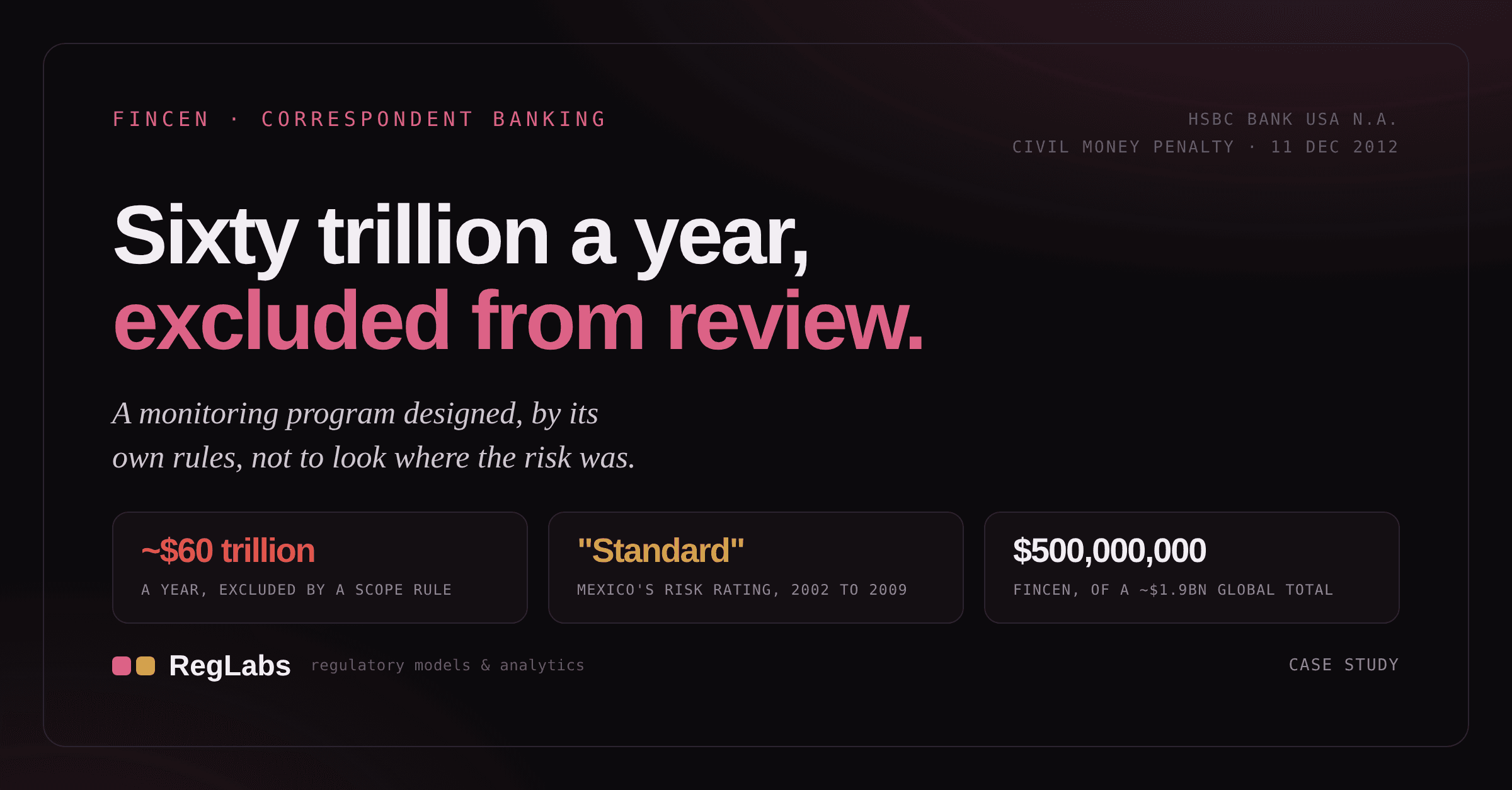
A $500 million penalty for a system built not to look
On 11 December 2012, the Financial Crimes Enforcement Network assessed a $500 million civil money penalty against HSBC Bank USA N.A., known as HBUS, finding that the bank had willfully violated the Bank Secrecy Act since at least mid-2006. The FinCEN assessment was one component of a coordinated resolution that, together with the Office of Foreign Assets Control, the Department of Justice, and other authorities, reached approximately $1.9 billion, at the time the largest AML-related settlement any bank had ever entered. FinCEN found three categories of willful violation: HBUS lacked an effective anti-money-laundering program, it failed to conduct due diligence on certain foreign correspondent accounts, and it failed to detect and adequately report evidence of money laundering and other illicit activity.1
What makes the HSBC case singular, and worth studying in depth more than a decade later, is that its failures were not primarily failures of effort or of technology that did not yet exist. They were failures of design. The bank had built, or allowed to persist, a set of rules and defaults that determined what its monitoring would and would not see, and those rules systematically pointed the monitoring away from the bank's largest risks. A wire-filtering policy excluded roughly $60 trillion a year in activity from review. A country-risk methodology rated Mexico, the corridor through which billions of dollars of drug proceeds were known to move, at the lowest of four risk levels for seven years. And when a country re-rating generated thousands of alerts the bank did not want to work, it cleared more than 4,000 of them in a stroke.
Three findings, one design choice
The aperture was narrowed by policy, not by oversight. The bank decided in advance what it would not see.
Source: FinCEN, Assessment of Civil Money Penalty: HSBC Bank USA, N.A. , 11 December 2012.
This study treats the HSBC matter as the definitive case on the gatekeeper risk of correspondent banking, the business in which a bank provides other banks, including banks in the world's weakest AML jurisdictions, with access to the US financial system, and in doing so inherits responsibility for activity it can only see at a distance and through several layers. It walks the structure of correspondent and affiliate banking, the specific design decisions that closed the monitoring aperture, and the backlog of suspicion the bank generated and did not report, and it lifts each failure into the discipline it violated: why the scope of what a firm monitors is its first and most consequential control; why the country-risk rating is the master dial that sets every downstream control's sensitivity; why an alert backlog can never be resolved by moving the threshold that produced it; why the counterparty a firm trusts most is the one it tends to watch least; why monitoring method must match product risk; and why a suspicious-activity report delivered late is a report that has failed. It closes on the proposition that correspondent banking makes a US bank the gatekeeper for the world's weakest compliance regimes, and that the duty to look cannot be designed away.
What correspondent banking actually is
To understand why a $60 trillion exclusion and a "standard" rating for Mexico were so dangerous, you have to understand the business they governed, because correspondent banking is the structure that turns one bank's weak controls into another bank's liability. A correspondent account is an account that one bank, the correspondent, holds for another bank, the respondent, so that the respondent and its customers can access services, dollar clearing, wire transfers, cash and banknote handling, that the respondent could not reach on its own. HBUS, as a major US bank, was a correspondent for financial institutions around the world, including affiliates within its own HSBC Group and banks in jurisdictions with, as the FinCEN assessment put it, weak anti-money-laundering and counter-terrorist-financing controls.1
The structural consequence is that a correspondent bank does not simply know its own customers; it is exposed to its customers' customers, and to their customers in turn, down a chain it cannot fully see. When HBUS cleared a dollar wire for a foreign respondent bank, the ultimate originator of that wire was a customer of the respondent, or a customer of a customer, whom HBUS had never onboarded, risk-rated, or met. The respondent bank was supposed to perform that diligence. But if the respondent sat in a jurisdiction with weak controls, or was itself careless, the diligence might never have happened, and HBUS was nonetheless the institution through which the money entered the US system and the institution US regulators would hold responsible for it. Correspondent banking concentrates, in the correspondent, the accountability for a population of underlying customers it depends on others to know.
This is the gatekeeper's bargain in its most acute form. A correspondent bank earns fees for providing access to the dollar system, and in exchange it accepts responsibility for monitoring flows whose true origins are several parties removed and often located in exactly the jurisdictions where the originating diligence is weakest. The only defenses the correspondent has are the quality of its own transaction monitoring, the rigor of its due diligence on the respondent banks, and the accuracy of its risk ratings for the countries and counterparties involved. Those are precisely the three things HBUS got wrong, and the reason the failures mattered so much is that in correspondent banking they are not peripheral controls, they are the entire safety mechanism of the business. A correspondent bank with a narrowed monitoring aperture and a miscalibrated country model is not running a slightly weak program; it is running the one business in which those specific weaknesses are fatal.
The sixty trillion that was never looked at
The most staggering single fact in the FinCEN assessment is a design decision about what the monitoring would exclude. HBUS operated a transaction-monitoring policy under which wire transactions involving countries rated below a certain risk level, below "cautionary" or "high," were generally excluded from review. The effect of that policy, FinCEN found, was that approximately $60 trillion per year was excluded from review. Not flagged and cleared, not reviewed and dismissed, but excluded, filtered out before any monitoring logic or any analyst ever considered it.1
Read that in combination with the country-rating failures and the design becomes clear. The monitoring aperture was tied to the country-risk rating: activity from higher-rated countries was reviewed, activity from lower-rated countries was largely not. That architecture is defensible only if the country ratings are accurate, because the ratings are now doing double duty, they are not just a risk signal, they are the on-off switch for whether a transaction is monitored at all. And the ratings were not accurate. Mexico, the single most important laundering corridor into the United States, was rated at the lowest level for years, which means that under the exclusion policy a vast volume of Mexico-linked wire activity would fall into the unreviewed category. The $60 trillion exclusion and the Mexico mis-rating were not two separate errors; they were one architecture in which a miscalibrated rating silently switched off monitoring for the activity that most needed it.
The reason an exclusion of this kind is so much more dangerous than an ordinary monitoring weakness is that it is invisible and total within its scope. A monitoring scenario that is badly tuned still looks at the activity and might, occasionally, fire. Activity that is excluded from review is never looked at by anything; it does not generate alerts that go unreviewed, it generates no alerts at all, because the system was told not to consider it. There is no backlog to find, no queue to measure, no evidence in the firm's own records that anything was missed, because the excluded activity leaves no trace in the monitoring system whatsoever. An exclusion rule is the quietest possible control failure, a decision, made once and then forgotten, that a category of risk simply will not be examined, and HBUS had made that decision across a slice of its activity measured in tens of trillions of dollars a year.
The scope of what you monitor is your first control
The $60 trillion exclusion points to the first and most underappreciated discipline of the entire case: before a firm tunes a single scenario or hires a single analyst, it has already made its most consequential control decision, which is what to monitor at all, and a firm that excludes a category of activity from review has made that decision against itself in the one place no downstream diligence can ever recover. You cannot detect suspicious activity in transactions your monitoring never examines. The scope of coverage, not the quality of the analytics inside it, is the outer boundary of everything a monitoring program can possibly achieve.1
Firms consistently underweight this because scope decisions are made quietly, early, and for reasons that feel like prudent resource management rather than risk-taking. Excluding low-rated countries from wire review sounds sensible: why spend analyst time on transactions from places that are, by the firm's own rating, low risk. But that reasoning contains the fatal circularity the HSBC case exposes. The exclusion is only safe if the ratings are right, and the ratings are the very thing the firm has the least basis to be confident about, because a rating is an estimate of risk, not a measurement of it, and the activity you most need to catch is by definition the activity whose risk you have underestimated. By making the rating the gate for monitoring, HBUS ensured that any error in the direction of underestimating a country's risk would not merely under-weight that country's activity, it would exclude that activity from examination entirely, converting a rating error into a monitoring blind spot. A scope rule tied to a risk estimate inherits every weakness of the estimate and amplifies it from a mis-weighting into an exclusion.
Decide scope deliberately, and monitor what you exclude
The discipline is that monitoring scope must be set as an explicit, governed, and regularly challenged decision, with any exclusion documented, justified, and itself monitored, because an exclusion is not an absence of a control, it is a control that says "do not look here," and it demands the same scrutiny as any rule that shapes what the firm detects. Concretely, a firm should be able to produce a map of its entire activity and show, for every category, whether it is monitored and, if not, the explicit and current rationale for excluding it. Exclusions should be rare, narrow, and reviewed on a schedule, and a firm should sample excluded activity periodically to confirm the exclusion is still safe, because the only way to know whether a blind spot hides a problem is to look into it deliberately from time to time. Above all, scope should never be made a silent function of another estimate: tying monitoring coverage to the country rating, as HBUS did, means a single miscalibrated dial can switch off examination of trillions of dollars, and no analyst, however diligent, can review what the scope rule has already discarded. The firm's first question about its monitoring should not be "how good are our scenarios" but "what are we not looking at, and why are we sure that is safe," and HBUS could not have answered the second question, because $60 trillion of the answer was an exclusion no one was revisiting.
Mexico, rated "standard"
At the center of the architecture sat a single rating that was wrong in the most consequential way a rating can be wrong. From 2002 until 2009, HBUS rated Mexico as having "standard" anti-money-laundering risk, the lowest of the bank's four possible country-risk ratings, despite publicly available information to the contrary. During those same years, as FinCEN recorded, law-enforcement authorities in the United States and Mexico had determined that billions of US dollars derived from illegal drug trafficking flowed annually from criminals through Mexican financial institutions to US financial institutions. The corridor that every relevant authority identified as a premier laundering route was, in HBUS's own system, the lowest risk on the scale.1
HBUS's four-level country-risk scale, and where Mexico sat
Because the exclusion policy keyed off the rating, "standard" did not just under-weight Mexico. It switched off wire monitoring for it.
Source: FinCEN, Assessment of Civil Money Penalty: HSBC Bank USA, N.A. , 11 December 2012.
The consequences cascaded from that one dial. HBUS treated its Mexican affiliate, HBMX, as a "standard" money-laundering risk until 2009 as well, so the affiliate relationship that funneled Mexican activity into the US bank was itself classed as routine. Because the wire-exclusion policy keyed off the country rating, Mexico's "standard" classification meant that a great deal of Mexico-linked wire activity fell into the unreviewed bucket. And because enhanced due diligence, closer monitoring, and heightened scrutiny are all triggered by a higher risk rating, the "standard" label meant none of those elevated controls engaged for the corridor that needed them most. A single rating, held stable for seven years against contrary public evidence, propagated through the exclusion policy, the affiliate treatment, and the entire escalation of controls, and at every stage it told the bank's systems that Mexico was ordinary.
FinCEN's finding that the rating persisted "despite publicly-available information to the contrary" is the detail that removes any defense of ignorance. This was not a case of a bank lacking the data to rate Mexico correctly; the data was public, produced by the very law-enforcement bodies the bank's compliance function was meant to track. The rating was wrong not because the risk was hidden but because the process that set it was, in FinCEN's words, lacking a structure to ensure systematic country-risk assessments and updates. A rating that is not systematically re-examined against current, available information will drift away from reality and then stay there, anchored by inertia, and HBUS's Mexico rating is the archetype: fixed at the bottom of the scale through the exact years the corridor it described was most notorious.
Country risk is the master dial
The Mexico rating generalizes into a discipline that every institution with international exposure should treat as foundational: the country-risk rating is not one input among many, it is the master dial that sets the sensitivity of nearly every downstream control, and a single error in it does not produce a single error in output, it mis-tunes the entire program at once. At HBUS the country rating determined whether wire activity was monitored, whether a correspondent relationship received enhanced due diligence, and how closely a customer linked to that country was scrutinized. Set the dial wrong, and all three move together, in the wrong direction, silently.1
This is what makes country-risk miscalibration uniquely dangerous and uniquely common. It is dangerous because of the leverage: the rating is upstream of so many controls that an error multiplies, and a country rated too low is simultaneously under-monitored, under-diligenced, and under-scrutinized, with no single alert or exception to reveal the problem, because the problem is that the alerts and exceptions were never generated. It is common because country ratings are among the least rigorously governed elements of many AML programs, often set once, rarely revisited, and anchored by institutional relationships and commercial interest, a bank with a large franchise in a country has every incentive, conscious or not, to see that country as lower risk. HBUS's rating process, which FinCEN found lacked a systematic structure for assessment and updates, is the typical failure mode: not a dramatic misjudgment but a quiet absence of the discipline that would force the rating to track reality, allowing it to sit at "standard" for Mexico through seven years in which reality moved sharply the other way.
Govern the master dial hardest of all
The discipline follows from the leverage: because the country rating sets the sensitivity of so much else, it deserves the most rigorous governance in the program, not the least, with a transparent methodology, mandatory periodic reassessment against current external information, and explicit challenge of any rating that commercial interest would prefer to keep low. A firm should be able to show, for every country it is exposed to, what the rating is, what evidence supports it, when it was last reviewed, and what would trigger a change, and it should treat a stable low rating for a high-exposure, high-notoriety jurisdiction as a finding to be defended rather than a default to be trusted. The specific test the HSBC case suggests is pointed: take the jurisdictions that public law-enforcement and international bodies identify as the highest financial-crime risks, and confirm that the firm's own ratings agree; where the firm rates such a jurisdiction low, as HBUS rated Mexico "standard," the burden is on the firm to justify the divergence, and an inability to justify it is itself the finding. The master dial must be the most scrutinized control in the program precisely because everything downstream inherits its setting, and HBUS inverted that, leaving the single most leveraged rating in its system fixed at the bottom while the controls it governed obediently stood down.
Four thousand alerts, cleared by reclassification
If the Mexico rating shows a dial set wrong and left there, another episode in the case shows the dial being moved for the express purpose of making a problem disappear. In 2008, HBUS summarily cleared more than 4,000 unaddressed alerts after changing a country's risk rating from "cautionary" to "medium." The alerts existed because the monitoring system, operating on the higher rating, had flagged the activity as warranting review. Rather than work the alerts, the bank re-rated the country downward, and in doing so swept the alerts away, because at the lower rating the activity no longer qualified for the scrutiny that had generated them.1
How 4,000 open alerts were resolved
The alerts were not worked. The threshold that created them was moved, and they ceased to qualify.
Source: FinCEN, Assessment of Civil Money Penalty: HSBC Bank USA, N.A. , 11 December 2012.
It is worth being precise about what this is, because it is a specific and insidious form of control subversion. The alerts were the output of the control working as intended: the monitoring had identified activity that, on the bank's own risk settings, deserved a human to look at it. Clearing them required either doing the work, reviewing each alert to a reasoned conclusion, or making the work unnecessary. HBUS chose the second path, not by investigating the activity and concluding it was benign, but by changing the upstream parameter so that the activity was reclassified as not warranting review in the first place. The 4,000 alerts were not resolved; they were disqualified. The suspicious activity they represented did not become less suspicious, it became, by administrative reclassification, invisible to a system that had just finished flagging it.
The timing and the direction are what make it damning. A country re-rating that happens to resolve a backlog of thousands of alerts, in the downward direction, is not a neutral risk reassessment that incidentally reduced workload; it has the shape of a workload reduction dressed as a risk reassessment. Whether or not the re-rating was independently justified on the merits, the effect, and the reason FinCEN singled it out, was that a large volume of flagged, unexamined activity was cleared not by examination but by the stroke that redefined it as unremarkable. The control had done its job and surfaced the suspicion; the response was to reach up to the dial that controlled the control, and turn the suspicion off.
You cannot clear a backlog by moving the threshold that made it
The 4,000 cleared alerts crystallize a discipline that applies to every alerting system a firm runs: an alert, once generated, represents a question the firm's own control has decided is worth asking, and the only legitimate way to close it is to answer the question, never to retroactively move the parameter so the question is deemed never to have been asked. Re-tuning a monitoring system is a legitimate and necessary activity, but re-tuning it in order to dispose of alerts it has already generated inverts the purpose of tuning, turning a calibration decision into a concealment mechanism.1
The distinction is between prospective and retrospective calibration, and it is the whole of the matter. Prospectively, a firm can and should adjust its thresholds and ratings as its understanding of risk improves, so that the system generates better alerts going forward, and if a re-rating means certain activity will no longer alert in future, that is an ordinary consequence of calibration. Retrospectively applying that re-rating to wipe out alerts that have already fired is a different act entirely, because those alerts are not hypotheses about future activity, they are existing records that specific past transactions met the firm's own criteria for suspicion. Clearing them by reclassification does not improve the system, it destroys the evidence the system produced, and it does so in the one direction, downward, that reduces the firm's workload and its reporting obligations simultaneously. A firm that resolves its backlog this way has discovered that it can make any inconvenient volume of suspicion vanish by adjusting the dial behind it, which is the precise opposite of what a monitoring system exists to do.
Close alerts by answering them, and change thresholds only forward
The discipline is twofold and strict. First, every alert must be closed by a documented disposition, a reasoned conclusion that the activity was or was not suspicious, and a change in an upstream parameter is never a valid disposition for an alert that already exists, because the alert records that the activity met the criteria in force when it fired. Second, threshold and rating changes must be governed, independently reviewed, and applied prospectively, with any change that would reduce alerting scrutinized specifically for whether it is being made to improve risk capture or merely to reduce work, and with existing alerts worked to conclusion regardless of the change. The governance test is to ask, of any re-calibration that reduces alert volume, whether it was driven by a genuine, evidenced reassessment of risk or by the pressure of a backlog, and to treat the coincidence of a downward re-rating with the clearing of thousands of open alerts, exactly HBUS's 2008 pattern, as a red flag about the firm's own integrity rather than a resolution of its backlog. An alert backlog is a resourcing and prioritization problem to be solved by working the alerts; the moment it is solved by moving the threshold that created them, the firm has stopped monitoring and started managing appearances.
The affiliates it exempted from diligence
The due-diligence failures in the case cluster around a revealing decision: HBUS exempted its own HSBC Group affiliates from the customer-due-diligence processes that applied to other correspondent relationships. FinCEN found that HBUS formerly did not collect or maintain customer-due-diligence information regarding any HSBC Group affiliates with correspondent account relationships at the bank, and that this policy of exempting affiliates from due-diligence processes inhibited the bank's ability to recognize potential money-laundering vulnerabilities. The bank did not incorporate information about its affiliates' business purposes, anticipated activity, AML supervision, host-country vulnerabilities, or compliance history into its monitoring of their transactions.1
The logic of the exemption is easy to reconstruct and dangerous precisely because it feels reasonable. These were affiliates, part of the same corporate group, sharing a brand and, nominally, a common standard. Why subject a sister entity to the same adversarial diligence as an unknown foreign respondent bank. The answer the case supplies is stark: because an affiliate in a high-risk jurisdiction is exposed to the same risks as any other bank in that jurisdiction, and the corporate relationship does nothing to reduce those risks, it merely reduces the scrutiny. HBMX, the Mexican affiliate, operated in the Mexican market with all of its laundering exposure, and its affiliation with HBUS did not make its customers safer; it only made HBUS less inclined to examine them. The exemption meant that the correspondent relationship carrying activity from one of the highest-risk markets into the US bank was the one relationship subjected to the least due diligence, on the basis of a family resemblance that had no bearing on the underlying risk.
The specific content of what the exemption omitted is instructive, because it names exactly the information a correspondent needs. HBUS did not capture its affiliates' business purposes, their anticipated activity, the quality of their AML supervision, the AML vulnerabilities of their host countries, or their compliance histories. Those are not bureaucratic data points; they are the precise factors that determine how much risk a respondent relationship carries and how closely it must be watched. A correspondent that does not know a respondent's expected activity cannot detect when actual activity deviates from it. A correspondent that does not assess a respondent's AML supervision and host-country risk cannot calibrate its monitoring to the relationship. By exempting affiliates from collecting any of it, HBUS did not just skip a formality, it blinded its own monitoring of the affiliate relationships, and it did so for the relationships that, running from markets like Mexico, most needed to be seen.
The counterparty you trust most is the one you watch least
The affiliate exemption generalizes into one of the most counterintuitive and most violated principles in financial-crime control: trust is not a control, and the counterparties a firm trusts most, its affiliates, its long-standing clients, its own group entities, are systematically the ones it watches least, which makes them the ideal conduit for exactly the risk the watching exists to catch. HBUS trusted its HSBC Group affiliates and exempted them from diligence, and the exemption converted trust into a blind spot precisely where the activity was highest-risk.1
The mechanism by which trust becomes a vulnerability is worth stating plainly, because it operates against the grain of intuition and institutional culture. Controls are costly, in effort, in friction, in the awkwardness of subjecting a trusted relationship to adversarial scrutiny, and firms naturally economize by relaxing controls where they feel least needed, which is where trust is highest. But the risk a monitoring program is designed to catch does not respect the firm's trust; a trusted affiliate in a high-risk market is exposed to that market's risks regardless of how the firm feels about it, and a launderer seeking a route into the system will naturally prefer the channel that is least scrutinized, which the firm has helpfully designated as the trusted one. The result is a perverse alignment: the firm relaxes its controls exactly where an adversary would most want them relaxed, and it does so for a reason, familiarity, that has no relationship to the actual risk. The affiliate's trustworthiness, even if genuine at the level of intent, does nothing about the trustworthiness of the affiliate's customers and their customers, whom neither the affiliate nor HBUS was diligently examining.
Rate the relationship on its risk, not your relationship with it
The discipline is that the intensity of due diligence and monitoring must be set by the objective risk of a relationship, its jurisdiction, its activity, its underlying customers, and never discounted for trust, familiarity, corporate affiliation, or the length of the relationship, because those factors change the firm's comfort without changing the risk. An affiliate in a high-risk market must be diligenced as a high-risk relationship, and if anything the integration that comes with affiliation, shared systems, assumed common standards, makes rigorous independent diligence more important, not less, because the assumption of a common standard is exactly what lets a weakness in one entity flow unexamined into another. The test a firm should apply is to look at the relationships it has quietly exempted or lightened, the group affiliates, the oldest clients, the banks "we know well," and ask whether the exemption is justified by lower objective risk or merely by higher subjective comfort. Where the answer is comfort, the firm has located its own most likely blind spot, because an adversary will find the trusted channel faster than the firm will. HBUS exempted its affiliates on the basis of trust, and the FinCEN assessment is the record of what flowed through the channel it had decided not to watch.
Bulk cash, reviewed by hand
Among the products HBUS handled were some of the highest-risk instruments in banking, physical cash and banknotes, bulk traveler's checks, and the way the bank monitored them exposed a mismatch between the risk of a product and the method used to watch it. From mid-2006 through mid-2009, FinCEN found, the bank did not perform automated and effective monitoring on banknote, or bulk-cash, transactions, relying instead on manual targeted and quarterly reviews. And until November 2008, HBUS cleared traveler's checks received from a foreign respondent bank, high-volume, sequentially numbered checks, a classic laundering red flag, without monitoring systems reasonably designed to detect, investigate, and report evidence of money laundering.1
The mismatch is the point. Bulk cash and banknotes are, by near-universal consensus, among the highest money-laundering risks a bank can handle, because cash is anonymous, fungible, and the preferred medium of the criminal economy, and bulk movements of it between jurisdictions are a core laundering typology. Sequentially numbered traveler's checks arriving in volume from a foreign respondent are a textbook structuring and laundering indicator. These are precisely the products that demand the most systematic, automated, continuous monitoring. HBUS monitored them with the least: manual reviews, targeted and quarterly, for bulk cash, and effectively nothing designed for the traveler's checks until late 2008. The firm had inverted the appropriate relationship between product risk and monitoring method, applying the weakest, most sporadic, most human-limited review method to the products whose risk most demanded automation and rigor.
Manual and quarterly review is not a less-thorough version of continuous automated monitoring; for high-volume, high-risk flows it is a fundamentally different and inadequate thing. A quarterly manual review cannot see patterns that unfold across the quarter and are structured to stay beneath the notice of any single sampling. It cannot process the volume that bulk-cash and banknote activity generates. And it depends entirely on a reviewer happening to select and scrutinize the right transactions, which for activity at this scale is a vanishingly unlikely way to catch a deliberate scheme. The method was not merely weaker than it should have been; it was categorically unsuited to the risk of the product it was applied to, which meant that for three years the bank's highest-risk cash flows were, in any meaningful sense, unmonitored.
Match the monitoring method to the product's risk
The bulk-cash failure generalizes into a discipline that is simple to state and routinely violated under resource pressure: the method by which a product is monitored must be matched to the money-laundering risk of that product, and applying a weak, manual, or sampling-based method to a high-risk, high-volume product is not a lesser control, it is the absence of an adequate one. HBUS applied manual quarterly review to bulk cash, one of the highest-risk products in banking, and the result was not thin coverage but no effective coverage at all.1
The reason this mismatch recurs is that monitoring method is usually chosen by cost and convenience rather than by risk, and manual review is cheap to stand up and easy to defend as "we review it." A firm under pressure to cover many products with limited systems will naturally apply automated monitoring where it is already built and fall back on manual review for the rest, and the products that fall into the manual bucket are often not the lowest-risk but simply the ones the firm's systems did not happen to cover, which can include the highest-risk cash and banknote flows. The defense "we reviewed it manually" then does real damage, because it lets the firm and its reviewers believe a control exists when what exists is a method incapable of the job. A quarterly manual sample of bulk-cash activity produces the paperwork of monitoring, a review was conducted, without the substance, and the gap between the two is exactly where the laundering runs. The adequacy of a monitoring control is not whether some review happens but whether the method can actually detect the typologies the product is used for, at the volume the product generates.
Let the product's risk choose the method
The discipline is to derive the monitoring method from a clear-eyed assessment of each product's inherent risk and transaction profile, so that high-risk, high-volume products, cash, banknotes, correspondent wires, instruments favored by launderers, receive the most systematic, automated, and continuous monitoring, and manual or sampling methods are reserved for genuinely low-risk, low-volume activity where they can plausibly work. The test is to list the firm's products in order of money-laundering risk and then check that the monitoring method tracks that order, with the highest-risk products getting the strongest methods, and to treat any high-risk product monitored by manual or periodic review as a control gap requiring either an automated solution or a decision to stop offering the product. HBUS would have failed that test visibly: its highest-risk products, bulk cash and banknotes, sat under its weakest method, manual quarterly review, for three years, and the traveler's-check flow that is a named laundering indicator had no reasonably designed monitoring at all until 2008. A firm that lets convenience rather than risk assign its monitoring methods will reliably end up watching its most dangerous products the least, which is the HSBC pattern and the reason the method-to-risk match is a control discipline in its own right.
The backlog of unfiled reports
Where the monitoring did fire, the reporting that was supposed to follow collapsed under a backlog, and the collapse turned detected suspicion into unfiled and late reports on a scale measured in billions of dollars. FinCEN found that the department responsible for investigating suspicious-activity alerts was severely understaffed, resulting in thousands of unprocessed, backlogged alerts, and that staff often cleared alerts without adequate review. The bank had a longstanding pattern of late suspicious-activity reports; several thousand SARs suffered lengthy delays, and in some instances more than a year elapsed between the underlying activity and the filing. After a historical review, HBUS filed hundreds of delinquent SARs on transactions totaling several billion dollars.1
From detection to a report that arrived too late, or not at all
The suspicion was detected and then stranded. A report filed after a year has already failed the law enforcement it exists to serve.
Source: FinCEN, Assessment of Civil Money Penalty: HSBC Bank USA, N.A. , 11 December 2012.
The structure of this failure is the same capacity collapse that appears whenever detection outruns the resources to act on it, but the AML context gives it a specific and severe edge. A suspicious-activity report is not an internal record; it is a filing to law enforcement, and its entire purpose is to put a timely signal in front of the authorities who can act on it while the action still matters. A SAR filed more than a year after the activity is not a late delivery of a useful product; it is, for most practical purposes, a non-delivery, because the window in which the information could have supported an investigation, a seizure, or an interdiction has closed. HBUS did not merely have an operational backlog; it had a backlog of the one output the entire AML program exists to produce, and the backlog meant that the suspicion the bank's monitoring successfully detected, in the areas where it was looking at all, was stranded in an unprocessed queue, cleared without review, or reported so late that its value had evaporated.
A late report is a failed report
The SAR backlog crystallizes a discipline specific to any control whose output is a time-sensitive report to an external party: timeliness is not a quality attribute of the report, it is the report's reason for existing, and a suspicious-activity report delivered late has not been delivered in any sense that matters, it has failed. HBUS filed hundreds of SARs more than a year after the fact, and FinCEN's finding that the delays and incomplete information impaired the reports' usefulness to law enforcement and regulators is the exact statement of the principle: a SAR's value is a function of its timeliness, and past a point, that value is zero.1
This reframes how a firm must think about the SAR process and about any similar reporting obligation. It is tempting to treat SAR filing as a task that must eventually be completed, so that a backlog looks like a queue to be worked down, a volume of work that is behind schedule but will be caught up. For a time-sensitive report, that framing is wrong, because the report caught up a year late is not the same report delivered on time, it is a different and largely worthless artifact that happens to share a form. The law requires SARs to be filed within defined periods precisely because the information is actionable only within a window, and a firm that files late has not partially satisfied the obligation, it has missed it, in the same way that a warning delivered after the event it warned of has not been partially useful. HBUS's several-thousand-SAR backlog was not a firm that was behind on its filing and catching up; it was a firm that was failing to perform the reporting function in real time, producing, after historical reviews, a pile of reports whose moment had passed.
Build the reporting pipeline for the clock, not just the queue
The discipline is to engineer any time-sensitive reporting obligation around the clock that governs it, with capacity sized to produce reports within the required window rather than merely to eventually clear the queue, and with the age of pending items monitored as a primary control metric rather than a background statistic. For SARs specifically, this means the investigating function must be resourced to keep pace with alert generation in real time, because a persistent investigation backlog is not an operational nuisance, it is a continuous, accruing failure to meet a legal reporting deadline on each item that ages past the window. The metric that matters is not how many SARs the firm eventually files but how many it files on time, and the age distribution of its open investigations is the leading indicator of whether the obligation is being met or quietly missed. A firm whose investigation queue is growing older is not behind on paperwork, it is failing its reporting duty in advance, and the only fixes are the same two that apply to any capacity failure, resource the function to the volume or reduce the volume, never let the clock run while the queue grows. HBUS let the clock run for years, and the hundreds of delinquent SARs on billions of dollars of transactions are the measure of a reporting function that had, in substance, stopped reporting.
Compliance without authority
Beneath the specific control failures ran a condition FinCEN named directly, and it is the condition that let all the others persist: the compliance function did not have the authority to make the business comply. FinCEN found that a corporate culture had persisted at the bank that effectively denied compliance officials the requisite authority over the business and account-relationship lines to manage the bank's risk profile, and that the compliance operation lacked continuity and sufficient standing or authority within the bank to execute its Bank Secrecy Act responsibilities. The independent audit program, meanwhile, repeatedly failed to evaluate the bank's money-laundering vulnerabilities effectively or to detect BSA compliance failures in a timely fashion.1
This is the structural root beneath the architectural failures. A compliance function with real authority would have been able to insist that Mexico be rated correctly, that the $60 trillion exclusion be examined, that the affiliate exemption be removed, that the SAR backlog be resourced, and that the 4,000 alerts be worked rather than cleared by reclassification. A compliance function denied authority over the business lines can recommend all of those things and be overruled, ignored, or under-resourced by a business that experiences compliance as a cost center rather than a control. The specific decisions that produced the penalty, the exclusions, the ratings, the exemptions, the understaffing, are each the kind of decision a business will make in its own favor unless a compliance function with genuine standing can force a different answer, and FinCEN's finding is that HBUS's compliance function could not, because the culture had denied it the authority to. The audit function, the third line that is supposed to catch exactly this, repeatedly failed to, so the one mechanism that might have surfaced the pattern to the board was itself ineffective.
Authority and independent assurance are the controls behind the controls
The discipline is that a control function's authority and the effectiveness of independent assurance are themselves controls, foundational ones, because every specific control the function operates depends on its power to make the business accept an answer it would prefer to reject, and on an audit function capable of catching the failures the first two lines miss. A compliance function that can be overruled by the business on risk-rating, scope, resourcing, and alert-disposition decisions is not a control function, it is an advisory one, and its recommendations will lose to commercial interest exactly when they matter most. The tests are concrete: can the compliance function compel a country re-rating, a scope change, or additional staffing over the objection of a profitable business line, and does the independent audit function actually find the program's material weaknesses before a regulator does. Where the answer to the first is no, the firm's specific controls are all provisional, subject to reversal by the business; where the answer to the second is no, as it was at HBUS, the last line of defense is decorative. FinCEN's culture and audit findings are not soft context around the hard control failures, they are the explanation for why the hard failures were never corrected from within, and they are the reason the correction finally came from outside, at a cost of $1.9 billion.
Told, and told again
None of this came to HBUS as a surprise, and that is the final aggravating thread: the bank had been told, by its supervisors, repeatedly, and its deficient responses to those warnings were themselves part of the finding. FinCEN recorded that the bank's failures were repeatedly evidenced by its deficient responses to adverse supervisory findings and mandates requiring it to implement effective measures to ensure the filing of accurate, timely, and complete SARs and compliance with other BSA requirements. The regulators had identified the problems and directed the bank to fix them, and the bank's responses were, in FinCEN's assessment, deficient, so the problems persisted into the conduct that produced the penalty.1
The technology timeline tells the same story of a firm that moved far too slowly on what it had been told to fix. FinCEN found that HBUS did not acquire an automated monitoring system equal to the needs of the bank, one with sufficient capacity for the volume, scope, and nature of its transactions, until April 2011, and that it then took another full year, until approximately April 2012, to validate that system for effective detection of suspicious activity. For an institution of HBUS's scale, part of a group with roughly $2.7 trillion in assets, operating a major correspondent business, the absence of an adequately capable automated monitoring system until 2011 is itself an extraordinary finding, and the year-long validation gap after acquisition meant that even once the tool existed, it was not reliably doing its job until the eve of the settlement. A firm that is told its monitoring is inadequate and takes until 2011 to acquire a capable system, and until 2012 to validate it, has not responded to the warnings with the urgency they demanded.
The lesson of the warnings is the one that recurs in every case where a regulator eventually imposes a large penalty on conduct it had flagged years earlier: a supervisory finding is not a suggestion to be managed down over time, it is a direction whose deficient execution becomes an aggravating element of the eventual enforcement. HBUS treated the adverse findings and mandates as problems to be addressed on the bank's own timeline and at the bank's own pace, and the pace was slow, the exclusions remained, the ratings stayed wrong, the backlog grew, and the system was not replaced for years. When the resolution came, the bank's history of being told and not adequately acting was not a mitigating sign of good faith; it was proof that the failures were known and uncorrected, which is the fact pattern that turns a control weakness into a willful violation.
The broader lesson: a correspondent is the gatekeeper for the world's weakest regimes
The enduring lesson of the HSBC case is a structural truth about correspondent banking that no amount of good intention can soften: when a bank provides other banks with access to the dollar system, it becomes the gatekeeper for the compliance standards of every institution and jurisdiction in that chain, including the weakest, and the only thing standing between those weak standards and the US financial system is the correspondent's own controls. HBUS banked affiliates and respondents in high-risk markets, inherited responsibility for activity that originated several parties away, and then narrowed its monitoring aperture, mis-rated its largest risk, exempted its own affiliates, and let its reporting fall years behind. Every one of those failures was a way of declining the gatekeeping duty the business had assumed.1
The disciplines that would have changed the outcome are the ones this study has drawn out, and they compose a coherent program for the gatekeeper. Set monitoring scope as an explicit, governed decision and monitor what you exclude, because an exclusion rule is the quietest way to switch off examination of your largest risk, and HBUS switched it off across $60 trillion a year. Govern the country-risk rating as the master dial it is, with mandatory reassessment against public information and explicit challenge of any low rating for a high-notoriety jurisdiction, because a single wrong rating, Mexico at "standard," mis-tunes the entire program. Close alerts by answering them and change thresholds only prospectively, because clearing 4,000 alerts by re-rating a country is concealment, not calibration. Diligence relationships on their objective risk and never discount for trust, because the affiliate you exempt is the channel an adversary will choose. Match monitoring method to product risk, because bulk cash under manual quarterly review is unmonitored. File reports to the clock, not the queue, because a SAR a year late has already failed. And give the compliance function real authority and the audit function real teeth, because without them every specific control is reversible by the business that profits from reversing it. Together they describe a correspondent bank that actually performs the gatekeeping its business model promises.
The forward view: more access, more layers, faster flows
The reason the case remains urgent is that the correspondent-banking risk it exemplifies is intensifying. Cross-border payment flows are larger, faster, and layered through more intermediaries than they were in 2006 to 2012, and the pressure to extend access, to fintechs, to payment platforms, to banks in emerging markets, continually adds new respondents whose own controls the correspondent must take substantially on faith. In that environment the disciplines of this case become more demanding, not less: the scope decision covers more activity, the country and counterparty ratings must track a faster-moving risk landscape, and the monitoring must process volumes that make manual methods even more obviously inadequate. The correspondent that will avoid HSBC's outcome is the one that treats its gatekeeping duty as the core of the business rather than an overhead on it, that keeps its monitoring aperture wide and its ratings honest even where commercial interest pulls the other way, and that resources detection and reporting to operate in real time at the scale of the access it grants. The HSBC case is a decade old, and its central finding, that a bank had designed its monitoring not to look where its risk was, is the one failure that modern volumes and modern pressure make easiest to repeat and most expensive to discover late. A gatekeeper that decides in advance what it will not see has not reduced its risk; it has only arranged to learn about it from a regulator.
What this case is really about
A monitoring program designed, by its own rules, not to look where the risk was
HBUS did not miss its largest risks by accident; its architecture pointed the monitoring away from them. A scope rule excluded roughly $60 trillion a year from review. Mexico, the premier laundering corridor, was rated "standard," the lowest level, for seven years, and because the exclusion keyed off the rating, that one dial switched off wire monitoring for the corridor that needed it most. The bank cleared 4,000 alerts by re-rating a country, exempted its own affiliates from due diligence, monitored bulk cash by hand, and filed hundreds of SARs more than a year late. The compliance function lacked the authority to stop any of it. The result was $500 million from FinCEN, part of a $1.9 billion global resolution.
Where it broke
- Wire-monitoring scope rule excluded ~$60 trillion a year from review before any analyst looked
- Mexico rated "standard," the lowest of four, from 2002 to 2009, against public evidence; HBMX treated as standard until 2009
- More than 4,000 live alerts cleared by changing a country's rating from cautionary to medium
- HSBC Group affiliates exempted from customer due diligence; no capture of their activity, supervision, or host-country risk
- Bulk cash and banknotes monitored by manual quarterly review; travelers checks unmonitored until late 2008
- Thousands of backlogged alerts, hundreds of SARs over a year late on billions of dollars; compliance denied authority; audit ineffective
What a correspondent bank requires
- Monitoring scope set as an explicit, governed decision, with every exclusion justified and itself sampled
- Country risk governed as the master dial: reassessed against public information, low ratings for high-risk corridors challenged
- Alerts closed only by reasoned disposition; threshold and rating changes applied prospectively, never to clear a backlog
- Diligence intensity set by objective risk, with affiliates and trusted counterparties held to the same standard
- Monitoring method matched to product risk, with high-risk cash flows on systematic automated monitoring
- SAR capacity sized to the clock, and a compliance function with authority plus an audit function that actually finds the gaps
AML Governance Analyst
Reviews the AML programme end to end against global enforcement and the typologies each control must catch: the scope of transaction monitoring and every exclusion within it, the country-risk methodology and its calibration against public information, the customer and correspondent due-diligence standards and any trust-based exemptions, the match between monitoring method and product risk, the alert-disposition and threshold-change governance, and the SAR investigation and filing pipeline against its deadlines. A $60-trillion exclusion, a high-risk corridor rated low, a backlog cleared by reclassification, an affiliate exempted from diligence, or a SAR queue aging past the filing window is surfaced as a program-design finding, with a remediation target and a health score, rather than discovered by a regulator reading the activity the firm declined to monitor.Five ways RegLabs keeps the aperture open on the real risk
This case study is an independent analysis prepared by RegLabs for educational and informational purposes, based on FinCEN's public Assessment of Civil Money Penalty concerning HSBC Bank USA, N.A. (11 December 2012). It is not legal advice and does not reproduce the assessment in full. All figures and quotations are drawn from the public record; any characterizations are those of RegLabs. Company and regulator names are used for identification and commentary only.