
- Enforcement
- Financial Crime
- Governance & Accountability
Both legs were visible. No one was looking across them.
Deutsche Bank's own trading systems held both sides of every mirror trade: a rouble buy in Moscow, a matching dollar sell in London, same stock, same size, same owners. The data to see a USD10 billion laundering channel was already in the building. The bank never joined it up. The FCA charged GBP163 million.
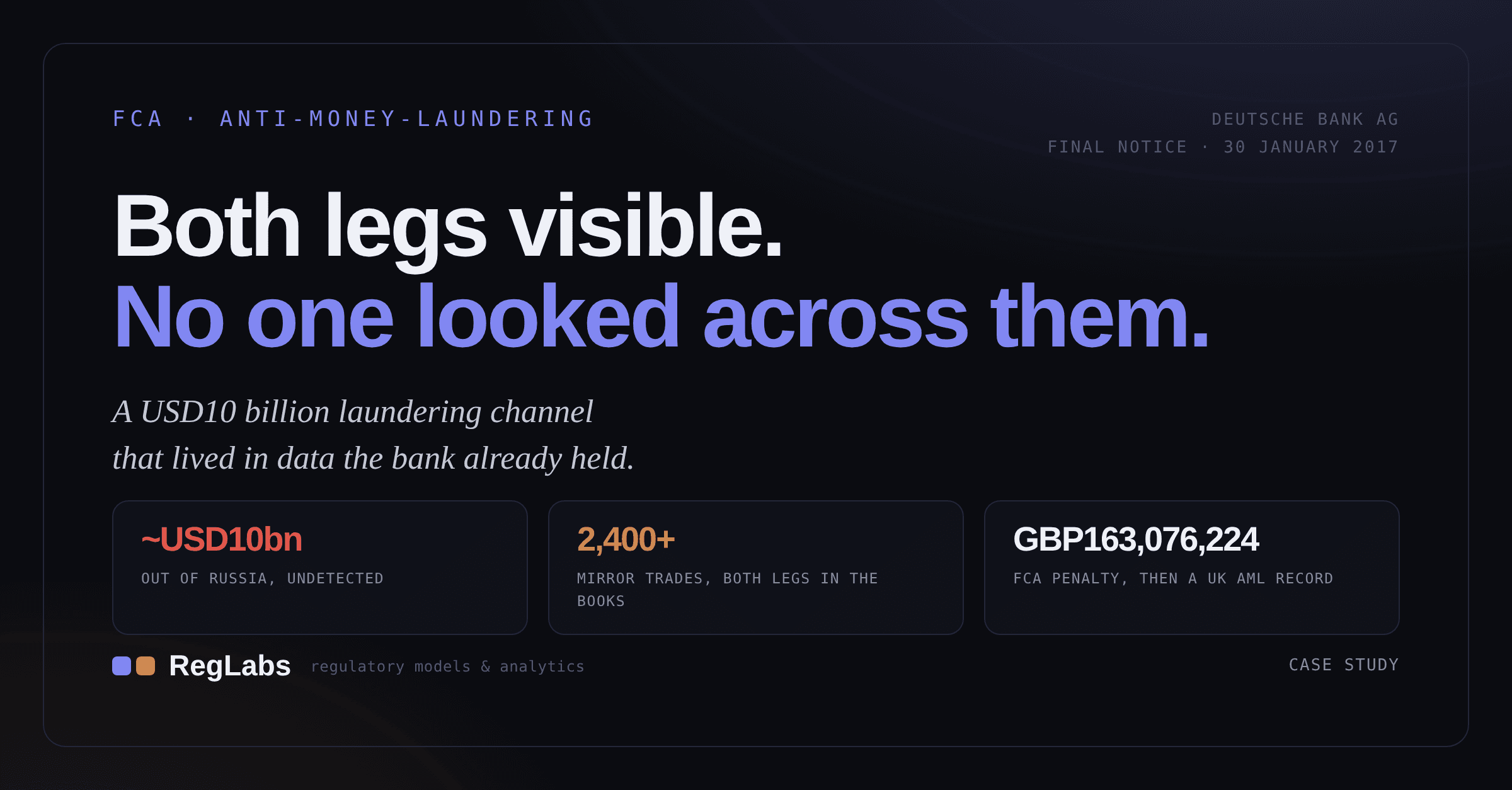
A GBP163 million penalty for a channel it never saw
On 30 January 2017, the Financial Conduct Authority issued a Final Notice against Deutsche Bank AG, imposing a financial penalty of GBP163,076,224, at the time the largest penalty the FCA had ever levied for anti-money-laundering control failings. The penalty comprised a penal element of GBP154 million and disgorgement of GBP9,076,224, and it was for breaches of Principle 3, the requirement to organise and control the firm's affairs responsibly and effectively, and of the Senior Management Arrangements, Systems and Controls rules SYSC 6.1.1 R and 6.3.1 R, across the period from 1 January 2012 to 31 December 2015.1
The conduct at the centre of the case was a scheme known as mirror trading, run through the bank's Corporate Banking and Securities division in the UK and arranged by its Russia-based subsidiary, DB Moscow. Related customers used Deutsche Bank to buy Russian blue-chip shares for roubles in Moscow and, at nearly the same moment and in the same size, to sell the identical shares for US dollars or other hard currency in London. The paired trades had no economic purpose beyond the one they achieved: converting roubles into dollars and moving them out of Russia to accounts in Cyprus, Estonia, and Latvia. More than 2,400 mirror trades moved over USD6 billion in this way, and when one-sided trades likely to represent the other half of further mirror pairs are included, the total approaches USD10 billion.
The scheme, in one line
Same security, same quantity, related owners, opposite currencies. No net market position; roubles become dollars offshore.
Source: FCA, Final Notice: Deutsche Bank AG , 30 January 2017.
The FCA was explicit that the failings were not deliberate or reckless, and that there was no evidence any member of Deutsche Bank's senior management knew of the suspicious trading. That is the feature that makes the case so instructive. A bank was fined a record sum for money laundering not because it chose to launder, but because its controls were so inadequate that a USD10 billion channel ran through its own books for years without the firm being able to identify, assess, monitor, or manage the risk. Every element the FCA faulted, the customer due diligence, the onboarding, the risk ratings, the transaction monitoring, the escalation, the resourcing, failed quietly and in combination, and the result was a laundering pipeline the bank could not see even though both ends of it were recorded in its own systems.
This study treats the case as the definitive anatomy of a particular and recurring failure: a firm holding, in its own records, all the data needed to detect a financial-crime scheme, and never joining that data up into a control that looks. It walks the mechanism of the mirror trade, the crowd of Russian customers behind it, and the specific controls that failed, and it lifts each failure into the discipline it violated: why the hardest schemes to launder money are the ones visible only across books a firm never reconciles; why a control no one in the first line believes they own does not exist; why a customer risk model that never outputs "high" is not a model; why an escalation that is not pursued to resolution is merely noise; why a non-response to an outside bank's request is itself a reportable failure; and why "we did not know" is the charge in an AML case, not the defence.
What a mirror trade actually is
To see why this case is about surveillance rather than about a clever new fraud, it helps to understand how unremarkable each half of a mirror trade looks on its own. A mirror trade is a pair of securities transactions, deliberately matched, executed by two customers who are connected to each other but appear on the bank's systems as separate. In the Deutsche Bank scheme, one customer, serviced by DB Moscow, would buy a liquid Russian stock, a Gazprom or a Sberbank, on the Moscow exchange, paying in roubles. At almost the same time, a related customer would sell the very same stock, in the very same quantity, through Deutsche Bank in London, receiving US dollars or another hard currency, with the trade booked to the bank's UK trading books.1
Look at either leg in isolation and there is nothing to see. A rouble purchase of Russian shares in Moscow is the most ordinary transaction imaginable for a Russian brokerage customer. A dollar sale of the same shares in London is an ordinary transaction too. Neither trade, standing alone, generates a loss, moves a price, or trips a conventional market-abuse scenario, because neither is market abuse. The abuse is invisible at the level of the single trade and becomes visible only when the two are placed side by side: the same beneficial owners, buying and selling the identical security in the identical size, on opposite sides of a border, in opposite currencies, netting to no market position at all. At that point the purpose is unmistakable. The customers were not investing; they were using matched trades to transform roubles into dollars and to move value out of Russia into accounts in Cyprus, Estonia, and Latvia, with the securities transactions serving only as the vehicle that made the currency conversion and cross-border transfer look like trading.
This is why the mirror trade is the canonical "look across the books" laundering typology. Its entire design exploits the gap between how a bank is organised, by desk, by geography, by legal entity, by system, and how a launderer operates, across all of those lines at once. The Moscow buy and the London sell lived in different systems, were serviced by different parts of the firm, and were each, individually, compliant and sensible. Only a monitoring function that could reach across the Moscow and London books, resolve the related customers to a common identity, and compare the two legs could ever have detected the pattern. That function is exactly what Deutsche Bank did not have, and the scheme is exactly the kind that absence was guaranteed to miss.
The Moscow pipe
The scale of the flow is what turns a control weakness into a record penalty, and the scale came from the kind of customers Deutsche Bank had taken on and the kind of trading it let them do through its UK books. Between April 2012 and October 2014, more than 2,400 mirror trades were used by connected DB Moscow and Deutsche Bank customers to transfer over USD6 billion from Russia, through Deutsche Bank in the UK, to overseas bank accounts. Separately, between January 2012 and February 2015, Moscow Front Office executed more than 3,400 one-sided securities trades through Deutsche Bank in the UK, totalling USD3.8 billion, which the FCA considered likely to form one half of further mirror trades whose matching legs it could not always identify. Taken together, the activity the FCA described amounted to a channel of approximately USD10 billion.1
Where the money went
Over USD6bn via 2,400+ matched mirror trades; a further USD3.8bn in 3,400+ one-sided trades likely to be unmatched legs.
Source: FCA, Final Notice: Deutsche Bank AG , 30 January 2017.
The customers behind this flow were, for the most part, not classified by Deutsche Bank as anything remarkable. The FCA found that fewer than 5% of the CB&S division's customers were rated high risk, and none of the mirror-trading customers were among them. Because they were not high risk, they were not subject to review by the AML team at onboarding, and the AML function never looked closely at the relationships that were moving billions. The bank had, in effect, built a pipe from Russia to the offshore accounts of Eastern Europe and run it through the regulatory identity of its London operation, while classifying the customers using it as ordinary and routing none of them to the people whose job was to scrutinise them.
It matters that the FCA located the risk in the structure rather than in any single rogue actor. The mirror-trading customers were serviced day to day by Moscow Front Office, and after they were onboarded in the UK there was no meaningful ongoing monitoring of the relationship by Deutsche Bank in London. The customers were close to one part of the firm and invisible to the part responsible for financial-crime risk. That is the shape of the gatekeeping failure here: the bank lent its UK market access and its name to a flow it serviced remotely, classified routinely, and monitored barely, and the USD10 billion is the measure of how much can move through a conduit that nobody with the duty to watch it was actually watching.
The data was already in the building
The single most important fact in the entire Final Notice is easy to miss because it is stated so plainly: both sides of the mirror trades were visible in the trading systems Deutsche Bank already used. The Moscow leg and the London leg were each recorded in the bank's own infrastructure. The information that would have revealed the scheme, matched buys and sells of identical securities in identical size by connected customers, was not missing, not hidden by the launderers, not held by some third party the bank could not reach. It was sitting in Deutsche Bank's systems the whole time. The FCA's finding is that these systems were not used for the monitoring of money-laundering risks.1
This reframes the failure entirely. It is tempting to read a USD10 billion laundering case as a story about sophisticated criminals outwitting a bank, but the FCA's own findings describe something less dramatic and more damning: the criminals did nothing to conceal the data, and the bank simply never looked at it in the one way that would have made the pattern appear. The CB&S business lacked any automated AML system for the detection of suspicious securities trades, so the high volumes of securities transactions could not be effectively monitored at all. And even the payments-monitoring system the bank did have was process-driven and was not recalibrated between 2011 and 2014, so it drifted while the scheme ran. The bank had the raw material for detection in two places at once and had built no mechanism that brought the two together.
Hold the two halves of this together, because their combination is the lesson. Deutsche Bank possessed the data. Deutsche Bank had no system that read the data for laundering. The scheme was therefore not undetectable; it was undetected, which is a different and more actionable thing. An undetectable scheme is a problem of information the firm does not have. An undetected scheme that lives in data the firm does have is a problem of surveillance design, of the firm never building the control that joins its own records and asks the question. Every subsequent failure in this case, the risk ratings, the onboarding, the escalation, compounded the problem, but the root was here: the firm held both legs and never looked across them.
You cannot surveil across books you never join
The reason the data sat unread is the first generalizable discipline of the case, and it is one most firms underinvest in because it is unglamorous plumbing rather than analytics: you cannot monitor across activity you have never joined together, and joining it requires that the firm can resolve the same customer, and relate connected customers, across every system that holds a piece of their activity. Deutsche Bank could not do this. The FCA found there was no single repository of know-your-customer information, and as a consequence there was a lack of reconciliation between the trading systems and the customer-onboarding systems. The absence of unique customer identifiers meant the bank was unable to connect trading activity with the underlying KYC information.1
Consider what that makes impossible. To detect a mirror trade, a monitoring system must be able to say: this buy in Moscow and this sell in London were done by the same ultimate owner, or by two owners the firm knows to be connected. That statement requires a shared identity, a key that ties the customer in the Moscow trading system to the customer in the London trading system to the customer in the onboarding files. Without it, the two legs are not two legs of one trade; they are two unrelated transactions by two unrelated account numbers, and no amount of analytical sophistication downstream can reunite them, because the join was never possible in the first place. The bank's inability to reconcile trading to onboarding data was not a reporting inconvenience; it was the precise technical reason the scheme could not be seen. The FCA also recorded the symptom this produced: orphan accounts, active trading accounts with no underlying KYC documentation the firm could locate, which are the literal manifestation of trading data and customer data that were never joined.
Identity resolution is a precondition, not a feature
The discipline is that identity resolution, the ability to tie every transaction, in every system, to a single resolved customer and to the network of parties connected to that customer, is a precondition of transaction monitoring, not an enhancement to it. A firm that cannot answer "who, ultimately, did this trade, and who are they connected to" across all of its books has not got a weak surveillance program; it has got a surveillance program that is structurally incapable of seeing any scheme that operates across accounts, which is to say most serious laundering. The test a firm should apply is concrete: take a customer and ask whether the firm can, quickly and reliably, assemble every piece of that customer's activity, and every related party's activity, from every system that holds any of it, into one view. If the answer is no, the firm's monitoring is confined to whatever each system can see on its own, and any typology that spans systems, mirror trades, layering across accounts, structuring across products, is invisible by construction. Deutsche Bank's missing identifiers and unreconciled systems were not a data-quality footnote. They were the reason a USD10 billion channel was, to the bank's own controls, a set of unconnected and unremarkable trades.
Onboarding no one believed they owned
If the monitoring could not see the trades, the onboarding should at least have scrutinised the customers, and here the case reveals a failure of ownership so complete that thousands of customers were taken on with no one accountable for knowing who they were. The FCA found that Deutsche Bank in the UK allowed certain overseas entities within the group to initiate and facilitate the establishment of new UK customer relationships, and that Deutsche Bank did not oversee this process. The UK client-onboarding team mainly checked whether files were complete, not whether the customers were understood. And after onboarding, the relationship was managed by Moscow Front Office with no meaningful ongoing monitoring by Deutsche Bank of the business relationship.1
The results were severe and quantified. A Skilled Person review of the bank's AML framework found serious deficiencies in customer due diligence, enhanced due diligence, and ongoing monitoring. Almost half of the low-risk files reviewed and 30% of the higher-risk files had inappropriate risk ratings. Nearly all of the higher-risk files had inadequate enhanced due diligence, with deficiencies as basic as limited evidence that anyone had ever met the customer. Files were missing identification and verification documents, lacked information about ultimate beneficial owners, and failed to record corporate ownership structures. The bank itself recognised, in 2014, that approximately 5,000 active customers had not been onboarded in line with KYC requirements. These were not edge cases; they were thousands of live relationships the bank could not properly say it knew.
Underneath every one of these specifics was a single structural fact that the FCA drew out directly: the London Front Office, which sat as the first line of defence and therefore held primary responsibility for KYC compliance, did not appreciate that it was ultimately responsible. It regarded the client-onboarding team in Operations as the party ultimately responsible for gathering customer information and deciding whether a customer should be taken on. So the business that brought in the customer thought Operations owned the diligence; Operations largely checked completeness; overseas entities initiated the relationships; and the AML team saw only the few customers flagged high risk, of whom the mirror traders were none. The customer was brought into the bank through a process in which every participant believed the real responsibility lay with someone else.
An unowned control is an absent one
The onboarding failure crystallizes into one of the most portable principles in all of control governance, and it is cultural before it is technical: a control that no one in the first line believes they own is not a weak control, it is an absent one, because a control is a responsibility exercised, and a responsibility everyone attributes to someone else is a responsibility no one discharges. The FCA was unusually direct about this, finding that the culture within the CB&S division failed to instil a sense of responsibility in the front office for the identification and management of non-financial risks, with the consequence that the front office did not appreciate that it was ultimately responsible for its customers' KYC.1
The mechanism by which ownership evaporated is worth naming precisely, because it is common and it is quiet. Deutsche Bank operated a complex matrix management structure that failed to clearly define and communicate roles and responsibilities, including between the London Front Office, Operations, and the AML function. In a matrix without clear ownership, every participant can point to a plausible other owner: the front office points to Operations, Operations points to its completeness-checking remit, the overseas initiators point to the UK, and the AML team points to the risk ratings that never sent it the customers in the first place. Each hand-off looks reasonable in isolation, and the sum is a customer who passes through the entire firm without any party having exercised the judgment the control required. The three-lines-of-defence model is supposed to prevent exactly this by assigning primary ownership of the risk to the first line, the business that creates it, but the model is only words if the first line does not accept that it owns the risk. Deutsche Bank had the model on paper and the opposite belief in practice.
Name the owner, and make them feel the risk
The discipline is that every control must have a single, named, first-line owner who understands and accepts that the responsibility is theirs and cannot be discharged by assuming another function will catch it, and the firm's structure and culture must make that ownership real rather than nominal. This is testable. For any control, the firm should be able to name the individual or desk that owns it, and that owner should, when asked, describe the responsibility as unambiguously theirs, not as something Operations, or Compliance, or an overseas entity ultimately handles. Where the answer comes back as a diffuse chain of "well, partly us and partly them," the control is unowned, and an unowned control fails silently, because its failure is nobody's failure until a regulator makes it everybody's. Structure is itself a control here: an organisational design that leaves responsibility ambiguous is not a neutral backdrop against which controls operate, it is a control weakness in its own right, and the FCA treated Deutsche Bank's unclear matrix exactly that way. The firms that get this right do something deceptively simple: they make the first line feel the financial-crime risk as its own, so that the business bringing in the customer is the business accountable for knowing the customer, and the question "whose job was this" never has more than one answer.
The risk rating that never said high
The gate that should have routed the mirror-trading customers to scrutiny was the risk rating, and it failed in the most consequential way a risk model can: it almost never rated anything high, so it almost never routed anything to the people who scrutinise. Deutsche Bank classified fewer than 5% of its CB&S customers as high risk. None of the mirror-trading customers were classified high risk, so none of them were reviewed by the AML team during onboarding. The customers moving billions out of Russia were, in the bank's own system, unremarkable.1
Two methodological failures produced this result, and both are instructive. The first was country risk. The bank developed its AML country-risk ratings using what the FCA called an informal and opaque methodology, and, strikingly, Russia was not classified as a high-risk country during the relevant period. A great deal of the mirror-trading flow derived its risk precisely from its connection to Russia, and the bank's country model did not register that connection as elevated. The second was the customer-risk methodology itself, which underestimated risk, failed to account properly for the type of legal entity or for non-face-to-face delivery channels, and did not identify politically exposed persons as connected parties. The combined effect was a rating engine calibrated so that the specific features of the mirror-trading customers, Russian nexus, opaque ownership, remote servicing, produced a low-risk output. The Skilled Person review confirmed how badly the engine was performing in general: inappropriate risk ratings on almost half the low-risk files and 30% of the higher-risk files it examined.
What the rating engine routed to scrutiny
A rating is the gate to enhanced diligence. Set so nothing is high, the gate routes nothing to the people who look.
Source: FCA, Final Notice: Deutsche Bank AG , 30 January 2017.
The quiet damage is that the risk rating is not an end in itself; it is the gate that decides who receives enhanced due diligence and ongoing scrutiny and who passes through as routine. When the gate is calibrated so that almost nothing is high, everything downstream that is triggered by a high rating, the EDD, the AML review, the ongoing monitoring, simply never fires, and it never fires for precisely the customers who most needed it, because the reason they were low risk was that the model could not see the features that made them dangerous. A record penalty's worth of laundering passed through a bank partly because a single upstream dial, the risk rating, was set so that the alarm it controlled was effectively switched off.
A risk model that never escalates is not a model
The rating failure generalizes into a discipline that applies to every risk-scoring system a firm runs, from customer AML ratings to credit scoring to conduct risk: a model whose output almost never crosses the threshold that triggers action is not a conservative model or a lenient one, it is a non-functioning one, because the entire value of a rating lies in its power to escalate, and a rating that never escalates has no value at all. Deutsche Bank's engine rated under 5% of customers high and zero of its mirror traders high, which is to say the engine, for the population that mattered, produced no escalations whatsoever.1
The reason this failure mode is so common is that a model which rarely says "high" is operationally comfortable in exactly the way a loose alert threshold is comfortable. It generates little work, few EDD cases, few AML reviews, few awkward conversations with the front office about a profitable customer. A risk function under resource pressure, and Deutsche Bank's was under severe resource pressure, has every incentive to tolerate a calibration that keeps the high-risk population small, because a larger high-risk population is a larger workload the function cannot staff. So the calibration drifts toward leniency not through any decision to launder but through the steady accommodation of a model to the capacity of the team that must act on it, and the FCA's finding that the methodology was informal and opaque is the signature of a model whose calibration was never rigorously challenged against the risk it was supposed to measure. The opacity is not incidental; it is what allows the leniency to persist unexamined.
Validate the rating against the risk, not against the workload
The discipline is to validate a risk-rating model against the risk it is meant to capture and against known-bad outcomes, not against the volume of work its outputs create, and to treat an implausibly low high-risk population as a red flag about the model rather than a reassurance about the book. Concretely, a firm should periodically take its actual bad cases, the customers later found to be laundering, the relationships that produced SARs, the exits forced by regulators, and ask whether the model rated them high before the fact; if it did not, the model is miscalibrated regardless of how comfortable its output volumes are. A firm should also stress the model against its own geography and product mix: a bank with a major Russian franchise whose country model does not flag Russia, as Deutsche Bank's did not, has a model that is not describing the firm's real risk. And the calibration and its rationale must be transparent and challengeable, the opposite of informal and opaque, so that a leniency drift driven by workload can be seen and corrected. The test is simple and unforgiving: if the model almost never escalates, either the book is genuinely pristine, which for an international bank it is not, or the model is broken. Deutsche Bank's book was not pristine, and the model was routing a USD10 billion channel through as routine.
The enquiries that died politely
The most human failures in the case are the ones where someone at Deutsche Bank did sense that something was wrong, asked a question, received an unsatisfying answer, and let the matter drop. This happened repeatedly, over years. The London Front Office sought information about the nature and activities of the mirror-trading customers in December 2012, again in July 2013, and again in January 2014. The responses did not provide sufficient clarity about what the customers were doing or why. On each occasion, the firm did not follow up.1
The pattern recurs at the end of the story as well, after the scheme had finally been named internally. In August 2014, DB Moscow's back-office trade-settlement team discovered the existence of a mirror-trade arrangement and escalated it to Deutsche Bank's AML team in the UK. The AML team requested more information. But when the team was told that producing the full trading data would be difficult, it did not persist with its enquiries. The FCA found that this failure to persist meant the investigation never obtained the information that would have shown the full extent of the trading and the potential for mirror trades to be used for large-scale money laundering. A control had fired, the suspicion had been raised and escalated to the right function, and the function let the enquiry lapse at the first sign of friction.
A suspicion raised, and dropped, over two and a half years
The control fired repeatedly. Each time, the follow-through stopped at the first inconvenience.
Source: FCA, Final Notice: Deutsche Bank AG , 30 January 2017.
What is striking across these episodes is how little separated detection from action. In every case the right instinct was present: someone wanted to know what these customers were really doing. What was missing was the insistence that the question be answered. The enquiries did not fail because the firm lacked suspicion; they failed because the firm's process allowed a suspicion to be registered, met with an unsatisfactory or difficult-to-produce answer, and then quietly closed, with no requirement that it be driven to a resolution. The suspicion was raised and the suspicion was dropped, politely, over and over, for two and a half years.
Asking is not acting
The enquiries that died crystallize a discipline that sounds obvious and is violated constantly: raising a question is not the same as discharging a concern, and an escalation process that does not drive every raised concern to a documented resolution is a process for recording suspicions rather than acting on them. Deutsche Bank's people asked the right questions in December 2012, July 2013, and January 2014, and again in the summer of 2014. The asking was not the failure. The failure was that nothing in the process required the answer, so when the answer was unclear, or the data was difficult, the concern was allowed to lapse rather than being owned by someone accountable for closing it.1
The reason this is so prevalent is that asking feels like acting and is far cheaper. When a front-office supervisor emails a counterpart to ask what a customer is doing, or an AML analyst requests trading data, the person has done something visible and reasonable, and the matter can feel handled. If the response is thin, or if obtaining the underlying data would require real effort from a reluctant part of the firm, the easy path is to treat the question as asked, note the inconclusive reply, and move on. Each individual decision to let it lapse is defensible in isolation, the answer was unclear, the data was hard to get, there were other priorities, but the cumulative effect is a firm that generates a long trail of unresolved questions about serious conduct, which is in some ways worse than never having asked, because the trail documents that the firm's own people suspected the problem and the firm did not resolve it. The FCA's specific criticism, that the AML team did not persist when told the data would be difficult, is a criticism of exactly this: friction was allowed to end an investigation that suspicion had correctly begun.
Every escalation needs an owner and a closed state
The discipline is that every raised concern must have a named owner and must reach an explicit, documented resolution, closed with a reasoned conclusion or escalated further, and that the process must not permit a concern to lapse merely because an answer is unsatisfactory or data is hard to obtain. Operationally this means an escalation is tracked like a case, not sent like an email: it has an owner, a required resolution, and a status that cannot quietly become "dropped." Difficulty in obtaining data is itself a finding to be escalated, not a reason to stop, because a launderer's best defence is precisely that the incriminating data is spread across systems and painful to assemble, and a firm that abandons enquiries at that obstacle has handed the launderer the win. The test is whether, for any suspicion the firm has ever raised, it can point to how that suspicion was resolved; if the honest answer for a material concern is "we asked and did not hear back," the firm has an escalation process that stops at asking. Deutsche Bank asked four times across two and a half years and acted only when a settlement team forced the issue and further examples piled up, which is the precise difference between a process that asks and a process that acts.
The red flags that came from outside
Not all of the warnings Deutsche Bank ignored came from inside the firm. Some came from other banks, in the clearest possible form, and the firm did not even respond. A third-party bank had identified wire transfers from Deutsche Bank to one of the customers totalling approximately USD444 million in 2013 and a further USD252 million in January 2014, a scale of transfer that any correspondent would find worth asking about. In January 2014, that third-party bank sent Deutsche Bank a formal request for assistance by SWIFT message, the standard mechanism by which banks query one another about suspicious transactions. Deutsche Bank did not respond. The bank tried again, and again Deutsche Bank did not respond, until in March 2014 the third-party bank resorted to contacting a different Deutsche Bank regional office to get an answer.1
A request for assistance from another institution is one of the highest-quality red flags a bank can receive. It is specific, it names the customer and the transactions, and it comes from a party that has itself concluded the activity is worth investigating and has spent its own effort to ask. Unlike an internal alert, which a firm might rationalise as a false positive from an over-sensitive system, an external RFA is a second institution independently reaching the judgment that something is wrong. Deutsche Bank's non-response to two such requests is therefore not a minor processing lapse; it is a failure to engage with the strongest form of warning the inter-bank system produces, and it meant the suspicion a peer institution had formed about a USD444 million flow was left unanswered while that flow continued.
An unanswered request for assistance is a failure, not a non-event
The discipline here is that external financial-crime signals, requests for assistance, counterparty queries, regulator warnings, information-sharing requests, must be treated as high-priority obligations with guaranteed response and investigation, never as correspondence that can go unanswered. A non-response to an RFA is not a neutral absence of action; it is an affirmative failure, because the inter-bank system depends on institutions answering one another, and a bank that does not respond both leaves its own suspicion un-investigated and degrades the network that other banks rely on. Practically, a firm needs a controlled intake for every external financial-crime signal, with ownership, a service-level requirement for response, and a link into the same case-management and SAR process that internal alerts feed, so that a peer bank's warning triggers the same investigation an internal alert would. The weighting should if anything run the other way from how firms often treat it: an external signal, representing another institution's independent judgment, deserves more scrutiny than a routine internal alert, not less. Deutsche Bank received one of the clearest warnings a bank can get, twice, and the FCA's record is that the firm did not answer.
The anomaly that named itself
There is one moment in the Final Notice that captures the whole case in a sentence, because in it the bank states the exact nature of the scheme to itself and then does nothing. In June 2014, Deutsche Bank identified internally that the trading of one of the Moscow-side customers was anomalous, because the trading appeared to generate no commission. A customer trading in size and generating no commission is economically strange, and it is strange in a way that points directly at the mirror-trade structure, where the trades exist to move value rather than to profit from the market. The observation prompted the bank to ask Moscow Front Office whether it was, in the bank's own words, "missing another leg to those trades." No further response was ever provided, and Deutsche Bank failed to follow up.1
"Missing another leg to those trades?"
Read what that question contains. To ask whether there is "another leg" to a set of trades is to articulate, precisely, the mechanism of a mirror trade: a leg visible here implies a matching leg elsewhere. The bank's own staff, looking at a no-commission trading pattern, had intuited the exact structure of the scheme, had named it, and had asked the one question whose answer would have unravelled the whole arrangement. The surveillance, in the loosest sense, had worked: a human had looked at anomalous data and formed the correct hypothesis. And then the question went unanswered and the firm did not pursue it, so the correct hypothesis died as an unreturned email months before the scheme was finally escalated by a settlement team in August and investigated in earnest the following February.
This is the single most important detail for understanding what kind of failure this case is. It is not a failure of detection in the ordinary sense, the firm failed to notice. The firm noticed. It noticed the no-commission anomaly, drew the right inference, and expressed it. The failure was entirely in what happened after the noticing: the named suspicion was not owned, not pursued, not resolved. The distance between Deutsche Bank and catching this scheme in June 2014 was not analytical and not technological. It was the distance between asking "missing another leg?" and insisting on the answer.
When your own people state the suspicion, detection has already happened
The June 2014 query points to a discipline that reframes how firms should think about where their surveillance actually fails: in the cases that become enforcement actions, the failure is rarely that no one detected the problem, and far more often that someone detected it, said so, and the firm did not convert the detection into action. Deutsche Bank's staff stated the suspicion in plain language. The control, in the only sense that matters, had already fired. What failed was everything that was supposed to happen next.1
This matters because firms invest overwhelmingly in detection, better models, more scenarios, more alerts, and comparatively little in the unglamorous machinery that ensures a detected suspicion is driven to a conclusion. The implicit theory is that the hard part is noticing, and that once something is noticed the organisation will naturally act. The Deutsche Bank case is a decisive counter-example, and it is not alone: in a striking number of major laundering enforcements, the firm's own records show that the suspicion was raised internally, sometimes in exactly the right terms, before it was dropped. When your own people can write "missing another leg to those trades," the detection problem is solved. The problem that remains, and the one that produced the GBP163 million penalty, is a closure problem: there was no mechanism that took that stated suspicion and forced it through investigation to either an exoneration or a report. The suspicion existed as a sentence in an email and nowhere in a process.
Build for closure as hard as you build for detection
The discipline is to treat the conversion of a detected or stated suspicion into a resolved outcome as a first-class control, engineered and resourced as seriously as detection itself, rather than assuming that noticing leads to acting. Concretely, a firm should be able to capture suspicions however they arise, from an alert, from an analyst's observation, from an email that asks "missing another leg," into a single case-management spine where each has an owner, a required resolution, and a status that is visible until it is closed with a reasoned conclusion. The measure of such a system is not how many suspicions it detects but how many it resolves, and how few it allows to lapse into the state Deutsche Bank's did, correctly stated and then abandoned. A firm that can show that every stated suspicion reached a documented conclusion has built for closure; a firm whose suspicions live and die in individuals' inboxes has built for detection and left the harder half undone. The lesson of the no-commission anomaly is that the firm had, for a moment, all the understanding it needed, and lacked only the machinery to make that understanding matter.
Reliance misplaced
Part of the reason no one in London pursued the Moscow customers is that London believed Moscow was watching them, and Moscow could not. The FCA found that the London Front Office considered DB Moscow to be responsible for monitoring the trades that were remotely booked into the UK, and that Deutsche Bank's reliance on DB Moscow in this regard was misplaced. DB Moscow was unable to introduce an effective automated trade-surveillance system because it lacked the resources to do so, and it lacked ready access to the relevant data. The monitoring that London assumed was happening elsewhere was not happening at all, because the party London relied on had neither the tools nor the information to do it.1
This is a specific and dangerous species of control failure: delegation of a monitoring responsibility to a party that lacks the capacity or the data to discharge it, combined with a failure by the delegating party to verify that the responsibility is actually being met. London did not decline to monitor the remotely booked trades out of indifference; it declined because it understood Moscow to have the job. Moscow did not refuse the job; it simply could not do it, being under-resourced and without the data. Between the two sat the remotely booked trades, each party assuming the other was watching, neither actually watching, and the FCA's phrase for the arrangement, "reliance was misplaced," is the exact description of a control that existed only as a mutual assumption. The cross-border booking structure that made the trades convenient to transact was the same structure that let the monitoring responsibility fall into the gap between two entities.
You cannot delegate monitoring to a party without the data or the means
The discipline is that monitoring can be delegated only to a party that demonstrably has both the data and the capacity to perform it, and the delegating party remains responsible for verifying that the monitoring is actually occurring, not merely assumed. When a trade is booked in one jurisdiction and serviced in another, someone must own the surveillance of it explicitly, and that owner must be a party that can actually see the trade and has the resources to examine it. A firm that lets a cross-border or cross-entity booking arrangement leave the monitoring responsibility ambiguous has created exactly the gap the mirror traders exploited: activity that is everyone's to transact and no one's to watch. The verification obligation is the crucial second half. London's error was not only relying on Moscow but never confirming that Moscow could and did monitor, which it plainly could not, lacking both the surveillance system and the data. The test is whether, for any delegated control, the delegating firm can show not just that it assigned the responsibility but that the assignee has the means and is demonstrably exercising them. Deutsche Bank could show the assignment, as an assumption, and nothing behind it.
The function with no resources to say no
Beneath almost every failure in this case sits a single enabling condition that the FCA returned to repeatedly: the AML function, in both the UK and Moscow, did not have the resources to do its job, and a financial-crime function without resources cannot challenge a profitable business. The FCA found that the AML functions of Deutsche Bank in the UK and of DB Moscow lacked sufficient resources, that this undermined their effectiveness, and that it restricted their ability to challenge the front-office business and to provide effective oversight. DB Moscow itself reported, in December 2013, that its quality assurance of historic KYC files was "very formalistic with no substance" and that the AML function was "completely understaffed."1
The AML function was "completely understaffed," and the review of historic KYC files was "very formalistic with no substance."
The resourcing failure explains the shape of everything else. An understaffed AML team is why the risk rating drifted toward a small high-risk population: a larger one would have generated more EDD cases than the team could handle. It is why enquiries were not persisted with: persisting is expensive, and a stretched function triages toward the resolvable. It is why the KYC review was formalistic: substance takes people and time the function did not have. And most fundamentally, it is why the function could not challenge the front office, because challenge requires standing, and standing requires the resources and seniority to make an objection stick against a business that is bringing in revenue. A financial-crime function that is completely understaffed does not merely do less work; it loses the authority to say no, and a control function that cannot say no to a profitable customer is not a control, it is an observer. The FCA's resourcing findings are therefore not a mitigating backdrop to the other failures; they are the common cause that produced them.
A control function's resourcing is itself a control
The discipline is that the resourcing of a control function, its headcount, its seniority, its tooling, is not an operational detail to be optimised against cost but a control in its own right, because every downstream control the function operates is only as strong as the capacity behind it. A board that under-resources financial crime has not saved money; it has quietly weakened every AML control the firm claims to run, and it has done so invisibly, because an understaffed function still produces reports, still holds meetings, still signs off, right up until a regulator finds the USD10 billion it did not have the capacity to catch. The test is whether the control function has the resources to do its work with substance rather than formality, and the authority to challenge the business when the business is wrong, and a firm whose own AML team describes itself as "completely understaffed" has failed that test on the record, in writing, before any scheme is ever found. Deutsche Bank had that sentence in its files in December 2013, and the mirror trades ran on.
The broader lesson: "we did not know" is the charge, not the defence
The enduring lesson of the Deutsche Bank case is contained in the FCA's own characterisation of it: the failings were not deliberate or reckless, no member of senior management knew of the suspicious trading, and the bank was fined a record GBP163 million anyway. For an anti-money-laundering control failure, the absence of knowledge and intent is not a mitigation that reduces the charge; it is close to the charge itself. The duty the rules impose is precisely to build a control framework that would have surfaced the scheme, and a firm that did not know a USD10 billion channel was running through its books has, by definition, failed that duty. "We did not know" is what an AML regime exists to make unacceptable, because the entire point of the framework is to ensure the firm knows.1
Every discipline this study has drawn out is a way of ensuring the firm would know. Join your data across systems, with resolved identities, so a scheme that lives across books becomes visible, because Deutsche Bank held both legs and never looked across them. Give every control a single named first-line owner who accepts the risk as theirs, because the bank's matrix left KYC owned by no one. Validate your risk-rating model against real bad outcomes and your own geography, not against the workload its outputs create, because a model that never says high routes nothing to scrutiny. Drive every raised suspicion to a documented resolution with an accountable owner, because the bank asked "missing another leg?" and let the answer never come. Treat external signals, an RFA from a peer bank, as high-priority obligations, because the bank did not answer two of them. Build for closure as hard as you build for detection, because the suspicion here was detected and stated and then abandoned. Delegate monitoring only to a party with the data and the means, and verify it is happening, because London relied on a Moscow that could not. And resource the control function enough that it can act with substance and say no to the business, because an understaffed AML team loses the authority that makes it a control. Each is a mechanism for turning "we did not know" into "we would have known," which is the only acceptable state for a regulated firm.
The forward view: laundering at the speed of cross-border automation
The reason the case grows more relevant rather than less is that the conditions that produced it, cross-border booking, remote servicing, fragmented systems, high transaction volumes, and control functions resourced for cost rather than risk, are intensifying, not receding. Flows move faster and across more entities and jurisdictions than they did in 2012 to 2015, which means the gap between how a firm is organised and how a launderer operates is wider, and the data a firm must join to see a scheme is spread across more systems. The mirror trade was detectable only by a control that could reach across the Moscow and London books and resolve related customers to a common identity, and the modern version of that control, continuous, automated monitoring that joins activity across every system and tests it against known typologies, is now the baseline a firm needs simply to see what it already holds. The firms that will avoid Deutsche Bank's outcome are the ones that treat their own fragmentation as the primary adversary, that build identity resolution and cross-system monitoring as foundational rather than aspirational, and that resource the people who must act on what the monitoring surfaces. The lesson is not that laundering is becoming more sophisticated; the Deutsche Bank launderers hid nothing. The lesson is that a firm which cannot read its own data, across its own books, in real time, will keep discovering that the scheme was always visible, and always its own to catch, only after a regulator reads the data for it.
What this case is really about
A USD10 billion channel that lived entirely in data the bank already held
Deutsche Bank did not lack the data to catch the mirror trades; it held both legs in its own trading systems and never built a control that read across them. The customer risk model rated under 5% of customers high and none of the mirror traders high, so the AML team never saw them. Onboarding was owned by no one, enquiries were asked four times and dropped, an RFA from a peer bank went unanswered twice, and the AML function was, in its own words, "completely understaffed." The FCA found no intent, and fined the bank GBP163 million anyway, because in an AML case, not knowing is the failure.
Where it broke
- Both legs of every mirror trade visible in the bank's systems; those systems never used to monitor money-laundering risk
- No single KYC repository, no unique customer IDs, no reconciliation between trading and onboarding data; orphan accounts
- Under 5% of customers rated high risk; Russia not a high-risk country; none of the mirror traders flagged
- First line did not believe it owned KYC; ~5,000 customers not onboarded to requirements; a matrix with no clear owner
- Enquiries in Dec 2012, Jul 2013, Jan 2014 and the "missing another leg?" query all dropped without follow-up
- Two peer-bank requests for assistance unanswered; AML function understaffed in both the UK and Moscow
What an AML program requires
- Identity resolution and cross-system reconciliation so a scheme that spans books can be seen
- Transaction monitoring that actually reads the firm's own trading data for laundering typologies
- A risk-rating model validated against real bad outcomes and the firm's true geography, not its workload
- A single named first-line owner for every control, with the structure to make ownership real
- Every suspicion driven to a documented resolution; every external signal answered as an obligation
- An AML function resourced to act with substance and to say no to a profitable business
AML Governance Analyst
Reviews the design and operation of the AML programme end to end, the customer risk-rating methodology and its calibration, the KYC and onboarding controls and their ownership, the transaction-monitoring coverage and whether it reads the firm's own trading data for cross-book typologies like mirror trading, the escalation and case-closure machinery, the handling of external requests for assistance, and the resourcing of the function itself, rated against global AML enforcement and the typologies each control must catch. A risk model that never rates a customer high, a monitoring program that cannot join the two legs of a trade, an escalation that lapses at the first inconvenience, or an understaffed function that cannot challenge the business is surfaced as a program-design finding, with a remediation target and a health score, rather than discovered by a regulator reading the firm's data for it.Five ways RegLabs turns "we did not know" into "we would have known"
This case study is an independent analysis prepared by RegLabs for educational and informational purposes, based on the FCA's public Final Notice concerning Deutsche Bank AG (30 January 2017). It is not legal advice and does not reproduce the Final Notice in full. All figures and quotations are drawn from the public record; any characterizations are those of RegLabs. Company and regulator names are used for identification and commentary only.