
- Enforcement
- Financial Crime
- Governance & Accountability
They did not hide the laundering. They lied about the controls.
Danske Bank's Estonian branch pushed about $160 billion of high-risk, mostly Russian money through US banks. What turned an AML failure into a $2 billion guilty plea for bank fraud was not the laundering itself. It was that Danske knew, and then lied to the US banks about its controls to keep the dollar access that made the whole scheme possible.
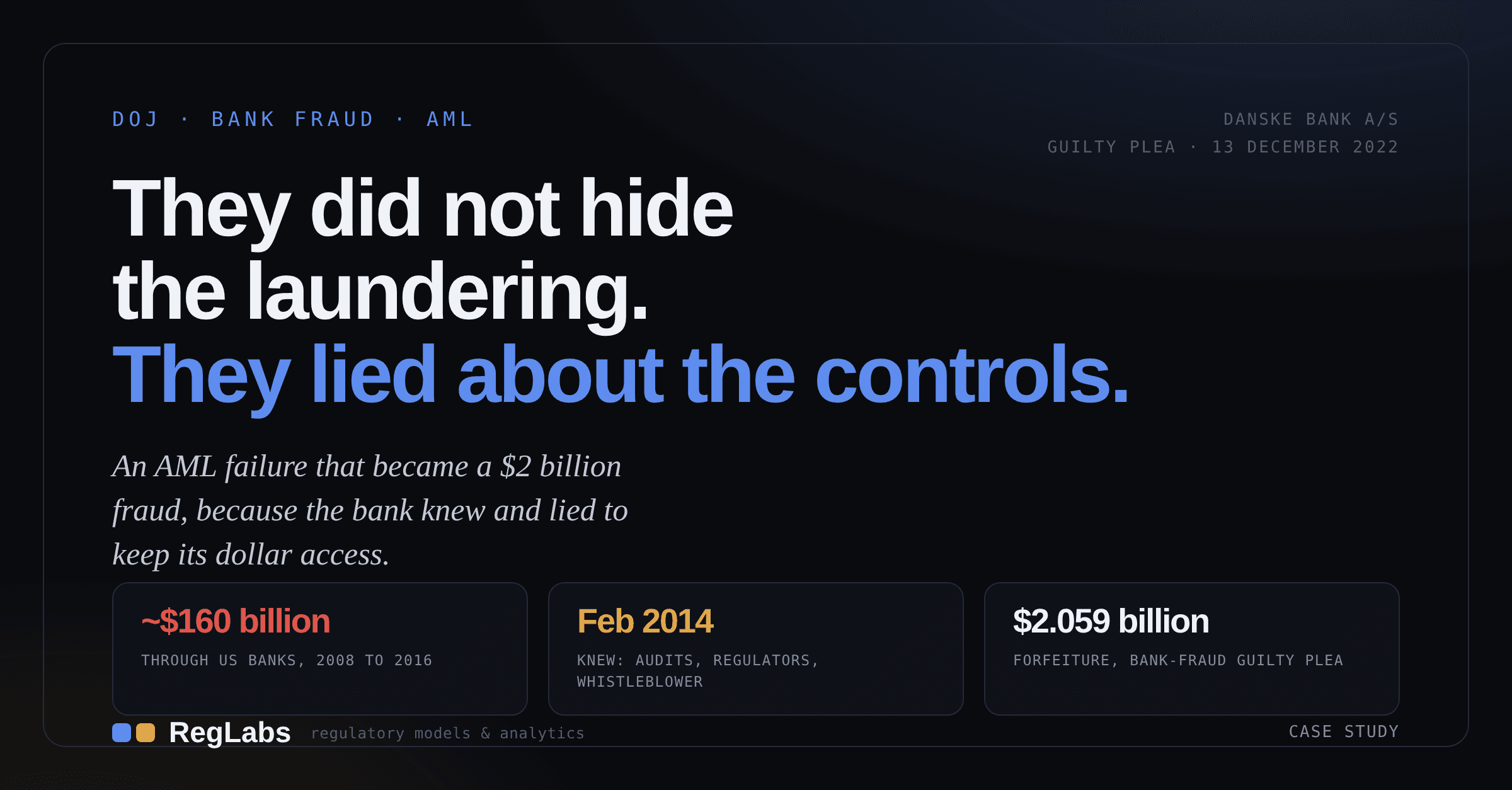
A $2 billion guilty plea for the lie, not just the laundering
On 13 December 2022, Danske Bank A/S, the largest bank in Denmark, pleaded guilty to one count of conspiracy to commit bank fraud and agreed to criminal forfeiture of $2.059 billion, resolving the US investigation into what the Department of Justice called a multi-billion-dollar scheme to gain access to the US financial system. A parallel SEC settlement added approximately $413 million, including a $178.6 million civil penalty, and the bank received credit for roughly $850 million in payments to resolve related proceedings by the SEC and Danish authorities. The underlying conduct ran through a single branch: Danske Bank Estonia, which between 2008 and 2016 served a book of high-risk non-resident customers, known as the NRP, and processed approximately $160 billion through US banks on their behalf.1
The crucial thing to understand about this case, and the reason it is a different lesson from the correspondent-banking failures it resembles, is what Danske actually pleaded guilty to. It did not plead guilty to failing to supervise, or to maintaining an inadequate AML program, which is how most money-laundering enforcement is framed. It pleaded guilty to bank fraud. The Department of Justice's theory was that Danske, knowing its Estonian branch had deficient AML controls, inadequate transaction monitoring, and a high-risk offshore customer base moving suspicious money, lied about all of it to the US banks whose correspondent accounts gave the branch access to the dollar system. The false representations to those US banks, made to obtain and keep access the branch could not have honestly earned, were the crime. The laundering was the context; the fraud was the deception that enabled it.
Where the crime actually sat
The US banks relied on Danske's representations about its controls. Danske lied to keep the access, and the lie was the federal crime.
Source: U.S. Department of Justice, Danske Bank Pleads Guilty to Fraud on U.S. Banks in Multi-Billion Dollar Scheme to Access the U.S. Financial System , 13 December 2022.
This study treats the Danske matter as the definitive case on the respondent side of correspondent banking, the obligations and the temptations of the bank that depends on another bank's access rather than the one that grants it. It walks the NRP business that was built to avoid scrutiny, the moment in early 2014 when the bank learned what it was really running, and the misrepresentations that kept the dollar access flowing for years afterward, and it lifts each into the discipline it violated: why a business model whose value proposition is the absence of controls is a crime in waiting; why the date a firm acquires knowledge is the date its failure becomes willful; why a firm's representations about its own controls are themselves a control surface that can be defrauded; why beneficial ownership is the single thing the whole system exists to establish; why transaction throughput wildly disproportionate to a business is itself the alarm; and why a group compliance standard that does not reach the periphery is not a standard at all. It closes on the duty that runs in both directions of every correspondent relationship, and on why the deception, not the deficiency, is what cost $2 billion.
The respondent side of the chain
Every correspondent-banking relationship has two sides, and most enforcement attention falls on the correspondent, the large bank that grants access and is faulted for failing to watch what passes through. The Danske case is about the other side: the respondent, the bank that needs the access. Danske Bank Estonia was a branch of a Danish bank operating in a small Baltic market, and to serve customers who wanted to move US dollars, it depended on correspondent accounts at US banks. Those accounts were the branch's gateway to the dollar system, and without them its most lucrative business, the non-resident portfolio, could not function. The respondent's entire ability to offer dollar services rests on the correspondent's willingness to carry it.1
That dependency creates a specific and powerful dynamic. The correspondent bank, before opening and maintaining an account for a foreign respondent, performs due diligence on it: it asks about the respondent's business, its customer base, its AML program, its transaction monitoring, and the risks of its market, and it decides whether to grant access based on the answers. The respondent, for its part, wants the access, and the quality of the answers it gives determines whether it gets and keeps it. The honest version of this relationship is a chain of verified trust: the correspondent relies on accurate representations from the respondent, tests them where it can, and monitors the flow, while the respondent tells the truth about what it is and what moves through it. The entire correspondent system, which is how dollars move across borders for most of the world, runs on the integrity of those representations, because the correspondent cannot directly see the respondent's underlying customers and must rely substantially on what the respondent tells it.
Danske Bank Estonia sat at exactly the pressure point this creates. Its most profitable business was precisely the kind a correspondent bank, told the truth, would have refused to carry or would have scrutinized intensely: high-risk non-resident customers, many from Russia and the former Soviet space, moving very large sums with minimal oversight. The branch needed the dollar access to run that business, and the truth about the business was the thing most likely to cost it the access. That is the structural setup for the fraud. A respondent whose real business would fail its correspondent's due diligence has two honest options, change the business or lose the access, and one dishonest one, lie. The case is the record of which option Danske took, and of why the correspondent system treats that lie not as a compliance lapse but as a fraud on the institutions that relied on it.
A business built on not looking
The non-resident portfolio was not a normal customer book that happened to develop AML problems; it was a business whose competitive advantage was the absence of scrutiny. According to the admissions, Danske Bank Estonia attracted its NRP customers by ensuring that they could transfer large amounts of money through the branch with little, if any, oversight. The lack of oversight was not a failing that crept in around the edges of the business; it was the feature the business was selling. Customers who wanted to move large sums without questions came to Danske Estonia because Danske Estonia did not ask them.1
This is a categorically different situation from a bank that has weak controls through neglect, under-investment, or incompetence. A bank with accidentally weak controls has a gap between what it intends and what it achieves, and remediation means closing that gap. A bank whose weak controls are its value proposition has no such gap: the controls are weak on purpose, because strengthening them would destroy the very thing the customers are paying for. The NRP customers were attracted by the minimal oversight, which means that effective oversight would have driven them away, which means the business had a direct, structural, financial interest in its controls not working. Every incentive inside that business line pointed toward keeping the monitoring weak, because the monitoring working as intended would have ended the business. The branch had, in effect, monetized its own control failure and turned it into a product.
The admissions sharpen the picture further: Danske Bank Estonia employees conspired with NRP customers to shield the true nature of their transactions, including by using shell companies that obscured actual ownership of the funds. This is the point at which a weak-controls business becomes an active-concealment business. The branch's staff were not merely failing to scrutinize; they were helping customers hide what the scrutiny would have found, participating in the construction of the shell-company structures whose purpose was to defeat any inquiry into beneficial ownership. A business model built on not looking had progressed to a business model built on helping customers ensure that if anyone did look, they would see nothing. The absence of controls was the offering, and the staff were actively protecting it.
When weak controls are the product, the business is the crime
The NRP crystallizes a discipline that separates ordinary compliance risk from criminal exposure: when a business line's profitability depends on the weakness of its controls, the firm does not have a control problem to be remediated, it has a business model that is a crime in waiting, and no amount of control enhancement can fix it, because the enhancement destroys the business. Danske Estonia's NRP was profitable because it did not look, and so the business and the control failure were the same thing.1
The reason this distinction matters is that it changes what the right response is, and firms consistently misdiagnose it. A business with accidentally weak controls can be fixed by investing in controls while keeping the business, because the business does not depend on the weakness. A business whose customers are there specifically because of the weak controls cannot be fixed that way, because fixing the controls removes the reason the customers came. When a firm finds a business line that is highly profitable, grows quickly, and attracts customers who value discretion and minimal questions, it is looking at a candidate for this category, and the correct question is not "how do we strengthen the controls" but "does this business survive effective controls at all." If the honest answer is no, the business is not a compliance challenge, it is a liability that will eventually become an enforcement action, because its economics are structurally opposed to the controls that law and prudence require. The only real remedies are to impose the controls and accept that the business will shrink or disappear, or to exit the business, and a firm that does neither, that keeps the profitable business and the weak controls because they are the same thing, has chosen to run a crime for as long as it is not caught.
Test every profitable business against the controls it can survive
The discipline is to subject every business line, especially the most profitable and fastest-growing, to an honest test of whether it can survive effective controls, and to treat a business whose economics depend on weak oversight as an exit decision rather than a remediation project. Concretely, a firm should be able to ask of any line: if we applied full, effective AML controls, rigorous KYC, real transaction monitoring, genuine beneficial-ownership verification, would this business still be here, and would these customers still want it. Where the answer is that the business would collapse under proper controls, the firm has identified a line it cannot compliantly run, and the only safe decisions are to impose the controls regardless of the revenue loss or to close the line. The dangerous path, the one Danske took, is to recognize the tension and resolve it in favor of the revenue, keeping the business and quietly keeping the controls weak enough to sustain it. That is not a control deficiency to be remediated; it is a decision to profit from the deficiency, and it is the decision that turns a bank into a defendant. A business that cannot survive its own controls is not an opportunity with a compliance cost, it is a crime with a revenue line.
What the bank knew, and when
The single most consequential fact in the case is a date, because it marks the moment the bank's conduct crossed from negligence into something the law treats far more harshly. By at least February 2014, as a result of internal audits, information from regulators, and an internal whistleblower, Danske Bank knew that some NRP customers were engaged in highly suspicious and potentially criminal transactions, including transactions through US banks. The bank also knew, by that point, that Danske Bank Estonia's anti-money-laundering program and procedures did not meet Danske Bank's own standards and were not appropriate to meet the risks associated with the NRP. The knowledge did not arrive from a single source that might have been doubted; it arrived from three independent directions at once.1
Three independent sources, one conclusion, by February 2014
- Danske's own audits identified that the Estonia program did not meet the group's standards or the NRP's risks.
- Information from regulators flagged the suspicious nature of the non-resident activity.
- An internal whistleblower reported that NRP customers were engaged in highly suspicious, potentially criminal transactions.
The knowledge was not ambiguous or singular. By February 2014 the bank had been told, three ways, what it was running.
Source: U.S. Department of Justice, Danske Bank Pleads Guilty to Fraud on U.S. Banks in Multi-Billion Dollar Scheme to Access the U.S. Financial System , 13 December 2022.
The convergence of the three sources is what removes any possibility that the knowledge was uncertain or deniable. An internal audit finding alone might be argued over internally, dismissed as too conservative, or buried in a remediation plan. A regulator's concern alone might be characterized as a difference of supervisory opinion. A whistleblower alone might be doubted or marginalized. But when internal audit, external regulators, and an internal whistleblower all independently reach the same conclusion, that the NRP customers include parties doing highly suspicious and potentially criminal things and that the branch's controls are not adequate to the risk, the bank cannot credibly claim it did not know. The DOJ's careful phrasing, "knew, as a result of internal audits, information from regulators, and an internal whistleblower," is a recitation of three independent knowledge sources precisely because their convergence establishes the knowledge beyond argument. After February 2014, nothing that happened was something the bank stumbled into unaware.
The date you knew is the date it turned
The February 2014 date generalizes into one of the most important disciplines in all of compliance and one that firms systematically underestimate: the moment a firm acquires knowledge of a problem is the moment its legal and moral position changes fundamentally, because everything it does after that date is done knowingly, and knowing conduct is what converts a regulatory failure into fraud, willfulness, and criminal liability. Before February 2014, Danske's position was that of a bank with bad controls. After February 2014, every day it continued was a day it continued knowing, and the law treats those two states as different in kind, not degree.1
The reason knowledge is such a sharp dividing line is that intent is the hinge on which the severity of almost every financial-crime provision turns. A bank that has weak controls and does not realize the harm they are causing is exposed to supervisory action and civil penalty. A bank that knows its controls are failing, knows the specific harm, knows that customers are doing criminal things through its systems, and continues anyway, has supplied the element, knowledge, that prosecutors need to charge willful conduct and fraud. This is why the acquisition of knowledge is the most dangerous event in the life of a compliance problem, and why how a firm responds to the first credible warning matters more than almost anything else it does. The warning does not create the problem; the problem already existed. What the warning creates is knowledge, and knowledge creates the obligation to act and the liability for not acting. A firm that receives a credible internal-audit finding, a regulator's concern, or a whistleblower's report and does not immediately and genuinely act on it has not merely failed to fix a problem, it has started the clock on knowing conduct, and every day after is evidence.
Treat the first credible warning as the decisive event
The discipline is that a firm must treat the arrival of credible knowledge, from audit, from a regulator, from a whistleblower, from its own monitoring, as the single most important moment in the handling of any risk, triggering immediate, documented, genuine action rather than management, minimization, or delay, because the firm's conduct after it knows is the conduct on which its liability will turn. This means a firm needs a process that cannot let a credible warning be absorbed and dissipated: warnings from audit, supervision, and whistleblowers must be escalated to a level with the authority to stop the business, assessed honestly rather than defensively, and answered with action whose adequacy is documented. It also means recognizing the specific danger of the convergent warning, when more than one independent source raises the same concern, as Danske had from three, the time for internal debate is over, because convergent independent warnings are as close to certain knowledge as a firm ever gets. The firms that survive these moments are the ones that treat the first credible warning as a reason to stop and fix, even at the cost of a profitable business, and the firms that become defendants are the ones that treat it as a problem to be managed while the business continues. Danske knew by February 2014, and what it did with that knowledge, over the following years, is the subject of the rest of this case.
The lie that kept the dollars
Having learned by February 2014 what its Estonian branch was, Danske faced the choice that the respondent's position forces: tell the US correspondent banks the truth and lose the dollar access the NRP depended on, or lie and keep it. It lied. Instead of providing the US banks with truthful information, the admissions state, Danske lied about the state of Danske Bank Estonia's AML compliance program, its transaction monitoring capabilities, and information regarding the branch's customers and their risk profile. The purpose of the lies was to maintain and obtain the US dollar accounts and the access to the US financial system that the business required.1
What Danske told the US banks, against what it knew
- An adequate AML compliance program
- Effective transaction monitoring
- A customer base and risk profile fit for dollar access
- A program that did not meet its own standards or the NRP's risks
- Inadequate transaction monitoring capabilities
- High-risk offshore customers, including in Russia, moving suspicious funds through shells
Each representation was false, and the US banks relied on it to grant access. That reliance on a known falsehood is the fraud.
Source: U.S. Department of Justice, Danske Bank Pleads Guilty to Fraud on U.S. Banks in Multi-Billion Dollar Scheme to Access the U.S. Financial System , 13 December 2022.
This is the hinge of the entire case, and it is worth being precise about why the lie, rather than the laundering, is what the Department of Justice charged. The US correspondent banks were not reckless; they performed the due diligence their own obligations required, asking Danske about its AML program, its monitoring, and its customers. The system worked as designed up to the point where it depended on Danske's honesty. Danske's representations were the inputs the US banks used to decide whether to grant and keep the access, and those representations were false, known by Danske to be false, and made for the purpose of obtaining a benefit, continued access to the dollar system, that truthful representations would have denied. That is the anatomy of fraud: a knowing material misrepresentation, made to induce reliance, that in fact induces the victim to part with something of value. The US banks, relying on Danske's lies, extended access they would have refused had they known the truth, and the branch used that access to move $160 billion. The laundering was the harm; the fraud was the mechanism, and the mechanism is what the plea was built on.
The elegance of the prosecution theory, from a compliance standpoint, is that it does not require the government to prove the details of the underlying money laundering transaction by transaction. It requires proof that Danske made false statements to US financial institutions to obtain access. The fraud is complete at the misrepresentation, regardless of how the subsequent flows are characterized, which is why a bank that might have contested the finer points of AML adequacy had no viable defense once the false representations to the correspondents were established. Danske did not plead guilty to running a bad AML program; it pleaded guilty to lying about it to the banks that relied on the truth.
Your controls are a thing you represent, and the representation is a control
The Danske fraud exposes a discipline that most firms never consciously consider: a firm's statements about its own controls, to correspondents, to counterparties, to regulators, to auditors, to the market, are themselves a control surface, one that can be true or false, relied upon or not, and defrauded, and a firm that misrepresents its controls has not merely failed at compliance, it has turned its compliance posture into an instrument of fraud. Danske's representations to the US banks about its AML program were not incidental paperwork; they were the load-bearing inputs on which the correspondents' access decisions rested, and falsifying them was the crime.1
This reframes how a firm should think about every attestation it makes about its own controls. When a bank tells a correspondent that it has an adequate AML program, it is not describing an internal matter; it is making a representation that a counterparty will rely on to extend something of value, and the representation carries the same obligation of truth as any other material statement in a commercial relationship. The same is true of a firm's certifications to regulators, its representations to auditors, its disclosures to the market about its control environment, and its attestations in contracts and questionnaires. Each is a statement about the firm's controls that someone relies on, and each can be false. The modern compliance environment runs substantially on these representations, because no counterparty, regulator, or auditor can directly inspect another firm's controls in full; they must rely on what the firm says about them. That reliance is exactly what makes a false representation about controls so damaging and so dangerous: it defeats the mechanism by which the entire system substitutes verified trust for direct inspection, and it does so at the precise point the system is most vulnerable, the firm's own account of itself.
Make every representation about your controls one you could prove
The discipline is that a firm must treat every representation it makes about its own controls, to correspondents, counterparties, regulators, auditors, and the market, as a material statement that must be true and provable at the moment it is made, and it must have the governance to ensure no one in the firm represents a control posture the firm does not actually have. This requires knowing, accurately and currently, what the firm's controls actually are, because a firm cannot make true representations about controls it has not honestly assessed, and it requires a process ensuring that the people who answer correspondent due-diligence questionnaires, sign regulatory certifications, and respond to auditors are stating the real posture rather than an aspirational or convenient one. The test is whether, for every representation the firm has made about its controls, it could produce the evidence that the representation was true when made, and a firm that is representing an adequate program while its own audits say the program is inadequate, exactly Danske's position after February 2014, is committing the fraud whether or not it thinks of it that way. The representation is a control, and like any control it can be the thing that fails, except that when this control fails by being false, the failure is not a deficiency, it is a deception, and the law treats deception far more severely than deficiency.
The shells and the owners they hid
At the operational heart of the laundering was the oldest tool in the launderer's kit, the shell company, and the aggravating detail is that the branch's own employees helped build the structures. Danske Bank Estonia employees conspired with NRP customers to shield the true nature of their transactions, including by using shell companies that obscured actual ownership of the funds. The shells were not something the customers brought and the bank failed to see through; they were part of a concealment the bank's staff participated in, structures whose entire function was to stand between the money and the people who actually owned it.1
The purpose of a shell company in a laundering scheme is singular and worth stating plainly: it breaks the link between a transaction and its true beneficial owner. A shell has no real business, no genuine operations, no economic substance; it exists to hold an account and move money so that the name on the transaction is the shell's name rather than the name of the person or criminal enterprise that actually controls the funds. When a bank's customer uses a shell, the bank's defense is beneficial-ownership due diligence, the obligation to look through the shell and identify the natural persons who own and control it. That obligation is the specific countermeasure to the specific tool. Danske Estonia did not merely fail to perform it; its employees helped the customers use the shells to defeat it, which means the one control designed to pierce the concealment was actively subverted by the people operating it. A shell company defeats a bank that does not look through it; it requires the bank's complicity to defeat a bank whose staff are building the shells with the customer.
The involvement of employees is what elevates this from a due-diligence failure to a conspiracy, and it is the detail that most clearly marks the branch as having crossed from weak compliance into criminal participation. A bank that fails to identify beneficial owners through negligence has a control failure. A bank whose employees conspire with customers to construct ownership-obscuring structures has insiders working against the control from within, which no amount of control design can withstand, because the control depends on the honesty of the people operating it. The shell companies obscured the actual ownership of the funds, and they did so with the help of the very staff whose job was to establish that ownership, which is the point at which the bank's control function had not just failed but switched sides.
Beneficial ownership is the whole game
The shell companies crystallize a discipline that sits at the foundation of all anti-money-laundering work: establishing the true beneficial owner of funds and accounts is not one AML control among many, it is the control the entire edifice exists to achieve, because almost every other control is ultimately in service of answering the single question of who really owns and controls this money. Danske's shells existed to defeat that one question, and the branch's staff helped, which is why the ownership failure is the deepest failure in the case.1
The reason beneficial ownership is foundational is that money laundering, at its core, is the act of disguising who owns criminal proceeds, and every laundering technique, the shell company, the nominee, the layered structure, the mirror trade, is a method of separating money from its true owner's name. An AML program that can reliably establish beneficial ownership can see through those techniques; a program that cannot is blind to all of them at once, because they all work by exploiting the same gap. This is why beneficial-ownership requirements, customer due diligence, the identification of ultimate beneficial owners, the obligation to look through legal structures to natural persons, sit at the center of every AML regime: they are the direct answer to the central laundering method. A firm that is lax about beneficial ownership has not weakened one control, it has weakened the one that most of the others depend on, because knowing who owns the money is the prerequisite for assessing whether a transaction makes sense, whether a customer's activity matches their profile, and whether a flow is suspicious. Lose the owner and you lose the basis for every judgment downstream.
Build everything on a verified owner, and guard that control hardest
The discipline is to treat beneficial-ownership identification as the foundational control of the AML program, verified rather than accepted, resistant to the shell and nominee structures designed to defeat it, and protected with particular rigor against insider subversion, because it is the control a complicit employee is most able and most tempted to corrupt. Concretely, a firm must look through legal entities to the natural persons who own and control them, verify that ownership rather than taking the customer's word, treat opacity and unnecessary structural complexity as risk indicators rather than neutral facts, and recognize a shell with no economic substance as what it is, a device whose purpose is concealment. And because the Danske case shows that the gravest ownership failures involve insiders, the firm must build the control so that no single employee or relationship can waive, bypass, or fabricate the ownership determination, with independent verification and oversight precisely because the people closest to a profitable customer are the ones most tempted to help them hide. A firm that establishes true beneficial ownership can catch most laundering; a firm that cannot, whether through negligence or because its own staff are building the shells, is defenseless against all of it, because every laundering scheme is, in the end, a scheme to hide an owner, and that is the one thing the firm most needs to see.
A hundred and sixty billion through a branch
The number that defines the case is almost impossible to reconcile with the size of the operation that produced it: approximately $160 billion processed through US banks, on behalf of non-resident customers, by a single branch in Estonia. Danske Bank Estonia was not one of the great financial centers of the world; it was a branch of a Danish bank in a small Baltic economy. That a flow of that magnitude passed through it on behalf of foreign customers, over the 2008 to 2016 period, is itself the loudest possible signal that something was wrong, because the volume was wildly out of proportion to anything the branch's legitimate market could explain.1
The flow, against the operation that carried it
Non-resident customers, many from Russia, moving ~$160 billion through one Estonian branch, 2008 to 2016.
Source: U.S. Department of Justice, Danske Bank Pleads Guilty to Fraud on U.S. Banks in Multi-Billion Dollar Scheme to Access the U.S. Financial System , 13 December 2022.
The disproportion is the kind of signal that requires no sophisticated analytics to detect, only the willingness to ask an obvious question: why is this much money moving through here. A branch of this size, in this market, serving this many non-resident customers, generating this volume of dollar flow, is an anomaly on its face, and the anomaly was not hidden in some granular pattern that only advanced monitoring could surface. It was visible in the aggregate, in the simple fact that the throughput dwarfed anything the branch's legitimate local business could produce. The $160 billion was not assembled from countless tiny transactions that individually looked normal and only summed to something strange; it was a sustained, enormous flow of non-resident money through an operation with no legitimate reason to carry it, and the size alone was a standing question the bank chose not to answer honestly.
This is why scale, treated as a monitoring input in its own right, is one of the most powerful and most neglected signals in financial crime. The sophisticated typologies, the structuring, the layering, the mirror trades, are designed to evade detection at the level of individual transactions, but they cannot disguise the aggregate, and a flow grossly disproportionate to the business that carries it is an alarm that no amount of transaction-level cleverness can silence. Danske Estonia's $160 billion was that alarm, ringing continuously for years, and the case is in part the story of an institution that heard it and chose to keep the business rather than answer the question the number was asking.
Throughput disproportionate to the business is the alarm
The $160 billion generalizes into a discipline that is simple, powerful, and routinely ignored because it is too obvious to feel like analysis: transaction volume grossly disproportionate to the legitimate business that produces it is, by itself, a primary money-laundering indicator, and a firm that does not monitor aggregate throughput against the expected scale of its business is missing the loudest signal it will ever receive. Danske Estonia's flow was out of all proportion to a small Baltic branch, and that disproportion was visible without any transaction-level investigation at all.1
The reason this signal is so reliable is rooted in what money laundering actually is. Laundering moves criminal proceeds, and criminal proceeds, in aggregate, are large and have to go somewhere, which means that a laundering operation shows up as volume that the legitimate economy around it cannot explain. The individual transactions can be disguised, structured to avoid thresholds, layered through shells, dressed as trades, but the total has to flow, and the total is the one thing the launderer cannot shrink without defeating the purpose. A small branch moving sums that would befit a major international clearing center is displaying, in the plainest possible form, that money is passing through it for reasons unrelated to its ostensible business. The signal is neglected precisely because it is aggregate rather than granular: compliance attention and monitoring investment flow toward sophisticated transaction-level analytics, and the simple question of whether the total makes sense can fall into the gap between systems, owned by no scenario and examined by no one, even as it carries more information than any individual alert.
Monitor the aggregate against the expected, not just the transaction against the rule
The discipline is to monitor aggregate activity, by customer, by product, by branch, by corridor, against a clear expectation of what the legitimate business should generate, and to treat gross disproportion between actual and expected volume as a primary alarm requiring explanation, independent of any transaction-level alert. This means a firm needs, for each part of its business, an articulated expectation of normal scale, and a control that compares actual throughput against it and escalates material divergences, so that a branch moving orders of magnitude more than its market could justify triggers an inquiry on the strength of the aggregate alone. The specific test the Danske case suggests is to ask, for every unit of the firm, whether its transaction volume is proportionate to its legitimate business, and to treat a large and sustained disproportion, a small operation with enormous flow, a customer whose activity dwarfs their stated business, as a finding that demands a documented explanation rather than a curiosity to be left unexamined. The $160 billion through an Estonian branch was an answer to a question no one with authority was willing to ask, and the discipline is simply to ask it, systematically, of the aggregate, because the total throughput, measured against what the business should produce, is often the truest signal a firm will ever have and the one its granular systems are least likely to surface.
The standard that did not reach the branch
One phrase in the admissions carries a structural lesson that reaches far beyond Danske: the Estonian branch's anti-money-laundering program and procedures did not meet Danske Bank's own standards. The group had standards. The branch did not meet them. The failure was not that the institution lacked a conception of adequate AML controls; it was that the conception existed at the center and did not reach, or was not enforced at, the periphery, in the branch where the highest-risk business was actually being conducted. The group standard and the branch reality had come apart, and the gap between them was where $160 billion flowed.1
This is a characteristic failure of large, geographically dispersed institutions, and it is dangerous precisely because it is invisible from the center if the center is not looking in the right place. Headquarters can point to a robust group AML policy, a well-resourced central compliance function, and a set of standards that would, if applied, be adequate, and all of that can be genuinely true while a branch at the edge of the organization operates nothing like it. The distance, organizational, geographic, linguistic, cultural, between the group center and a foreign branch creates room for the branch's actual practice to diverge from the group standard, and that divergence is most likely exactly where it is most dangerous: in a branch running a high-risk, high-profit business that has every local incentive to keep its controls weak. Danske's center had standards the Estonian branch did not meet, and the NRP was precisely the kind of lucrative local business whose managers would resist the application of the group standard that threatened it. The periphery is where the group's stated standards are tested against local incentives, and at Danske Estonia the local incentives won.
The detail that the branch did not meet the group's own standards is also what makes the center's culpability unavoidable. This was not a case where the institution had no standard and could claim it did not know what good looked like. The standard existed; the group had defined adequate AML controls; and the branch's failure to meet that defined standard was knowable by reference to the group's own criteria. When a firm's own standard is not met at one of its locations, the firm cannot claim ignorance of the gap, because it has the measuring stick in hand. The question is whether the center was measuring, and the Danske case, with its $160 billion flowing through a branch that did not meet the group's own standards for years, is the record of a center whose standards did not reach, or were not enforced at, the place they most needed to.
A group standard is only real where it reaches the edge
The gap between Danske's group standard and its Estonian branch crystallizes a discipline that every multi-entity, multi-jurisdiction institution must internalize: a compliance standard that exists at the center but is not enforced and verified at every branch, subsidiary, and affiliate is not a standard, it is an aspiration, and the places where it is least likely to be met are the high-risk, high-profit peripheries where it matters most. Danske had the standard; the branch did not meet it; and the group is where the responsibility finally landed.1
The reason the periphery is the point of greatest risk is a convergence of two forces. First, the center's visibility is weakest at the edge: a foreign branch is harder to see into, its practices are mediated by distance and local management, and its divergence from group standards can persist unnoticed by a center that assumes its policies are being followed. Second, the edge is where the incentive to diverge is strongest, because the high-risk, high-margin businesses that group standards most constrain are often precisely the ones that local units are most motivated to protect, and a branch with a lucrative book built on weak controls has every reason to let the group standard remain a document rather than a practice. Those two forces compound: the place the center can see least is the place that wants most to diverge, which is why the gap between stated and actual compliance is widest exactly where it is most dangerous. A group that measures its compliance by the quality of its central policies rather than by their enforcement at the edge is measuring the wrong thing, because the policy is not the control, the control is the policy actually operating at every point where the firm does business.
Verify the standard at the edge, hardest where profit resists it
The discipline is that a group must actively verify, not assume, that its compliance standards are met at every branch, subsidiary, and affiliate, with the most intensive scrutiny directed at the high-risk, high-profit peripheries where the incentive to diverge is strongest and the center's visibility is weakest. This means treating the group standard as a claim to be tested at each location rather than a policy to be promulgated from the center, with independent verification that reaches the edge, that is not satisfied by local attestations from the units with the most to hide, and that concentrates on the places where profitability and risk are highest. The test is whether the group can demonstrate, for each of its units, that the group standard is actually operating there, verified independently of the unit's own account of itself, and a group that can show only that it has a good central policy has not met the standard, it has only written it. Danske's center had the standard and the Estonian branch did not meet it, and the lesson the guilty plea enforces is that the center owns the gap: a standard that does not reach the edge is the center's failure, because the center is responsible for ensuring that what it requires is what actually happens everywhere it operates, most of all at the profitable, high-risk edge where the temptation to let the standard lapse is greatest.
Knowing, and continuing
The element that transforms the case from a serious failure into a criminal one is the combination of the knowledge and what followed it: Danske knew by at least February 2014, and the conduct continued, with the branch's business and the misrepresentations to US banks persisting rather than stopping. The bank did not learn of the problem and immediately halt the business, sever the correspondent relationships it could not honestly maintain, and report. It learned, and the scheme went on, which means that for the period after February 2014 the bank was not failing to prevent something it did not understand, it was continuing something it did.1
The arc the plea was built on
Before February 2014, a failure. After it, a knowing continuation, which is the conduct that became a crime.
Source: U.S. Department of Justice, Danske Bank Pleads Guilty to Fraud on U.S. Banks in Multi-Billion Dollar Scheme to Access the U.S. Financial System , 13 December 2022.
The discipline here closes the loop opened by the knowledge discipline, and it is the one that most directly determines whether a firm's mistakes become its indictment: the obligation that attaches to knowledge is to stop, and a firm that knows and continues has made the single worst choice available to it, converting a problem it inherited into a crime it committed. When a firm acquires credible knowledge that it is facilitating criminal activity and that its controls are inadequate, the lawful and the only safe response is to halt the conduct, which at Danske would have meant confronting the NRP business directly and accepting its loss. Continuing, especially while misrepresenting the situation to the counterparties relying on the truth, is not a slower remediation, it is a decision to keep committing the offense, and it is the decision that the law punishes most severely because it is the one most clearly within the firm's control. Every day the scheme continued after February 2014 was a day the bank chose it, and the $2 billion forfeiture and the criminal plea are the price of those days, the days after it knew.
Why it was fraud, not a fine
The resolution is as instructive as the conduct, because it shows what separates the cases that end in civil penalties from the ones that end in guilty pleas. Danske pleaded guilty to conspiracy to commit bank fraud and agreed to criminal forfeiture of $2.059 billion, with a parallel SEC settlement of approximately $413 million including a $178.6 million civil penalty, and credit for roughly $850 million in payments to the SEC and Danish authorities. The Department of Justice framed it bluntly: the bank deliberately disregarded US law of which it was well aware, facilitated the laundering of criminal and suspicious proceeds through the United States, and placed the US financial network at risk, all in the name of its bottom line.1
The shape of the resolution reflects the nature of the conduct. A bank that had merely maintained a weak AML program, even a seriously deficient one, would likely have faced a large civil penalty, perhaps a deferred-prosecution agreement, and a remediation mandate, the standard architecture of AML enforcement. Danske got a criminal conviction, a guilty plea to a felony fraud charge, because its conduct contained the three elements that escalate a compliance failure into a crime: knowledge, which it had by February 2014 from three independent sources; deception, the false representations to the US banks; and continuation, the persistence of the scheme after the bank knew. Those three together, knowing, lying, and continuing, are the signature of fraud rather than failure, and they are what moved the matter from the civil-penalty track to the criminal one. The deliberate disregard the DOJ described is the mental state of an institution that understood exactly what it was doing and did it for the revenue, which is the state the criminal law exists to punish.
The lesson for any institution is in that escalation. The difference between a civil penalty and a criminal conviction is rarely the severity of the underlying control weakness; it is the presence or absence of knowledge, deception, and continuation. A firm that discovers a problem, tells the truth about it, and stops, even a serious problem, is on the civil track. A firm that knows, lies to the parties relying on it, and continues, has assembled the elements of a crime regardless of how its controls looked on paper. Danske's $2 billion forfeiture was not the price of a bad AML program; plenty of banks have had bad AML programs and paid civil penalties. It was the price of knowing, lying, and continuing, the three choices that no control framework makes for a firm and that a firm's leadership makes for itself.
The broader lesson: the respondent's duty, and the honesty the system runs on
The enduring lesson of the Danske case is that the correspondent-banking system, and much of modern compliance, runs on representations that must be true, and that the bank which lies about its controls to keep access it could not honestly earn commits not a compliance failure but a fraud on everyone who relied on it. Danske was the respondent, the bank that needed access, and it discharged the respondent's duty by deceiving the correspondents who granted it, which is the precise inversion of the honesty the system requires.1
The disciplines this study has drawn out compose a coherent account of what that duty demands. Test every profitable business against the controls it can survive, because a business whose economics depend on weak oversight, like the NRP, is a crime with a revenue line rather than a remediation project. Treat the first credible warning as the decisive event, because the date a firm knows is the date its failure can become fraud, and Danske knew from three sources at once. Make every representation about your controls one you could prove, because a firm's account of its own controls is a control surface that can be defrauded, and the false account is the crime. Build everything on verified beneficial ownership and guard that control against insiders, because ownership is the one question laundering exists to obscure and the one the branch's own staff helped hide. Monitor aggregate throughput against the expected scale of the business, because a flow disproportionate to its operation, $160 billion through a Baltic branch, is the loudest alarm a firm will ever receive. Verify the group standard at the edge, hardest where profit resists it, because the standard that does not reach the high-risk periphery is only an aspiration. And above all, when you know, stop, because knowing and continuing is the choice that turns a problem into a plea.
The forward view: more respondents, more representations, more reliance
The reason the case grows more relevant is that the web of representations the financial system relies on is expanding, not contracting. As access to the dollar system is intermediated through more respondents, more fintechs, more payment platforms, and more banks in more jurisdictions, the volume of control representations that counterparties must rely on without direct inspection grows, and so does the system's exposure to false ones. Every new respondent relationship, every new platform granted indirect access, rests on representations about controls that the granting institution largely cannot verify firsthand and must substantially take on trust. The Danske case is the warning about what that trust is worth when a respondent chooses revenue over honesty, and the forward-looking response runs in both directions of every relationship. Correspondents and access-granting institutions must move from relying on representations to testing them, treating a respondent's account of its controls as a claim to be independently verified rather than a questionnaire to be filed, because the Danske correspondents did their due diligence and were defeated by lies. And respondents must recognize that their representations about their controls are the most consequential statements they make, truthful ones the foundation of their access and false ones the foundation of a fraud case. The system substitutes verified trust for direct inspection because direct inspection does not scale, and that substitution works only if the representations are true. Danske proved what happens when they are not, and the price, $2 billion and a felony conviction, is the measure of how much the honesty the system runs on is actually worth.
What this case is really about
An AML failure that became a fraud, because the bank knew, lied, and continued
Danske Bank Estonia ran a non-resident business whose value proposition was minimal oversight, and pushed roughly $160 billion of mostly Russian money through US banks. By February 2014 the bank knew, from audits, regulators, and a whistleblower, that the customers were highly suspicious and the controls inadequate. Rather than stop, it lied to the US correspondent banks about its AML program, its monitoring, and its customers, to keep the dollar access the business depended on. That deception, not the laundering alone, is why Danske pleaded guilty to bank fraud and forfeited $2.059 billion, with ~$413 million more to the SEC.
Where it broke
- A business line, the NRP, built to attract customers precisely by offering minimal oversight
- Known by February 2014 from three independent sources to be highly suspicious, with inadequate controls
- False representations to US correspondent banks about the AML program, monitoring, and customer risk, to keep dollar access
- Employees conspiring with customers to use shell companies that obscured beneficial ownership
- ~$160 billion in throughput grossly disproportionate to a small Baltic branch, unexamined
- A group AML standard the branch did not meet, and continuation of the scheme after the bank knew
What the respondent's duty requires
- Every business tested against the controls it can survive; exit the ones that cannot
- The first credible warning treated as the decisive event, triggering a stop, not management
- Every representation about controls, to correspondents and regulators, true and provable when made
- Beneficial ownership verified and the control protected against insider subversion
- Aggregate throughput monitored against the expected scale of the business as a primary alarm
- The group standard verified at every branch, hardest at the high-risk, high-profit edge
AML Governance Analyst
Reviews the AML programme end to end against global enforcement and the typologies each control must catch: the risk of each business line and whether it can survive effective controls, the customer risk-rating and due-diligence standards, beneficial-ownership verification and its resistance to shell and nominee structures, transaction-monitoring coverage including aggregate throughput against expected scale, the handling and escalation of audit, regulatory, and whistleblower warnings, and the enforcement of the group standard at every branch and subsidiary. A business built on weak oversight, an unexamined throughput anomaly, an ownership control a relationship manager can bypass, or a branch operating below the group standard is surfaced as a program-design finding, with a remediation target and a health score, so the gap is closed before it becomes the thing a firm has to misrepresent.Five ways RegLabs keeps a control posture you never have to lie about
This case study is an independent analysis prepared by RegLabs for educational and informational purposes, based on the U.S. Department of Justice's public announcement of Danske Bank A/S's guilty plea and resolution (13 December 2022). It is not legal advice and does not reproduce the court documents in full. All figures and quotations are drawn from the public record; any characterizations are those of RegLabs. Company and regulator names are used for identification and commentary only.