
- Enforcement
- Governance & Accountability
- Markets & Trading
One minute late
Macquarie could pay, did pay, and lost nothing. ASX still fined it, because a one-minute miss and a 24-minute miss three days apart exposed a critical payment desk watched by one person, with no cover and no fix in between.
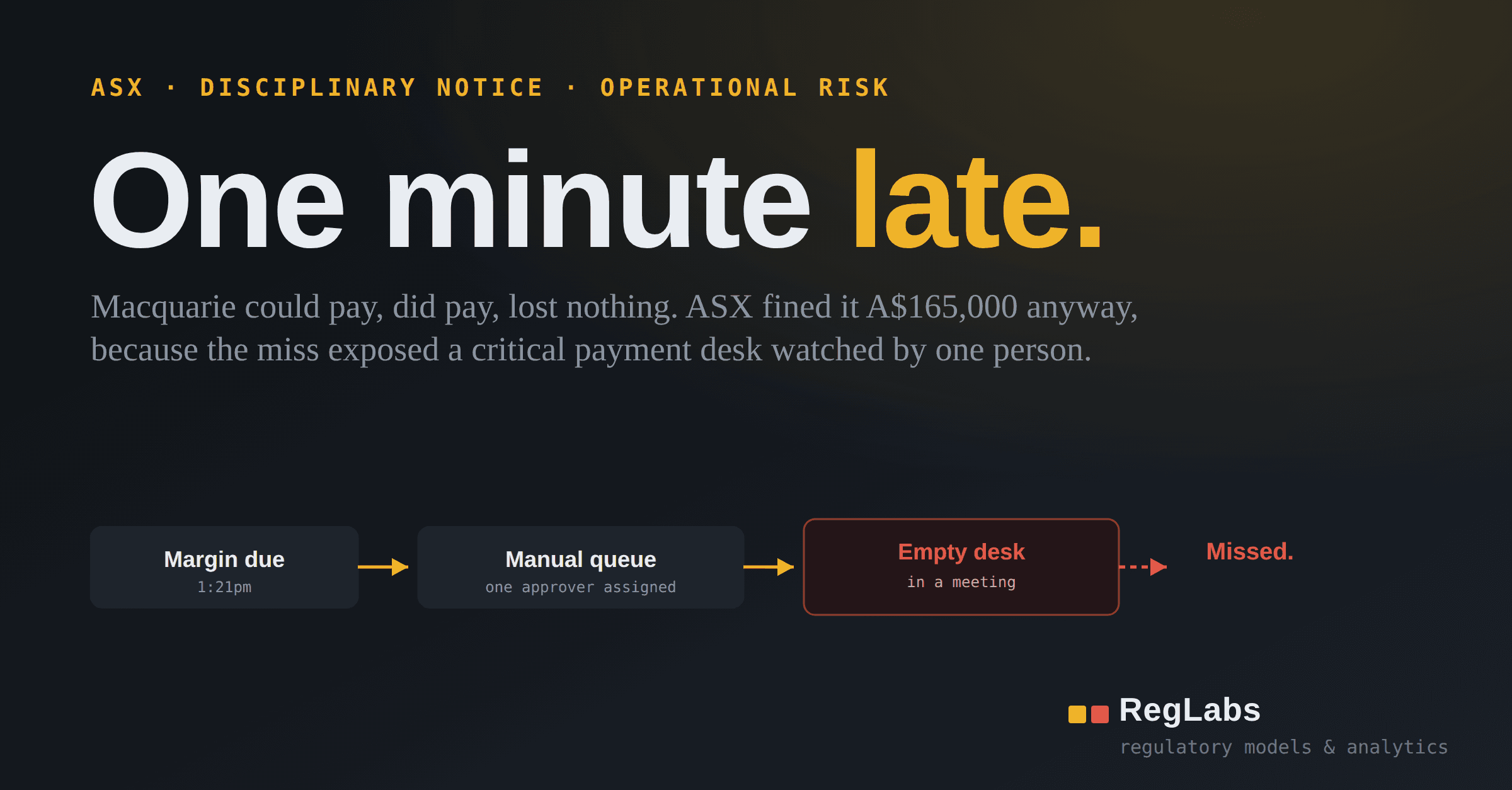
Event 1: the manual payment bottleneck
EVENT 1 · 11 NOVEMBER 2025: Margin call due, 1:21pm deadline → Manual release queue, NZD limit set to zero → One primary approver in a meeting → Deadline missed, settled 1:22pm. Four officers could release it. One was assigned to watch. That one was in a meeting, and nothing escalated until another team chased it.
Illustrative of the ASX findings for Event 1. Because Macquarie had set the NZD payment limit to zero as a funding control, the payment required manual release, which was ordinarily left to one primary team member. Three days later a second payment missed its deadline for want of approver coverage. Diagram, not actual data.
Source: ASX disciplinary notice, Macquarie Bank Limited, 13 October 2026; RegLabs case record.
A fine that was never about the money
On 13 October 2026, ASX disciplined Macquarie Bank Limited for two late margin payments and imposed a fine of A$165,000 plus GST. The numbers that usually anchor an enforcement story are, here, almost beside the point. The first payment, an intraday margin call of NZD $1,213,498, was one minute late. The second, a cash market margin of AUD $5,763,304.12, was twenty-four minutes late. Macquarie was able to fund both, gained no advantage, and caused no loss. By the standards of the cases that make headlines, nothing happened.
ASX fined it anyway, and the reasons are the whole point of the case. Timely margin settlement is not an administrative courtesy; it is one of the mechanisms that keeps a clearing house, and the market behind it, safe. A clearing participant that does not pay on time, even when it has the money, is a participant whose operational arrangements cannot be relied on under pressure, and in the machinery of a central counterparty a missed payment deadline can in principle be an event of default. So ASX does not grade these failures by the dollar shortfall, because there was none. It grades them by what they reveal about the control environment, and what this one revealed was a time-critical process that depended on a single person who was not there.
That is why this small case is worth more attention than its penalty suggests. It is a clean study in operational risk: not a sophisticated fraud or a billion-dollar monitoring gap, but the ordinary, unglamorous question of whether a bank has resourced, supervised and made resilient the processes it cannot afford to get wrong. Macquarie could pay. What it could not do, on two days in one week, was get the payment out the door on time, and ASX treated the reason for that as the real finding.
Two deadlines, three days apart
Both failures came out of the same function, the Funding Operations Team inside Macquarie's Market Operations Division, and both were failures to get a payment reviewed, authorised and released to ASX in time. The first, on 11 November 2025, had a specific trigger. Macquarie had set its NZD payment limit to zero as a deliberate funding control, which meant any NZD payment dropped into an internal queue and required manual review and release before it could go out. Responsibility for watching and actioning that queue was ordinarily allocated to one primary team member. On this day that person was in an internal meeting, and the payment simply sat, unactioned, until another team, the Futures Cash Team, noticed and chased its status shortly before the deadline. It settled at 1:22pm, one minute late.
The second, on 14 November, was the same weakness wearing different clothes. The cash market margin payment needed an authorised approver to release it, and during the relevant window Macquarie did not have adequate authorised approver coverage within the team. The payment went out at 10:54am, twenty-four minutes past its 10:30am deadline. Neither event was caused by a shortage of money or a system crash. Both were caused by the absence of a person with the authority and attention to push a time-critical payment through.
How late, and how much
Minutes past the prescribed settlement deadline, by event
Source: ASX disciplinary notices and RegLabs case records listed in Sources.
Event 1: +1 min · NZD $1.21m intraday margin. Event 2: +24 min · AUD $5.76m cash market margin.
Four could release it, one was watching
The detail that turns this from an unlucky day into a finding is the staffing design behind the queue. Four members of the Funding Operations Team had the authority to release NZD payments, so the capability existed and was not the problem. What failed was the allocation: the job of actually monitoring and actioning the queue was, in the ordinary course, given to a single primary person. The moment that person stepped into a meeting, a time-critical control had no one operating it, and the three colleagues who could have acted were not watching because it was not their role to. The redundancy existed on paper and evaporated in practice.
This is key-person risk in its purest form, and it is more dangerous than it looks because it is invisible until the one day it matters. A process that runs on one person's attention works perfectly every day that person is at their desk, which is almost every day, and that long run of success is exactly what lets the fragility hide. There was also no safety net underneath it: nothing monitored the queue independently, and nothing escalated when the payment sat unactioned. The only reason Event 1 was caught at all was that a different team happened to ask about the payment's status before the deadline, which is luck, not control.
Adequate resources, documented escalation, effective monitoring
ASX's formal finding is that Macquarie did not maintain adequate resources and processes to ensure compliance with its margin payment obligations, and the phrase does real work. Resourcing was the first gap: a critical function allocated to one person with no effective cover, and, for the second event, a window in which there were not enough authorised approvers available to release a payment at all. Supervision was the second: the queue was not monitored closely enough for anyone to notice it had stalled, and the escalation path that should have raised an alarm did not, so a deadline approached in silence.
None of this was for want of warning about what good looks like. Almost two years earlier, in December 2023, ASX had sent all participants a guidance document on margin obligations setting out the controls and processes it considers best practice, and had asked firms to self-assess against it. ASX has been explicit, in this matter and others, about what it expects: resilient arrangements, including adequate staffing, documented escalation and effective monitoring, so that margin obligations are met within the prescribed timeframes. The three things that failed at Macquarie are precisely the three things that guidance names. The expectation was not ambiguous, and it was not new.
The weakness it did not fix
The single most important fact in the case is the one that separates it from an ordinary slip: the same critical control dependency failed twice in the same week, and Macquarie did not fix it in between. Event 1 was a near-miss of the most useful kind, a one-minute failure that exposed exactly where the process was brittle, caught before it could do any harm. It was, in effect, a free warning. Three days later the same resourcing and process weakness crystallised again in Event 2, and this time the payment was twenty-four minutes late.
ASX was pointed about what that gap meant. It considered Macquarie's initial failure to adequately resource a key process a significant concern, and its subsequent failure to address that deficiency once identified a serious breakdown in its control environment and risk management arrangements. That second phrase is the heavier charge, and it is why this fine sits at roughly three times the going rate for a late margin payment. ASX was not really pricing twenty-five minutes of lateness. It was pricing the governance failure of receiving a clear signal on Tuesday and letting the same thing happen on Friday. A near-miss that is not acted on is not a near-miss; it is the first instance of a repeat failure.
Resilience is about the control, not the outcome
The instinct, reading that a global bank was fined for being one minute late while able to pay, is to see an overreach. The better reading is that operational resilience has to be judged on the control rather than the outcome, because the outcome is a lagging and lucky indicator. On 11 November the control was already broken, a payment with no one watching it, and the only thing that varied between a one-minute miss and a genuinely damaging failure was whether another team happened to look. Grading the day by its mild result would reward the luck and ignore the defect. ASX grades the defect, which is the only part a firm can actually manage.
The mechanism matters too, and it carries a lesson that generalises well beyond margin. Macquarie's NZD blind spot was created by a control. Setting the payment limit to zero was a sensible funding safeguard, but it routed payments into a manual exception path, and that exception path was never resourced to the same standard as the automated flow it bypassed. This is a common shape for operational failures: a control introduces a manual step, the manual step runs on one person's attention, and the organisation forgets that it has quietly created a single point of failure in the name of safety. Every control that creates a manual fallback inherits the obligation to resource and supervise that fallback as a first-class process.
Finally, the case is a reminder of how the clearing system actually distributes risk. A central counterparty manages the failure of its members by collecting margin on time, every time, so that the collateral is in place before it is needed. A member that treats a payment deadline as a soft target is, from the clearing house's perspective, importing operational uncertainty into the one process the whole safety model depends on. That is why ASX closed, as it often does, by emphasising that timely margin settlement is critical to market integrity and stability. The deadline is not bureaucracy. It is the load-bearing wall.
Resource the process you cannot get wrong
The first lesson is to hunt down single-person dependencies in time-critical processes and engineer them out. Having several people with the authority to act is not the same as having coverage; someone has to be actively responsible at every moment the process is live, with a named backup and a roster that survives meetings, leave and handovers. The test is not whether the team could in principle do the task, but whether the task will still get done when the usual person is unavailable at the worst possible minute.
The second is to put independent monitoring and automatic escalation on any queue or step whose deadline carries real consequences. A time-critical payment should not rely on the assigned person remembering to look; it should raise an alert on its own when it has not moved, routed to someone who can act, well before the deadline rather than minutes before it. If the only thing that catches a stalled payment is another team asking by chance, the escalation design has failed even on the day nothing goes wrong.
The third is to treat a near-miss as a same-day event. The costly part of this case was not the first failure but the decision, implicit or otherwise, to carry on unchanged after it. A near-miss on a critical process is the cheapest diagnostic a firm will ever get, and its value decays to zero the moment the identical failure recurs. And the fourth is to actually self-assess against the regulator's stated expectations when they are handed to you: Macquarie had two years and a best-practice guidance note, and the three controls that failed were the three the guidance named. The gap between knowing the standard and resourcing to it is where this fine lived.
- Does any time-critical process depend on a single person's attention, and is there a named, rostered backup that survives meetings, leave and handovers?
- Do critical queues and payment steps raise automatic alerts when they stall, routed to someone who can act, well before the deadline rather than at it?
- Has every control that creates a manual exception path, such as a zero payment limit, been resourced and supervised to the same standard as the automated flow it bypasses?
- Is a near-miss on a critical process treated as a same-day remediation trigger, with evidence the fix was made before the next cycle?
- Has the firm self-assessed against the regulator's stated best-practice expectations, with documented coverage of adequate staffing, escalation and monitoring?
The same failure, firm after firm
Macquarie is not an outlier. It is the latest entry in a remarkably consistent line of ASX disciplinary actions against major clearing participants for late margin payments, and the causes repeat almost word for word: a payment left to one person, a queue no one was watching, an escalation path that did not fire. These three show the pattern across three of the largest banks in the world.
The closest mirror. ASX fined Instinet for settling a cash market margin of A$69.8 million twenty-seven minutes late, citing inadequate procedures including reliance on a single staff member for monitoring, delays in arranging intraday credit, and a failure to review the daily margin stress-testing report. The single-person dependency that undid Macquarie is named in black and white here too.
An intraday margin call of USD 24 million settled late after human error in closing a payment queue during an end-of-day handover between Poland and Switzerland, made worse by inadequate escalation despite documented procedures. The lesson Macquarie would repeat two years later: having the procedure written down does not help if nothing escalates when the queue goes quiet.
Two margin failures, one from a system outage tied to inadequate testing and change management, the other because staff failed to monitor the relevant inbox and a time-zone discrepancy pushed the instruction past the cut-off. Different mechanism, identical root: a time-critical payment with no one reliably watching the channel it came through.
The striking feature across the set is how little the dollar penalties move, and how much Macquarie's stands out. For years the going rate for a late margin payment has sat around A$50,000 to A$65,000. Macquarie drew A$165,000, and the difference is not the lateness but the recurrence, the failure to fix a known weakness within the same week.
The going rate, and the premium for not fixing it
ASX fines for late margin payments by clearing participants, AUD plus GST, per RegLabs
Six late-margin fines in four years, almost all tied to resourcing, monitoring or escalation gaps rather than a lack of funds. Macquarie's penalty is roughly three times the norm, which ASX attributes to the same failure recurring three days apart and not being remediated after the first.
Source: ASX disciplinary notices and RegLabs case records listed in Sources.
Where the supervision is settled
If there is a theme here, it is consistency. ASX has been saying the same thing, in case after case, for years: that the operational resilience of a clearing participant is measured by whether it can meet a time-critical obligation on an ordinary bad day, and that adequate staffing, documented escalation and effective monitoring are not optional refinements but the substance of the obligation. The remarkable thing about the parallel cases is not that they happened but that they keep happening at the largest, best-resourced institutions, which tells you this is a design problem, not a budget one. The firms can afford the controls. They have not always built them to survive the absence of one person.
A second theme is that regulators are increasingly willing to price the response to a failure as heavily as the failure itself. The jump from a A$50,000 norm to Macquarie's A$165,000 was driven almost entirely by what happened between the two events, which is to say by nothing happening. That is a signal worth internalising: supervisors reward a firm that treats a near-miss as an emergency and penalise one that treats it as noise, and the window in which a near-miss can be converted from aggravating factor to mitigating one is short, often a single day.
The durable lesson reaches any firm with a process it cannot afford to get wrong, whether that is a margin payment, a regulatory filing, a settlement instruction or a client transfer. The question the Macquarie case puts is not whether the team is capable or the systems are sophisticated, but whether the process will still complete when the usual person is in a meeting, and whether anyone will notice in time if it does not. Resilience is not the absence of failure on good days. It is the presence of cover, monitoring and escalation on the one bad day that was always going to come.
Find the desk nobody is covering
The Macquarie failure was not a lack of money or a lack of systems. It was a time-critical process resourced to one person, unwatched, unescalated, and unfixed after a clear warning. That is exactly the kind of operational fragility regulatory analytics are built to surface. RegLabs regulatory models let a firm map its time-critical processes against the enforcement record, find the single points of failure and escalation gaps before a deadline does, and show that a near-miss became a same-day fix.
ASX found the contraventions inadvertent, noted that Macquarie remained able to fund both payments, gained no financial or commercial advantage, cooperated, had a good payment history and has implemented remediation including additional payment approvers and improved escalation and training. Penalty figures for parallel cases are the amounts recorded in the relevant ASX disciplinary notices. The diagrams are illustrative depictions of the findings, not representations of actual data. This post is informational and is not legal advice.
Explore this case in RegLabs StudioSources
- ASX disciplinary notice, Macquarie Bank Limited, dated 13 October 2026, fine of A$165,000 plus GST for late settlement of margin obligations under ASX Clear (Futures) Operating Rule 45.1 and ASX Clear Operating Rule 12.17.5. Case record and analytics: RegLabs Studio.
- Parallels, with case records and analytics on RegLabs: Instinet Australia Pty Ltd, 2026 (RegLabs); UBS AG, 2024 (RegLabs); Deutsche Bank AG, 2023 (RegLabs). Chart also draws on HSBC Bank Australia, 2024 (RegLabs) and Societe Generale Securities Australia, 2025 (RegLabs).
- Rules referenced: ASX Clear (Futures) Operating Rule 45.1 and Rule 4.10; ASX Clear Operating Rule 12.17.5 and Rule 4.1.1(a).
- Macquarie Bank Limited — case record and analytics
- Instinet Australia Pty Ltd, 2026
- UBS AG, 2024
- Deutsche Bank AG, 2023
- HSBC Bank Australia, 2024
- Societe Generale Securities Australia, 2025