
- AI & Technology
- Regulatory Change
- Governance & Accountability
Accountable for the machine
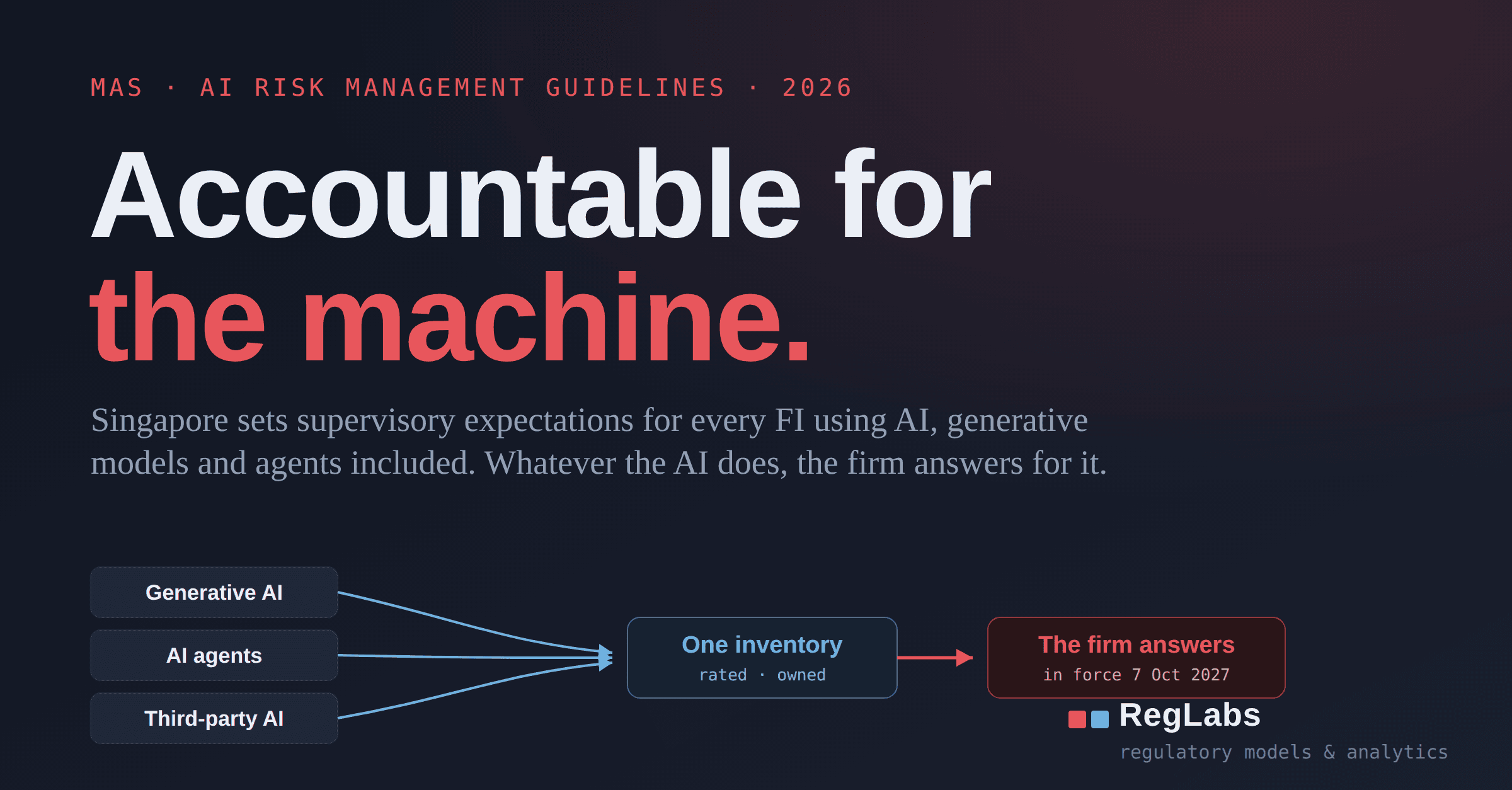
Singapore has set supervisory expectations for every financial institution that uses AI, generative models and autonomous agents included. The through-line is simple: whatever the AI does, the firm answers for it.
MAS · AI Risk Management Guidelines · Oct 2026
Every AI, one inventory
- Generative AI
- AI agents
- Third-party AI
- ML models
identify every AI, govern it across its life, stay accountable for it
The structure MAS sets out: a financial institution must identify all of its AI use, hold it in a single inventory with assessed materiality and a clear owner, control it across its lifecycle, and remain accountable for the outcomes, including AI it buys and AI that acts on its own.
Source: MAS Guidelines on Artificial Intelligence Risk Management for Financial Institutions, issued 7 October 2026 (mas.gov.sg).
Scope, timing and accountability
The guidelines take effect on 7 October 2027, with the expectations in two of the sections, Sections 5 and 6, allowed a further year to 7 October 2028.
Source: MAS Guidelines on Artificial Intelligence Risk Management for Financial Institutions, issued 7 October 2026 (mas.gov.sg).
A supervisory floor for every AI
On 7 October 2026 the Monetary Authority of Singapore issued its Guidelines on Artificial Intelligence Risk Management for Financial Institutions, setting out what it expects of any regulated firm that uses AI. The scope is deliberately wide. It reaches every financial institution, and it explicitly covers the newer forms that most existing rulebooks were not written for: generative AI and AI agents, systems that do not just score or predict but produce content and take actions. The guidelines take effect on 7 October 2027, with the expectations in two of the sections, Sections 5 and 6, allowed a further year to 7 October 2028.
MAS frames the guidelines as a floor to be applied proportionately. A firm should calibrate its response to its size, its activities, how much and how critically it uses AI, and the risk that use creates, so that a bank running agentic systems across trading and financial crime carries a heavier burden than a small firm using a single vendor tool. The guidelines sit on top of, not in place of, the obligations already in force, and they continue MAS's FEAT principles, the Fairness, Ethics, Accountability and Transparency framework the regulator published in 2018 and later operationalised through its Veritas work. What is new is the shift from principles to supervisory expectations, and the explicit extension to systems that act.
Read as a whole, the document makes one argument in many forms. AI does not dilute an institution's responsibility; it concentrates it. A firm remains accountable for what its AI does, whether the model was built in-house, bought from a vendor, or left to operate as an agent, and it must be able to show that the residual risk it is carrying sits within the risk appetite its board has set. The rest of the guidelines is the machinery for making that accountability real: identify the AI, inventory it, rate it, govern it across its life, and keep a human able to answer for the result.
You cannot govern what you have not listed
The guidelines begin where most AI governance actually breaks down, which is knowing what you have. MAS expects firms to run consistent, repeatable processes to identify where AI is used across the business, to record that use in a maintained AI inventory, and to assess the materiality of each use so that oversight and controls can be scaled to the risk. This sounds procedural, and it is the quiet foundation of everything else. An agent quietly embedded in a vendor product, a model a desk built in a spreadsheet, a generative tool a team adopted without telling compliance: none of these can be governed, validated or challenged if no one knows they exist. The inventory is the control that makes the other controls possible.
Above the inventory sits governance. MAS expects board and senior-management oversight of AI risk, with clear lines of accountability, so that named people are answerable for how AI is used and how its risks are managed. This is the same lesson that enforcement in other jurisdictions has been teaching the hard way: a control no senior person understands well enough to challenge is not really being overseen. By asking firms to assign accountability and to assess materiality up front, the guidelines put a person behind every material AI system before anything goes wrong, rather than searching for one afterward.
Controls that follow the model from build to retirement
The core of the guidelines is a set of controls that MAS expects to run across the whole AI lifecycle, not just at launch. The list is comprehensive, covering data governance, transparency, fairness, human oversight, testing, cybersecurity, independent review, ongoing monitoring, incident management, change control and retirement. Grouped, they describe a discipline that treats an AI system the way sound practice already treats a critical model: something to be built on good data, tested before it is trusted, watched while it runs, and shut down safely when it is done.
Data governance across the data that trains and feeds the system, covering quality, lineage and privacy, because a model is only ever as sound as the data beneath it.
Outputs that can be explained to the degree the use demands, and testing for fairness so the system does not produce biased or discriminatory outcomes.
Meaningful human oversight, with someone able to understand, challenge and override the AI rather than defer to it, scaled to how consequential the decision is.
Testing and validation before and during use, subject to independent review by people other than those who built the system, so the check is not the builder grading their own work.
Cybersecurity around the AI and the data it touches, plus incident management, so that failures and attacks are caught, contained and recovered from.
Ongoing monitoring for drift and degradation, change control over every update, and a managed path to retire a system safely when it is replaced or withdrawn.
The design point running through the list is that an AI control is not a one-time gate. A model that was fair, accurate and well-understood at launch can drift as its data and the world around it change, a vendor update can alter its behaviour overnight, and an agent given a new tool can act in ways no one tested. MAS expects the controls to be live, and it expects firms to review them regularly as AI develops, which is a direct acknowledgement that the technology, and therefore the risk, will keep moving.
Bought in, or acting alone, still yours
Two extensions give the guidelines their sharpest edge. The first is third-party AI. Most firms will not build their most powerful models; they will buy them, or consume them through a vendor's product, and MAS is explicit that outsourcing the technology does not outsource the responsibility. A firm remains accountable for third-party AI it relies on, must manage the risk of that dependence, and must be able to show that the residual risk it cannot see into, the vendor's training data, the model's hidden failure modes, still sits within its own risk appetite. Buying a model is not a way to inherit someone else's assurance; it is a reason to demand it.
The second is agentic AI. By naming AI agents in scope, MAS is regulating systems that do not merely inform a decision but take one, and often chain several together with access to tools and data. That is precisely the capability that makes agents attractive for work like financial-crime triage, trading operations and customer handling, and precisely the capability that makes the accountability question urgent. An agent that closes an alert, places an order or resolves a complaint has acted on the firm's behalf, and the guidelines insist that a human oversight structure and a clear owner stand behind that action. The breadth of the risks MAS ties to AI, spanning model risk, data privacy, cybersecurity, conduct, financial crime and surveillance, reflects how far an agent's decisions can now reach into a regulated business.
Why a floor, and why now
The timing is not accidental. Financial institutions are adopting generative AI and agents faster than most governance frameworks were built to handle, and the pressure to do so, to cut cost, clear backlogs and move quickly, is exactly the pressure that has produced control failures when detection and decision systems were calibrated to capacity rather than risk. A supervisory floor arriving before the technology is fully embedded is an attempt to get the governance in place while it can still shape how these systems are deployed, rather than after the first large failure forces the question.
The structure MAS chose is telling. Rather than write AI-specific rules for each activity, it has set cross-cutting expectations that attach to the AI itself, wherever it is used, and then asked firms to apply them proportionately. That design treats an AI system as a thing to be governed in its own right, with an inventory entry, an owner, a materiality rating and a lifecycle of controls, in the same way model risk management treats a model. It is the natural next step from FEAT: the 2018 principles said AI should be fair, ethical, accountable and transparent, and these guidelines say what a firm must actually do, and be able to evidence, to make those principles hold for systems that now generate and act.
For firms already reading enforcement in AML and market conduct as a warning about AI, the guidelines close a loop. The recurring failure in those cases was a detection or decision system that no one had calibrated to risk, validated honestly or overseen closely enough to challenge, and the recurring lesson was that automating a weak control at scale makes it worse, not better. MAS has now written the other half of that lesson as supervisory expectation: before you let a model or an agent make or shape a decision, you must be able to show it was built, tested, watched and owned. The accountability that enforcement imposes after the fact, the guidelines ask firms to build in from the start.
Using the runway
The dates give firms a defined runway, and the first move is the least glamorous and the most important: build the inventory. A firm cannot assess materiality, assign owners or scope controls until it knows where AI already lives in its business, including the agents inside vendor products and the generative tools adopted outside any formal process. An honest discovery exercise, run now, is what turns the rest of the guidelines from aspiration into a plan, and it almost always finds more AI than the organisation expected.
The second is to put the lifecycle controls on the systems that matter most first. Materiality is the lever MAS hands firms, and it should be used: the agent that disposes of financial-crime alerts, the model that prices risk, the generative tool that drafts customer communications deserve independent validation, strong human oversight and close monitoring before a low-impact convenience tool does. For each material system, the questions are concrete, and they map directly to the lifecycle list: is the data governed, can the output be explained, who can override it, who validated it independently, how is drift caught, and who owns the result.
The third is to fix third-party accountability before the deadline, not after. Firms relying on vendor and foundation models should be renegotiating for the transparency, testing evidence and change notice they will need to show their own residual risk is within appetite, because that assurance is far harder to obtain once a system is embedded and a deadline is close. And because the guidelines expect controls to be reviewed as AI develops, the governance a firm builds should be designed to keep moving, not to pass a single point-in-time assessment in 2027.
The compliance runway
Key dates in the MAS AI risk management guidelines
- 7 Oct 2026issued
- 7 Oct 2027in force (most expectations)
- 7 Oct 2028Sections 5 & 6 deadline
The dates give firms a defined runway, and the first move is the least glamorous and the most important: build the inventory.
Source: MAS Guidelines on Artificial Intelligence Risk Management for Financial Institutions, issued 7 October 2026 (mas.gov.sg).
- Is there a complete, maintained inventory of every AI system in use, including agents inside vendor products and generative tools adopted outside formal channels?
- Does each material system have a named owner, a materiality rating, and board or senior-management visibility that is genuine enough to challenge it?
- Can the firm evidence the full lifecycle on its material AI: governed data, explainable output, independent validation, human override, drift monitoring and a retirement path?
- For third-party and foundation models, can the firm show residual risk sits within its risk appetite, with the transparency and change notice to keep showing it?
- For agentic systems, is there a human oversight structure and clear accountability behind every action the agent takes on the firm's behalf?
Singapore is not moving alone
The guidelines land in the middle of a fast-forming global consensus. Across a single fortnight in October 2026, standard-setters and regulators on three continents moved on the same question, and the common thread is governance of AI as a thing in itself, with particular attention to agents. These three mark the direction of travel around MAS.
The Financial Stability Board published sound practices for responsible AI adoption, the international reference point that national supervisors are now aligning to. Canada's OSFI issued a statement endorsing it the same month. MAS's guidelines are a national supervisor turning that emerging global baseline into concrete, enforceable expectation for its own firms.
Days after the guidelines, MAS's Managing Director spoke on building trusted foundations for digital finance at a summit explicitly about agentic AI. The pairing of a keynote on trust and agents with binding-style guidance on AI risk shows a regulator treating agentic AI not as a distant prospect but as the near-term supervisory priority its guidelines are built for.
The UK's data regulator secured changes from leading AI developers and said its scrutiny now extends to AI agents. Different mandate, same target: the systems that act. For a firm operating across jurisdictions, the message is consistent enough to plan around, agentic AI is being governed everywhere at once, and the accountability stays with whoever deploys it.
What links a financial-stability board, a conduct-and-markets supervisor and a data-protection regulator is that each has concluded the same thing: AI, and agentic AI in particular, needs to be governed where it is used, by the institution that uses it. MAS's contribution is to make that expectation specific, dated and proportionate, which is why its guidelines are worth reading even by firms far outside Singapore.
The rulebook arrives for the agent
For most of the past two years the conversation about AI agents in finance has run ahead of the rules. Firms have piloted agents to triage alerts, draft reports and handle customers, and the governing question, who is accountable when the agent is wrong, has been answered mostly by analogy and good intentions. MAS's guidelines are among the first supervisory frameworks to answer it directly, and the answer is unambiguous: the institution is accountable, it must know where its AI is, it must govern each system across its life, and it must keep a human who can understand and override what the AI does. The era of deploying agents faster than anyone can govern them now has a deadline attached.
The second theme is that model risk management has gone horizontal. The discipline that grew up around pricing and credit models, build it soundly, validate it independently, document it, challenge it, is now being asked of every AI a firm uses, including the generative and agentic systems that are harder to explain and faster to change. Firms with a mature model risk function have a head start; firms that treated AI as an IT procurement rather than a model will find the gap between the two is exactly what the guidelines are written to close.
The durable lesson, for firms in Singapore and well beyond it, is to treat this as the shape of what is coming everywhere rather than a local requirement to be met once. The specifics will vary by jurisdiction, but the spine is converging: an inventory of every AI, a materiality rating, an owner, lifecycle controls, accountability that survives outsourcing, and human oversight of systems that act. A firm that builds that spine now will meet the next framework, and the one after, with the work already done, and will be able to show an examiner, on the day it is asked, exactly what its AI does and who answers for it.
Know your AI before the examiner asks
The MAS guidelines turn a principle into a checklist: identify every AI, inventory it, rate it, govern it across its life, and stay accountable for it, agents and vendor models included. That is exactly the ground regulatory analytics are built to cover. RegLabs regulatory models let a firm map its AI estate against supervisory expectations in Singapore and beyond, pressure-test its controls and accountability, and see the gaps as review items while there is still runway to close them.
This post summarises and analyses supervisory guidance; it is not legal or compliance advice, and firms should read the MAS guidelines in full and assess their own obligations. Dates and scope are drawn from the MAS guidelines as recorded in RegLabs; the FEAT and Veritas references are provided as background on MAS's earlier AI work. The diagrams are illustrative depictions of the guidance structure, not representations of any data.
Sources
- MAS Guidelines on Artificial Intelligence Risk Management for Financial Institutions, issued 7 October 2026 (mas.gov.sg).
- Record and analytics: RegLabs Pulse.
- Builds on the MAS FEAT principles (Fairness, Ethics, Accountability, Transparency), 2018, and the Veritas initiative.
- Global convergence, with records on RegLabs: FSB Sound Practices for Responsible Adoption of AI, via OSFI statement, 2026 (RegLabs);
- MAS keynote, Building Trusted Foundations for Digital Finance, 2026 (RegLabs);
- UK ICO, scrutiny extends to AI agents, 2026 (RegLabs).