
- Enforcement
- Financial Crime
- Governance & Accountability
Without delay.
The one phrase that turned a filed report into a EUR 90,000 fine.
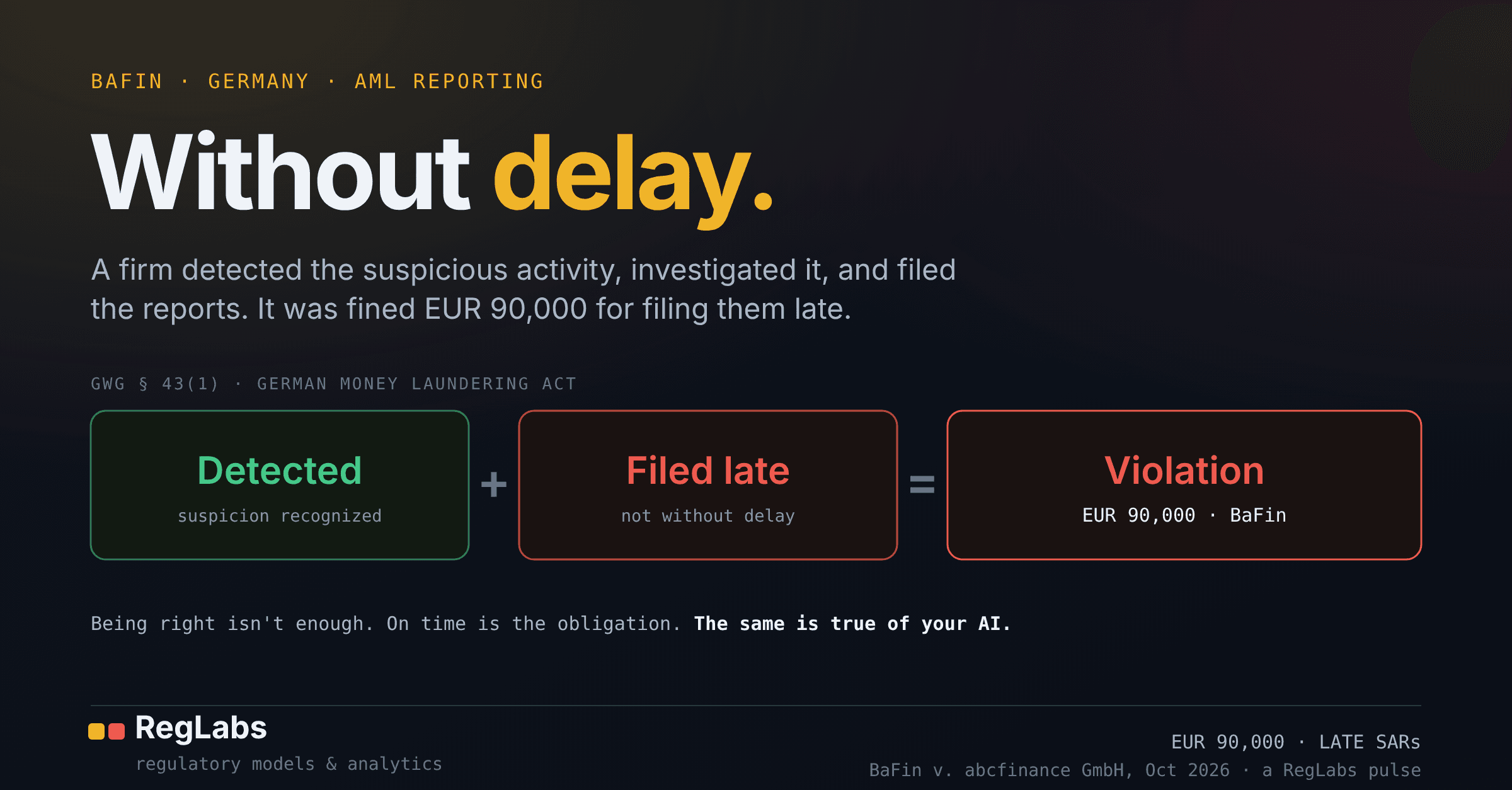
A German financial institution detected suspicious activity, investigated it, and filed the reports. It was still fined EUR 90,000.
Not for missing the activity. Not for getting it wrong. For filing several of its suspicious activity reports late. In October 2026, BaFin made the penalty final and binding. The entire case turns on a single word in the law: reports must be filed without delay. That word is not a quality standard. It is the obligation itself, and it is the one most firms, and most automated systems, quietly treat as optional.
Fine and reporting obligation summary
Not for missing the activity. Not for getting it wrong. For filing several of its suspicious activity reports late . In October 2026, BaFin made the penalty final and binding. The entire case turns on a single word in the law: reports must be filed without delay . That word is not a quality standard. It is the obligation itself, and it is the one most firms, and most automated systems, quietly treat as optional.
Source: BaFin, measure published 8 October 2026; RegLabs analysis. See Sources & notes.
A fine for being late, not for being wrong
BaFin fined abcfinance GmbH a total of EUR 90,000 for violating the German Money Laundering Act by submitting several suspicious activity reports late in April 2025.
That is nearly the whole of the public record, and its brevity is the point.1 There is no allegation that money laundering occurred. There is no finding that the firm failed to spot the activity, or misjudged it, or filed an incomplete report. The reports were made. They were simply made late, and under German law that is a reportable breach on its own, serious enough to carry a fine and a public naming by the regulator.
For any compliance function that measures itself by detection rates and filing volumes, this is the uncomfortable case. You can do the hard part, recognizing the suspicion, and still fail the obligation, because the obligation includes a clock.
Everything hangs on “without delay”
Under Section 43(1) of the Geldwaeschegesetz, an obliged entity that has grounds to suspect a transaction may be connected with money laundering or terrorist financing must report it to the Financial Intelligence Unit unverzueglich, without undue delay.2 The duty is not “report suspicious activity.” It is “report suspicious activity, promptly.” Promptness is written into the obligation, not bolted on as a service target.
It helps to be precise about what the standard is and is not. “Without delay” does not name a fixed number of hours or days. It is a legal standard: file as soon as reasonably possible once suspicion is established, with no avoidable hold-up. A firm’s internal response targets, a same-day triage rule, a two-hour acknowledgement window, are useful operational tools, but they are not safe harbors. Meeting an internal target does not prove legal compliance, and the law is not satisfied by a deadline a firm sets for its own convenience.
A report has a shelf life
The reason timeliness is load-bearing is mechanical, not bureaucratic. A suspicious activity report is an input to a time-sensitive chain. The FIU receives it, assesses it, and, where warranted, forwards it to law enforcement so they can act, freeze funds, open an investigation, connect it to other reports, while the trail is still warm.2
Delay breaks that chain quietly. The money has already moved. The accounts have already been emptied or closed. The pattern that would have linked this report to three others has already dissolved. A late report can be perfectly accurate and still arrive after the only window in which it could have mattered. Its value is not fixed; it decays, and past a point it approaches zero.
This is why the regulator treats lateness as a substantive failure rather than a paperwork quibble. A report filed too late is not a slightly worse version of a report filed on time. In the moment that counts, it is closer to no report at all.
Ninety thousand euros for doing the hard part
Step back and the shape of this case is almost the inverse of the headline AML scandals. The billion-dollar cases, the ones involving unmonitored volume or programs that watched the wrong products, are failures of detection: the activity was never seen. This is a failure of latency: the activity was seen, assessed, and reported, and the firm was still penalized because the reporting took too long.
Detection, late filing, and the violation
Step back and the shape of this case is almost the inverse of the headline AML scandals. The billion-dollar cases, the ones involving unmonitored volume or programs that watched the wrong products, are failures of detection : the activity was never seen. This is a failure of latency : the activity was seen, assessed, and reported, and the firm was still penalized because the reporting took too long.
Source: BaFin, measure published 8 October 2026; RegLabs analysis. See Sources & notes.
The sum is EUR 90,000, which, next to the nine- and ten-figure penalties this series usually covers, looks almost incidental. It is not. The size of the fine understates the size of the principle. A small, clean, final enforcement action like this one is the regulator stating a rule in its purest form: timeliness is not a nice-to-have on top of a working reporting process. It is part of what makes the process working.
Where the time actually goes
Lateness is rarely a decision. No one chooses to file a suspicious activity report late. It accrues, quietly, in the gap between the moment suspicion is first recognized and the moment the report leaves the building. Map that gap and you can see where the hours hide.
The detection-to-filing pipeline
Lateness is rarely a decision. No one chooses to file a suspicious activity report late. It accrues, quietly, in the gap between the moment suspicion is first recognized and the moment the report leaves the building. Map that gap and you can see where the hours hide.
Source: RegLabs illustrative detection-to-filing pipeline; not this firm’s specific process. See Sources & notes.
The control recommendations attached to this case read like a map of exactly these gaps.3 A suspicion that does not immediately become an owned, timestamped case can sit unattended. A reporting officer with no named deputy becomes a single point of delay the moment they are out. A case queue with no ageing alerts lets quietly overdue items blend into the backlog. Each is a place where “without delay” turns into “eventually,” without anyone noticing the line being crossed.
Latency is a control, not a footnote
This series keeps circling one theme: automated systems do exactly what they are built to do, and the governance failure is almost always in what they were built to do, or how fast. A trading system that could not be stopped in time. A monitoring program aimed at the wrong product for a decade. And now the quietest version of all, a report that was right but late.
As detection moves to automated and machine-learning models, the lesson transfers cleanly, and it is one most AI governance programs underweight. Teams obsess over whether the model is accurate. Far fewer instrument whether it is timely. But a correct alert that surfaces after the window to act has closed is not a success with a delivery problem. It is a failed control, graded by outcome.
not just accuracy
is the risk
not a queue
The uncomfortable translation: you can deploy a flawless detection model and still fail your obligation, for the same reason abcfinance did. The intelligence was there. The speed of acting on it was not.
Designing for “without delay”
A reporting process that can actually meet a promptness standard has a recognizable shape. None of it is exotic; all of it is about never letting a time-sensitive case go dark.3
- A clock that starts at first suspicion. The moment a referral or indicator is raised, it becomes a uniquely numbered case with an immutable trigger timestamp, so elapsed time is measured from the right instant and is visible to everyone.
- Named ownership, and a named deputy. Every open case routes to an on-duty reporting officer, with automatic reassignment to a deputy if it is not acknowledged. Absence and workload stop being causes of delay.
- Ageing alerts on the open queue. A live view of every case by trigger time, owner, and status, with escalation on items that have not progressed, so overdue work surfaces instead of blending into the backlog.
- Intake reconciliation. A daily check that every referral channel, every mailbox, monitoring escalation, and employee report, actually became a case. A workflow cannot be timely about a suspicion it never captured.
- Timeliness as a governed metric. Management information that tracks elapsed time from suspicion to decision to filing, with root-cause review of any late report, so recurring delay is treated as a control failure and fixed.
One caution runs through all of it, and the guidance is emphatic about it: internal targets are operational tools, not legal lines. A two-hour acknowledgement rule helps a team move; it does not redefine “without delay.” Build the clocks to drive behavior, not to manufacture a safe harbor that the law does not grant.
On time is the obligation
It is tempting to file this case under “minor,” a modest fine against a firm that mostly did its job. That reading misses what the regulator is actually saying. BaFin did not fine abcfinance for a failure of effort or of intent. It fined the firm for a failure of speed, and in doing so stated, cleanly and without the noise of an underlying scandal, that timeliness is not a bonus on top of a working reporting process. It is a condition of it.
For every firm building faster detection, automated, model-driven, tireless, the warning is pointed. Speeding up the finding does nothing if the acting stays slow. The clock does not care how good your model is. It only cares whether you beat it, and it is always running.
This analysis is prepared independently by RegLabs for educational purposes, based on BaFin’s published measure and the associated enforcement record. The firm description and figures reflect those sources; “without delay” is a legal standard and nothing here is legal advice. The detection-to-filing pipeline is illustrative of common delay points, not a depiction of this firm’s specific process.
Sources & notes
- BaFin, measure published 8 October 2026: fines totaling EUR 90,000 imposed on abcfinance GmbH for violations of the Money Laundering Act (Geldwaeschegesetz) through late submission of several suspicious activity reports in April 2025; fine notice final and binding. Official notice: bafin.de . RegLabs case record: studio.reglabs.ai/case/721705b9…
- studio.reglabs.ai/case/721705b9…
- Geldwaeschegesetz (German Money Laundering Act), Section 43(1): obliged entities must report facts indicating possible money laundering or terrorist financing to the Financial Intelligence Unit (Zentralstelle fuer Finanztransaktionsuntersuchungen) without undue delay. The requirement and the FIU’s role in promptly forwarding reports to law enforcement are described in the enforcement record and the underlying statute.
- Control design points (suspicion-trigger workflow with immutable timestamp, primary and deputy coverage, open-case ageing and delay alerts, intake-channel reconciliation, decision and filing record standards, timeliness training, independent review, and timeliness management information) are drawn from the control recommendations accompanying the RegLabs case record for this matter. Internal response targets are operational tools and do not constitute a legal safe harbor for the statutory “without delay” standard.