
- Enforcement
- Financial Crime
- Governance & Accountability
The framework was the violation.
The Bank of Italy sanctioned a bank for how its controls were built, not for anything that went wrong.
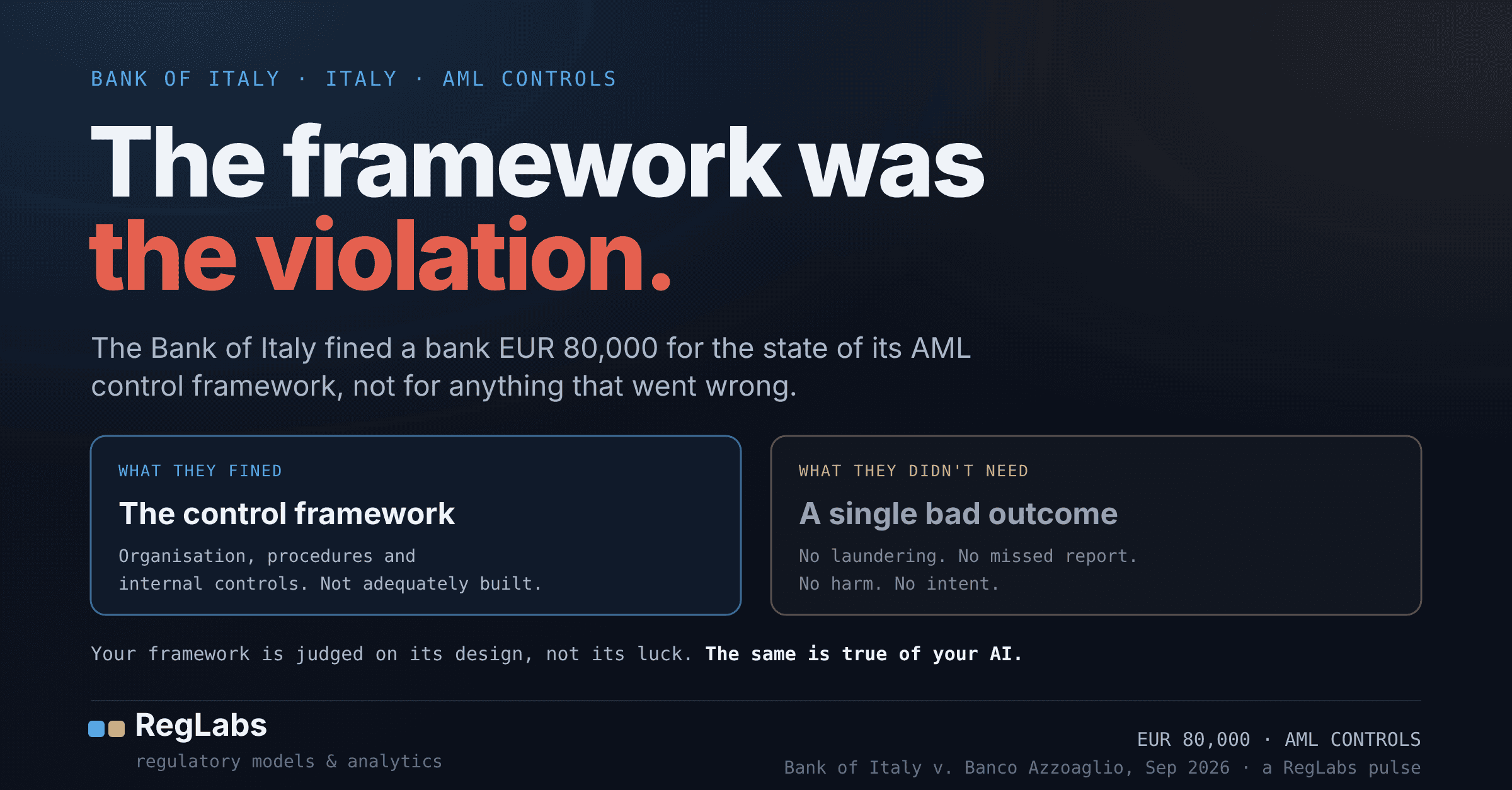
No laundered euro. No named missing report. No victim. A EUR 80,000 fine all the same.
After on-site inspections in 2025, the Bank of Italy did not accuse Banco di Credito Paolo Azzoaglio of letting money laundering happen. It found something more structural, and for a regulator, more important: the bank’s organisation, procedures and internal controls for knowing its customers and for cooperating in the fight against laundering were not adequately built. The framework was the violation.
Sanction and control summary
After on-site inspections in 2025, the Bank of Italy did not accuse Banco di Credito Paolo Azzoaglio of letting money laundering happen. It found something more structural, and for a regulator, more important: the bank’s organisation, procedures and internal controls for knowing its customers and for cooperating in the fight against laundering were not adequately built. The framework was the violation.
Source: Bank of Italy, measure no. 281 of 29 September 2026; RegLabs analysis. See Sources & notes.
Sanctioned for the state of the system
Following on-site inspections in 2025, the Bank of Italy found deficiencies in Banco di Credito Paolo Azzoaglio’s organisation, procedures and internal controls relating to customer due diligence and active cooperation, and imposed a EUR 80,000 administrative sanction under Article 62 of Legislative Decree 231/2007.
The measure, dated 29 September 2026, is brief, and its brevity is the lesson.1 It does not describe a laundered transaction. It does not name a suspicious operation that went unreported. It does not point to a customer who turned out to be a criminal. It identifies a category of failure that sits one level above any single incident: the way the bank had organised, written down, and controlled its anti-money-laundering work was not good enough. The regulator weighed the bank’s submissions and the remedial action it had already taken, and still concluded the framework fell short.1
For any compliance team that measures success by the absence of incidents, this is the uncomfortable case. You can have no scandal, no loss, no headline, and still be sanctioned, because the obligation is not only to avoid bad outcomes. It is to build and run an adequate system for preventing them.
They fined the framework, not an outcome
Strip the measure to its core and the object of the penalty is unusual. It is not a transaction. It is not a report. It is the control architecture itself: the organisation that assigns responsibility, the procedures that tell staff what to do, and the internal controls that check the work is actually done.2
This is preventive supervision in its purest form. Anti-money-laundering rules exist to stop harm before it happens, so the regulator does not wait for harm to judge the system. It inspects the system directly and asks a design question: is this framework capable of doing its job, reliably, across every customer and every branch? When the answer is no, the gap is itself the breach, whether or not a criminal ever walked through it.
That is a higher and in some ways harder standard than it first appears. A firm cannot defend itself by pointing to a clean record, because a clean record may be luck rather than control. The question is not “did anything go wrong?” It is “would you have caught it if it had?” And that question is answered by looking at the design, not the outcome.
The duty you may not have a word for
One half of the finding concerns customer due diligence, a phrase every compliance professional knows: identify the customer, understand the relationship, keep that understanding current. The other half uses a term that English-speaking programs rarely name directly: active cooperation, in Italian collaborazione attiva.
Italian anti-money-laundering law draws a line between two postures. Passive cooperation is answering the authorities when they ask: producing records, responding to requests. Active cooperation is the affirmative duty that runs the other way: the obliged entity is expected to participate in the system on its own initiative, by applying due diligence, monitoring activity, forming suspicions, and reporting them, without being prompted.2 It is the difference between a bank that waits to be asked and a bank that is always looking.
Naming it is useful even outside Italy, because it captures a posture that box-ticking compliance quietly abandons. A program can complete every mandatory field and still fail at active cooperation if it is not genuinely trying to see. The Bank of Italy’s finding is that the organisation, procedures and controls behind this duty were not adequately designed to support it.
Three layers, two duties, one gap
The measure repeats a precise triad: organisation, procedures, and internal controls. These are the three layers of any functioning compliance framework, and the finding is that both of the bank’s core AML duties were deficient across them.
The two AML duties across three control layers
The measure repeats a precise triad: organisation, procedures, and internal controls. These are the three layers of any functioning compliance framework, and the finding is that both of the bank’s core AML duties were deficient across them.
Source: RegLabs illustrative framework, based on Bank of Italy measure no. 281; not a reproduction of the bank’s specific controls.
Read the grid across and the structure of the failure is clear. It is not that one control broke. It is that the scaffolding holding the controls up, who is responsible, what they are told to do, and how anyone verifies they did it, was judged inadequate in both of the areas that matter most. A gap in organisation leaves work unowned. A gap in procedures leaves it undefined. A gap in internal controls leaves it unverified. Any one is a weakness. All three, across both duties, is a framework that cannot assure its own effectiveness.
Judged before the harm
It helps to see exactly what the regulator did and did not have to establish, because it inverts the intuition most people bring to enforcement.
Design findings and outcomes not required
- The adequacy of the organisation and assigned responsibilities
- Whether procedures translated the law into usable steps
- Whether internal controls verified the work was done
- Whether the framework supported genuine active cooperation
- That any money was actually laundered
- That a specific suspicious report was missed
- That a particular customer caused harm
- That the bank intended any wrongdoing
It helps to see exactly what the regulator did and did not have to establish, because it inverts the intuition most people bring to enforcement.
Source: RegLabs illustrative comparison, based on Bank of Italy measure no. 281; not a reproduction of the bank’s specific controls.
The column on the right is the one firms instinctively defend against. We prepare to explain a bad transaction, to show a report was filed, to argue a loss was unforeseeable. None of it is responsive here, because none of it was the charge. The charge was about the left column: the condition of the system that is supposed to make the right column impossible. A regulator practising preventive supervision reserves the right to act on the left column alone, and the Bank of Italy did.
Your framework is graded on design, not luck
This series keeps finding the same truth in different disguises. A trading system judged by a catastrophic loss. A monitoring program judged by an eleven-year blind spot. A reporting process judged by a late filing. And now the quietest judgment of all: a framework judged by its design, with no bad outcome required at all.
For anyone standing up AI and automated controls, this is the supervisory posture to internalise early. As model risk management and AI governance mature, regulators increasingly assess the system of control around a model, the ownership, the documented procedures, the validation, the monitoring, and they assess it on whether it is adequately designed and operating, not on whether an incident has occurred yet. A clean incident log is not evidence of a sound system. It may just be evidence that the dice have not come up wrong.
the deliverable
inspectable
layers, or none
The translation is blunt: you can run an AI system that has never visibly failed and still be found deficient, for the same reason this bank was. Supervision of a preventive control does not wait for the thing it prevents. It inspects the prevention.
Building a framework that survives inspection
An AML framework that holds up when a supervisor opens it has a recognisable shape across both duties the Bank of Italy examined. None of it is novel; all of it is about making ownership, procedure and verification real.3
- Named ownership, top to branch. A governance charter that assigns a board sponsor, a qualified AML officer, and a named owner for onboarding, CDD, monitoring, and reporting, with written escalation and deputy coverage, so no duty is unowned.
- A documented risk assessment that drives the controls. An enterprise view of money-laundering and terrorist-financing risk across customers, channels and geographies, linked to the proportionate CDD and monitoring each risk requires.
- CDD as a controlled procedure, not a habit. Version-controlled policy covering identification, verification, beneficial ownership, expected activity, risk rating, and periodic and event-driven refresh, mapped to the law and to system fields.
- Active cooperation, built as a pipeline. Risk-based monitoring, a documented suspicious-activity investigation and reporting workflow, and a confidential branch escalation channel, so a suspicion formed anywhere reaches the right desk.
- Verification that is independent. First-line quality assurance on CDD files, an issue register that tracks remediation to validated closure, and independent internal audit that tests whether the controls are designed and operating, not just present.
- Evidence that the framework runs. Management information and a board dashboard on CDD completion, overdue reviews, alert backlogs and remediation, so adequacy can be demonstrated, not just asserted.
Adequacy is the obligation
It is easy to file an EUR 80,000 sanction against a small bank under “minor.” That misreads what the Bank of Italy is saying, which is not minor at all. The regulator is asserting that the obligation is the framework, continuously, and that it will inspect and penalise the framework on its own terms, without waiting for it to fail in public. A clean record buys no credit. An adequate, owned, verified system is the thing being required.
For every firm racing to automate its controls, the posture to adopt is the one this small Italian bank learned in an inspection room. Do not build a framework to survive the day something goes wrong. Build it to survive the day a supervisor opens it when nothing has. That day is the real test, and it can come first.
This analysis is prepared independently by RegLabs for educational purposes, based on the Bank of Italy’s published sanctioning measure and the associated enforcement record. The firm description and figures reflect those sources; the measure records no finding that money laundering occurred, and nothing here is legal advice. The framework grid and the two-column panel are illustrative of the areas the measure describes, not a reproduction of the bank’s specific controls.
Sources & notes
- Bank of Italy (Banca d’Italia), sanctioning measure provv. no. 281 of 29 September 2026 (published 14 October 2026): EUR 80,000 pecuniary administrative sanction imposed on Banco di Credito Paolo Azzoaglio Spa under Article 62 of Legislative Decree No. 231/2007, following on-site inspections in 2025, for deficiencies in organisation, procedures and internal controls relating to customer due diligence and active cooperation. The measure reflects consideration of the bank’s submissions and remedial action taken. Official document: bancaditalia.it . RegLabs case record: studio.reglabs.ai/case/aba75436…
- studio.reglabs.ai/case/aba75436…
- Legal basis cited in the measure: Legislative Decree No. 231/2007 (Italy’s AML decree), Articles 7, 15, 16, 24, 25 and 36, with the sanction imposed under Article 62(1); Bank of Italy Measure of 26 March 2019 (provisions on organisation, procedures and internal controls to prevent the use of intermediaries for money laundering and terrorist financing) and Bank of Italy Measure of 30 July 2019 (provisions on customer due diligence). “Active cooperation” (collaborazione attiva) refers to an obliged entity’s affirmative duties to apply due diligence, monitor, and detect and report suspicious activity on its own initiative, as distinct from passively responding to authority requests.
- Control design points (governance and accountability framework, enterprise risk assessment, CDD policy and the identity, beneficial-ownership, risk-rating, EDD and periodic and event-driven review controls, transaction monitoring and suspicious-activity workflow, branch escalation, independent QA and audit, training, management information, and issue and remediation tracking) are drawn from the control recommendations accompanying the RegLabs case record for this matter.