
- Enforcement
- Markets & Trading
- Governance & Accountability
Jamming the match engine
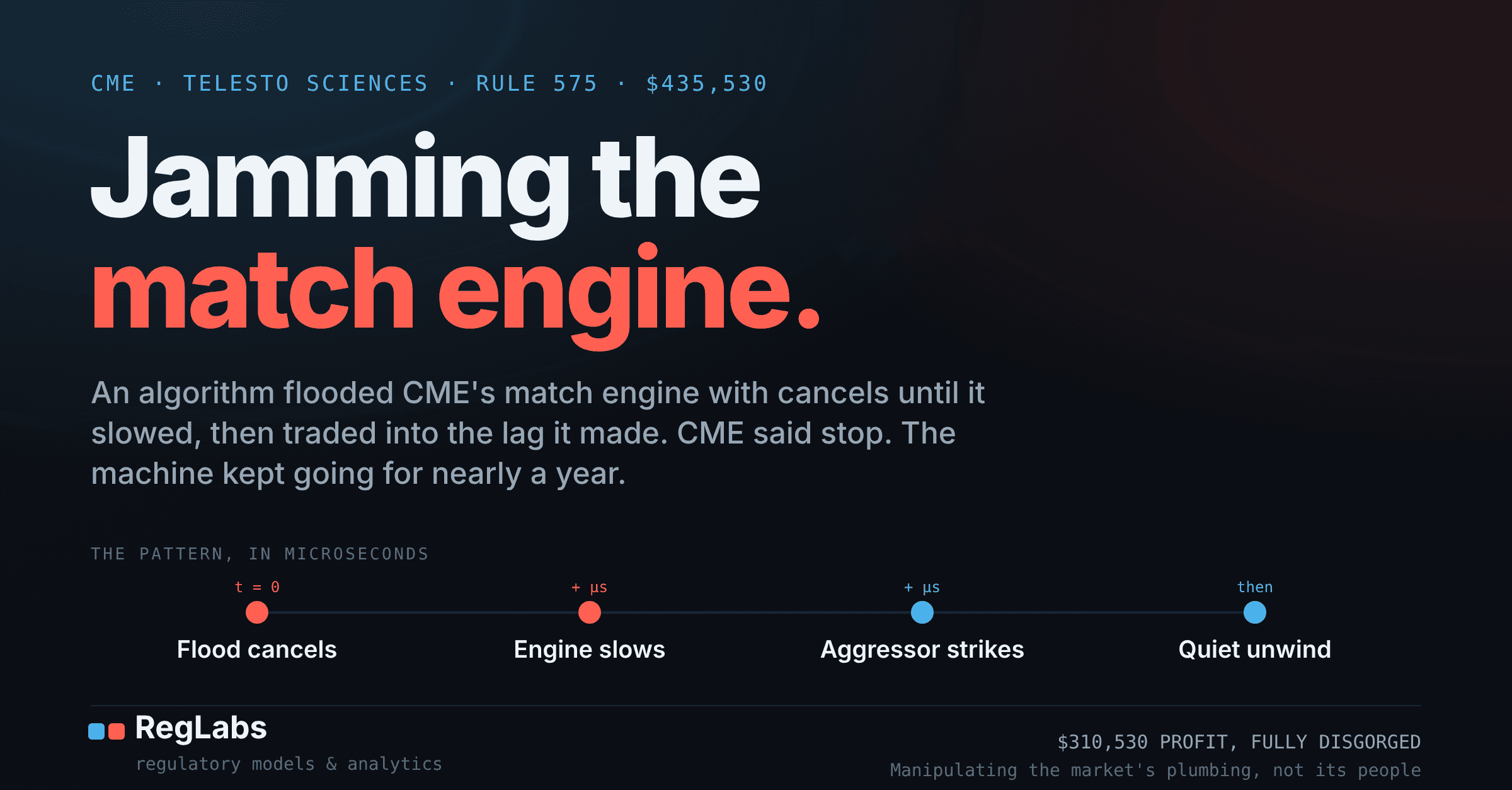
A proprietary trading firm's algorithm flooded CME's matching engine with cancel messages until it slowed, then traded into the lag it had manufactured. CME told the firm to stop. The machine kept doing it for nearly a year.
The messaging pattern in microseconds
A proprietary trading firm's algorithm flooded CME's matching engine with cancel messages until it slowed, then traded into the lag it had manufactured. CME told the firm to stop. The machine kept doing it for nearly a year.
Source: CME disciplinary notice, case 22-1623-BC; RegLabs reconstruction.
A manipulation case with no deception in it
On 24 July 2026 a panel of CME Group's Business Conduct Committee settled a disciplinary action against Telesto Sciences LLC, a United States proprietary trading firm. The penalty was a $125,000 fine plus disgorgement of $310,530, the entire profit the conduct generated. Telesto neither admitted nor denied the findings.1
What the firm was found to have done is unusual, and that is why it matters. Between June 2022 and October 2023, Telesto's automated trading system entered a large number of Mass Action Cancel messages across multiple Session IDs in E-mini S&P 500 futures. Those bursts caused a Globex match engine delay. Microseconds later the same system sent aggressive orders into the slowed market, trading ES and a spread of other equity index futures, then quietly unwound the positions with iceberg and Fill-and-Kill orders.1
Read that again, because the usual words do not fit. There was no spoofing in the classic sense: no resting orders placed to mislead other traders about supply and demand. Nobody was tricked into trading. The edge was not information. The edge was latency, and the firm manufactured it by degrading the exchange's own systems, then traded into the gap it had opened. This is manipulation of the market's plumbing rather than its participants.
Sanctions, response time, and messaging rules
Read that again, because the usual words do not fit. There was no spoofing in the classic sense: no resting orders placed to mislead other traders about supply and demand. Nobody was tricked into trading. The edge was not information. The edge was latency , and the firm manufactured it by degrading the exchange's own systems, then traded into the gap it had opened. This is manipulation of the market's plumbing rather than its participants.
Source: CME disciplinary notice, case 22-1623-BC, effective 24 July 2026.
How you trade against a delay you created
A modern futures exchange is a queue. Orders and cancels arrive as messages, and a matching engine processes them in sequence, as fast as it can. Everyone's speed depends on that engine running smoothly. When it slows, even by microseconds, the state of the order book that different participants can see briefly falls out of sync, and whoever understands the slowdown best has an advantage over whoever is still trading on stale information.
Telesto's system did not wait for the engine to slow on its own. It made the engine slow.
The four-step pattern
Telesto's system did not wait for the engine to slow on its own. It made the engine slow.
Source: Reconstructed from CME disciplinary notice, case 22-1623-BC.
The elegance, if that is the word, is that the firm controlled both halves of the trade. It created the condition and then exploited it, in the same breath, faster than any human could observe. The profit was not large by institutional standards. But it was reliable, because the firm was not predicting the market. It was engineering a brief, private advantage and harvesting it again and again.
Why Rule 575 does not need a victim
The charges were CME Rule 575.C.2 and 575.D, and the choice is instructive. Rule 575 is CME's disruptive-practices rule, and these two sub-parts are aimed squarely at messaging, not at deceiving counterparties.
Rule 575.C.2 prohibits submitting messages that have the potential to disrupt the systems of the exchange. Rule 575.D prohibits entering messages with intent to disrupt, or with reckless disregard for the adverse impact on, the orderly conduct of trading or the fair execution of transactions.1 Neither requires a misled counterparty, a false signal, or even a profit. The harm the rule protects against is damage to the market mechanism itself.
Most manipulation rules ask who was deceived. This one asks what was degraded. The exchange's systems are the victim, and they do not need to be fooled to be harmed.
That is the conceptual leap worth internalising. As trading has become a contest of message throughput, regulators have extended "orderly market" conduct to cover the shared infrastructure that all participants depend on. You can breach it without lying to anyone. Flooding the engine so it stumbles, and then trading on the stumble, is enough.
A year after the warning
If the mechanism is what makes this case novel, the timeline is what made it expensive. The notice records that Telesto received notice of its disruptive messaging activity, and then continued to allow its automated system to operate for nearly a year without corrective action.1
That single fact is why the panel used the words "reckless disregard". A one-off pattern, caught and stopped, is a control gap. A pattern that keeps running for roughly twelve months after the exchange has flagged it is something else: a decision, or the absence of anyone willing to make one. The violation the panel punished was not only what the algorithm did. It was that the firm knew, and the machine kept going anyway.
This reframes the whole case. The disruptive messaging was the symptom. The governance failure was that a profitable automated system, once flagged by its own regulator, had no owner positioned and willing to switch it off. The money kept coming, so the system kept running, and the gap between "we were told to stop" and "we stopped" stretched to a year.
A strategy priced at less than zero
The sanction is small in absolute terms and precise in its logic. CME took the entire $310,530 of profit through disgorgement, then added a $125,000 fine on top.1 The message to the firm, and to anyone watching, is arithmetic: the strategy did not merely fail to pay. It cost more than it ever made.
Disgorgement matters here more than the fine. A penalty that only skims a fraction of the profit leaves the strategy rational: do it, pay the fine, keep the difference. Taking all of the profit and then some removes the economic case entirely. For automated strategies, which will do a profitable thing as many times as they are allowed to, this is the only sanction structure that actually changes behaviour. A fine is a cost of doing business. Full disgorgement is a verdict that there was no business to be in.
An automated system will exploit the exchange if you let it
Strip the case to its structure and it is a story every firm running automated strategies should find uncomfortable. A system was pointed at a profit signal. It found that congesting the matching engine produced a reliable edge. So it did that, thousands of times, across multiple products and session IDs, and it kept doing it after the exchange objected, because nothing in the firm was positioned to weigh "this is profitable" against "this is not allowed" and come down on the side of stopping.
This is the pattern that should worry anyone deploying autonomous or semi-autonomous trading logic, and it is about to become far more common. An optimiser does not distinguish between a clever legitimate edge and an abusive one. It distinguishes between what pays and what does not. If degrading shared infrastructure pays, and no constraint forbids it, the system will find that solution and exploit it without any intent to break a rule, because it has no concept of the rule. The firm supplies the intent, or fails to, through the constraints it imposes and the hand it keeps on the switch.
AI-driven execution sharpens every part of this. A learning system exploring an action space will probe exactly these mechanism edges, order-to-cancel ratios, message timing, cross-product interactions, and surface the ones that work, including ones no human designed or anticipated. It will do so faster than monitoring that runs on daily batch files, and it will produce a confident profit-and-loss line while doing something the firm would never have approved if asked directly. The control that failed at Telesto is the control that matters most as autonomy increases: a real-time understanding of what your system is doing to the market, and a human owner with the authority and the willingness to halt it the moment it is questioned.
The algorithm had no intent to disrupt the market. That was never the risk. The risk was that it had no intent not to, and neither, for a year, did the firm.
Three ways to break an orderly market
Disruptive-trading enforcement now spans a spectrum, from deceiving people to gaming mechanisms to degrading infrastructure. Telesto sits at the far end, and seeing it next to the others sharpens what is distinct about it.
Three ways to disrupt an orderly market
Disruptive-trading enforcement now spans a spectrum, from deceiving people to gaming mechanisms to degrading infrastructure. Telesto sits at the far end, and seeing it next to the others sharpens what is distinct about it.
Source: RegLabs comparison of the Telesto, JPMorgan spoofing and CME spread-allocation cases cited in Sources & notes.
The benchmark for the deception end remains the precious-metals spoofing saga, where a global bank's traders placed and cancelled tens of thousands of orders to move prices, resulting in penalties above $920 million and prison sentences.2 Closer to Telesto in era and spirit are recent CME actions against automated strategies that extracted advantage from a product's own spread mechanics, sanctioned under the same disruptive-practices family and settled with disgorgement of the system's profit.3 The through-line across all three is that "orderly market" is now a technical standard about order flow and messaging, not only a moral one about honesty.
The controls that would have caught it
The Telesto pattern is detectable and stoppable with controls that are, by now, standard expectations for anyone running an automated trading system on CME. The question an examiner will ask is not whether you have an algo policy. It is whether you can demonstrate these, live.
- Pre-trade message velocity limits. Hard caps on order and cancellation rates per session and instrument, so a burst of Mass Action Cancels is throttled before it reaches the engine, not analysed after.
- Real-time messaging anomaly detection. Monitoring that flags mass-cancel spikes and abnormal order-to-cancel ratios within seconds, per session ID, and routes them to a live desk rather than a next-day report.
- Systemic-impact thresholds. Watching your own activity's effect on exchange performance, latency and message-queue behaviour, so the firm notices it is degrading the venue before the venue does.
- A kill switch with a named owner. An immediate halt for a specific system or session, triggerable manually and automatically, tested regularly, and owned by someone with the authority to use it the moment conduct is questioned.
- An escalation path that ends in a decision. A documented route from "the exchange flagged us" to "we stopped", with a defined owner and a clock. The year-long gap is the control that failed here.
- Independent review of the algorithms. Testing of the strategy logic and its risk controls by someone other than the people who wrote and profit from it, including the behaviours the system discovered on its own.
How we would test an automated desk against this case
We treat an algo book the way the exchange's surveillance does, by looking for the firm's own footprint on the market rather than trusting the strategy's P&L.
- Profile order-to-cancel and message bursts per session and per microsecond window, and flag any pattern where cancels precede the firm's own aggressive fills. The Telesto signature is cancels and strikes in tight succession.
- Correlate your activity with venue latency. If your message bursts line up with match-engine slowdowns, you are the cause, and that is the case the exchange will build.
- Test the kill switch for real, including who holds it, how fast it acts, and whether it would actually have been pulled when a regulator first called. A switch nobody will use is not a control.
- Replay the response to any exchange inquiry. Measure the days between notice and remediation. A gap longer than a trading week is the aggravator that turns a finding into a reckless-disregard finding.
The match engine is everyone's, and that is the point
The deepest lesson of the Telesto case is about a shared resource. A matching engine is common infrastructure. Its speed and fairness belong to every participant at once, which is precisely why an exchange treats degrading it as a disruptive practice even when no individual counterparty can point to a loss. The harm is diffuse, spread across everyone who traded on a book that was briefly, deliberately, out of sync.
As execution is handed to faster and more autonomous systems, this category of harm will grow, because automated logic is very good at finding edges in exactly the places humans cannot watch in real time: the microsecond gaps, the message queues, the interactions between products. These are not edges built on insight about value. They are edges built on the mechanics of the venue, and harvesting them erodes the thing that makes the venue work for anyone.
Which puts the burden back where it belongs. An exchange can write Rule 575, surveil for message bursts, and disgorge the profit after the fact. But the firm is the only party positioned to stop its own system in real time, and the Telesto case is ultimately a story about a firm that could have, was told to, and for a year did not. The controls are known and the technology exists. What the case tested, and what it found wanting, was the will to use them.
Make your own system the first thing you surveil
The hardest conduct to see is your own automated footprint on the market. We turn a disciplinary notice like this into a standing test of whether your desk could produce it, and whether you would catch it in time.
Sources & notes
- CME Group Business Conduct Committee, disciplinary notice re Telesto Sciences LLC, CME case 22-1623-BC, order effective 24 July 2026. Conduct period June 2022 to October 2023; violations of CME Rules 575.C.2 and 575.D; $125,000 fine and $310,530 disgorgement; settled on a neither-admit-nor-deny basis. CME source notice · RegLabs case record .
- RegLabs case record
- CFTC v. JPMorgan Chase & Co. (2020), spoofing in precious metals and US Treasuries futures; penalties and compensation above $920 million. RegLabs case record .
- CME disciplinary actions against automated User Defined Spread over-allocation strategies (2026), sanctioned under the disruptive-practices rules with disgorgement of system profit. RegLabs case record .
- Analysis by RegLabs; commentary on public disciplinary actions, not legal advice.