
- Enforcement
- Markets & Trading
- Governance & Accountability
Both sides of the same owner
An exchange-for-physical is a legitimate tool, until both legs belong to the same owner. Then it is a wash trade in a bona fide costume, and the broker that submits it cannot hide behind the client's instruction.
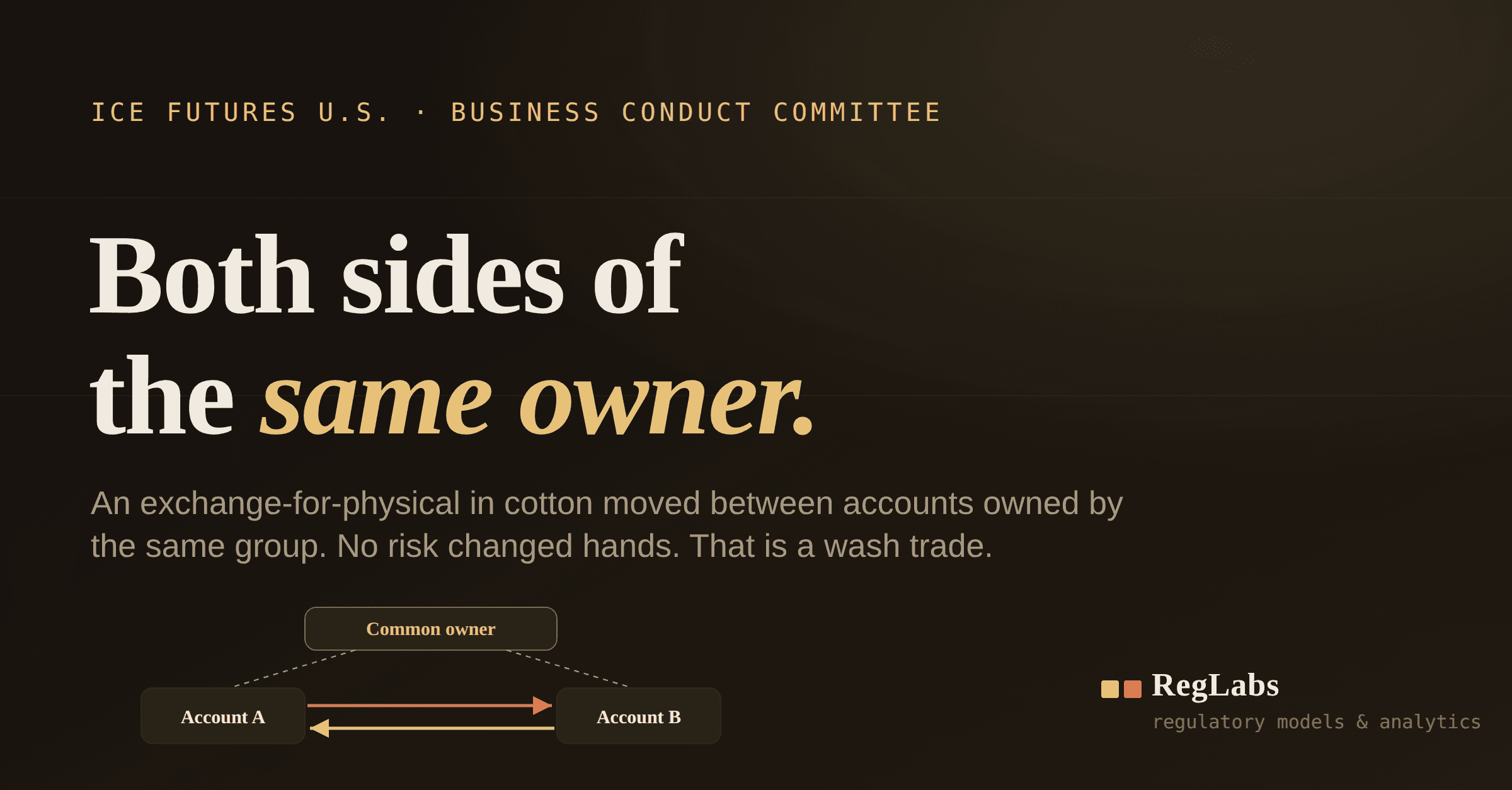
The same owner on both legs
How an EFP becomes a wash: the futures leg and the physical (cotton) leg move between two accounts that share one beneficial owner, so nothing genuinely changes hands and no bona fide market risk is transferred. Illustrative of the mechanism described in the ICE notices.
An exchange-for-physical loop between two accounts under one beneficial owner, leaving net exposure unchanged. Common beneficial owner → common ownership → common ownership → Account A → Account B → futures leg → cotton, the physical leg → no change of ownership = wash.
Source: ICE Futures U.S. StoneX settlements, 7 October 2026; RegLabs case records.
Settlement and control summary
$35,000 StoneX Financial's penalty; $195,000 across three StoneX settlements, one day; Nov 2023 to Nov 2024 the conduct window; Cotton No. 2 the market involved.
Source: ICE Futures U.S. StoneX settlements, 7 October 2026; RegLabs case records.
A legitimate tool, used against itself
On 7 October 2026, the Business Conduct Committee of ICE Futures U.S. settled three matters at once, all arising from the same conduct in the Cotton No. 2 market between November 2023 and November 2024. StoneX Financial Inc., the broker, agreed to pay $35,000. Two StoneX affiliates, the firm formerly known as CDI-Brazil and the firm formerly known as CDI-Swiss, each agreed to pay $80,000. None admitted or denied the findings, and no customer harm was reported. Together the three settlements total $195,000, and together they describe a single mechanism: an exchange-for-physical transaction that moved between accounts owned, ultimately, by the same group.
An exchange-for-physical, or EFP, is a bedrock tool of commodity markets. It lets a trader swap a futures position for an equivalent physical or cash position in a privately negotiated deal, and it is entirely legitimate when it does what it is meant to do: transfer real exposure between two genuinely independent parties. The requirement that makes it bona fide is a change of ownership. The two sides must be independent, and the deal must move risk from one owner to another. Take that away, and an EFP is just a round trip: a position that leaves one pocket and arrives in another pocket belonging to the same person.
That is what the exchange found here. The EFPs in Cotton No. 2 ran between accounts with common beneficial ownership, submitted by StoneX Financial at its client's direction, with the two StoneX trading affiliates on the opposing sides without demonstrating the independent control that an EFP requires. The result, in the exchange's words, was wash trades. The dollar figures are small. The principle the case draws out, about what an EFP must be and whose job it is to check, is not.
One mechanism, three respondents
The core charge is the wash trade. ICE Rule 4.02(c) prohibits transactions that do not result in a genuine change of ownership and are not exposed to real market risk. The committee found that the Cotton No. 2 EFPs were submitted between accounts with common beneficial ownership, so the futures leg and the physical leg moved within a single ownership structure. For the two trading affiliates, the committee added a violation of Rule 4.06(b)(iv), the provision that requires the accounts on the two sides of an EFP to be under independent control. They were not: the affiliates traded opposite an affiliated entity without demonstrating that independence, which is precisely the condition that separates a bona fide EFP from a wash.
Around the wash trade sits the supervision case, and this is where the broker's exposure lives. The committee found that StoneX Financial may have violated Rule 4.01(a) by failing to diligently supervise the exchange-related activities of its employees and agents, and Rule 4.01(b) by failing to establish, administer, or enforce supervisory systems, policies, and procedures reasonably designed to achieve compliance with exchange rules. The two affiliates drew the same supervisory findings. In other words, the exchange did not treat the wash trades as a one-off error by a trader. It treated them as evidence that the systems meant to catch same-owner EFPs were not doing their job.
The detail that gives the case its edge is the phrase "at the direction of its client." StoneX Financial submitted the EFPs because its client asked it to. That is a normal thing for a broker to do, and it is not a defense. An intermediary that routes a client's EFP instruction still owns the obligation to ensure the transaction is bona fide, and to have surveillance that flags EFPs between commonly owned or affiliated accounts before they reach the exchange. The client's instruction is an input to that judgment, not a substitute for it. A broker cannot outsource its gatekeeping to the person it is supposed to be a gatekeeper against.
Why common ownership is the whole question
Every wash-trade rule in the futures world converges on one fact: whether the two sides of a trade share a beneficial owner. CME Rule 534, ICE Rule 4.02(c), the NYMEX equivalent, all say in slightly different words that buy and sell orders between accounts with common beneficial ownership, entered to negate market risk or price competition, are prohibited. The EFP rules add the mirror-image requirement that the parties be independently controlled. So the single most important piece of data in preventing this entire category of violation is an accurate map of who owns and controls which account. A firm that cannot reliably link its accounts to their ultimate owners cannot reliably prevent wash trades, because it cannot see the thing the rule turns on.
That is the structural lesson of the StoneX sweep. The conduct was not exotic. It was EFPs in cotton between affiliated entities of the same group, which is exactly the pattern a competent surveillance system should catch on sight, because the accounts involved were related in the firm's own records. The reason it was not caught is the reason most wash-trade cases happen: the ownership and control relationships were not wired into the pre-trade and surveillance controls, so the system evaluated each leg as if the counterparties were strangers. When the map of common ownership is missing or stale, every control downstream of it is guessing.
The broker's position sharpens the point. StoneX Financial was not the beneficial owner of the trades; it was the conduit. But the exchange's supervision rules exist precisely because conduits are where the market's integrity is enforced in practice. A broker sees the order flow, knows or can know the account relationships, and is positioned to stop a non-bona-fide transaction before it prints. When it submits a same-owner EFP at a client's direction without that check, the harm to market integrity is identical whether the broker initiated the idea or merely executed it. That is why "at the direction of its client" earns a supervisory finding rather than a pass.
There is also a reason these cases cluster at the exchanges rather than the headline regulators. Wash trading rarely moves prices dramatically or produces a dramatic victim; here the exchange expressly reported no customer harm. What it does is corrupt the signal the market sends, by manufacturing volume or transferring positions without the risk that volume is supposed to represent. The exchanges, as the first-line self-regulatory bodies, police this with a steady stream of modest settlements precisely because the conduct is granular and the deterrence has to be constant. A $35,000 penalty is not a measure of how seriously the exchange takes it. It is a measure of how routine the enforcement has become.
Where a same-owner EFP should be stopped
The controls that would have caught this are well understood, and they sit at every stage from onboarding to post-trade review. Each depends on the same foundation: knowing who owns what.
A governed relationship graph linking every account to its beneficial owners and controllers, refreshed on change, is the data the whole wash-trade regime depends on.
A hard pre-submission check that blocks offsetting orders and EFPs between linked accounts, releasable only on a documented, independent approval.
An EFP workflow that requires evidence of a bona fide related position and independent control, and routes same-owner or affiliated EFPs to compliance before submission.
Real-time and daily detection of opposite-side activity across accounts that share an owner, with EFPs flagged and prioritized for review.
Traders may submit but cannot approve or release their own flagged transactions; same-owner exceptions need an independent, documented sign-off.
Alerts and EFP exceptions assigned, worked to a service level, and escalated, so a flag cannot be closed silently or left unattended.
What this case asks of brokers and trading firms
The first lesson is that the beneficial-ownership map is a trading control, not a KYC artifact that lives in a compliance folder. If account relationships are not wired into the pre-trade and surveillance systems, the firm is blind to the single fact that wash-trade and EFP rules turn on. The map has to be current, it has to link affiliates and commonly controlled accounts, and it has to be queryable at the moment an order or an EFP is submitted. A relationship that exists only in an onboarding file is a relationship the trading system cannot see.
The second is that "at the direction of the client" is a reason to check harder, not a reason to stop checking. A broker that receives an instruction to submit an EFP between accounts it can see are related should treat that as a trigger for review, not a clearance to proceed. The supervisory rules make the intermediary responsible for the integrity of what it submits, and an instruction from the client does not transfer that responsibility back to the client. Firms should make sure their procedures say so explicitly, and that the system routes related-account EFPs to an independent approver rather than letting them flow through.
The third is that EFPs deserve their own control path. They are privately negotiated, they bypass the central order book, and their whole legitimacy rests on two conditions, a bona fide related position and independent control, that an ordinary trade does not have to prove. A firm that handles EFPs should be able to show, for each one, the supporting position and the independence of the two sides, with same-owner or affiliated EFPs gated to compliance before submission. The exchange's own rule, 4.06(b)(iv), is a reminder that independence is not assumed; it has to be demonstrated.
The fourth is that a group structure is a surveillance obligation, not just a legal one. When a firm has affiliates that can be on opposite sides of a trade, the surveillance has to look across the group, not account by account. The StoneX matter is a clean illustration: the counterparties were affiliates of the same group, which should have been the easiest common-ownership link to detect, because the firm already knew the relationship. Cross-entity surveillance is where that knowledge becomes a control.
- Is the beneficial-ownership and control map wired into pre-trade and surveillance systems, current, and able to link affiliates and commonly controlled accounts in real time?
- Do procedures state that a client's instruction to submit an EFP is not a substitute for the broker's own bona-fide check, and does the system enforce that?
- Does each EFP have a documented related position and evidence of independent control, with same-owner or affiliated EFPs gated to independent approval before submission?
- Does surveillance look across affiliated entities for opposing activity, so a trade between group affiliates is flagged as the common-ownership link it is?
- Can a trader release or approve their own flagged transaction, or is independent sign-off enforced for every same-owner exception?
Each maps to a stage in the control map above, and each is a question a firm can put to its own EFP and surveillance workflow today, well before an exchange inquiry puts it to them.
The same rule, every kind of firm
Wash-trade enforcement at the futures exchanges is a steady drumbeat, and the striking thing is how many kinds of participant it reaches. The common thread is always the same: opposite-side activity between accounts that share an owner, and often a supervision failure for not catching it. These three, all recent, show the range.
A trader at the commodity merchant entered matching buy and sell orders for the same account in NY Harbor ULSD futures, a wash intended to avoid market risk for the firm's biodiesel business, and NYMEX found the firm had failed to supervise the trader against wash trading. A reminder that even a legitimate commercial hedging motive does not make a wash trade bona fide, and that supervision is charged alongside the conduct.
A proprietary firm's automated strategy failed to maintain a price gap and matched its own orders in crypto futures across its accounts. The firm received notifications of the self-matches and did not investigate, so CME found it knew or should have known. The parallel is the supervision gap: an alert that fires and is ignored is, for enforcement purposes, an alert that never fired.
The same rule as the StoneX matter. A BofA trader entered buy and sell orders in MSCI Emerging Markets Index futures in a way that resulted in a trade between accounts for the same principal, which the trader should have known would self-execute. Proof that Rule 4.02(c) reaches a global bank's trading desk exactly as it reaches a commodity broker's EFP flow.
At the far end of the range sits the CFTC's $16 million consent order against Kraft and Mondelez, where wash and fictitious sales were charged alongside manipulation of a wheat futures contract. The distance between a $10,000 exchange settlement and a sixteen-million-dollar federal order is a distance of scale and intent, not of principle. The rule being enforced is the same one: a trade that does not transfer real risk between real counterparties is not a trade the market should treat as real.
Wash-trade enforcement is dense and granular
RegLabs cases tagged Wash Sales, by regulator (selected; India's SEBI retail volume excluded for scale)
Across all markets, RegLabs holds 4,255 wash-trade cases. On the futures side, the exchanges themselves, CME and ICE, are the busiest enforcers, policing the conduct with a constant flow of modest settlements.
Source: ICE Futures U.S. StoneX settlements, 7 October 2026; RegLabs case records.
Where the exchanges are looking
The StoneX sweep is a snapshot of how self-regulation actually works at the derivatives venues. The exchanges run the first line of market-integrity enforcement, and their disciplinary dockets are dominated not by dramatic manipulation cases but by exactly this kind of granular conduct: wash trades between related accounts, EFPs that fail the independence test, self-matches an automated system should have caught. The penalties are small and the volume is high, by design. The message to the market is that these controls are expected to work every day, and that the exchange will keep testing whether they do.
Two features of this case point to where the attention is concentrating. The first is EFPs and other privately negotiated transactions, block trades included. Because they happen away from the central order book and rest on conditions that have to be demonstrated rather than observed, they are a natural focus for surveillance, and the exchanges have been explicit that common-ownership block trades and EFPs are wash trades unless independence and a bona fide purpose can be shown. The second is the intermediary's supervisory duty. Charging the submitting broker alongside the trading affiliates signals that the exchanges expect the firms closest to the order flow to be active gatekeepers, not passive pipes, and that a client instruction will not insulate a broker that submits a non-bona-fide transaction.
For any firm that trades through affiliates, handles EFPs, or runs automated strategies that could self-match, the forward-looking reading is straightforward. The conduct in these settlements is the conduct the exchanges are most practiced at finding, which makes their disciplinary notices a reliable preview of what a firm's own surveillance will be measured against. The durable defense is unglamorous: a current map of who owns and controls each account, wired into the controls that evaluate every order and every EFP before it reaches the market. Get that foundation right and the whole category of risk narrows. Leave it stale, and the next same-owner trade is one instruction away from a notice.
Catch the same-owner trade before it prints
The StoneX matter did not turn on intent or scale. It turned on a relationship the firm already knew about, that was not wired into the controls that evaluate a trade. That is exactly the kind of gap regulatory analytics are built to surface. RegLabs regulatory models let a firm test its EFP controls, its wash-trade surveillance, and its beneficial-ownership coverage against the full exchange enforcement record, so the patterns a disciplinary panel would find show up as review items first.
StoneX Financial Inc. and its affiliates neither admitted nor denied the alleged violations, and the exchange reported no customer harm. Figures for parallel cases are the monetary penalties recorded for those matters. The hero diagram is an illustrative reconstruction of the EFP mechanism described in the notices, not a depiction of specific transactions. This post is informational and is not legal advice.
Sources
- ICE Futures U.S. Business Conduct Committee settlement with StoneX Financial Inc., effective 7 October 2026. Case record and analytics: RegLabs Studio .
- Companion settlements, same date: StoneX Comércio e Exportação de Commodities Ltda, formerly CDI-Brazil ( RegLabs ); StoneX Switzerland S.A., formerly CDI-Swiss ( RegLabs ).
- StoneX Comércio e Exportação de Commodities Ltda, formerly CDI-Brazil (RegLabs)
- StoneX Comércio e Exportação de Commodities Ltda, formerly CDI-Brazil (RegLabs)
- Parallels: NYMEX v. Louis Dreyfus Company LLC, 2026 ( RegLabs ); CME v. Riccio Holdings Limited, 2026 ( RegLabs ); ICE Futures U.S. v. BofA Securities, Inc., 2026 ( RegLabs ); CFTC v. Kraft Foods / Mondelez, 2022 ( RegLabs ). Thematic figures: RegLabs enforcement database, cases tagged Wash Sales.
- NYMEX v. Louis Dreyfus Company LLC, 2026 (RegLabs)
- NYMEX v. Louis Dreyfus Company LLC, 2026 (RegLabs)
- NYMEX v. Louis Dreyfus Company LLC, 2026 (RegLabs)
- NYMEX v. Louis Dreyfus Company LLC, 2026 (RegLabs)
- Rules referenced: ICE Futures U.S. Rules 4.01(a), 4.01(b), 4.02(c), and 4.06(b)(iv).