
- AI & Technology
- Regulatory Change
- Governance & Accountability
The checklist in disguise
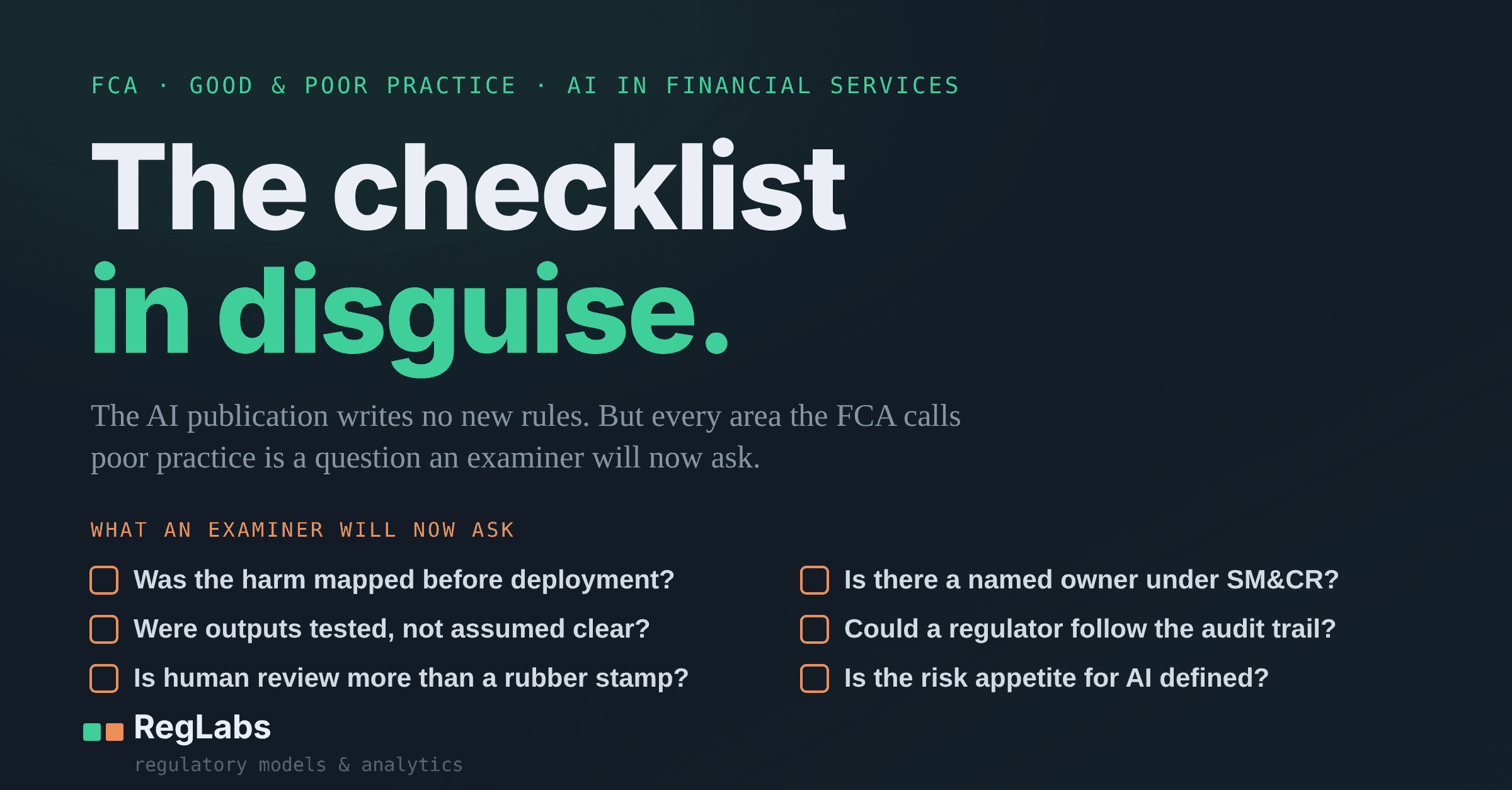
The FCA's new AI publication creates no new rules. It sets out good and poor practice, and every example of poor practice is a description of what an examiner will now look for.
Good practice and areas for improvement
- Decide where AI should support, automate, or abstain and escalate to a person
- Explain AI's role and limits at the right level for the consumer
- Map each material use case to a named senior-manager owner
- Building the tool before establishing the consumer problem or the foreseeable harm
- Assuming AI outputs are clear without testing them on real consumer groups
- Thin audit trails and vague delegation that leave no one accountable
The publication's device, applied throughout: paired examples of what the FCA has seen done well and done poorly, drawn from supervisory work and its AI Lab, rather than a list of new requirements.
Source: FCA, AI in financial services: good practice and areas for improvement, 19 October 2026; RegLabs Pulse and compared-regulator records in Sources.
Examples, not requirements
0 new rules created by the publication; 3 themes consumer duty, governance, resilience; Good / poor examples, not requirements; ML, gen, agentic all AI use cases in scope.
Source: FCA, AI in financial services: good practice and areas for improvement, 19 October 2026; RegLabs Pulse and compared-regulator records in Sources.
A publication that writes no rules
On 19 October 2026 the Financial Conduct Authority published AI in financial services: good practice and areas for improvement, a set of illustrative examples gathered from its supervisory work, industry engagement and its AI Lab, which runs AI Live Testing and the Supercharged Sandbox. The most important sentence in it is a disclaimer. The examples, the FCA says, do not create new requirements, do not prescribe a single model, and do not replace a firm's responsibility to decide what is appropriate and proportionate for its own use cases. Where most regulators meeting the arrival of AI have reached for something new, the FCA has deliberately declined to.
Its argument is that the existing rulebook already covers AI. The publication maps AI risks onto frameworks that are already in force: the Principles for Businesses and the Threshold Conditions, the systems-and-controls sourcebook (SYSC), the operational resilience and critical-third-parties regimes, the Consumer Duty, the Senior Managers and Certification Regime for accountability, and the complaints rules for redress. AI, in this view, does not need its own statute because the obligations that govern a bank's conduct, controls and accountability do not change when the tool making a decision is a model. The firm remains responsible for the AI it develops, procures or deploys, whatever the technology underneath, and that responsibility is already written down.
So instead of requirements, the FCA offers a picture of what good and poor look like, organised under three themes: the Consumer Duty and consumers in vulnerable circumstances, governance and accountability across the AI lifecycle, and operational resilience. The examples span machine learning, generative AI and, increasingly, agentic AI. Read as guidance, it is light. Read as a signal of how the FCA will supervise, it is precise, because an example of poor practice is a description of what an examiner will now look for.
AI, and the consumer on the other end
The first theme runs AI through the Consumer Duty, and its through-line is that a firm must be able to show the AI produces good outcomes for the people it touches, especially those in vulnerable circumstances. The examples are concrete, and they pair naturally.
Firms worked out which tasks AI can support or automate, which must stay staff-led, and where the tool should abstain, redirect or escalate to a person, building proportionality into the design.
Some firms built the tool before establishing the consumer problem, the target market or the foreseeable harms, and set guardrails that addressed one risk while creating another.
Firms made clear to consumers that a tool was AI-enabled, and explained what it could and could not do, and when the consumer should seek help from a person instead.
Some assumed their AI outputs were clear and helpful without testing whether different consumer groups understood them, including people with lower financial capability.
Firms used AI to surface vulnerability indicators, such as keywords in responses, spending patterns, or signs a consumer was struggling in a digital journey, and responded appropriately.
Firms left long gaps between reviews of live outcomes, or defined their escalation triggers so vaguely that problems could run before anyone acted on them.
Who answers for the model
The richest theme is governance, and it is where the FCA's reliance on the existing rulebook does the most work, because the Senior Managers Regime already supplies the answer to the hardest AI question: who is accountable. The good examples describe firms operationalising that accountability across the lifecycle; the poor ones describe firms that left it implicit.
Firms took a risk-based approach to new deployments, involving staff from across the business in testing and sign-off, with formal evaluation and clear accountability before go-live.
Some had no formal process to test, challenge and approve AI use cases, and were inconsistent across use cases, including in the evidence they used to justify a deployment.
Firms mapped AI responsibilities to senior management functions. One mapped every material use case to a named senior manager, with a documented risk appetite and escalation routes before deployment.
Some firms' AI decisions were poorly documented, with limited audit trails or rationale, so senior managers could not show the steps they had taken to assess and mitigate the risks.
Firms risk-assessed where human oversight was actually needed and what it should look like, making sure an appropriately qualified person with the right expertise was genuinely in the loop.
Some relied excessively on staff to oversee AI outputs without addressing the underlying model risk, so human review masked model weaknesses rather than catching them.
Firms tracked real-world outcomes and impacts and adapted to evolving risks such as model drift, using continuous monitoring rather than a single point-in-time sign-off.
Some firms had no defined risk appetite or thresholds, and defaulted to avoiding anything near a regulatory boundary rather than engaging with where the acceptable line actually sat.
The pairing on human oversight is the one worth dwelling on, because it corrects a comfortable assumption. A human in the loop is a genuine control only when the person is qualified, informed and able to challenge the model; used as a reassurance rather than a check, it does the opposite, letting a weak model run under cover of a signature. The same subtlety runs through the risk-appetite finding: the FCA is as critical of firms that freeze near the regulatory line as of firms that cross it, because an undefined appetite is itself a governance gap.
Reasonable steps, and the limits of delegation
The whole approach rests on one load-bearing regime, and the publication leans on it hard. The hardest question AI poses to a regulator, who is answerable when a model gets it wrong, the FCA does not have to invent an answer to, because the Senior Managers and Certification Regime already supplies one: a named senior manager, personally accountable, who must take reasonable steps to manage the risks in their area. The document is careful about what that does and does not demand. It does not expect senior managers to become technical specialists in machine learning. It does expect them to take reasonable steps to understand, govern and mitigate the risks of the AI under their responsibility, which is a more durable obligation than technical mastery and one that does not expire when the model changes.
The practical content of reasonable steps is exactly where the good and poor examples bite. A senior manager who has mapped a use case to a documented risk appetite, required testing and sign-off, and kept an audit trail of the decisions has taken steps they can evidence. One whose AI decisions are poorly documented, with limited rationale, cannot show the steps they took, and under the regime the inability to evidence reasonable steps is itself the exposure. The scheme the FCA tags this publication with names the failure directly: improper delegation. Accountability can be shared across a firm, but it cannot be handed to a model, a vendor, or a human reviewer whose oversight is nominal. A firm that uses a human-in-the-loop to move responsibility onto a junior has not delegated the risk; it has only hidden the owner.
This is the quiet reason the FCA can regulate AI without new rules. The Senior Managers Regime was built to answer precisely this kind of question, to put a name against a risk and demand that the named person can show what they did about it, and it applies to a decision made by a model as cleanly as to one made by a desk. What AI changes is not the principle but the evidence. The reasonable steps now include understanding a model's limitations, challenging its outputs, and governing the vendor behind it, and a senior manager who cannot speak to those has a gap the regime has always punished.
When the system acts, not just answers
The most forward-looking thread in the publication is agentic AI, which it defines precisely: AI that can take a sequence of actions towards a goal, rather than only producing a single response. That definition is the problem in a sentence. A model that produces an output can be checked before anyone acts on it; a system that takes a sequence of actions is already acting, and the controls have to live inside the loop rather than after it. The FCA's good examples recognise this. Firms deploying agentic use cases built a governance structure before switching the agents on, with stronger escalation and oversight designed for autonomy, and, tellingly, registered their agents in a central inventory so they could be overseen at all. That inventory is the same control the Monetary Authority of Singapore makes a formal expectation, arriving here as observed good practice: you cannot govern a population of agents you have not listed.
Firms building agentic use cases recorded their agents in a central inventory so they could be overseen, the same discipline MAS now formalises as an expectation.
A human placed at the end of an agent's sequence is reviewing history, not controlling risk. For a system that has already acted, the checks have to sit inside the loop.
Firms designed escalation and human-oversight structures suited to autonomous systems before deploying them, rather than retrofitting controls to an agent already running.
Deploying agents able to act across many steps without limiting what they can do, monitoring them while they run, or being able to stop them.
Agentic systems sharpen two findings that are merely important for ordinary AI. The first is the human-oversight-as-crutch problem. For a tool that produces a recommendation, a qualified reviewer can still catch a bad output; for an agent that has already placed an order, resolved a complaint or moved value across a chain of steps, a person positioned at the end of the process is reviewing what happened, not preventing it. The FCA's own instruction, to build proportionate technical checks and continuous monitoring into the system rather than relying on a person to review and approve, is a direct order to move the control upstream of the action. The second is accountability. When an agent acts on the firm's behalf, the named senior manager owns what it did, and the reasonable steps now include constraining what the agent may do, watching it while it runs, and being able to stop it. Agentic AI does not get its own rulebook here either, but it is the use case where the existing one is stretched hardest, and where the distance between a program that is governed and one that is merely watched becomes most expensive.
One standard, scaled to the firm
The word that recurs most in the publication is proportionate, and it carries more weight than it looks. The FCA is explicit that it does not expect a small firm to run a large bank's AI governance, and it gives real attention to what good looks like at smaller scale: folding AI oversight into existing governance rather than building a parallel machine, using simpler risk tiers, introducing AI in phases, and tailoring the framework to the firm's size, capability and risk profile instead of copying a larger firm's. On testing, where a small firm cannot evaluate at scale, it credits carefully filtered, people-reviewed, high-quality sample data, treating a proportionate method as good practice rather than a shortfall. This is the approach working as intended: one standard, applied with judgment about what the firm and the use case actually require.
Smaller firms scaled governance to their size, capability and risk, using simpler risk tiers and a phased, iterative rollout rather than copying a large firm's framework.
Firms that did not adapt their governance proportionately to the potential impact of a use case, so heavy risks ran under light controls.
Where testing at scale was not feasible, smaller firms used carefully filtered, human-reviewed high-quality data to check outputs within their resources.
Firms designed and deployed AI first and considered the controls afterwards, so governance chased the risk instead of leading it.
But proportionality is also the approach's softest edge, and the FCA's own findings show why. The weaknesses it names are firms that did not adapt their governance to the potential impact, and firms that governed retrospectively, deploying first and considering controls later. Proportionate is a direction, not a threshold, and a firm acting in good faith can land on either side of it without ever being told where it was. The discipline the FCA rewards closes the gap: tier use cases by impact so the heaviest controls fall on the heaviest risks, and decide the governance before deployment rather than after. Proportionality is not a licence to do less. It is an obligation to match the control to the risk, and to be able to show the match was deliberate.
Secure, sustainable, and not stuck with one vendor
The third theme treats AI as an operational dependency like any other, to be made resilient and governed as a third-party relationship. The examples are the most concrete of all, and they land hardest on the question of what a firm owes when the model is someone else's.
Firms made considered decisions on whether to host models on their own architecture or a third-party cloud GPU, weighing resilience, control and dependency rather than defaulting to convenience.
Some firms did not account for their use of, or dependence on, AI models in their operational resilience plans as they moved from low-risk to higher-risk deployments.
Firms built AI architecture that could operate with different providers, reducing overreliance on, or inability to switch from, a single vendor, and involved functions from across the business.
Some relied on vendors' assurances without challenging or testing them. Firms remain accountable for outsourced AI, and without testing those assurances they may never understand the model's limitations.
The vendor finding is the most portable, because most firms will buy their most capable models rather than build them. The FCA's position is the one every regulator now shares: outsourcing the model does not outsource the accountability, and an assurance a firm has not tested is an assurance it cannot rely on. A resilience plan that does not mention the AI the business increasingly runs on is a plan for a firm that no longer exists.
From a firm's vendor to the system's
The single-vendor finding has a larger shadow than the operational-resilience theme lets on. At the level of one firm, relying on a single AI provider is a resilience risk, and the FCA credits firms that designed architecture able to run on more than one, reducing concentration risk and keeping the ability to switch if the supplier's performance, its availability, or the firm's own priorities changed. But the same dependency, repeated across an industry, becomes a systemic one. If most firms run their most capable models on a handful of foundation-model providers and a few cloud GPUs, a failure, an outage, or a correlated behaviour in one of them is no longer one firm's operational incident. It is a shock transmitted across the market at once.
This is the concern the Financial Stability Board's work on AI foregrounds, and it is why the FCA points firms to the critical third parties regime, under which the most systemically important technology suppliers can be brought into supervisory scope directly. For an individual firm it reframes the vendor question. Testing a provider's assurances and keeping the option to switch is not only prudent resilience; it is the firm's contribution to not building a single point of failure for the whole system. The publication is firm-facing and says little about the macro picture, but the thread runs through it: the move from low-risk to higher-risk AI, which the FCA flags as the moment firms forget to update their resilience plans, is also the move that turns a convenient shared dependency into a concentrated one. The regulator treating AI as a third-party-risk problem at the firm level is, through the critical third parties regime and the FSB, watching the same problem at the level of the system.
Supervision by participation
There is a quieter innovation in how this publication was produced. Its examples come not only from supervisory visits but from the FCA's AI Lab, a set of channels, including AI Live Testing, the Supercharged Sandbox, an AI in smaller firms event and an AI Input Zone, through which the regulator watches firms build and test AI in a controlled setting. This is a different supervisory model from inspection after the fact. By sitting alongside firms as they experiment, the FCA learns what good and poor practice look like in real deployments, and then publishes that learning as examples for everyone else. The good-and-poor format is not a stylistic choice; it is the natural output of a regulator gathering practice by taking part in it.
The model fits the flexible approach. A regulator that wants firms to innovate, and that declines to freeze requirements against a fast-moving technology, needs a way to keep its expectations current without rewriting rules, and observed practice refreshed through live testing is that way. It also explains why the publication is explicitly non-exhaustive and expected to evolve: it is a snapshot from a process that continues. For firms the implication is twofold. The examples will be updated, so meeting them is a moving target rather than a one-time exercise, and the AI Lab is a channel worth being inside, because the firms whose practice the FCA observes are the firms helping to define what the next version of good will say.
Three answers to the same question
The FCA's choice is sharpest when set beside what other regulators did in the same months. Faced with the same question, how to govern AI in finance, supervisors have reached for instruments of very different hardness, and the FCA sits at the softest, most flexible end of the range.
The spectrum of regulatory instruments
How recent financial-sector AI interventions compare, from flexible to prescriptive
FCA: examples + existing rules. FSB: global sound practices. MAS: supervisory expectations. EU AI Act: binding, risk-tiered law. More flexible → more prescriptive. The diagram is an illustrative depiction of the comparison, not a precise ranking.
Source: FCA, AI in financial services: good practice and areas for improvement, 19 October 2026; RegLabs Pulse and compared-regulator records in Sources.
At the flexible end, the FCA keeps AI inside the rulebook it already runs and publishes examples rather than requirements, betting that the Consumer Duty and the Senior Managers Regime can carry the weight. Just behind it sit the global soft-law instruments: the Financial Stability Board's Sound Practices for Responsible Adoption of AI, which Canada's OSFI endorsed the same month, set an international baseline that national supervisors are expected to align to, without binding anyone directly. A step further, the Monetary Authority of Singapore issued Guidelines on AI Risk Management that read as genuine supervisory expectations, with an AI inventory, lifecycle controls and a dated compliance runway into 2027 and 2028. At the prescriptive end stands the European Union's AI Act, a binding horizontal law that tiers AI systems by risk and attaches hard obligations to the high-risk ones, financial-services uses among them.
What is striking is how much the substance converges even as the instruments diverge. Every one of them lands on the same handful of ideas: the deploying firm is accountable for AI it buys as well as AI it builds, human oversight has to be real rather than nominal, third-party and agentic systems need particular scrutiny, and risk has to be governed against a defined appetite with documentation that survives an examiner. The FCA's own themes, accountability through the SMF, tested human oversight, vendor assurances that must be challenged, are MAS's themes and the FSB's themes in different words. The disagreement is not about what good looks like. It is about whether good should be a law, an expectation, or an example.
One major jurisdiction is absent from the diagram because it sits almost on top of the FCA. The United States has so far declined to pass a single AI law for finance, relying instead on frameworks already in force: the model-risk-management guidance that already governs a bank's models, the securities and consumer rules that already govern its conduct, and a run of interagency statements reminding firms that those rules apply to AI as much as to anything else. The Anglo-American position is, in substance, the FCA's: no new rulebook, existing obligations extended, supervision rather than legislation. What this adds is that the flexible end of the spectrum is crowded and the prescriptive end is, for now, largely Europe. A firm reading the FCA and the US as the global norm and the EU AI Act as the outlier is making a bet about which way the rest of the world moves, and the convergence of substance suggests the destination is already agreed even where the instrument is not.
The shape of the silence
It is as instructive to read what the publication withholds as what it sets out. It gives no quantitative thresholds, so a firm asking how much testing, how continuous the monitoring, or how senior the owner must be is told to be proportionate and left to judge. It does not define a material AI use case, even though the heaviest obligations attach to material ones, which leaves the trigger for serious governance to the firm's own classification. It sets no timeline, in deliberate contrast to the dated runway the Monetary Authority of Singapore gives into 2027 and 2028, because examples do not commence. And on the two subjects where AI poses genuinely new technical questions, bias and explainability, it largely points outward, to the Consumer Duty, the Equality Act and the Information Commissioner's guidance, rather than working them through itself.
None of this is an oversight; it is the method. A technology-neutral, outcomes-based regulator deliberately avoids the thresholds and definitions that date fastest, and relies instead on principle plus supervision to fill the space. But the silences are where the cost of flexibility sits, and firms should treat them as the areas to govern most carefully, precisely because the regulator has not drawn the line for them. Where the FCA declines to set a number, a firm still has to choose one and defend it; where it declines to define material, a firm still has to draw the line and document why. The disclaimers that this publication creates no new requirements and prescribes no single model are not reassurances. They are a transfer of the hardest judgments back to the firm.
The cost and the bet of flexibility
The FCA's approach has a clear logic and a clear price. The logic is that technology-neutral, outcomes-based regulation ages well: a rule written for today's models would be obsolete by the time agentic systems are routine, whereas the Consumer Duty's demand for good outcomes and the SMF's demand for a named owner apply to whatever the technology becomes. Pinning AI to existing frameworks also avoids the duplication and friction of a parallel regime, and the AI Lab signals a regulator that wants to see firms experiment rather than freeze. For a jurisdiction competing to host AI in finance, this is a deliberate, pro-innovation posture.
The price is certainty. Principles and examples leave firms to infer the standard, and the FCA's own findings show the hazard: it flags firms that default to avoiding anything near a regulatory boundary as an area for improvement, which is the predictable behaviour of institutions told to be proportionate without being told where the line is. Flexible regulation asks firms to exercise judgment, and firms unsure of the standard will either over-comply, stalling the innovation the approach is meant to encourage, or under-comply and discover the line in a supervisory visit. The good-and-poor format narrows that gap, but it does not close it the way a threshold does.
The deeper point is that the softness is probably temporary. Good and poor practice, repeated across supervisory cycles and reinforced through the AI Lab, is how the FCA historically hardens expectations before, and sometimes instead of, writing a rule. Today's example of poor practice is tomorrow's finding, and a finding repeated often enough becomes an effective requirement whether or not it is ever codified. The firms that read this publication as optional because it creates no new rules are misreading it. It is a supervisory checklist wearing the clothes of guidance.
Treat the examples as the checklist
The most direct use of the publication is as a self-assessment. For every area of poor practice the FCA names, a firm can ask whether it is the firm being described: is AI deployed before the consumer harm is mapped, are outputs assumed clear without testing across vulnerable groups, is approval informal, is the audit trail thin, is human oversight a signature rather than a check, is the risk appetite undefined, is AI missing from the resilience plan, are vendor assurances untested. Each poor example is a question an examiner can be expected to ask, and answering them honestly now is cheaper than answering them in a review.
The second is to anchor AI accountability in the Senior Managers Regime explicitly. The single clearest piece of good practice is mapping each material AI use case to a named senior manager, with a documented risk appetite and escalation routes before deployment. That one discipline resolves most of the governance findings at once, because it forces the documentation, the sign-off and the ownership that the poor examples lack. Human oversight should then be designed as a real control, assigned to someone qualified to challenge the model, not bolted on to reassure.
The third, for any firm operating across borders, is not to mistake the FCA's flexibility for the global standard. A firm that meets only the FCA's existing-rules bar will still face MAS's dated expectations in Singapore and the EU AI Act's hard obligations in Europe, and the substance those regimes demand is the same substance the FCA's examples describe. Building to the convergent standard, accountability for bought-in and agentic AI, tested human oversight, challenged vendor assurances, documented risk appetite, satisfies the FCA today and the harder regimes already in force elsewhere. The cheapest path through a fragmented world is to build to its highest common denominator once.
The fourth discipline is specific to the systems that act. For any agentic use case the controls have to move inside the loop: register the agent in an inventory, constrain what it is permitted to do, monitor it while it runs, and keep the ability to stop it. A person asked to review an agent's work after the fact is not a control, and the FCA's examples are explicit that proportionate technical checks and continuous monitoring, built into the system, are what should stand behind an autonomous deployment. The agent inventory is also the cheapest governance a firm can own, because you cannot constrain, monitor or stop a population of agents you have never listed.
The fifth is to tier by impact and govern before deployment. Not every use case needs a large bank's apparatus, but every use case needs a control proportionate to what it could do, which means classifying uses by impact so the heaviest governance falls on the heaviest risk, and settling that governance before the system goes live rather than retrofitting it after an incident. The firms the FCA criticises are not the ones that did less. They are the ones that did not match what they did to the risk, or that governed in hindsight, and both failures are visible the moment an examiner asks for the impact assessment that should have come first.
- Is every material AI use case mapped to a named senior manager, with a documented risk appetite and escalation routes recorded before deployment?
- Are AI outputs tested for clarity and fairness across real consumer groups, including those in vulnerable circumstances, rather than assumed to be understood?
- Is human oversight assigned to someone qualified to challenge the model, or is it a signature that masks unaddressed model risk?
- Is monitoring focused on real-world outcomes and drift rather than technical metrics, and is it continuous rather than a point-in-time sign-off?
- Does operational resilience account for AI dependence, are vendor assurances tested rather than trusted, and can the firm switch away from a single provider?
- For agentic use cases, are agents registered in an inventory, constrained in what they can do, monitored while running and stoppable, with the control inside the loop rather than after the action?
- Is each use case tiered by its potential impact, with proportionate governance decided before deployment, so heavier controls fall on higher-risk uses rather than being applied in hindsight?
Different instruments, one destination
Step back from the instruments and the global picture is one of convergence on substance and divergence on form. Within a few weeks, a binding European law, Singaporean supervisory expectations, a global soft-law baseline and British good-practice examples all said, in their different registers, the same thing: a financial institution is accountable for what its AI does, must keep a qualified human able to understand and override it, must treat bought-in and agentic systems with particular care, and must govern all of it against a defined appetite with evidence it can produce on demand. The world has not agreed on how to regulate AI. It has quietly agreed on what to require.
That makes the FCA's bet more interesting than it first appears. By declining to write new rules, the FCA is wagering that its existing framework is already expressive enough to say everything the harder regimes say, and that examples plus supervision will get firms there without the cost of a new rulebook. It may be right. But the softness places more weight on firms' own judgment, and the publication is candid that judgment is exactly where many firms are falling short, defaulting to caution, documenting thinly, trusting human review and vendor assurance they have not tested.
The durable lesson, for firms inside the UK and well beyond it, is to read all of these documents as one. The FCA's examples, MAS's expectations, the FSB's practices and the EU's law are converging on a single operating standard for AI in finance, and the firms that build to that standard now, accountability, tested oversight, governed third parties, documented appetite, will satisfy the soft regimes and the hard ones at once, and will be ready when today's good practice becomes tomorrow's rule.
Build to the standard, not the softest instrument
The FCA wrote examples, Singapore wrote expectations, Europe wrote a law, and underneath they ask for the same thing: AI that is owned, overseen, governed and documented. That convergent standard is exactly what regulatory analytics are built to map. RegLabs regulatory models let a firm test its AI governance against the FCA's good and poor practice and the harder regimes elsewhere at once, so the gaps surface as review items rather than findings.
This post summarises and analyses an FCA good-and-poor-practice publication, which the FCA states creates no new requirements. It is not legal or compliance advice, and firms should read the FCA publication in full and assess what is appropriate and proportionate for their own AI use cases. Characterisations of other regulators' approaches are summaries for comparison; firms subject to those regimes should consult the underlying instruments. The diagram is an illustrative depiction of the comparison, not a precise ranking.
Sources
- FCA, AI in financial services: good practice and areas for improvement, 19 October 2026 ( fca.org.uk ). Record and analytics: RegLabs Pulse . The publication builds on the FCA's AI Update and its existing framework: PRIN, COND, SYSC, the Consumer Duty, the Senior Managers and Certification Regime, operational resilience and critical third parties, and DISP.
- FCA, AI in financial services: good practice and areas for improvement, 19 October 2026 (fca.org.uk).
- Record and analytics: RegLabs Pulse.
- Compared regulators, with records on RegLabs: MAS Guidelines on AI Risk Management for Financial Institutions, 2026 ( RegLabs ); FSB Sound Practices for Responsible Adoption of AI, via OSFI, 2026 ( RegLabs ); UK ICO, scrutiny extends to AI agents, 2026 ( RegLabs ). The EU AI Act is referenced as the binding-law comparator.
- MAS Guidelines on AI Risk Management for Financial Institutions, 2026 (RegLabs).
- FSB Sound Practices for Responsible Adoption of AI, via OSFI, 2026 (RegLabs).
- UK ICO, scrutiny extends to AI agents, 2026 (RegLabs).