
- Enforcement
- Markets & Trading
- AI & Technology
Losing on purpose
No competent trading firm loses money by accident, over and over, in the same markets. SEBI says Jane Street did it on purpose.
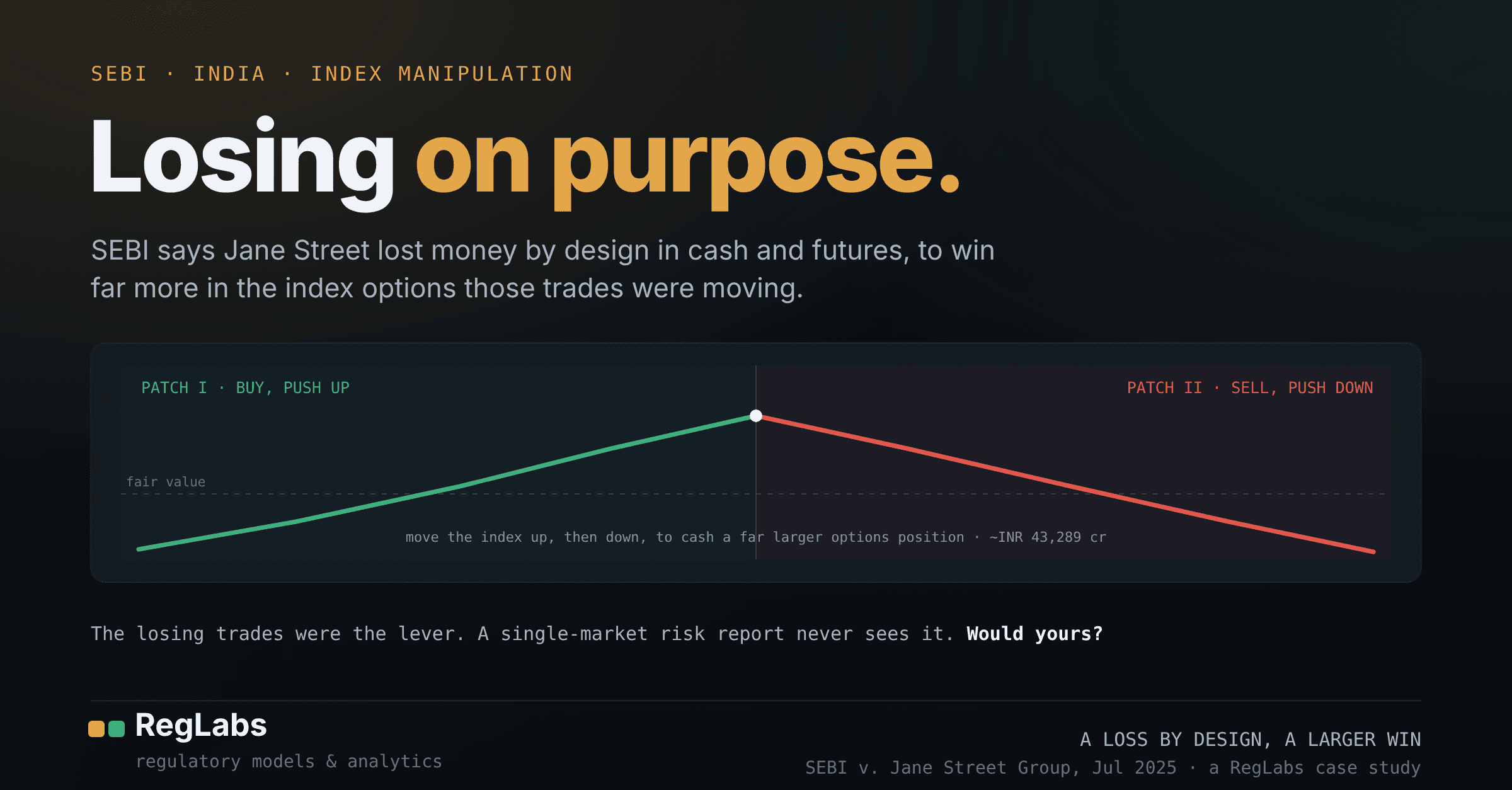
No competent trading firm loses money by accident, over and over, in the same markets. SEBI says Jane Street did it on purpose.
SEBI’s interim order against Jane Street Group describes a trading operation that worked precisely and repeatably across dozens of expiry days over roughly two years. On SEBI’s prima facie findings, it moved an entire index on purpose, losing money by design in the cash and futures markets in order to win far more in the index options those trades were steering. The alleged profit in index and stock options was on the order of INR 43,000 crore, about five billion dollars.
The losing trades were the tell. A deliberate, reliable loss in one market only makes sense as the price of a larger win in another. This is the anatomy of that trade: how a small market was used to move a much larger one, and why it is the kind of scheme a single-market risk report never sees.
SEBI interim order: case facts
The interim order records prima facie findings, disputed by Jane Street, and the matter remains under examination.
Source: SEBI interim order, 3 July 2025.
What SEBI alleges, in one paragraph
A sophisticated, automated trading group moved India’s most-traded index derivatives by moving the smaller market underneath them, on purpose, again and again.
On 3 July 2025, the Securities and Exchange Board of India issued an interim order making prima facie findings against entities of the Jane Street Group.1 SEBI described two recurring strategies around the expiry of BANKNIFTY and NIFTY index options. In one, the group bought large, aggressive volumes of index constituent stocks and futures early in the day to push the index up, while holding much larger opposite positions in index options, then reversed and sold hard to push it back down. In the other, it traded aggressively near the close on expiry day to move the settlement price toward its expiring options. The cash and futures trades that did the pushing often lost money. The options positions they were steering made far more. SEBI found this fell foul of Section 12A of the SEBI Act and the PFUTP Regulations against fraudulent and manipulative trade practices, and separately flagged a structure that appeared to work around a rule that applies only to foreign investors. It is an interim order with prima facie findings, which Jane Street disputes, and the matter remains under examination.
The number that explains it
The figure that frames this case is not the profit. It is the loss. According to SEBI’s order, across the period examined the group made roughly INR 43,289 crore in index and stock options, while net losing about INR 7,208 crore in stock futures, INR 191 crore in index futures, and INR 288 crore in cash equities.1
Read those losses again. A firm whose entire reason for existing is to be right about prices chose, consistently, to lose money in the cash and futures markets. No competent trader loses that much that reliably by accident. The losses only make sense if they were never meant to be profitable on their own. They were the cost of moving the market, and the options were where that movement was cashed in. SEBI puts it directly: the aggressive cash and futures trading had, in its view, little standalone economic rationale other than to manipulate prices.
That inversion, a deliberate loss as the price of a larger win, is the thread through everything below. It is also the thing a single-market risk report would never flag, because in isolation each losing book just looks like a book that lost.
A machine built to be right
Jane Street is not a boiler room. It is one of the most sophisticated quantitative trading firms in the world, with more than 2,600 people across offices in the United States, Europe and Asia, trading in 45 countries.1 Its edge is precisely the ability to see and act on the mathematical relationships between related instruments faster and more accurately than almost anyone else. This matters to the story, because it removes the usual defenses.
When a regulator describes a small operator pushing a penny stock, you can imagine clumsiness, or a one-off. None of that is available here. A firm of this caliber does not accidentally run thousands of crore of losses in one market while holding the exactly offsetting, much larger winning position in another. If the pattern SEBI describes is there, it is there by design, executed by systems built to do exactly this, with full understanding of the arbitrage mechanics that connect the markets. The sophistication is not a mitigating factor. It is the point.
That is why this belongs in a series about machines and the humans who govern them. The Jane Street systems, on SEBI’s account, are the best-case version of automation: precise, disciplined, consistent, utterly in control. And they were allegedly pointed at an objective that the rules prohibit.
Why expiry day, why index options
To see the alleged strategy, you need one fact about market structure that the order itself takes care to explain.1 On expiry days, trading in index options is vastly larger than trading in the underlying constituent stocks and futures. The derivatives are the ocean; the cash market beneath them is a pond.
The two are tied together by arbitrage. Through relationships like put-call parity, the price of an index option is anchored to the level of the index, which is just a basket of its constituent stocks. Move the constituents, and the index moves. Move the index, and every option on it reprices. Because the options market is so much larger than the cash market on expiry day, a relatively modest, aggressive push in the thin underlying can swing the value of an enormous options position.
This is the asymmetry the alleged scheme runs on. You do not need to spend as much moving the index as you stand to gain on the options, as long as your options position is large enough. The arbitrage that normally keeps prices honest becomes, if abused, the transmission belt that turns a small manufactured move in one market into a large, engineered payoff in another.
Push the index, cash the options
SEBI calls the first pattern the Intraday Index Manipulation Strategy, and found it on about 15 of the 18 days it examined closely.1 It unfolds in two patches across a single expiry day.
In Patch I, early in the day, the group bought large and aggressive volumes of BANKNIFTY constituent stocks and futures, pushing the index up. This created, in SEBI’s words, a false or misleading appearance of market activity, drawing other participants into index options at prices that were artificially and temporarily elevated. Crucially, the group’s own, far larger position in the options was positioned on the other side. In Patch II, later in the day, it reversed: selling the constituents and futures just as aggressively, pushing the index back down, so the options positions paid off as the manufactured move unwound.
The intraday pattern
SEBI describes buying to push the index up and selling to push it down, with a larger opposite index-options position.
Source: SEBI interim order, 3 July 2025.
On the most profitable day SEBI examined in detail, 17 January 2024, it attributed a single-day gain of about INR 735 crore to this pattern.1 The group’s intraday trades in the underlying cash and futures lost money that day. The options, moved by those trades, more than made up for it. Repeat the structure across expiry after expiry, and the arithmetic of section 02 is the result.
Marking the close
The second pattern SEBI describes is older and simpler, a classic abuse with a name: extended marking the close.1 On an index derivative, the settlement value is driven by the closing level of the index. Whoever can nudge that closing level can change what every expiring contract is worth.
On the days SEBI flagged for this pattern, the group held large positions in options expiring that day, then traded aggressively in the constituent stocks and futures in the closing window to push the settlement price in the direction that made those options most valuable. Buy hard into the close when you hold the bullish side; sell hard into the close when you hold the bearish side. The order describes both a bearish version, pressing the settlement down, and a bullish one, lifting it.
Marking the close is among the most well-understood manipulation typologies in the world, which is exactly why its appearance here is so striking. This is not an exotic new trick that surveillance could be forgiven for missing. It is a named pattern that every market surveillance textbook describes, allegedly executed at scale, on expiry days, in the most liquid index in the market.
A loss with no other purpose
Return to the losses, because they are the evidentiary heart of the order. SEBI did not have to prove what anyone was thinking. It only had to show that the aggressive trading in the underlying had, by a preponderance of probability, no economic rationale other than to move prices.1 The firm’s own books supplied that proof.
The group’s profit and loss by market
The order states a gain of INR 43,289 crore in index and stock options and losses of INR 7,208 crore in stock futures, INR 288 crore in cash equities and INR 191 crore in index futures.
Source: SEBI interim order, 3 July 2025.
This is why the case is so clean as a matter of pattern, whatever its ultimate legal outcome. In a normal arbitrage business, the legs roughly offset and the firm earns a small, consistent spread. Here the legs did not offset in intent. One set of books was built to lose, reliably, so that another set of books could win far more. A trader does not do that by mistake. A machine does not do that unless it was told to.
Engineering around the rule
There is a second, quieter finding in the order that deserves attention, because it shows the same design mind at work on the compliance surface.1
Foreign portfolio investors in India are restricted under Regulation 20(4) of the FPI Regulations: they cannot net off intraday cash-market trades, and effectively cannot run the intraday buy-and-reverse cash leg that strategy one requires. Two of the Jane Street entities trading the large options positions were FPIs, and so were barred from doing the cash-market pushing themselves. The group also had an Indian-incorporated entity, JSI Investments, which was not an FPI and faced no such restriction. On SEBI’s account, it was the Indian entity that executed the intraday cash trades, the loss-making leg, while the FPIs held the winning options positions.
Read structurally, the Indian entity’s incorporation appears to have let the group do, through a domestic arm, the precise thing the foreign arms were prohibited from doing, without any single entity visibly breaching the FPI rule. SEBI treats the entities as one group under common control and reads the structure as a workaround.
For anyone governing automated or structured activity, this is the companion lesson to the trading itself. A control that applies to one legal entity, one desk, or one model is only as good as its reach. Sophisticated actors do not break such rules head on. They restructure until the rule technically does not apply, and the only way to see it is to look at the group as a whole and ask what the arrangement is for.
Told to stop, and didn’t
If the trading is the substance, the chronology is the aggravation. This was not a pattern caught on its first appearance.1
From first pattern to interim order
The sequence runs from the trading pattern identified in August 2023 through the interim order.
Source: SEBI interim order, 3 July 2025.
In February 2025, on SEBI’s instruction, the NSE issued a caution letter directing the Jane Street entities to refrain from taking large cash-equivalent positions and from the specific trading patterns of concern. The group replied. Then, SEBI found, it continued, running very large cash-equivalent positions and a fresh marking-the-close pattern on NIFTY expiry days in May 2025, in SEBI’s words in disregard of the caution and its own commitments. That continuation is a large part of why the regulator moved to an urgent interim order rather than waiting for a full adjudication: it concluded it needed to act, in its phrase, while the iron was hot, to protect other investors.
A machine that keeps running a flagged pattern after a direct warning is no longer a question of detection. It is a question of governance and intent, at the level of the people who decide what the machine is allowed to do.
Who was on the other side
Manipulation is sometimes framed as a victimless technicality, a fight between large professionals over fractions of a percent. This order forecloses that reading, because it names who was on the other side of the artificial prices.1
On expiry days, the index options being nudged are a mass retail market. When the index was pushed to an artificial, temporary level, the traders enticed to buy and sell options at those levels were, in large numbers, individuals. SEBI connects this to its own earlier research, published in September 2024, which found that about 93 percent of more than one crore individual futures-and-options traders lost money over the three years from FY22 to FY24.
The order does not claim the alleged manipulation caused all of those losses. It makes a narrower, sharper point: when a sophisticated group manufactures artificial prices on expiry day, the counterparties induced to trade at those prices are disproportionately small retail participants, and some meaningful part of their losses is the mirror image of the group’s gains. The INR 43,289 crore did not come from nowhere. In a zero-sum derivatives market, it came from the people on the other side of the trades.
The system that never errs
Almost everything we build to police automated systems, in markets and in AI alike, is built to catch errors: the trade that is out of line, the model that breaks, the number that spikes the wrong way. The operation SEBI describes produced none of those. Every trade was deliberate, controlled, and internally consistent. Nothing looked broken, because on SEBI’s account nothing was.
That is what makes it the harder case. Set the thing we usually guard against beside the thing SEBI describes, and the gap is the whole lesson.
Surveillance and the alleged trading pattern
The draft contrasts controls designed to identify malfunction with the deliberate trading pattern described by SEBI.
Source: SEBI interim order and RegLabs analysis.
Almost all of the energy in AI and automation governance today goes to the first column: the model that breaks, hallucinates, runs away, produces the wrong output. We build kill switches, circuit breakers, guardrails and testing regimes for the system that malfunctions. That work is necessary. It is also the easier half of the problem.
This order is the other half. It describes a system that never malfunctioned, never produced an error, never needed a kill switch, because it did exactly what it was designed to do, flawlessly, toward an objective that happened to be prohibited. No guardrail against malfunction catches that, because there is no malfunction. The only thing that catches it is governance of the objective: what is this system optimizing for, and is that goal itself permitted?
This is the uncomfortable frontier for every firm deploying optimizing systems. An AI told to maximize a number will find the most effective path to that number, including paths its designers would be embarrassed to defend, and it will not trip any error alarm along the way, because from the system’s point of view nothing is wrong. Jane Street, as SEBI describes it, is what that looks like when the optimizer is state of the art and the number is profit on expiry day.
What surveillance should have seen
The patterns SEBI describes are, with hindsight, highly detectable, which is both the frustration and the lesson. The control recommendations that map to this matter are not speculative; they describe surveillance that looks at the dimensions where this behaviour lives.2
- Cross-market, single-actor P&L surveillance. The tell was a group losing in cash and futures while winning far more in options. Monitoring that reconciles a single actor’s positions and profit across linked markets would surface a persistent, deliberate loss in one leg paired with a larger gain in another, the pattern no single-market report shows.
- Marking-the-close and expiry detection. Named scenarios for aggressive trading in index constituents in the closing window and around expiry settlement, correlated with the actor’s outstanding options exposure, so a push into the close that benefits an expiring position is flagged in its own right.
- Index-impact surveillance. Rules that watch for concentrated, aggressive trading in constituent stocks and futures that moves the index level, especially when it reverses within the day, the exact shape of the two-patch pattern.
- Algorithmic trading governance. Monitoring that an automated strategy behaves consistently with its stated purpose, so a system whose underlying trades have no standalone economic rationale is challenged, not just executed.
- Concentration limits and group-level views. Pre-trade and intraday limits on cash-equivalent exposure, assessed at the level of the whole group under common control rather than per entity, so a structure cannot distribute a scheme across arms to stay under each individual threshold.
- Entity-aware regulatory checks. FPI and similar rules enforced with sight of related-party structures, so a prohibited leg cannot simply be moved to the affiliate the rule does not name.
Not the first to lose on purpose
The instruments are new; the structure is not. Regulators have sanctioned the same essential move before, losing or trading uneconomically in one market to profit in a linked one, across very different asset classes.
Set against these, what is new about Jane Street is not the idea. It is the sophistication of the execution and the scale of the market it played out in: the most liquid index derivatives in one of the world’s largest options markets, with a retail crowd on the other side. The move is old. The machine running it, and the venue, are new.
The harder problem
Markets have spent a decade building defenses against the runaway algorithm: circuit breakers, mandatory pre-trade risk controls, and kill switches aimed squarely at the system that spins out of control. All of it is necessary, and none of it would have made any difference here. Nothing in the operation SEBI describes was a malfunction.
That is the harder problem this case leaves. A system that works perfectly, in complete control, optimizing exactly what it was told to optimize, can still be doing something the rules forbid, and it will never raise an error, because from inside the system there is no error. Catching that requires looking past the machinery to the goal: not only is the system operating correctly, but is the thing it is trying to do permitted at all?
For regulators, that means surveillance that reasons across markets and across a group’s whole structure, at the level of intent-shaped patterns rather than single-venue anomalies. For every firm building optimizing and AI-driven systems, it means the same discipline turned inward: govern what your systems are for, not just whether they are working. The danger in automated markets no longer looks like a crash. It looks like a system doing its job, flawlessly, toward an end no one stopped to forbid.
This case study is an independent analysis prepared by RegLabs for educational purposes, based on SEBI’s interim order of 3 July 2025 and public records. The order sets out prima facie findings only; it is not a final adjudication, and the Jane Street Group disputes the findings. Descriptions of strategies, figures and intent reflect SEBI’s order and are characterised as alleged or prima facie throughout. The price-path diagram is an illustrative schematic of the pattern the order describes, not actual market data. Nothing here is legal or investment advice.
Sources & notes
- SEBI, Interim Order in the matter of Index Manipulation by Jane Street Group, dated 3 July 2025 (Whole Time Member Ananth Narayan G.). Prima facie findings of violations of Section 12A(a), (b) and (c) of the SEBI Act, 1992 and regulations 3(a) to (d), 4(1), 4(2)(a) and 4(2)(e) of the PFUTP Regulations, 2003, and of Regulation 20(4) of the FPI Regulations, 2019. Figures (including approximately INR 43,289 crore in index and stock options profit and the stated losses in stock futures, index futures and cash equities, the ~INR 735 crore gain on 17 January 2024, the two strategies across 18 examined days, the February 2025 caution and May 2025 continuation, and the 93 percent retail-loss research) are as stated in the order. This is an interim order with prima facie findings, which Jane Street disputes; the matter remains under examination and nothing here is a final determination. Official document: sebi.gov.in . RegLabs case record: studio.reglabs.ai/case/10f04cff…
- studio.reglabs.ai/case/10f04cff…
- Control design points (cross-market and single-actor surveillance, marking-the-close and expiry detection, index-impact monitoring, algorithmic trading governance, group-level concentration limits, and entity-aware FPI checks) are drawn from the control recommendations accompanying the RegLabs case record for this matter.
- FERC, Order to Show Cause and Notice of Proposed Penalty, Total Gas & Power North America, Inc. et al. (28 April 2016); proposed civil penalties and disgorgement for uneconomic trading to affect monthly natural-gas index prices benefiting derivative positions. RegLabs record: studio.reglabs.ai/case/cf1512b7…
- FERC, Order to Show Cause and Notice of Proposed Penalty, BP America Inc. et al. (5 August 2013); alleged uneconomic trading to suppress the Houston Ship Channel gas daily index to benefit a financial position. RegLabs record: studio.reglabs.ai/case/08eb1919…
- CFTC, Order, Moore Capital Management, LP et al. (29 April 2010); $25 million civil monetary penalty for attempting to manipulate platinum and palladium futures settlement prices by banging the close. RegLabs record: studio.reglabs.ai/case/090bc6cf…