
- Enforcement
- Markets & Trading
- Governance & Accountability
The spoofing cost $800,000. Lying about it cost $17 million.
Scotiabank self-reported a spoofing trader, cooperated, and won a reduced penalty. Then the CFTC discovered the bank had misled it throughout that very investigation, hiding accounts, traders, and 27 trader IDs, telling the exchange it kept records it did not keep, and telling the regulator it ran spoofing-detection software it had never fed any data into. The cover-up was priced at twenty-one times the crime.
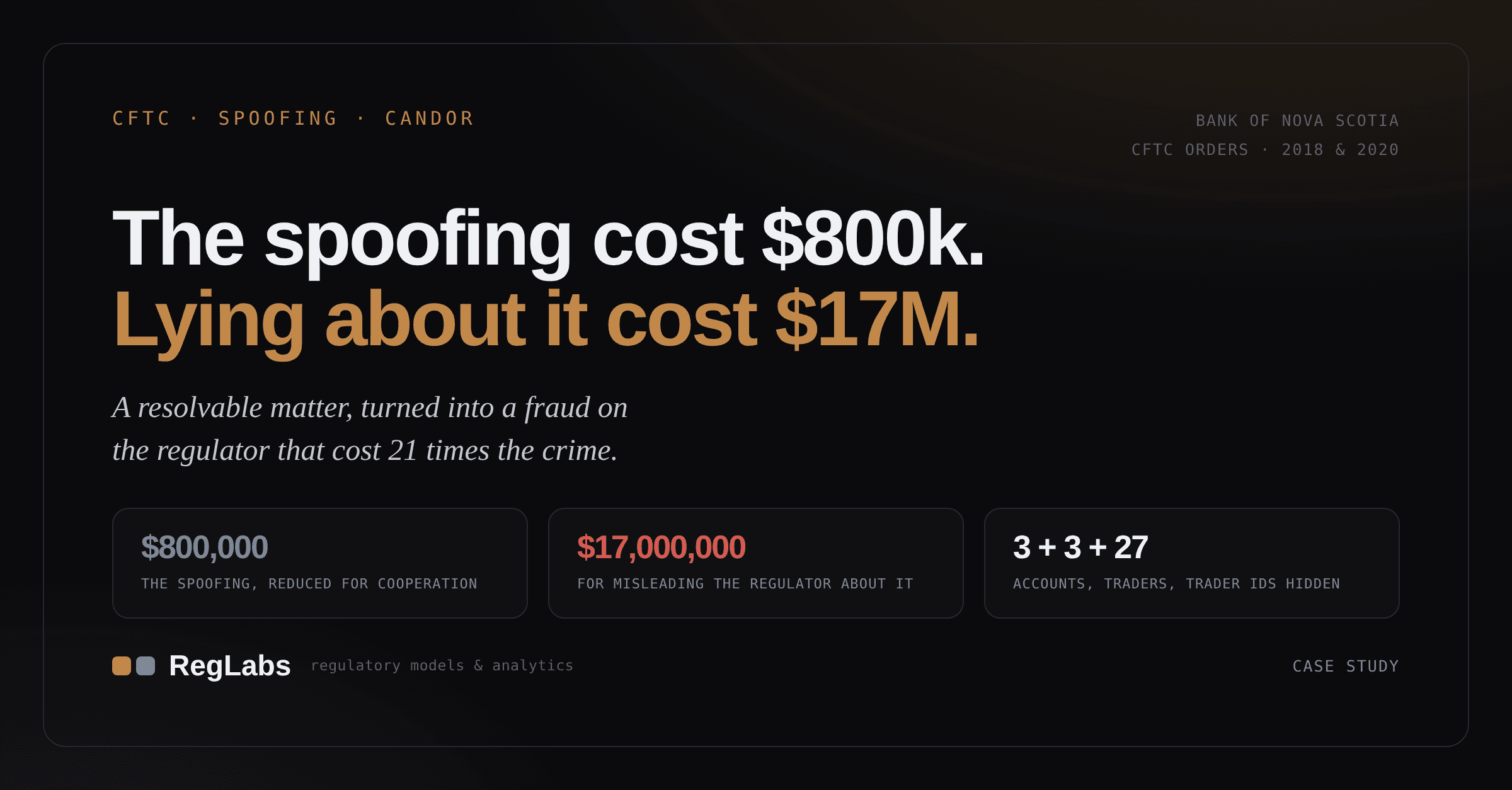
A reduced penalty, spent on a lie, repaid at twenty-one times the price
In September 2018, the Commodity Futures Trading Commission settled an investigation into spoofing by traders on the precious-metals desk of The Bank of Nova Scotia, imposing a civil penalty of $800,000, a figure the Commission substantially reduced in recognition of the bank's self-reporting, cooperation, and remediation. Spoofing, placing orders with the intent to cancel them before execution in order to create a false impression of supply or demand, had occurred in gold and silver futures from June 2013 through June 2016, and BNS had disclosed to the CFTC that one of its traders, whom it terminated, had engaged in it. The matter looked, in 2018, like a model of how a firm should handle its own misconduct: find it, report it, fix it, and receive credit for the candor.1
It was not. On 19 August 2020, the CFTC issued a second order finding that, throughout the 2018 investigation, BNS had made multiple false and misleading statements and omitted material facts, and that the Commission's decision to accept the 2018 settlement had been predicated on representations BNS made during the investigation that were false or misleading. Over five written submissions between February and July 2017, the bank had failed to identify three of its accounts through which it traded precious-metals futures, three of the traders who traded them, and at least twenty-seven of the order-entry operator identifiers, called Tag50s, those traders used, including the Tag50s of the very trader terminated for spoofing. Those omissions, the Commission found, prevented it from addressing the true nature and scope of the bank's spoofing. For that conduct, and for related false statements to the exchange and the self-regulatory organization, the CFTC imposed a penalty of $17 million, more than twenty-one times the penalty for the spoofing itself.1
The crime, and the cover-up, priced side by side
Two CFTC orders, 2018 and 2020. The cooperation credit that shrank the first was built on candor the second found to be false.
Source: CFTC, In the Matter of The Bank of Nova Scotia (spoofing), Order of 28 September 2018, and In the Matter of The Bank of Nova Scotia (false statements), Order of 19 August 2020.
This study treats the Scotiabank matter as the definitive case on candor to regulators, the obligation that sits beneath and behind every other compliance obligation, because the integrity of what a firm tells its regulator is the foundation on which the entire supervisory relationship rests. It walks the spoofing, the surveillance tool that monitored nothing, the cooperation credit and its premise, the omissions that hollowed out the investigation, and the false statements to the exchange and the self-regulator, and it lifts each into the discipline it violated: why a surveillance system with no data in it is not a control; why cooperation credit is a loan a firm takes out against its own future candor; why misleading a regulator during an investigation is a separate and graver offense than the conduct investigated; why representations to an exchange or a self-regulatory organization carry the full weight of representations to the regulator itself; and why a compliance function that authors a misrepresentation is not a weak control but the absence of one. It closes on the proposition that candor is the control behind all other controls, because a regulator that cannot trust what a firm tells it cannot rely on any of the firm's controls at all, and the firm that spends its credibility is left with nothing the regulator can accept.
What spoofing is
To understand both the original offense and why hiding the traders who committed it mattered so much, it helps to be precise about what spoofing is and how a market detects it. Spoofing, as the CFTC defines it and as the statute prohibits, is bidding or offering with the intent to cancel the bid or offer before execution. A spoofer places orders it does not intend to fill, large orders on one side of the market, to create a false impression of supply or demand, inducing other participants to trade against the trader's genuine, smaller orders on the other side at prices the spoofer has artificially moved. The orders that do the manipulating are the ones the spoofer always meant to cancel, and the moment they have done their work of misleading the market, they are pulled.1
What makes spoofing legally and practically distinctive is that it is a crime of intent manifested in a pattern, not in any single order. A large order that is later cancelled is, on its own, entirely legitimate; traders cancel orders constantly for innocent reasons, and the right to place and cancel orders is fundamental to how markets work. What makes a cancelled order a spoof is the intent behind it, the intent to cancel before execution, formed at the time of placement, and that intent is not visible in the order itself. It is inferred from the pattern: orders placed and cancelled in a systematic relationship to the trader's genuine orders on the other side, repeated in a way that reveals the orders were never meant to trade. Detecting spoofing therefore requires looking across a trader's whole sequence of orders, placements, cancellations, and the genuine trades they surround, and reconstructing the pattern that betrays the intent. It is inherently a surveillance problem, and a surveillance problem of a specific kind: one that requires attributing orders to traders and analyzing each trader's complete order sequence over time.
This is why the identities at the center of the 2020 case, the accounts, the traders, and above all the Tag50s, matter so much, and why hiding them was so damaging. A Tag50 is an order-entry operator identifier, the tag that ties a given order to the individual who entered it. Surveillance for spoofing depends entirely on being able to attribute orders to traders, because the pattern that reveals spoofing is a pattern in a single trader's behavior, and you cannot see that pattern if you cannot tell which orders a given trader placed. To hide a trader's Tag50s is to make that trader's order pattern invisible to surveillance, to sever the orders from the hand that placed them. When BNS omitted twenty-seven Tag50s, including those of the terminated spoofer, from its submissions to the CFTC, it was not withholding administrative trivia; it was concealing the very identifiers that would have let the Commission reconstruct the full scope of the spoofing, which is exactly what the Commission found the omissions did.
The tool that monitored nothing
One of the false statements the CFTC found is so clean an illustration of a hollow control that it deserves to be isolated, because it shows a firm claiming the appearance of surveillance while possessing none of its substance. During the period in question, BNS made a presentation to the National Futures Association, the self-regulatory organization, about its continuous monitoring program. The presentation reflected that BNS was using a software program to monitor for manipulative or deceptive trading activity, including spoofing. What it failed to explain was that BNS had not imported any trade-order data into the program, which rendered the program's monitoring for spoofing entirely ineffective. The compliance officials who prepared the slide, the CFTC found, knew that portion of the presentation was false.1
A surveillance program with nothing to surveil
The firm told the self-regulator it monitored for spoofing with software. The software had never been given a single order to look at.
Source: CFTC, In the Matter of The Bank of Nova Scotia (spoofing), Order of 28 September 2018, and In the Matter of The Bank of Nova Scotia (false statements), Order of 19 August 2020.
Sit with what this describes, because it is the purest possible form of a control that exists only as an appearance. BNS had acquired a surveillance tool, a piece of software designed to monitor for manipulative trading including spoofing, and it could truthfully say it had the software. What it had not done was the one thing that makes the software a control: feed it the data. A spoofing-surveillance program with no trade-order data imported is not a weak surveillance program or a poorly-tuned one; it is not surveillance at all, because surveillance is the analysis of data, and a tool analyzing no data analyzes nothing. The program could run, could appear on an architecture diagram, could be named in a presentation, and could detect precisely zero instances of anything, because it had never been shown a single order. The firm had purchased the form of a control and never supplied its content, and then represented the form to its self-regulator as though it were the substance.
The detail that the compliance officials knew the slide was false is what elevates this from a gap to a misrepresentation, but set that aside for a moment and consider the underlying condition, because even an honest version of it would be a serious control failure. A firm that believes it is monitoring for spoofing because it owns monitoring software, while the software receives no data, has a catastrophic blind spot it does not know it has: it feels covered, can report that it surveils, and is in fact surveilling nothing. The illusion of coverage that an unfed tool creates is more dangerous than an acknowledged absence of surveillance, because an absence prompts action while an illusion produces complacency. BNS's tool was the illusion made literal, a monitoring program whose monitoring was defined entirely by the data it did not have.
A control with no data is not a control
The empty surveillance tool crystallizes a discipline that firms systematically miss because they conflate acquiring a control with operating one: a surveillance or monitoring control is defined not by the software or the system but by the data flowing through it, and a tool that receives no data, or incomplete data, is not a weak control, it is the absence of one, no matter how capable the tool or how prominently it features in the firm's description of itself. BNS owned spoofing-monitoring software and imported no data into it, which means it had, as a matter of substance, no spoofing surveillance at all.1
The reason this confusion is so common is that acquisition is visible and operation is not. Buying a surveillance system is a discrete, documentable act: the firm selects a vendor, implements the software, and can point to the system as evidence that it monitors for the relevant risks. Feeding the system complete and accurate data, continuously, is an ongoing, invisible operational discipline that produces no artifact to point to and fails silently when neglected. A firm can therefore have, with complete sincerity, a strong sense that it is covered, because it has the system, while the system sits starved of the data that would make it function, and nothing about the system's mere existence reveals the gap. This extends well beyond the extreme case of no data at all, which is where BNS sat: a surveillance system fed incomplete data, missing certain traders, certain accounts, certain products, certain venues, has a blind spot exactly the size of the missing data, and a system fed stale, delayed, or erroneous data produces unreliable results across its whole output. In every case the control's real coverage is a function of the data it actually receives, not of the capability it nominally possesses, and a firm that assesses its surveillance by the systems it owns rather than the data they consume is measuring the wrong thing entirely.
Assess surveillance by its data coverage, not its tooling
The discipline is to assess every surveillance and monitoring control by the completeness, accuracy, and timeliness of the data flowing into it, treating data coverage as the measure of the control, and to verify continuously that each system is actually receiving the full population of data it needs to do its job. Concretely, a firm must be able to show, for each surveillance scenario, exactly what data feeds it, confirm that the feed covers every relevant trader, account, product, and venue, and detect when a feed is missing, incomplete, or delayed, because a gap in the data is a gap in the surveillance regardless of the tool's sophistication. The test is not whether the firm has a spoofing-surveillance system but whether that system is actually analyzing the complete, current order data of every trader it should, and a firm that can describe its tools but cannot demonstrate that they are fully fed has not shown it has surveillance, it has shown it has software. BNS's unfed tool is the reductio of the whole principle: a monitoring program is worth exactly the data it monitors, and a program monitoring no data is worth nothing, however real the software and however confident the presentation about it.
The credit, and what it rests on
The 2018 settlement is the hinge of the whole case, because the leniency it granted was built entirely on a foundation the firm was simultaneously undermining. When the CFTC resolved the spoofing investigation in September 2018 for $800,000, it did so, as it later recorded, with a penalty substantially reduced in recognition of BNS's self-reporting, cooperation, and remediation. The bank had disclosed the spoofing trader, had represented that it was cooperating with the investigation, and had received the benefit that regulators extend to firms that deal with them honestly and helpfully. And the Commission's acceptance of that settlement, the 2020 order states, was predicated on certain representations BNS made during the investigation that were false or misleading.1
Cooperation credit is one of the most important mechanisms in modern enforcement, and understanding what it is premised on is essential to seeing why BNS's conduct was so corrosive. A regulator cannot investigate every firm exhaustively; it depends, heavily, on firms being honest with it, self-reporting their own misconduct, producing complete and accurate information, and cooperating in good faith, and it incentivizes that honesty by substantially reducing penalties for firms that provide it. The entire arrangement is a bargain built on trust: the firm gives the regulator truthful, complete cooperation, and the regulator, relying on that cooperation, resolves the matter more favorably and more efficiently than it could through adversarial investigation. The credit is the price the regulator pays for the firm's candor, and it is extended on the assumption that the candor is real. When a firm collects the credit, the reduced penalty, the favorable resolution, the regulator's forbearance, while providing cooperation that is in fact incomplete and misleading, it has obtained the benefit of the bargain without paying its price, which is to say it has defrauded the regulator of the leniency. BNS received the reduced 2018 penalty for cooperation it was not genuinely providing, which is why the 2020 order treats the matter not as a cooperation that fell short but as a settlement obtained on false premises.
Cooperation credit is a loan taken against your own future candor
The 2018 credit and the 2020 reckoning together crystallize a discipline about dealing with regulators that firms treat too lightly: cooperation credit and the favorable treatment that comes from self-reporting are extended on the strength of the firm's representations, and a firm that collects them while being less than fully candid has not earned leniency, it has taken out a loan against its own honesty that the regulator will call, with interest, the moment the truth emerges. BNS spent the credit it had not earned, and the $17 million is the loan being called.1
The reason this framing matters is that firms experience cooperation credit as a present benefit and underweight the contingent liability it creates. In the moment, cooperating, self-reporting, and representing full candor produce an immediate, tangible reward, a reduced penalty, a faster resolution, a better relationship with the regulator, and the temptation, where the firm's cooperation is actually incomplete, is to collect that reward while hoping the incompleteness is never discovered. But the reward is not a payment for cooperation as the firm chooses to define it; it is a payment for complete and honest cooperation, and the firm's representations of candor are the collateral. If those representations later prove false, the firm has not merely failed to earn the credit; it has obtained a benefit by misrepresentation, which converts the original matter into a fraud on the regulator and typically results in penalties far exceeding what the underlying conduct alone would have drawn, as BNS's twenty-one-fold multiplier demonstrates. The credit is genuinely available and genuinely valuable, but only to a firm whose cooperation is actually complete and honest, and a firm that takes the credit on partial candor has borrowed against a truth it cannot control the disclosure of, because regulators share information, investigations continue, and the omitted facts, the hidden Tag50s, the unfed software, tend eventually to surface. When they do, the loan comes due, and the interest is the enforcement premium for having deceived the regulator in the first place.
Earn the credit with complete candor, or do not claim it
The discipline is that a firm seeking the benefits of self-reporting and cooperation must provide complete, accurate, and honest candor to earn them, must never represent cooperation it is not fully providing, and should understand that every favorable resolution obtained on the strength of its representations is contingent on those representations being true, a contingent liability that crystallizes catastrophically if they are not. This means that when a firm decides to cooperate, it must commit to genuine completeness, producing all relevant information, identifying all relevant actors, correcting any error in its submissions the moment it is found, and never allowing the desire for favorable treatment to shade its candor, because the favorable treatment is worthless, and worse than worthless, if the candor behind it is false. The test is whether a firm's cooperation is complete enough that it would withstand the regulator later learning everything, and a firm that is collecting cooperation credit while hoping certain facts stay hidden, as BNS did with its omitted traders and Tag50s and its unfed software, is not cooperating, it is defrauding, and the eventual price is the enforcement equivalent of a called loan. Candor is the only currency that actually buys leniency, and a firm cannot counterfeit it, because the regulator holds the right to audit the payment forever.
What the bank hid during the investigation
The specific omissions the CFTC found are worth laying out precisely, because their character, they concealed exactly the information surveillance for spoofing requires, is what made them so damaging. During the 2018 investigation, the Division of Enforcement issued multiple written requests to BNS to identify all accounts through which it traded precious-metals futures, all traders who traded them, and all Tag50s those traders used. Over five written submissions between February and July 2017, BNS failed to identify three accounts, three traders, and at least twenty-seven Tag50s that its traders used to trade precious-metals futures, with certain traders using more than one Tag50. Among the omitted Tag50s were those of the trader the bank had terminated for spoofing.1
Omitted from five written submissions, February to July 2017
The CFTC had asked, in writing, five times, for exactly these. The omissions prevented it from addressing the true nature and scope of the spoofing.
Source: CFTC, In the Matter of The Bank of Nova Scotia (spoofing), Order of 28 September 2018, and In the Matter of The Bank of Nova Scotia (false statements), Order of 19 August 2020.
The pattern of the omissions is what distinguishes them from an innocent gap. These were not facts the regulator failed to ask for; the Division issued multiple written requests specifically for the accounts, the traders, and the Tag50s, and BNS responded to those requests across five submissions over six months, each time failing to provide the complete answer. The firm possessed the information, its own records identified the accounts, traders, and Tag50s, and it was, the Commission noted, contemporaneously reporting certain of the same trader and Tag50 information to the exchange while omitting it from its submissions to the Division. So this was not a firm that could not find the information or did not understand what was requested; it was a firm that had the information, was reporting some of it elsewhere, and repeatedly failed to provide it in full to the regulator investigating its spoofing. And the content of the omissions pointed directly at the misconduct: by withholding accounts, traders, and especially the Tag50s of the terminated spoofer, the bank concealed precisely the identifiers that would have let the Commission reconstruct the full scope of the spoofing, which the Commission expressly found the omissions did. The hidden facts were not random; they were the facts that would have revealed how much spoofing there really was.
Candor to the regulator is the master obligation
BNS's omissions crystallize the discipline that sits above all others in a regulated firm's relationship with its supervisor: complete and accurate candor to the regulator is the master obligation, because every other control and obligation the firm has is only as credible as the honesty of what the firm tells the regulator about it, and misleading a regulator during an investigation, by false statement or by material omission, is a distinct and graver offense than the conduct being investigated. BNS's spoofing drew $800,000; its misleading of the investigation into the spoofing drew $17 million, because the latter struck at the foundation the whole system rests on.1
The reason candor is foundational, rather than one obligation among many, is that the entire edifice of financial regulation depends on it. A regulator does not and cannot directly observe most of what a firm does; it relies on what the firm reports, discloses, and represents, and it supervises through examinations and investigations in which it asks questions and depends on truthful, complete answers. Every substantive obligation a firm has, to surveil, to keep records, to maintain controls, to report, is verified primarily through the firm's own representations about its compliance, which means that if those representations cannot be trusted, none of the substantive compliance can be verified either. A firm that lies to its regulator does not merely commit an additional offense alongside the underlying one; it attacks the mechanism by which the regulator confirms anything about the firm, which is why regulators treat candor violations with a severity that often exceeds the underlying misconduct. An omission is as much a candor violation as a false statement, because the obligation is to provide complete and accurate information, and a response that is literally true but materially incomplete, like BNS's submissions that identified some but not all of the traders and Tag50s, misleads exactly as effectively as an outright falsehood. The duty is not merely to avoid lying; it is to affirmatively provide the complete, accurate truth in response to the regulator's inquiries.
Make complete candor a controlled, verified process
The discipline is to treat candor to regulators, in filings, examinations, investigations, and all communications, as the firm's paramount obligation and to build a controlled process around it that ensures every response is complete, accurate, and verified before it is given, because a material omission or misstatement to a regulator is a graver offense than most underlying misconduct and strikes at the foundation of the supervisory relationship. This means that responses to regulatory requests, especially in investigations, must be subject to rigorous internal verification, confirming that the firm has searched completely, identified every responsive item, and provided the full and accurate answer, with particular care that responses are not merely literally true but materially complete, and with any error corrected and disclosed the instant it is discovered. The test is whether a firm's representations to its regulator would survive the regulator independently learning everything the firm knows, and a firm whose submissions omit material facts it possesses, as BNS's did across five submissions, has failed the one obligation that cannot be failed without poisoning everything else. Candor is not a compliance obligation among others; it is the obligation on which the regulator's ability to accept any of the firm's other representations depends, and a firm that compromises it has compromised its entire standing with its supervisor.
The $800,000 that became $17 million
The two numbers at the heart of this case, placed against each other, tell the whole story more economically than any argument: the spoofing was penalized at $800,000, and misleading the regulator about the spoofing was penalized at $17 million, roughly twenty-one times as much. The ratio is not an accident or an aberration; it reflects a consistent principle in how regulators and prosecutors weigh underlying misconduct against the concealment of it, and the principle is worth stating plainly because firms so often get it backwards in the moment of decision.1
The reason the cover-up is priced above the crime is rooted in what each one damages. The underlying misconduct, the spoofing, harmed the market and other participants, and it was serious, but it was also bounded, detectable, and, once found, resolvable through the normal enforcement process, which is exactly what the 2018 settlement did, at a penalty reduced because the firm appeared to be dealing with it honestly. The concealment damaged something the enforcement process itself depends on: the regulator's ability to rely on what the firm tells it, which is the mechanism by which every matter, including this one, is supposed to be resolved. A firm that commits misconduct and is honest about it leaves the supervisory system intact and functioning; a firm that commits misconduct and lies about it to the regulator attacks the system's capacity to function at all, and regulators price that attack heavily precisely because they must, because a world in which firms could mislead investigations without severe consequence is a world in which the supervisory model collapses. The twenty-one-fold multiplier is the regulator signaling that the integrity of the process is worth far more than any single instance of the conduct the process exists to address, and that a firm which preserves its candor will be treated far more leniently than one which spends it, even for identical underlying misconduct.
When you have a problem, the disclosure decision dwarfs the conduct decision
The discipline, for any firm that discovers misconduct within itself, is to recognize that the decision about how to deal with the regulator, candidly and completely, or evasively, is far more consequential than the misconduct itself, and to resolve it toward complete candor every time, because the penalty differential between honesty and concealment dwarfs the penalty for the underlying conduct. This is the practical lesson of the twenty-one-fold multiplier: a firm facing its own misconduct will be tempted to minimize, to shade its disclosures, to hope certain facts stay buried, and that temptation is the single most dangerous one in the entire situation, because yielding to it converts a bounded, resolvable problem into an attack on the regulator that will be punished at a multiple of the original. The test a firm should apply when it finds a problem is to ask not only how do we fix the conduct but, more importantly, how do we ensure our dealing with the regulator about it is completely honest, because the second question governs the far larger exposure. BNS got the first decision substantially right, it found and reported the spoofing, and the second decision catastrophically wrong, it misled the investigation, and the twenty-one-fold ratio between the two penalties is the measure of how much the second decision matters more. The crime is survivable; the cover-up is what multiplies it.
The cover-up exceeds the crime
The multiplier generalizes into one of the oldest and most reliable principles in all of enforcement, and one firms persistently underweight because it runs against the instinct to minimize a problem: the concealment of misconduct is punished more severely than the misconduct itself, so the response to a discovered problem determines the firm's exposure far more than the problem did. It is true across domains and regulators, and the Scotiabank numbers, $800,000 against $17 million, are simply an unusually clean expression of it.1
The principle holds because concealment adds a second, graver wrong on top of the first and compounds the firm's culpability in a way that aggravates everything. The underlying misconduct may have been the act of a few traders, bounded in time, and potentially the product of control failures rather than institutional intent; it is bad, but it is the kind of thing enforcement is built to resolve. Concealment is different in character: it is a deliberate institutional choice to deceive the regulator, it typically involves more senior people than the original misconduct, and it demonstrates that the firm, faced with a choice between honesty and self-protection, chose to deceive its supervisor, which tells the regulator something damning about the firm's integrity that the original misconduct alone did not. The regulator responds to that demonstration not only with a larger penalty but with a deeper distrust, because a firm that has lied once in an investigation has shown it will, and every future representation it makes is now suspect. The cover-up thus costs more than the crime in two currencies at once: in the immediate penalty, which is multiplied, and in the firm's standing, which is durably impaired in a way a one-time instance of underlying misconduct, honestly handled, would never have been. A firm that honestly discloses its own misconduct remains a trustworthy counterparty that made a mistake; a firm that conceals it becomes an untrustworthy one, which is a far worse thing to be.
Resolve every disclosure dilemma toward disclosure
The discipline is that a firm must resolve every dilemma about whether to disclose, how completely to disclose, and whether to correct a prior incomplete disclosure, in favor of full disclosure and correction, recognizing that concealment is punished more severely than the underlying matter and damages the firm's standing in ways no penalty fully captures. This means building a culture and a set of controls in which the reflex, upon discovering a problem or an error in a prior submission, is to disclose and correct immediately and completely, because the alternative, hoping it stays hidden, carries the asymmetric risk the Scotiabank case illustrates: a limited downside to disclosure and a catastrophic, multiplied downside to concealment discovered. The test is whether, at every point where the firm could have chosen minimization over candor, it chose candor, and a firm that shaded, omitted, or failed to correct, as BNS did, has taken the one path that reliably makes everything worse. The cover-up always costs more than the crime, and the firms that internalize this treat the discovery of their own problems as, above all, a disclosure decision, and they make it toward the truth, because the truth, however painful, is always cheaper than its concealment.
Lying to the exchange and the self-regulator
The false statements in the case were not confined to the CFTC; the bank also misled the exchange and the self-regulatory organization, and the CFTC treated those as violations of equal gravity under a separate provision of the statute. During the relevant period, COMEX, via CME Group's Market Regulation Department, conducted multiple Electronic Trading Recordkeeping Exams of BNS as a clearing member. When asked how it maintained records of Tag50s, BNS falsely represented to COMEX that it kept a database of the Tag50s it had assigned to its traders, pointing to policy and procedure documents that were in fact silent on the matter, when the firm did not maintain a comprehensive repository of Tag50s. And the false presentation to the NFA about its monitoring software, describing surveillance that was not actually functioning, was the other half of the same pattern. The CFTC found that these false statements to COMEX and the NFA violated Section 9(a)(4) of the Act.1
The inclusion of the exchange and the self-regulator alongside the CFTC itself makes an important point about the scope of the candor obligation, because firms sometimes treat their self-regulatory organizations as less consequential audiences than the government regulator, a softer forum where representations carry less weight. The Scotiabank case flatly contradicts that view. COMEX and the NFA are self-regulatory organizations with delegated authority over the markets and their members, and their examinations and oversight are part of the same supervisory system the CFTC sits atop; a false statement to them is a false statement to the regulatory structure, and the statute makes it a federal violation in its own right. BNS's false representations to COMEX about its Tag50 recordkeeping during formal recordkeeping examinations, and to the NFA about its monitoring program, were not lesser transgressions than its omissions to the CFTC; they were the same kind of offense directed at other parts of the same structure, and they drew the same statutory treatment. A firm that is scrupulously honest with the CFTC but shades its representations to the exchange or the self-regulator has not met its candor obligation; it has merely misunderstood its scope.
Your answers to an SRO carry the full weight of the law
The COMEX and NFA findings crystallize a discipline firms too often miss: representations to exchanges, self-regulatory organizations, and any body exercising delegated regulatory authority carry the full weight of representations to the primary regulator, and a false or misleading statement to a self-regulator in an examination is a federal violation, not a lesser matter in a softer forum. BNS's false statements to COMEX and the NFA were penalized under the same statute, in the same order, as its misleading of the CFTC.1
The reason firms underweight representations to self-regulators is a kind of category error about the regulatory structure. The firm perceives a hierarchy, with the government regulator at the top and self-regulatory organizations as intermediaries, and infers, wrongly, that the obligations owed to the intermediaries are correspondingly lesser. But the self-regulatory organizations are not a softer tier of the structure; they are the structure, operating with delegated authority, conducting the examinations and oversight through which much of the day-to-day supervision actually happens. An exchange's recordkeeping examination of a clearing member is a formal regulatory process, and the member's answers in it are formal regulatory representations, subject to the same obligation of candor and the same consequences for its breach as any statement to the primary regulator, which is exactly why the statute reaches false statements to registered entities and self-regulatory organizations as its own offense. A firm that maintains rigorous candor in its direct dealings with the primary regulator while treating exchange and self-regulator examinations as lower-stakes exercises where a convenient answer will do has created a gap in its most important obligation precisely where it feels least scrutinized, and that gap is exactly what the Scotiabank exchange and self-regulator findings occupy.
Hold every regulatory representation to the same standard
The discipline is to treat every representation to any body exercising regulatory or self-regulatory authority, the primary regulator, the exchanges, the self-regulatory organizations, in any examination, inquiry, or filing, as carrying the full weight of law and the full obligation of candor, with the same verification and the same rigor regardless of which body is asking. This means a firm's process for ensuring complete and accurate regulatory responses must extend uniformly across all of its supervisors, with exchange and self-regulator examinations subject to the same internal verification as a direct regulatory inquiry, because a false statement in any of them is a violation and the firm's credibility is indivisible across them. The test is whether a firm's representations to its exchanges and self-regulators would withstand the same scrutiny as its representations to its primary regulator, and a firm that holds the former to a lower standard, as BNS did in telling COMEX it kept records it did not keep, has misunderstood that there is only one standard. Candor is owed to the entire regulatory structure, and a firm's honesty is a single reputation that every part of that structure can see and will share, so a lie told in the examination that feels least important is a lie told to the whole system.
The slide compliance knew was false
The single most troubling detail in the entire case is a short clause in the CFTC's findings about the NFA presentation, and it concerns who made the misrepresentation. The presentation to the NFA stated that BNS was using software to monitor for manipulative or deceptive trading including spoofing, while omitting that no trade-order data had been imported into the program. And the Commission found, specifically, that the BNS compliance officials who prepared the slide presentation knew this portion of the presentation was false. The misrepresentation about the firm's surveillance was authored, knowingly, by the very function whose job is to ensure the firm's representations are true.1
The compliance officials who prepared the presentation "knew this portion of the presentation was false."
This is a categorically different failure from a firm whose business side deceives a regulator while compliance is kept in the dark, and it is worse, because it corrupts the control function itself. In the ordinary, already-serious case, a firm's traders or business leaders mislead the regulator and the compliance function has failed to prevent it; the control was inadequate, but it was at least pointed in the right direction. When the compliance officials are the ones who knowingly prepare the false presentation, the control function has not failed to catch a misrepresentation, it has become the source of one, which means the firm's last line of defense against deceiving the regulator is the thing doing the deceiving. A firm relies on its compliance function to be the guardian of its candor, the part of the organization specifically charged with ensuring that what the firm tells its regulators is true, and when that function knowingly authors a false statement to a self-regulator about the firm's own surveillance, there is no guardian left. The slide is not evidence of a compliance program that was weak; it is evidence of a compliance program that was, in this instance, operating in reverse, manufacturing the misrepresentation it existed to prevent.
The control function cannot be the one that lies
The knowingly false slide crystallizes a discipline that is almost definitional and yet was violated here: the compliance and control functions are the guardians of a firm's integrity and candor, and when they are the ones who knowingly make a misrepresentation, the firm has not a weak control but no control, because the function that exists to ensure honesty cannot be the source of the dishonesty without the entire control structure collapsing. BNS's compliance officials knowingly authored a false statement about the firm's surveillance, which is the guardian becoming the threat.1
The reason this is so corrosive is that the compliance function occupies a position of presumed trust that the whole control structure depends on. When a firm represents its compliance to a regulator, the regulator relies substantially on the assumption that the compliance function, whatever the failings elsewhere in the firm, is the part that tells the truth, because that is its defining role. The business may have conflicts, the traders may have incentives to cut corners, but compliance is supposed to be the counterweight, the function whose loyalty is to the rules and to honest dealing with the regulator. When compliance itself knowingly makes a false statement, that presumption is destroyed, and with it the regulator's ability to rely on any representation routed through or blessed by the control function, which is most of them. A firm whose compliance officials will knowingly prepare a false presentation has no reliable internal source of truth about its own compliance, which means neither the regulator nor the firm's own leadership can trust what the function reports. This is why the knowing involvement of compliance in a misrepresentation is treated as gravely as it is: it is not a failure within the control system but a failure of the control system, the corruption of the specific function whose integrity the entire structure presupposes.
Protect the integrity of the control function above all
The discipline is that a firm must hold its compliance and control functions to an absolute standard of candor and protect their integrity above all, because those functions are the guarantors of the firm's honesty with its regulators, and the moment they knowingly participate in a misrepresentation the firm has lost the thing that makes any of its representations credible. This means a firm must build its control functions to be independent enough, and its culture around them honest enough, that compliance officials are never placed in the position of, or willing to, author a statement they know to be false, with escalation paths and protections that make truth-telling the only option, and it means treating any instance of compliance knowingly misrepresenting as the gravest kind of failure, because it is. The test is whether a firm's control functions can be relied upon, by the regulator and by the firm's own board, as a source of truth under all circumstances, and a firm whose compliance officials knowingly prepared a false regulatory presentation, as BNS's did, has failed that test at the root. The control function's integrity is the firm's integrity, because it is the part the regulator trusts to be honest when it cannot trust anything else, and a firm that lets that function lie has nothing left for the regulator to rely on.
The records they had and did not give
A final detail sharpens the whole case and removes any possible reading of the omissions as inability rather than evasion: BNS possessed the very records it failed to produce, and was producing some of them to another regulator at the same time. The Commission found that BNS's own records identified the accounts, traders, and Tag50s that the firm omitted from its submissions to the Division, and, strikingly, that BNS was contemporaneously reporting certain of the same trader and Tag50 information to COMEX, via CME Market Regulation, that it omitted from its reporting to the Division, due in part to inconsistency in the firm's recordkeeping and reporting. The firm had the information and was giving pieces of it to one part of the regulatory structure while withholding it from another.1
The inconsistency across recipients is the detail that most clearly establishes the character of the failure, and it carries its own lesson about recordkeeping and production. A firm that genuinely cannot locate or assemble certain records produces them to no one; a firm that produces certain trader and Tag50 information to the exchange while omitting the same information from the regulator investigating its spoofing has demonstrated that it possessed the information and that the omission was selective rather than a product of genuine inability. The CFTC's observation that the inconsistency was due in part to inconsistency in BNS's recordkeeping and reporting adds a structural dimension: a firm without a single, authoritative, comprehensive repository of key data, here, a central repository of Tag50s, cannot produce consistent, complete information across its various regulatory obligations, and the gaps and inconsistencies in its production become both a compliance failure in themselves and, where they align conveniently with concealing misconduct, evidence of something worse. BNS's lack of a comprehensive Tag50 repository was not merely the subject of a false statement to COMEX; it was the condition that made its production to the CFTC incomplete and inconsistent, and the incompleteness fell, as such incompleteness often does, in exactly the place that concealed the scope of the spoofing.
Completeness and consistency of production are a control
The inconsistent production crystallizes a discipline that firms treat as mere recordkeeping hygiene and that the Scotiabank case shows to be central: the completeness and consistency of what a firm produces to its regulators is itself a control, dependent on the firm maintaining authoritative, comprehensive records, and inconsistent or incomplete production, whatever its cause, both violates the firm's obligations and creates the appearance, or the reality, of selective concealment. BNS could not produce consistent, complete Tag50 information because it had no comprehensive Tag50 repository, and the gaps aligned with hiding its spoofing.1
The reason this is a control rather than an administrative nicety is that a firm's ability to respond to its regulators completely and consistently depends entirely on the quality of its underlying records, and a firm that lacks authoritative, comprehensive repositories of its key data cannot meet its candor obligations even when it intends to, because it cannot assemble the complete, consistent answer. When the CFTC, COMEX, and the NFA each ask BNS about its traders and their Tag50s, a firm with a single authoritative repository of that information produces the same complete answer to each; a firm whose Tag50 information is scattered, inconsistent, and incomplete produces different partial answers to different bodies, which is both a failure of its production obligations and, as the Scotiabank case shows, a condition in which concealment can hide, because incomplete production is indistinguishable from, and can shade into, selective withholding. The firm's recordkeeping is therefore upstream of its candor: it cannot be consistently honest with its regulators about facts it has not maintained in a form that lets it produce them completely and consistently. This means that comprehensive, authoritative recordkeeping of the data regulators will ask about, trader identities, order-entry identifiers, accounts, communications, is not a back-office concern but a precondition of candor, and its absence is a control failure that both breaches the firm's obligations directly and leaves it unable to demonstrate that its incomplete production was innocent.
Maintain authoritative records, and reconcile production across regulators
The discipline is to maintain single, authoritative, comprehensive repositories of the key data regulators will request, trader and operator identifiers, accounts, orders, communications, and to reconcile what the firm produces across all of its regulators and self-regulators so that every body receives the same complete and consistent answer, because incomplete or inconsistent production is both a direct violation and a condition in which concealment hides. This means a firm must know where its authoritative records of each key category live, ensure they are comprehensive and current, and have a process that assembles complete responses from them and checks that what is produced to one regulator is consistent with what is produced to another, so that no gap or inconsistency, innocent or otherwise, creeps into its production. The test is whether a firm could produce the same complete, consistent answer about its traders, accounts, and identifiers to every regulator that asks, and a firm that cannot, because its records are scattered and inconsistent as BNS's Tag50 records were, has a recordkeeping failure that undermines its candor at the root. Complete and consistent production is a control, its foundation is authoritative recordkeeping, and a firm that neglects the records will find, as Scotiabank did, that the resulting gaps fall in the worst possible places and look, to a regulator, exactly like concealment.
The broader lesson: candor is the control behind all the controls
The enduring lesson of the Scotiabank case is that candor to regulators is not one compliance obligation among many but the foundation beneath all of them, because a regulator that cannot trust what a firm tells it cannot rely on any of the firm's controls, reports, or representations, and a firm that spends its credibility is left with nothing the regulator can accept, which is why misleading the regulator cost twenty-one times what the underlying misconduct did. BNS had controls, a surveillance tool, policies, a compliance function, and it hollowed every one of them by lying about them, to the CFTC, to the exchange, and to the self-regulator, including through the compliance function itself.1
The disciplines this study has drawn out all serve that foundation. Assess surveillance by its data, not its tooling, because BNS's spoofing-monitoring software had no data in it and was therefore no control at all, a fact the firm then lied about. Earn cooperation credit with complete candor or do not claim it, because the credit is a loan against the firm's honesty that the regulator will call with interest, as the $17 million called the reduced $800,000. Treat candor to the regulator as the master obligation and build a verified process around every response, because material omissions mislead as effectively as lies and strike at the system's foundation. Resolve every disclosure dilemma toward disclosure, because the cover-up is reliably punished above the crime. Hold representations to exchanges and self-regulators to the same standard as to the primary regulator, because a false statement to any of them is a federal violation and the firm's credibility is indivisible. Protect the integrity of the control function above all, because a firm whose compliance officials knowingly lie has no guardian of its candor left. And maintain authoritative records and reconcile production across regulators, because incomplete production both breaches the firm's obligations and is where concealment hides. Each is a way of protecting the one thing the firm cannot afford to lose, the regulator's ability to believe it.
The forward view: the examination that trusts less and verifies more
The reason the case grows more relevant is that the supervisory relationship it concerns is being reshaped by exactly the kind of conduct Scotiabank exhibited, and in a direction that makes candor both more verifiable and more unforgiving. Regulators increasingly have the data and the tools to independently check what firms tell them, to reconstruct order flow and attribute it to traders, to compare a firm's representations across its various filings and examinations, and to detect the inconsistencies and omissions that once might have passed, which means the space in which a firm could mislead a regulator and hope the gap went unnoticed is shrinking, and the probability that a BNS-style omission or an unfed-tool misrepresentation is discovered is rising. In that environment the only durable strategy is complete candor, because the alternative is a bet against the regulator's growing ability to verify, and that is an increasingly losing bet with an increasingly catastrophic payout. The firms that will navigate the coming decade are the ones that treat their regulators as counterparties to whom they owe, and reliably provide, the complete truth, that build the records and the verification to make complete candor possible, and that protect the integrity of the control functions that guarantee it, because the supervisory relationship rewards the trustworthy firm and punishes the deceptive one at a multiple that is only growing. Scotiabank spent its credibility to save $800,000 of exposure and paid $17 million for the attempt, and the forward lesson is that credibility is the most valuable and least recoverable asset a firm has with its regulator, and the one it must never, under any pressure, spend.
What this case is really about
A resolvable spoofing matter, turned into a $17 million fraud on the regulator
Scotiabank self-reported a spoofing trader and won a reduced $800,000 penalty for cooperation. Then the CFTC found the cooperation had been false: across five submissions the bank omitted 3 accounts, 3 traders, and 27 trader IDs, including the spoofer's, preventing the Commission from seeing the true scope of the spoofing. It told COMEX it kept a Tag50 repository it did not keep, and told the NFA it ran spoofing-monitoring software, without mentioning it had never imported any trade data into it, a slide its compliance officials knew was false. The lie cost $17 million, twenty-one times the spoofing.
Where it broke
- Spoofing-monitoring software with no trade-order data imported, so it monitored nothing, and the firm said otherwise
- Cooperation credit obtained on representations the CFTC later found false or misleading
- 3 accounts, 3 traders, and 27+ Tag50s omitted across five written submissions, concealing the scope of the spoofing
- False statements to COMEX about keeping a Tag50 repository and to the NFA about the monitoring program
- Compliance officials who knowingly prepared the false NFA presentation about the firm's surveillance
- Records the firm possessed but produced inconsistently across regulators, with no comprehensive Tag50 repository
What candor to regulators requires
- Surveillance assessed by the completeness of the data feeding it, not by the tools the firm owns
- Cooperation and self-reporting backed by genuinely complete, verified candor, or not claimed
- Every regulatory response verified for material completeness, with errors corrected the moment found
- Representations to exchanges and self-regulators held to the same standard as to the primary regulator
- Control-function integrity protected absolutely, so compliance is never the author of a misstatement
- Authoritative, comprehensive records and production reconciled so every regulator gets the same complete answer
Trade Surveillance Governance agent
Tests the design and operation of a firm's manipulation-surveillance program against global enforcement and the typologies each scenario must catch, including spoofing and layering: whether a spoofing scenario exists and is calibrated to catch the firm's own order patterns, whether every trader, account, order-entry identifier, product, and venue is actually feeding the surveillance, and whether the data coverage is complete, current, and reconciled, so a tool that owns the software but imports no data, a Tag50 or account missing from the feed, or a scenario calibrated never to fire is surfaced as a program-design finding, with a remediation target and a health score, before an examiner discovers the firm has been monitoring nothing, and long before the firm is tempted to misrepresent the gap.Five ways RegLabs keeps the surveillance real and the candor earned
This case study is an independent analysis prepared by RegLabs for educational and informational purposes, based on the CFTC's public orders concerning The Bank of Nova Scotia (28 September 2018 and 19 August 2020). It is not legal advice and does not reproduce the orders in full. All figures and quotations are drawn from the public record; any characterizations are those of RegLabs. Company and regulator names are used for identification and commentary only.