
- Enforcement
- Markets & Trading
- Governance & Accountability
They called it free. The customers paid in worse prices.
Robinhood's commission-free trading ran on payment for order flow, and the firm negotiated a deal that explicitly traded its customers' price improvement for its own revenue, roughly an 80/20 split in the firm's favor. "Free" cost certain customers about $34.1 million in worse execution. Then the firm told them its execution matched or beat the competition, while its own analysis said it lagged by a wide margin.
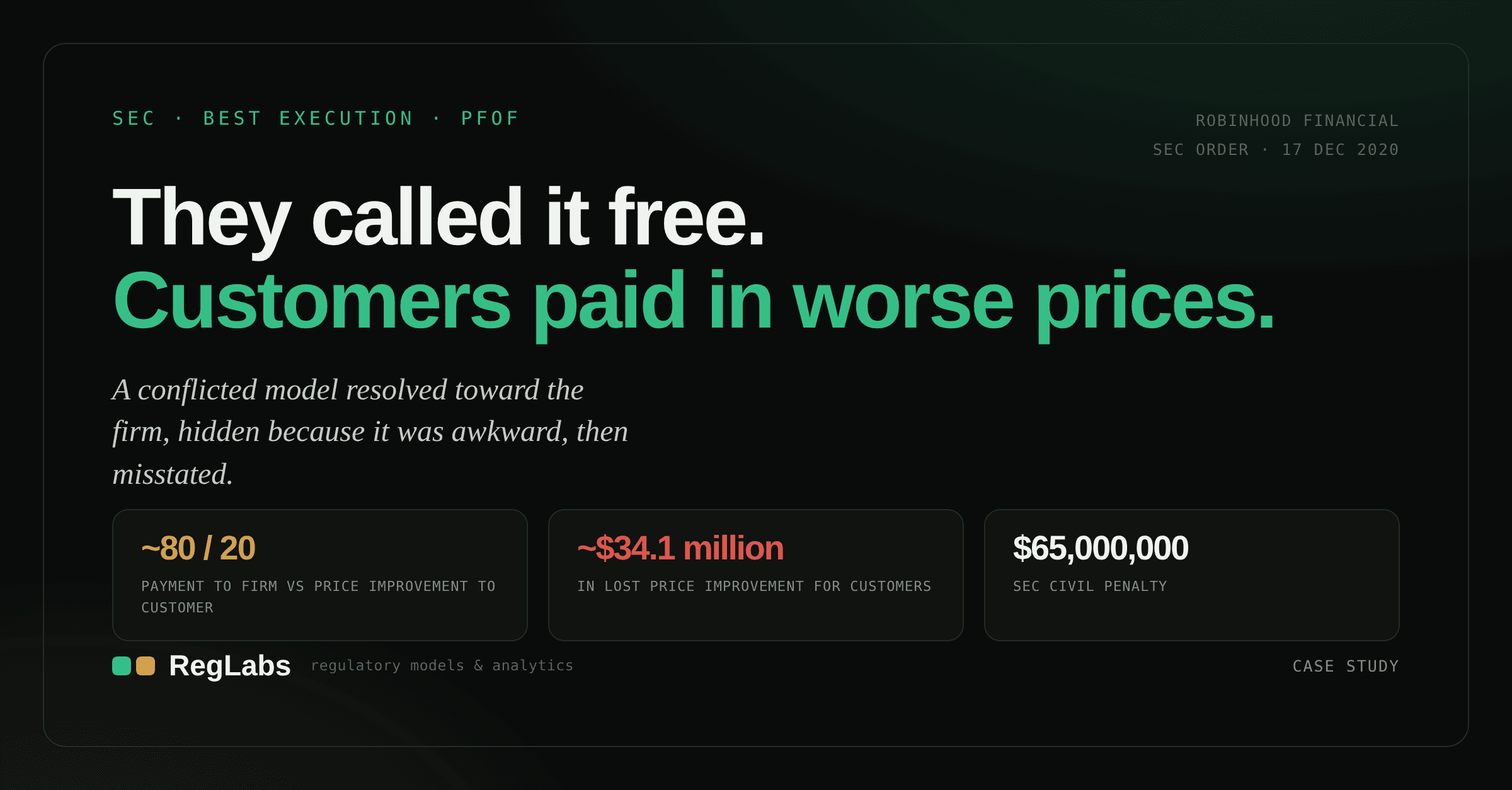
A $65 million penalty for the price of "free"
On 17 December 2020, the Securities and Exchange Commission settled proceedings against Robinhood Financial, LLC, by then one of the largest retail broker-dealers in the United States, imposing a $65 million civil penalty. The order found material misrepresentations and omissions about Robinhood's revenue sources and its execution quality, and a failure to satisfy its duty of best execution. The violations spanned Sections 17(a)(2) and 17(a)(3) of the Securities Act, Section 17(a) of the Exchange Act and the books-and-records Rule 17a-4, and the common-law duty of best execution that every broker routing customer orders owes. The subject at the center of it all was the business model that made Robinhood famous: commission-free trading.1
Commission-free did not mean cost-free, and the gap between those two is the whole case. Robinhood's single largest source of revenue, since its launch, was payment for order flow: the practice by which a retail broker, instead of sending customer orders to an exchange, routes them to principal trading firms, also called electronic market makers, that pay the broker for the flow. Payment for order flow is legal and widespread, but it carries an inherent conflict, because the payment goes to the broker while the thing it competes with, price improvement, better execution prices, goes to the customer. Robinhood did not merely accept this conflict; it leaned into it. The firm negotiated a payment-for-order-flow rate substantially higher than what the trading firms paid other retail brokers, in a deal that split the value roughly 80/20 in the firm's favor, and, as the SEC put it, it explicitly offered to accept less price improvement for its customers in exchange for a higher rate of payment for itself.1
How Robinhood split the value its order flow created
Roughly an 80/20 split of the value between the firm's payment and the customer's execution price.
Source: SEC, In the Matter of Robinhood Financial, LLC , Securities Act Release No. 10906 / Exchange Act Release No. 90694, 17 December 2020.
The consequence was measurable and was borne by customers who thought they were trading for free. Between October 2016 and June 2019, certain Robinhood orders received approximately $34.1 million less in price improvement than they would have received at competing retail brokers, a cost that existed precisely because Robinhood had traded execution quality for revenue. And the firm did two further things that turned a conflict into a set of misrepresentations: for years it omitted payment for order flow from its customer-facing descriptions of how it made money, because it believed customers might find the practice controversial, even instructing its customer-service representatives not to mention it, and in October 2018 it published a claim that its execution quality matched or beat other major brokerages at the very moment its own internal comparisons were showing it was worse, a claim it left up until the SEC's examiners questioned it in June 2019. This study walks the conflict, the concealment, and the false claim, and lifts each into the discipline it violated: why a firm cannot trade its customers' benefit for its own revenue; why the absence of a visible fee is never the absence of a cost; why the fact a firm least wants to disclose is the one it most must; why a disclosure cannot be quietly un-published; and why a public claim contradicted by a firm's own data is not optimism but knowing falsity.
How "free" trading actually works
To see the conflict at the heart of the case, you have to understand where a commission-free broker's money comes from, because the absence of a commission does not mean the absence of a revenue model, it means the revenue has moved somewhere less visible. When a retail customer places an order to buy or sell a stock, the broker does not have to send that order to a public exchange. It can route the order to a principal trading firm, an electronic market maker, that will execute the order against its own inventory, and those firms pay brokers for the privilege of receiving that order flow. That payment, payment for order flow, is how a broker can charge no commission and still make money, and for Robinhood it was the single largest revenue source from the start.1
The reason order flow is worth paying for, and the reason the arrangement carries a conflict, lies in what happens to the price. When a market maker executes a retail order, it can execute it exactly at the national best bid or offer, the prevailing public quote, or it can execute it at a slightly better price, giving the customer what is called price improvement. The value a market maker is willing to return on a given order flow is finite, and it can be split between two recipients: price improvement, which benefits the customer, and payment for order flow, which benefits the broker. Every dollar of that value directed to the broker as payment is a dollar not directed to the customer as price improvement, and every dollar given to the customer as price improvement is a dollar the broker did not receive as payment. The two are in direct tension, drawn from the same pool, which is precisely why the SEC describes payment for order flow as having the potential to create a conflict of interest: the broker is choosing how to divide a fixed value between its own revenue and its customers' execution prices, and its financial interest pulls toward keeping more for itself.
This is the structural reality every commission-free broker operates inside, and it is not inherently improper; payment for order flow is legal, disclosed under SEC rules, and used across the industry, and a broker can take payment for order flow while still delivering competitive execution. What the arrangement demands is that the broker manage the conflict faithfully, splitting the value in a way consistent with its overriding duty to seek the best reasonably available terms for its customers' orders, and that it be honest with customers about the arrangement and about the execution quality they are actually receiving. The conflict is a condition of the business, not a violation of it. Robinhood's failures were in how it managed the conflict, which was to resolve it heavily in its own favor, and in how it described it, which was to hide it and then to misstate the result. The model was permissible; what Robinhood did inside it was not.
The explicit trade
What moves the Robinhood case from an ordinary conflict-of-interest matter to a stark one is that the firm did not merely let the conflict tilt against its customers by inattention; it actively negotiated for the tilt. In 2016, Robinhood began routing its customer orders directly and solely to principal trading firms, and in those negotiations it secured a payment-for-order-flow rate substantially higher than the rate the same firms paid to other retail brokers. The way it secured the higher rate is the damning detail: Robinhood explicitly offered to accept less price improvement for its customers than the trading firms were offering, in exchange for a higher rate of payment for order flow for itself. The result was a split of the available value running roughly 80/20 in Robinhood's favor, far more lopsided than the arrangements its competitors struck.1
Sit with the structure of that trade, because it is the moral center of the case. The value created by routing a customer's order to a market maker is a shared pool that can go to the customer as price improvement or to the broker as payment. Robinhood, facing that pool, went to the market makers and proposed a specific division: give my customers less of it, and give me more. It traded away execution quality that its customers would otherwise have received, and it did so knowingly and by negotiation, in order to increase its own revenue. This is not a conflict that crept in; it is a conflict the firm consciously resolved against the very people it owed a duty to, and resolved not at the margin but to the tune of an 80/20 split. The customers whose orders generated the value had no seat at that negotiation and no knowledge of it, and the thing being bargained away was theirs.
The significance is sharpened by the duty Robinhood owed. A broker routing customer orders is not a neutral intermediary free to maximize its own take; it owes a duty of best execution, an obligation to seek the best reasonably available terms for its customers' orders. That duty does not forbid payment for order flow, but it does forbid a broker from subordinating its customers' execution quality to its own revenue, which is exactly what trading away price improvement for a higher payment rate does. Robinhood's negotiated 80/20 split was not a permissible business choice within the duty; it was a choice made against the duty, a deliberate decision to give its customers worse prices so that it could earn more, by a firm legally bound to seek them better ones. The explicitness is what makes it unforgettable: the firm did not fail to protect its customers' interest, it offered that interest up at the bargaining table.
You cannot trade the customer's benefit for your own revenue
Robinhood's negotiated split crystallizes the most fundamental discipline in any agency or fiduciary relationship, and the one the case violates most directly: when a firm owes a duty to act in its customers' interest, it cannot resolve a conflict between that interest and its own revenue by trading the former away for the latter, because the duty is precisely the obligation not to make that trade. Robinhood went to the market and bargained its customers' price improvement down to raise its own payment, which is the trade the duty of best execution exists to prohibit.1
The reason this discipline is so often tested is that conflicts between customer interest and firm revenue are not occasional; they are structural, built into the economics of most financial businesses, and a firm faces them continuously, in how it routes orders, prices products, recommends investments, and sets fees. In every such conflict there is a fixed or contested pool of value, and the firm has the power to direct more of it to itself at the customer's expense. The duty to the customer, whether best execution for a broker or the broader fiduciary duty for an adviser, is the constraint that is supposed to govern how the firm exercises that power: it may earn a fair return, but it may not resolve the conflict by sacrificing the customer's interest to its own, because that is the one move the duty forecloses. What makes Robinhood's conduct a clear violation rather than a close call is that the sacrifice was explicit and quantified: the firm did not merely fail to optimize the customer's outcome, it affirmatively negotiated to worsen it, offering less price improvement in exchange for more payment, which is the duty's prohibition stated as a business term sheet. A firm can take payment for order flow and meet its duty by directing the value in a way consistent with its customers' interest; it cannot meet its duty while bargaining that value away from them.
Resolve every conflict toward the duty, and prove you did
The discipline is that a firm owing a duty to its customers must resolve every conflict between that duty and its own revenue in favor of the duty, and must be able to demonstrate, with evidence, that it did so, treating any arrangement that trades customer benefit for firm revenue as a violation regardless of how the arrangement is characterized. Concretely, where a firm's revenue and its customers' interest draw on the same pool of value, order-routing payments and execution quality, product fees and product suitability, the firm must be able to show that it directed the value consistently with the customer's interest, not its own, and that its arrangements with counterparties did not purchase the firm's revenue with the customer's outcome. The test is whether, for any conflict the firm faces, the resolution favored the customer and the firm can prove it with analysis and records, and a firm that has negotiated terms worsening its customers' outcomes to improve its own revenue, as Robinhood did with its 80/20 split, has resolved the conflict the forbidden way and cannot cure it with disclosure or characterization. The duty is not a disclosure obligation to be satisfied by telling customers about the conflict; it is a conduct obligation to resolve the conflict in their favor, and the one thing it absolutely forbids is the trade Robinhood made.
The cost of free
The abstraction of split value becomes concrete in a single number that is the truest measure of what Robinhood's conflict cost the people it was supposed to serve. Between October 2016 and June 2019, certain Robinhood customer orders received approximately $34.1 million less in price improvement than those same orders would have received had they been placed at competing retail broker-dealers. The effect was particularly pronounced on larger orders, those of 100 shares or more, where the amount of price improvement at stake is greater. The customers paid no commission, and they paid $34.1 million in worse prices, a cost they never saw on any statement and that existed precisely because the trades were routed to maximize the firm's payment rather than their execution.1
What "commission-free" cost the customers who paid no commission
No commission appeared on any statement. The cost moved into the execution price, where no customer could see it. Free was a location, not a total.
Source: SEC, In the Matter of Robinhood Financial, LLC , Securities Act Release No. 10906 / Exchange Act Release No. 90694, 17 December 2020.
The $34.1 million is important not only as a measure of harm but as a demonstration of how a cost can be real and large while being completely invisible to the people bearing it. A commission is a line item; a customer sees it, understands it, and can compare it across brokers, which is exactly why commission-free was such a powerful marketing proposition, it eliminated the visible cost. But the cost did not disappear; it migrated into the execution price, where it is diffuse, per-order, and unobservable to a retail customer who has no way to know what price improvement they would have received elsewhere. Each individual customer's share of the $34.1 million was small and invisible, buried in the difference between the price they got and the better price they could have gotten, a difference no retail investor is equipped to detect. The aggregate was tens of millions of dollars, extracted in a way that no customer could see on any confirmation or statement, which is both why it was so effective as a business model and why it was so dangerous as a practice: the harm was maximized precisely by being hidden in the one place customers cannot inspect.
No visible fee is not no cost, and the duty runs to the total
The $34.1 million crystallizes a discipline that matters for every firm offering a "free" or "zero-fee" product, and that the marketing of such products is designed to obscure: the elimination of a visible fee does not eliminate the cost, it relocates it, and a firm's duty runs to the total cost its customers bear, including the costs that have been moved out of sight into prices, spreads, or execution quality. Robinhood eliminated the commission and moved the cost into execution, where it was larger, for some customers, than a commission would have been, and invisible.1
The reason this discipline is so important and so widely evaded is that "free" is among the most powerful words in consumer finance, and the business models behind free products are specifically engineered to make the cost disappear from view rather than disappear in fact. A customer choosing a broker, a bank account, a payment service, or an investment product on the basis of "no fees" is making a decision on visible cost, and a firm can win that decision by removing the visible cost while recovering more than its value through a channel the customer does not see: the spread, the execution price, the interest retained, the data sold, the counterparty payment. The customer experiences the product as free and is in fact paying, often more than they would under a transparent fee, through a mechanism they cannot observe or compare. A firm's obligation, whether framed as best execution, fair dealing, or honest marketing, is to the customer's true all-in outcome, not to the presence or absence of a labeled fee, and a firm that advertises free while recovering its revenue through a hidden, larger cost has not given the customer a better deal, it has given them a less visible one. The honest version of a free product is one whose hidden costs are genuinely lower than the visible fees it replaced; Robinhood's was one whose hidden cost, for many orders, was higher.
Account for the all-in cost, and market on that
The discipline is that a firm offering a product without a visible fee must understand, measure, and be honest about the total cost its customers actually bear, including costs embedded in prices and execution, and must not present the absence of a visible fee as the absence of cost when the cost has merely been relocated. This means a firm should be able to quantify its customers' all-in cost of using a "free" product, the execution quality they receive, the spread they pay, the value they forgo, and compare it honestly to the alternatives, rather than marketing on the visible-fee comparison alone while a larger invisible cost runs underneath. The test is whether the firm's customers are genuinely better off on a total-cost basis, and whether the firm's marketing reflects the total rather than only the visible line, and a firm advertising free while extracting more than the foregone fee through a hidden channel, as Robinhood did through execution quality, is misrepresenting the deal even if every individual statement about the absence of a commission is literally true. Free is a claim about total cost, and a firm that makes it while the total cost is higher than it appears has made the claim falsely, because the duty, and the honesty, run to the total the customer pays, not to the line the customer sees.
Hidden because it was controversial
Having built its revenue on payment for order flow, Robinhood made a choice about disclosure that the SEC order states with unusual bluntness, and that choice is the beginning of the misrepresentation case. In its customer-facing descriptions of how it made money, its website FAQs and its communications with customers, Robinhood omitted payment for order flow from its list of revenue sources, even though it was the firm's single largest source of revenue. The order is explicit about the reason: Robinhood omitted it because it believed that payment for order flow might be viewed as controversial by customers. The firm left its biggest revenue source out of its account of how it made money specifically because telling customers about it might trouble them.1
The timeline of the omission shows it was a sustained posture, not a one-time slip. As early as December 2014, Robinhood removed payment for order flow from its answer to the question of how it made money, moving it to a separate FAQ that described the revenue as indirect and negligible, and at some point in 2016 it deleted even that separate payment-for-order-flow FAQ entirely. From 2015 through September 2018, its retail communications omitted payment for order flow, and its prominent "How Robinhood Makes Money" FAQ, linked from the website's home page for stretches of that period, did not list the company's largest revenue source among the ways it made money. The firm maintained, on the page specifically titled to explain how it made money, an account that omitted the primary way it made money, for years, because that way was awkward.
The reasoning the SEC attributes to the firm, that it omitted the fact because customers might find it controversial, is the exact inversion of how disclosure is supposed to work, and that inversion is what makes the omission a violation rather than a judgment call. The potential for customers to react negatively to payment for order flow is a function of the practice mattering to them: customers would find it controversial because it bears on the conflict behind their "free" trades and the execution quality they receive, which is to say because it is material to their understanding of the service. A firm that omits a fact because its customers would care about it has identified, by its own reasoning, precisely the fact it is obligated to disclose, because materiality is defined by whether the fact matters to the customer's decision, and the firm's fear of controversy is its own admission that the fact matters. Robinhood did not omit a trivial detail; it omitted the detail it judged most likely to affect how customers viewed the service, which is the detail disclosure law most requires it to include.
The fact you least want to disclose is the one you most must
Robinhood's controversial-so-omit reasoning crystallizes a discipline that runs against a firm's every marketing instinct: the material fact a firm most wants to conceal, because it is unflattering, awkward, or likely to trouble customers, is almost always the fact it is most obligated to disclose, because the very quality that makes the firm want to hide it, that customers would care, is the definition of the materiality that requires its disclosure. Robinhood's discomfort with payment for order flow was its own evidence that payment for order flow was material.1
The reason this inversion is so reliable, and so reliably violated, is that firms experience disclosure through the lens of marketing, where the goal is to present the service favorably, and a fact that would trouble customers is a fact that works against that goal. The instinct is therefore to minimize, relocate, or omit the troubling fact, to describe the revenue as indirect and negligible, to move it to a separate page, to delete the page, to leave it off the list, because every one of those moves serves the marketing objective of not troubling the customer. But disclosure law operates on an opposite logic: it exists precisely to ensure that customers learn the facts that would affect their decisions, especially the unfavorable ones, because the favorable facts need no legal compulsion, the firm will volunteer them. The entire purpose of a disclosure obligation is to force out the information a firm would rather withhold, which means the information a firm is tempted to withhold is, almost by construction, the information the obligation targets. A firm's own reluctance to disclose a fact is therefore not a reason to omit it but a signal to disclose it prominently, because that reluctance is the firm telling itself the fact is material. Robinhood read its own reluctance exactly backwards, treating the controversy as a reason to hide rather than a reason to tell.
Disclose the uncomfortable fact prominently, and treat reluctance as a flag
The discipline is that a firm must disclose material facts in proportion to their materiality, prominently and plainly, and must treat its own reluctance to disclose a fact, the sense that it is unflattering or would trouble customers, as a strong signal that the fact is material and must be disclosed, never as a license to omit, minimize, or relocate it. This means that when a firm finds itself wanting to leave something out, move it to a buried page, or soften it into meaninglessness, it should recognize that impulse as a red flag that the fact matters, and should instead ensure the fact is disclosed where customers will actually see it, with the prominence its materiality warrants. The test is whether the facts most relevant to a customer's decision, including the unfavorable ones, are disclosed as prominently as the favorable ones the firm markets, and a firm whose marketing is prominent while its material-but-awkward disclosures are omitted or buried, exactly Robinhood's asymmetry between its "How We Make Money" FAQ and its deleted payment-for-order-flow page, has inverted the obligation. The fact a firm is tempted to hide is the fact disclosure exists to reveal, and the temptation itself is the proof.
The deleted FAQ and the missing records
The way Robinhood removed its payment-for-order-flow disclosure produced a second, separate violation that is easy to overlook and quietly important: the firm could not account for its own act of removal. When Robinhood deleted the payment-for-order-flow FAQ in 2016, and when it updated its "How Robinhood Makes Money" FAQ over the years, it failed to maintain adequate records of those modifications and their approvals. It kept no records showing when the payment-for-order-flow FAQ was deleted, why it was deleted, or who was responsible for approving its removal, and it kept incomplete records of the updates to the revenue FAQ, including who approved them. This violated Exchange Act Rule 17a-4, which requires broker-dealers to preserve, for at least three years, originals of business communications and the approvals of them.1
The recordkeeping failure matters beyond its technical character because of what the missing records conceal. A disclosure page about the firm's largest revenue source, a conflict-laden practice the firm itself considered controversial, was deleted, and the firm could not say when, why, or on whose authority. Those are exactly the facts that would reveal whether the deletion was a considered, governed decision or a quiet erasure of an inconvenient disclosure, and their absence means the act of removing a material disclosure happened with no accountable record of who decided it or why. The recordkeeping rules exist in part to ensure that decisions about a firm's communications, including decisions to change or remove disclosures, leave an auditable trail, so that a firm cannot alter what it tells customers without a record of having done so. Robinhood's inability to document the deletion of its payment-for-order-flow disclosure meant that one of the most consequential disclosure decisions it made, to stop telling customers about its largest and most conflicted revenue source, was undocumented, and a material disclosure disappeared from the firm's website with no governed, recorded decision behind it.
You cannot un-disclose, and removing a disclosure is a governed act
The undocumented deletion crystallizes a discipline that firms rarely consider because they think of disclosure as something you add rather than something you can take away: removing or changing a disclosure is as consequential a decision as making one, requiring the same governance, approval, and records, because un-disclosing a material fact, quietly dropping it from where customers were told it, is itself a disclosure decision with legal weight. Robinhood deleted its payment-for-order-flow disclosure and could not say who decided to, which is the governance of un-disclosure failing entirely.1
The reason this is overlooked is that organizations treat the removal of content as a low-stakes editorial act, housekeeping on a website, rather than as the reversal of a disclosure, and the asymmetry in how firms govern the two is stark. Adding a disclosure typically goes through review and approval, because the firm understands it is making a representation; removing one often does not, because it feels like simply taking something down, and the result is that a firm can subject its initial disclosure to governance and then quietly undo it with none. But the removal changes what customers are told exactly as much as the addition did, and arguably more consequentially, because it withdraws information customers previously had access to. When the removed content is a material disclosure, as Robinhood's payment-for-order-flow FAQ was, its deletion is a decision to stop disclosing a material fact, which is precisely the kind of decision that must be deliberate, approved by someone accountable, and recorded, both so that the firm can justify it and so that there is a trail if it was improper. A disclosure that can be silently deleted with no record is a disclosure the firm can effectively un-make at will, which defeats the purpose of having made it, and the recordkeeping rules exist to prevent exactly that silent reversibility.
Govern the removal of a disclosure like the making of one
The discipline is that changing or removing any material disclosure must be governed, approved, and recorded to the same standard as creating it, with a documented decision showing when, why, and on whose authority the disclosure was altered or withdrawn, because un-disclosing a material fact is a disclosure decision and must leave the same auditable trail. This means a firm needs version control and approval governance over its public disclosures that covers deletions and edits, not just additions, so that the firm can always show the history of what it told customers and account for every change to it, and so that a material disclosure cannot vanish without a recorded, accountable decision. The test is whether a firm can produce, for any disclosure it has changed or removed, the record of when and why and by whom, and a firm that can document how a disclosure was added but not how it was deleted, as Robinhood could not for its payment-for-order-flow page, has governed only half of its disclosure lifecycle. You cannot un-disclose a material fact as a matter of housekeeping; withdrawing it is a decision with the same weight as making it, and it demands the same deliberation and the same record.
Trained to deny it
The omission was not confined to what Robinhood wrote; it extended to what the firm trained its people to say, and that extension turned a passive omission into something closer to an active denial. When customers asked directly how Robinhood made money, the firm's customer-service representatives did not identify payment for order flow among its revenue sources, and in approximately 150 such inquiries between 2015 and August 2018 the largest revenue source went unmentioned. This was not accidental: training documents for customer-service representatives in early 2018 explicitly instructed them to avoid talking about payment for order flow, and stated that it was incorrect to identify payment for order flow in response to the question of how Robinhood makes money.1
Representatives were instructed to "avoid" discussing payment for order flow, and told it was "incorrect" to identify it as a source of revenue.
The training instruction is the moment the firm's conduct crosses a line that the FAQ omission only approached. Omitting a fact from a written description is a sin of omission; it leaves the fact unstated. Instructing employees to avoid a direct customer question about revenue, and telling them that the true answer is incorrect, is different in kind, because now a customer is affirmatively asking, and the firm has scripted its representatives to withhold the true answer and to treat the truth as an error. A customer who asks how the firm makes money and is given an answer that omits the largest source, by a representative trained to omit it, has not merely failed to encounter a disclosure; they have asked a direct question and been given a misleading answer by design. The characterization of the true answer as incorrect is especially striking, because it inverts truth and falsehood in the training itself: the representatives were told that the accurate statement, that payment for order flow was a revenue source, was the wrong thing to say. A scripted non-answer to a direct question is not the absence of a representation; it is a representation, engineered, that the thing omitted is not part of the answer.
You cannot train your way around a true answer
The discipline is that a firm cannot use training, scripts, or talking points to direct its employees to withhold or deny a material truth in response to customer inquiries, because a scripted omission in answer to a direct question is an affirmative misrepresentation, and instructing staff that the accurate answer is incorrect compounds the misrepresentation into something the firm has deliberately engineered. This means a firm's customer-facing training must equip representatives to answer material questions truthfully and completely, and must never instruct them to avoid, deflect, or deny a true and material fact, because the moment a customer asks and an employee is scripted to withhold the honest answer, the firm has manufactured a misrepresentation at scale, delivered by its own people under its own instruction. The test is whether a firm's training would produce truthful, complete answers to the questions customers actually ask about material matters, and a firm whose scripts steer representatives away from a true answer, or label the truth as incorrect, as Robinhood's did, has used its training function to institutionalize deception. A firm cannot disclose on paper while denying in person, and it certainly cannot teach its people that the truth is the wrong thing to say.
Matches or beats, while the data said lags
The final and most serious misrepresentation is the one where Robinhood did not merely omit a fact but affirmatively stated something its own analysis contradicted. By late 2018, as media attention turned to its payment-for-order-flow rates, Robinhood added the practice to its revenue FAQ, and on 12 October 2018 it published a new FAQ page that addressed execution quality, stating that Robinhood's execution quality and speed matches or beats what is found at other major brokerages. The problem was timing and knowledge: at that very time, Robinhood had begun comparing its execution quality to competitors and was learning that it was worse on most metrics, including the percentage of orders receiving price improvement. The firm published a claim of superior or equal execution at the moment its own data was showing the opposite.1
What Robinhood published, against what Robinhood knew
The public claim stayed up until June 2019, removed only after SEC examiners questioned it. The firm's own words measured the distance between its claim and the truth.
Source: SEC, In the Matter of Robinhood Financial, LLC , Securities Act Release No. 10906 / Exchange Act Release No. 90694, 17 December 2020.
The internal analysis makes the contradiction undeniable, and in Robinhood's own language. When the firm began benchmarking in October 2018, it learned its execution quality was worse on most metrics; by March 2019 a more extensive internal analysis stated, in words that leave no room for interpretation, that no matter how the data was cut, the firm's percentage of orders receiving price improvement lagged behind other retail brokerages by a wide margin. Senior Robinhood personnel were aware of this analysis. And yet the public claim that Robinhood's execution matched or beat its competitors remained on the website, uncorrected, through the period the firm was internally documenting that the opposite was true, and it was removed only in June 2019, after the SEC's examination staff raised concerns about that specific sentence. The firm published a claim of competitive execution, discovered through its own analysis that the claim was false, and left the claim standing until a regulator pointed at it.
A public claim your own data contradicts is knowing falsity
The matches-or-beats claim crystallizes a discipline that distinguishes an honest mistake from a violation: a public claim that a firm's own internal data contradicts is not optimism, puffery, or a defensible difference of view, it is a knowing misrepresentation, because the firm's own analysis is the measure of what the firm knows, and a claim made or maintained against that analysis is made or maintained in knowledge of its falsity. Robinhood's internal benchmarking was the proof of what the firm knew, and its public claim stood in direct contradiction to it.1
The reason this discipline is decisive is that it locates the line between aggressive marketing and fraud in a firm's own knowledge, which its internal analysis documents. Firms make favorable claims about themselves constantly, and many are defensible as optimistic characterizations, matters of interpretation, or genuine if arguable beliefs, and the law tolerates a good deal of favorable self-description. What it does not tolerate is a claim the firm knows to be false, and the clearest possible evidence of that knowledge is the firm's own contemporaneous analysis reaching the opposite conclusion. When Robinhood's internal data said its price improvement lagged competitors by a wide margin and its website said its execution matched or beat them, there was no room for the claim to be a defensible interpretation, because the firm itself had interpreted the data and reached the contrary result. The internal analysis is not just relevant evidence; it is the firm's own determination of the truth, and a public claim contradicting it is false by the firm's own lights. This also means that maintaining such a claim is as culpable as making it: once the March 2019 analysis existed and senior personnel knew it, every day the matches-or-beats claim stayed up was a day the firm published a statement it had itself disproven, which is why leaving it up until the regulator asked compounds rather than mitigates the violation.
Reconcile every public claim against your own analysis, continuously
The discipline is that a firm must reconcile its public claims against its own internal data and analysis, before making a claim and continuously while it stands, and must correct or withdraw any claim its analysis contradicts the moment the contradiction is known, because a claim at odds with the firm's own knowledge is a knowing misrepresentation and maintaining it is a continuing one. This means a firm needs a connection between the functions that generate internal analysis, execution-quality benchmarking, performance analysis, risk assessment, and the functions that make public claims, marketing, investor relations, client communications, so that a public claim is tested against what the firm actually knows and is pulled down when the knowledge turns against it. The test is whether every public claim the firm maintains is consistent with the firm's own current internal analysis, and a firm whose marketing says one thing while its analysis says the opposite, as Robinhood's did on execution quality, is publishing knowing falsehoods regardless of whether the marketing and analysis functions ever spoke to each other. Ignorance of your own data is not a defense when you possess it; the firm's analysis is the measure of its knowledge, and a claim against that measure is a lie the firm has told itself permission to keep telling.
The committee that watched and did nothing
Robinhood did not lack the governance structure that should have caught all of this; it had the structure and the structure did not function, which is in some ways the most cautionary part of the case. Around the time it began routing orders directly to principal trading firms in September 2016, Robinhood formed a Best Execution Committee to monitor the speed and prices at which those firms were executing customer orders. The Committee met at least monthly and included the firm's General Counsel. From October 2016, it observed that Robinhood was not obtaining much price improvement on customer orders, particularly on larger orders. And through the entire period, it did not conduct the adequate, regular, and rigorous reviews that the duty of best execution required: it did not assess whether the firm's high payment-for-order-flow rates were hurting execution prices, and it did not benchmark the firm's price improvement against other retail brokers until October 2018.1
The Committee is a study in the difference between the appearance of governance and its substance. On paper, Robinhood had exactly what best-execution oversight calls for: a dedicated committee, senior membership including the General Counsel, a regular monthly cadence, and a defined remit to monitor execution quality. It met, it observed, and it was aware that price improvement was limited. What it did not do was the one thing a governance body exists to do, which is to translate observation into decision and action. It watched the firm obtain poor price improvement and did not act on it; it was on notice that high payment-for-order-flow rates could be hurting customers and did not investigate whether they were; and most damningly, when the firm's own March 2019 analysis showed execution quality substantially worse than competitors, the Committee did not take appropriate steps to assess whether the firm was meeting its best-execution duty. A committee that meets monthly, observes a problem for years, receives analysis confirming the problem, and takes no corrective action has not provided governance; it has provided the documentation that the problem was known at the governance level and tolerated there, which is worse than no committee at all, because it establishes that the firm's own oversight body saw the issue and let it stand.
Governance is measured by the decisions it forces, not the meetings it holds
Robinhood's Best Execution Committee crystallizes a discipline that distinguishes real governance from its performance: a governance body is measured not by whether it exists, meets, or is appropriately staffed, but by whether it forces decisions and actions in response to what it observes, and a committee that watches a problem without acting on it is not weak governance, it is the documentation of a tolerated failure. Robinhood's Committee met, was senior, observed the problem, and did nothing, which is governance theater rather than governance.1
The reason the distinction matters is that governance structures are easy to establish and hard to make effective, and the gap between the two is where firms and their regulators are increasingly focused. Forming a committee, setting a cadence, and appointing senior members are structural acts that produce the visible indicia of oversight, the committee exists, it meets, its minutes accumulate, and a firm can point to all of it as evidence that it governs the relevant risk. But those indicia are not governance; they are its container. Governance is the function of taking what the body observes and converting it into decisions, interventions, and changes, and a committee that observes without deciding has the container without the content. Robinhood's Committee had every structural feature of effective best-execution oversight and performed none of its function, observing limited price improvement, holding the information that payment-for-order-flow rates might be the cause, and receiving analysis that execution was worse than competitors, while never forcing the firm to assess or fix any of it. The structure, far from mitigating the failure, aggravated it, because it established that the issue reached a senior governance body, which considered it and did not act, converting a possible oversight gap into a documented decision to tolerate a known problem. A governance body that does not act on what it knows does not protect the firm; it indicts it.
Judge every governance body by its decisions and interventions
The discipline is to measure every governance body, committee, board, or oversight function by the decisions it makes and the actions it forces in response to what it observes, not by its existence, membership, or meeting cadence, and to treat a body that observes a problem without acting on it as a serious failure rather than a mitigant, because a known problem tolerated at the governance level is worse than one never surfaced. This means a firm must hold its governance bodies to a standard of consequence, asking not whether the committee met but what it decided, not whether it reviewed the issue but what it changed, and treating observation without action as the failure it is. The test is whether a governance body, faced with a problem it observed, forced an investigation, a decision, or a corrective action, and a body that watched a problem persist for years while taking no appropriate steps, as Robinhood's Best Execution Committee did, has failed at its core function regardless of how properly it was constituted. Governance is a verb, the forcing of decisions, not a noun, the existence of a committee, and a firm whose oversight bodies observe without acting has built structures that will, in the end, serve mainly to prove that it knew.
Best execution is a duty of comparison
Beneath the Committee's inaction lay a specific failure to perform the one activity that the duty of best execution fundamentally requires, and naming it precisely is the final technical lesson of the case. Robinhood did not begin comparing its execution quality to that of its competitors until October 2018, two years into the relevant period, and even its earlier internal observations of limited price improvement were not tested against what other brokers were achieving. The SEC was explicit that the duty of best execution required Robinhood to conduct regular and rigorous reviews that involved benchmarking its execution quality against competitor broker-dealers to determine whether it was obtaining the best terms reasonably available, and that its failure to do so from October 2016 through June 2019 violated the duty.1
The insight here is that best execution is inherently comparative, and a firm that does not compare cannot know whether it is meeting the duty, regardless of how its own numbers look in isolation. The duty is to obtain the best terms reasonably available, and the word available is doing essential work: it defines the standard not by some absolute threshold but by what other venues and other brokers are actually achieving, which means the only way to assess compliance is to benchmark against those alternatives. A firm looking only at its own execution statistics, as Robinhood's Committee initially did, can see that it is obtaining some price improvement and conclude, wrongly, that it is doing acceptably, because it has no basis for comparison; the same statistics benchmarked against competitors might reveal, as Robinhood's eventually did, that the firm was lagging badly. Without comparison, a firm is not meeting the duty of best execution even if it happens to be executing well, because it does not know whether it is, and it certainly cannot demonstrate that it is. Robinhood's failure to benchmark until October 2018 meant that for two years it was operating without the one piece of information the duty requires, a view of how its execution compared to the reasonably available alternatives, and when it finally looked, the comparison showed it had been failing the duty the whole time.
Make best execution a continuous, benchmarked comparison
The discipline is that best execution, and more broadly any duty to obtain the best reasonably available terms, must be discharged through continuous, rigorous comparison against the actual alternatives, because the duty is comparative by its nature and a firm that does not benchmark cannot know or demonstrate that it is meeting it. For a broker this means regular, rigorous review that compares the firm's execution quality, price improvement rates and amounts, speed, fill quality, against competitor brokers and other available venues, with the comparison owned by a governance function empowered to act on it, and with any adverse finding triggering investigation and correction. The test is whether a firm can show, through current benchmarking against the reasonably available alternatives, that it is obtaining best execution, and a firm assessing its execution only in isolation, or not comparing until years into the relevant period as Robinhood did, is not meeting the duty because it cannot know whether it is. Best execution is not a quality a firm can certify from its own numbers alone; it is a comparative judgment that requires looking outward at what else was available, continuously, and a firm that does not look has not met the duty, it has merely avoided learning that it failed.
The broader lesson: a conflicted model demands more honesty, not less
The enduring lesson of the Robinhood case is that a business model built on a structural conflict between the firm's revenue and its customers' interest is not prohibited, but it imposes a heightened, not a reduced, obligation of faithful conflict management and honest disclosure, and a firm that adopts such a model and then resolves the conflict in its own favor, hides it because it is awkward, and misstates its results has multiplied the duty it owed and breached it at every point. Robinhood's commission-free model was permissible; its resolution of the conflict, its concealment of it, and its false claims about the outcome were the violations, and they share a root in treating a conflicted model as a license to favor the firm rather than a reason to protect the customer harder.1
The disciplines this study has drawn out compose the honesty a conflicted model requires. Resolve every conflict toward the duty and prove you did, because Robinhood instead negotiated to give its customers less price improvement for its own higher payment. Account for the all-in cost and market on it, because "free" relocated a $34.1 million cost into execution prices customers could not see. Disclose the uncomfortable fact prominently and treat reluctance as a flag, because Robinhood omitted payment for order flow precisely because customers would have cared. Govern the removal of a disclosure like its making, because the firm deleted its payment-for-order-flow page with no record of who decided. Never train your people to withhold a true answer, because Robinhood scripted its representatives to avoid the question and called the truth incorrect. Reconcile every public claim against your own data continuously, because the firm claimed its execution matched or beat competitors while its analysis said it lagged by a wide margin. Judge governance by the decisions it forces, because the Best Execution Committee watched for years and acted on nothing. And make best execution a continuous, benchmarked comparison, because a duty to obtain the best available terms cannot be met without looking at what was available. Each is a way of meeting the heightened honesty a conflicted model demands, and Robinhood failed each.
The forward view: "free," at scale, in everyone's pocket
The reason the case is a template rather than a closed chapter is that the conflicted, "free," app-based model Robinhood pioneered is now the dominant shape of retail finance, and the conditions that made its failures so consequential are intensifying. More financial products are offered free or at zero visible cost, funded by revenue streams, order-flow payments, spreads, data, interest, that are structurally opposed to the customer's interest and invisible to them, and more of these products reach mass retail audiences through apps that compress the relationship into a frictionless screen. In that environment the temptations Robinhood yielded to are everywhere: to resolve the conflict toward the firm because customers cannot see the cost, to omit the awkward revenue source because it would trouble users, to claim favorable outcomes the firm's own data does not support, and to let governance observe without acting. The regulators have signaled, with Robinhood and the cases that followed, that they will measure the all-in cost to customers, test claims against internal data, and hold conflicted models to a heightened standard of honesty rather than a relaxed one. The firms that will navigate this are the ones that treat a conflicted business model as a reason to build more honesty into every layer, the conflict resolution, the cost accounting, the disclosure, the claims, the governance, rather than as a discovery that customers will not notice. The deepest lesson of Robinhood is that when the customer cannot see the cost, the obligation to deal with them honestly does not diminish, it intensifies, because the only protection the customer has left is the firm's integrity, and that is precisely the thing Robinhood traded away at the negotiating table.
What this case is really about
A conflicted model resolved toward the firm, hidden because it was awkward, then misstated
Robinhood's commission-free model ran on payment for order flow, and the firm negotiated a roughly 80/20 split of the value in its own favor, explicitly offering customers less price improvement for a higher payment to itself, at a cost of about $34.1 million in worse execution. It omitted payment for order flow from its customer-facing revenue disclosures because it was "controversial," deleted the disclosure with no record of who decided, trained representatives to avoid the question, and claimed its execution matched or beat competitors while its own analysis said it lagged by a wide margin. Its Best Execution Committee watched and did not act. The SEC priced it at $65 million.
Where it broke
- Negotiated an ~80/20 split favoring the firm, trading customer price improvement for higher payment for order flow
- About $34.1 million in lost price improvement versus competing retail brokers, a hidden cost of "free"
- Omitted payment for order flow from revenue disclosures because it was "controversial"; deleted the FAQ with no records
- Trained customer-service reps to avoid the question and told them the true answer was "incorrect"
- Claimed execution "matches or beats" competitors while internal analysis said it "lags by a wide margin"
- A Best Execution Committee that met monthly, observed the problem, and took no corrective action; no benchmarking until 2018
What a conflicted model requires
- Every conflict resolved toward the duty, with evidence the firm did not trade customer benefit for revenue
- The all-in cost to customers measured and honestly marketed, not hidden in execution or spreads
- Material, awkward facts disclosed prominently, with reluctance to disclose treated as a materiality flag
- Disclosure changes and deletions governed and recorded like the original disclosures
- Public claims reconciled continuously against the firm's own internal data, and withdrawn when contradicted
- Governance judged by the decisions it forces, and best execution discharged through continuous benchmarking
Best Execution & Conflicts Analyst
Reviews order-routing arrangements, payment-for-order-flow economics, and the firm's best-execution program against the duty and the rules, testing whether the firm is resolving the routing conflict toward customers, whether it benchmarks execution quality continuously against the reasonably available alternatives, and whether its governance forces decisions on adverse findings rather than merely observing them, so a lopsided split, a benchmarking gap, or a committee that watches without acting is surfaced as a finding.Marketing Compliance Analyst
Reviews the firm's customer-facing claims and disclosures, website, FAQs, scripts, communications, against the antifraud and disclosure rules, testing whether material facts like payment for order flow are disclosed prominently, whether disclosure changes are governed and recorded, whether representative training steers toward truthful answers, and whether every public claim is consistent with the firm's own internal data, so an omitted revenue source, an un-recorded deletion, a misleading script, or a claim the firm's analysis contradicts is caught before an examiner finds it.Five ways RegLabs keeps a conflicted model honest
This case study is an independent analysis prepared by RegLabs for educational and informational purposes, based on the SEC's public order concerning Robinhood Financial, LLC (17 December 2020). It is not legal advice and does not reproduce the order in full. All figures and quotations are drawn from the public record; any characterizations are those of RegLabs. Company and regulator names are used for identification and commentary only.