
- Enforcement
- Financial Crime
- Markets & Trading
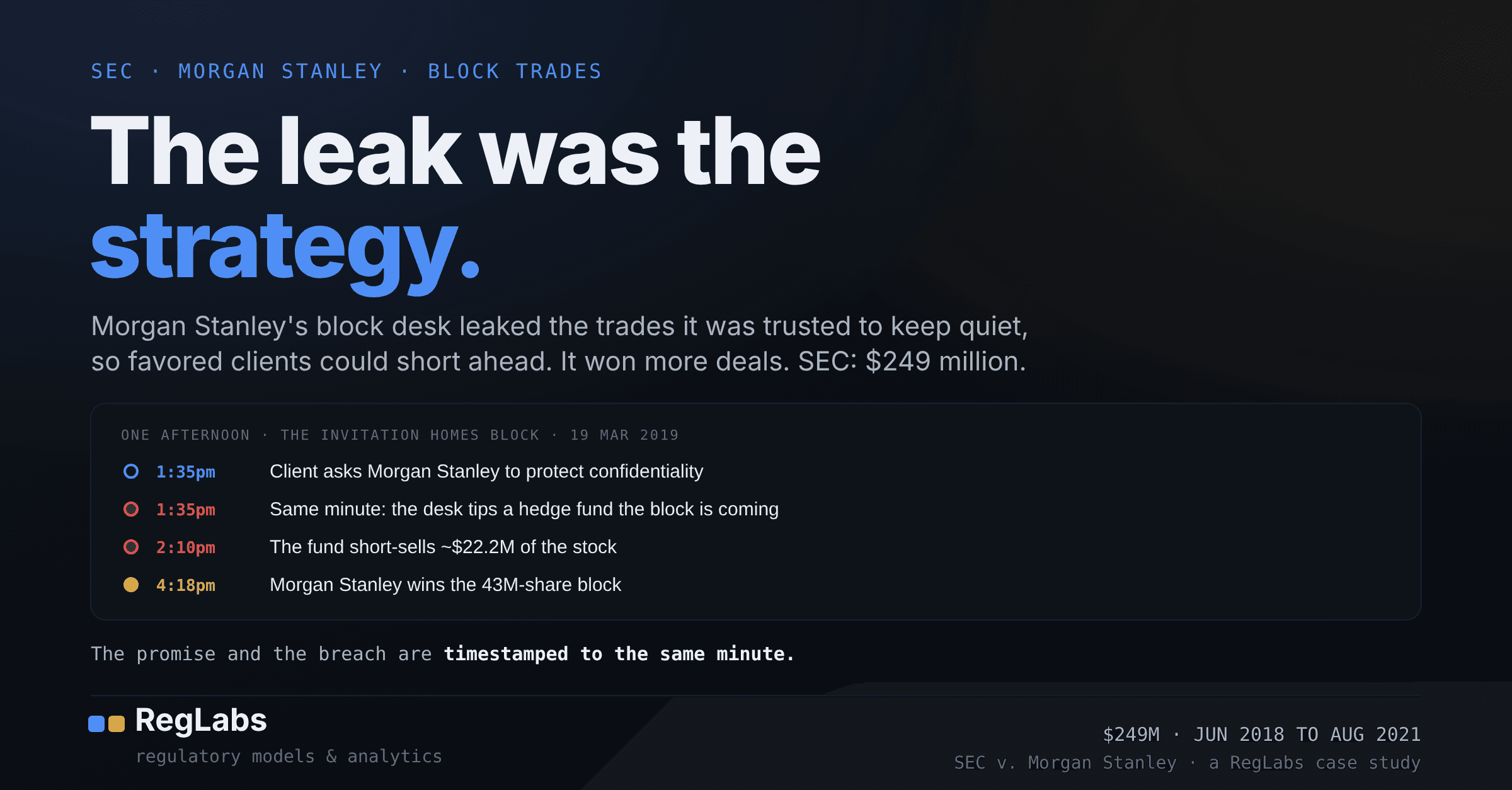
The leak was the strategy.
Morgan Stanley's block-trade desk leaked the deals it was trusted to keep quiet, so favored clients could short ahead. It was not a lapse. It made the bank more competitive. Price: $249 million.
A quarter-billion-dollar penalty for selling a confidence
On 12 January 2024, the SEC settled charges against Morgan Stanley & Co. for fraudulent conduct on its Equity Syndicate Desk. From at least June 2018 through August 2021, the desk's former head and a senior member disclosed non-public information about impending block trades to select buy-side investors, who used it to short the stock ahead of the deal. The total came to $249,354,821, alongside a non-prosecution agreement with the U.S. Attorney for the Southern District of New York.1
The order carries two distinct charges, and the distinction matters. The first is fraud: the firm willfully violated Section 10(b) of the Exchange Act and Rule 10b-5(b), the core antifraud provisions, because its promises of confidentiality were false while it was leaking. The second is a controls charge: the firm willfully violated Section 15(g), which requires a broker-dealer to enforce written policies reasonably designed to prevent the misuse of material non-public information. One charge is about what two employees did. The other is about what the institution failed to do about it. The $249 million answers both.
On its surface this is an insider-information case. What makes it instructive is the motive. The leaks were not careless gossip or a favor to a friend. They were a commercial strategy. By tipping certain investors that a block was coming, Morgan Stanley guaranteed itself a ready buyer, lowered its own risk, and could therefore bid more aggressively to win the business. The misuse of confidential information was wired into how the desk competed.
That motive is what makes this case the purest study in the set of a particular and difficult control problem: misconduct that serves the firm's own interest. Almost every control a financial institution builds is designed to stop an employee from acting against the firm, the rogue trader, the embezzler, the person trading their own account on the firm's information. Those controls were useless here, because the conduct made the firm more money, and the people meant to restrain it were the people benefiting from it. This study walks the mechanism, the two deals the order reconstructs in forensic detail, and the full apparatus of compliance the firm had in place, and then lifts each failure into the discipline it violated: why a control must be built against your own incentive, not just against the rogue individual; why an annual attestation is not assurance that a control works; why existence is not enforcement, which is the whole meaning of the Section 15(g) charge; why a wall applied selectively is not a wall; why an alert is only as good as its disposition; and why, in a business trusted with a secret, confidentiality is not a courtesy but the central control. The lesson is the most unsettling in all of enforcement: a firm can tick every box a regulator would ask for and fail completely, if the boxes were never aligned against the incentive that mattered.
A block trade's one secret
A block trade is the sale of a very large holding of stock, arranged privately and executed outside the open market. A big shareholder, often a private equity firm, a founder, or a large manager, wants to sell tens of millions of shares at once without crushing the price on the public market. An investment bank buys the whole block at a discount to the current price, commits its own capital to the purchase, and then resells the shares to institutional investors at a small markup. The bank's profit is the spread between what it pays and what it sells at; its risk is being left holding a residual position it cannot place if the price falls before it distributes the stock.
Everything in that arrangement depends on one thing staying secret: that the block is coming. If the market learns a huge supply of stock is about to hit, the price drops before the sale, and the selling shareholder, who is pricing against the current market, gets less. That is precisely why selling shareholders insist on confidentiality, and why the bank is trusted with information no one else has. The information is not incidental to the deal; it is the thing that makes the deal fair to the seller. The secret is the product. Morgan Stanley sold it.
It is worth being precise about the nature of the information, because its character is what makes the conduct fraud rather than mere discourtesy. Knowledge that a large block is about to be sold is material, because a flood of supply moves the price; it is non-public, because the entire point is that the market does not know; and the bank obtained it in confidence, as the agent of the selling shareholder. That is the textbook definition of material non-public information held in a position of trust, the exact category the securities laws build their most serious prohibitions around. The block desk is, structurally, a repository of continuous, high-value MNPI, created fresh with every deal: which blocks are coming, from whom, at what size, at what price. A firm running such a desk is not handling the occasional piece of inside information; it is operating a factory of it, and the controls around that factory are not an overlay on the business. They are the license to run it.
The leak
The order names two people by role: the former head of the Syndicate Desk and a former senior member. When Morgan Stanley was invited to bid on, or was in the process of negotiating, a block trade, these employees told certain favored buy-side investors it was coming. They did this knowing exactly what those investors would do with the information: take a large short position in the stock before the block executed, then request and receive an allocation from the block to cover the short at a profit.
This is textbook misuse of material non-public information. But the detail that elevates it, and that the order dwells on, is the mutual understanding. The tippees were not passive recipients who happened to receive a loose word. The desk provided the information with the understanding that these investors frequently would take large short positions in anticipation of the block, and that if Morgan Stanley won the auction, the investor would request allocations to cover. The relationship was recurring, and both sides knew the shape of it. The leak was not a slip. It was an arrangement.
The recurring, understood quality of the relationship is legally and practically decisive, and it separates this case from the accidental leak a control is normally designed to catch. An accidental disclosure is a one-time failure: a careless word, an email to the wrong recipient, a conversation overheard. It leaves little pattern and no mutual expectation. A standing arrangement, in which the desk knows the tippee will short and the tippee knows it will be allocated to cover, is a repeated transaction with a stable structure, and a stable structure produces a detectable pattern, the same investors shorting the same names shortly before the same desk's blocks, then appearing in the allocation. That the conduct was an arrangement rather than an accident is what makes it both more culpable and, crucially, more surveillable, because arrangements recur and recurrence is exactly what a well-designed surveillance system is built to find. The firm's failure was not that it could not have detected a pattern this stable; it was that it was not looking for it.
Why the leak was the strategy, not a lapse
Here is the mechanism that makes this case unusual, and that the order states almost as a matter of economics. When a tipped investor shorted the stock ahead of the block, Morgan Stanley gained a near-certain buyer for a chunk of the shares it was about to purchase, because that investor would eventually need to buy stock to cover the short. A guaranteed buyer means less risk of being stuck holding an unsold residual position. Less risk means the firm could offer the selling shareholder a tighter, more competitive bid, and win more block deals. The order says exactly this: the pre-positioning benefited Morgan Stanley by ensuring a large buyer for at least part of the block, lowering its risk, and giving it comfort to bid more aggressively.
The loop: how a leak became an edge
- Morgan Stanley: lower risk, more wins
- The tipped investors: a near risk-free trade
- The selling shareholder: confidentiality broken, price pressured down
- The market: trading against a leak it could not see
The leak was not friction in the business. It was the flywheel that powered it.
Source: SEC, Order Instituting Administrative and Cease-and-Desist Proceedings , In the Matter of Morgan Stanley & Co. LLC, Securities Exchange Act Release No. 99336 (12 January 2024).
This is why the case is more dangerous than a simple tipping scandal, and why its lesson generalizes. A one-off leak is an individual's misconduct, the kind a firm can hope to catch and punish. A leak that makes the desk structurally more competitive is something the firm's own success depends on, which means the incentive to keep doing it, and to look away from it, is built into the business. The misconduct and the profit were the same act.
One afternoon: Invitation Homes
The clearest illustration is a single afternoon in March 2019, around a block of Invitation Homes stock. The selling shareholder, a large investment manager that held nearly 220 million shares, wanted to sell, and it wanted the discussion kept from the market. The sequence, reconstructed from the order, is damning in its compression. The request for confidentiality and the breach of it are timestamped to the same minute.
19 March 2019 · the Invitation Homes block
The client's confidentiality request and the tip that broke it share a timestamp.
Source: SEC, Order Instituting Administrative and Cease-and-Desist Proceedings , In the Matter of Morgan Stanley & Co. LLC, Securities Exchange Act Release No. 99336 (12 January 2024).
Read the sequence as a client would. You asked your bank, in writing, to protect a discussion from the marketplace. In the same minute, your bank picked up the phone and told a hedge fund what you were about to do, and that hedge fund spent the next two hours selling your stock short. Then your bank won your business, and the hedge fund it had tipped collected a slice of the very block you sold, using it to close out the short at a profit. Every party in that chain came out ahead except the one that asked for confidentiality in the first place.
The use of equity swaps to build the short is a detail worth flagging, because it points to a second-order control problem. The tipped fund did not short the stock directly in a way that would appear plainly in the cash equity tape under its own name; it used swaps, which route the economic exposure through a dealer and can obscure the identity of the party taking the position. For a surveillance system, this means that catching the pre-positioning requires seeing beyond the obvious short-sale record into the derivative positions that carry the same economic effect, and correlating those with the desk's deal information. A firm whose MNPI surveillance watches only direct short sales, and not the swap and options positions that replicate them, has a gap that a sophisticated tippee will use, and the Invitation Homes short went straight through it.
Star Bulk, and the profit
The pattern was not a one-off, and the Star Bulk Carriers block in May 2021 shows the full loop inside a single deal. The selling shareholder's advisory clients were the largest holders of the stock, with more than 39 percent of the shares outstanding. The client was, per an internal email, in capital letters, VERY focused on confidentiality, and that email was circulated inside Morgan Stanley, including to the Syndicate Desk head.
On 17 May, the desk head told the founder of a registered investment adviser that a block of up to 10 million shares was coming. That same day, the adviser began selling Star Bulk short, its first-ever trades in the stock, and over the next week sold short more than 1.3 million shares. Meanwhile the negotiation played out: Morgan Stanley's indicated discount moved from a range of 12 to 14 percent, to 8 percent after the client threatened an auction, and the trade was delayed when the stock fell nearly 7 percent on earnings. After the close on 24 May, Morgan Stanley bought 10.63 million shares at $21.05, a 7.4 percent discount to the last sale, reoffered the stock at $21.40, and the tipped adviser bought 2 million shares, roughly 19 percent of the block, to cover. Morgan Stanley booked about $3.7 million on the deal. Every role in the loop is visible in that one transaction: the tip, the pre-positioning short on a name the adviser had never traded, the win, and the cover.
Two details in the Star Bulk sequence are, for a compliance officer, almost unmissable red flags in hindsight, and that is exactly why they matter. The first is that the adviser's short sales were its first-ever trades in Star Bulk, beginning the very day it was tipped. A party that has never touched a stock suddenly building a large short position in it, days before a block it could not publicly have known about, is precisely the anomaly that MNPI surveillance exists to surface; the absence of any prior trading history in the name is what makes the timing so improbable as coincidence. The second is that the internal email flagging the client as VERY focused on confidentiality was circulated to the very desk head who then leaked, which means the firm had, in writing and in his hands, the clearest possible statement of the obligation he proceeded to breach. These details did not need sophisticated analytics to notice; they needed a surveillance system that joined the firm's own deal information to the trading of the parties it dealt with, and a review function that treated a first-ever short before a block as the alarm it plainly was.
"VERY focused on confidentiality"
What turns this from a controls failure into a fraud is the explicit promise. These were not situations where confidentiality was merely assumed as a matter of market custom. Selling shareholders asked for it directly, in writing, in the moment. In the Star Bulk matter, the client was flagged internally as VERY focused on confidentiality. In the Invitation Homes matter, the client thanked Morgan Stanley in advance for protecting the discussion from the marketplace. The Syndicate Desk, for its part, made its own representations of confidentiality. Then it did the opposite, often within the same minute.
That gap, between the promise and the conduct, is why the SEC charged Morgan Stanley with willful violations of the antifraud provisions, Section 10(b) and Rule 10b-5(b), and not merely a supervisory lapse. A representation of confidentiality, made while leaking, is a false statement of material fact in connection with the purchase or sale of a security. The firm did not simply fail to keep a secret. It told clients, expressly, that it was keeping a secret it was in the act of selling.
The elevation from a controls failure to a fraud charge is worth understanding, because it marks the line between a firm that failed to prevent misconduct and a firm that itself made a false statement. A firm that leaks MNPI through weak controls has a supervisory and controls problem. A firm that expressly promises confidentiality while in the act of breaching it has made a misrepresentation, and the law of securities fraud attaches to the misrepresentation. The promise is what converts the leak from an internal control failure into an affirmative lie to a client, in connection with a securities transaction, which is the heart of the antifraud regime. For any firm, the lesson is that the representations it makes to clients are not marketing language or relationship courtesies; they are statements of fact whose truth the firm is legally bound to, and a promise the firm's own conduct contradicts is not a broken courtesy but a securities-law violation. The desk's routine assurances of confidentiality, made while the desk was routinely leaking, were the legal hinge of the entire case.
The control you have to build against yourself
The deepest lesson of this case is about a category of risk that most control frameworks are structurally unprepared for: misconduct that serves the firm's own interest. Step back and consider what nearly every control in a financial institution is designed to do. It is designed to stop an individual from acting against the firm. The rogue trader who hides a loss, the employee who front-runs the firm's own orders, the insider who trades their personal account on the firm's information, the embezzler, the person who takes a bribe, all of these are individuals whose gain is the firm's loss, and the firm's incentive is naturally aligned with catching them. The control and the firm's interest point the same way.1
The Morgan Stanley conduct was the opposite kind, and it is far harder to control precisely because the firm's interest points the wrong way. Leaking impending blocks did not cost the firm; it made the desk more competitive, lowered its risk, and won it more business. The gain from the misconduct flowed to the firm, not away from it. This inverts the normal logic of control in a way that quietly disables the entire apparatus, because the people who would have to detect, escalate, and act on the conduct, the desk, its management, and to a degree the business-aligned parts of the control function, were all, however indirectly, beneficiaries of it. A control depends on someone wanting to enforce it, and when the misconduct makes everyone in the chain a little richer, the will to enforce quietly evaporates even if no one ever decides to look away.
The misconduct controls are built for
An individual acts against the firm: the rogue trader, the front-runner, the embezzler. The firm loses, so the firm wants to catch them. The control and the firm's interest point the same way, and the apparatus works.
The misconduct that defeats them
The conduct serves the firm: the leak that wins more blocks. The firm gains, so the will to catch it evaporates. The control and the firm's interest point opposite ways, and the apparatus, however complete, goes quiet.
The discipline this demands is to identify, deliberately and in advance, the places where the firm's commercial incentive runs against its clients or the market, and to build controls specifically hardened against that incentive, owned by a function with genuine independence from the business that benefits. This is the hardest kind of control to build, because it has to work against the grain of the organization's own self-interest, which means it cannot rely on the business to want it to succeed. It requires surveillance that is not dependent on the desk raising its own hand, escalation paths that do not run through the people who profit from the conduct, and a control function with the independence and the mandate to act against a practice precisely because it is lucrative. Morgan Stanley's failure was that its controls were all of the first kind, built against the rogue individual, and the conduct was all of the second kind, aligned with the firm, so the apparatus never engaged. The generalizable warning is that every firm has at least a few places where doing the wrong thing would make money, and those places are exactly where the ordinary controls are weakest, because the ordinary controls assume the firm is on their side.
The policy on paper
The uncomfortable truth of this case is that Morgan Stanley was not missing the controls. It had them, in full, and they were serious documents maintained by a serious compliance function. The order catalogues them, and the catalogue is the point: every box was ticked, and none of it worked where it mattered.
The controls that existed, in full
Six real controls, maintained and certified. The conduct ran for three years anyway.
Source: SEC, Order Instituting Administrative and Cease-and-Desist Proceedings , In the Matter of Morgan Stanley & Co. LLC, Securities Exchange Act Release No. 99336 (12 January 2024).
This is the most generalizable lesson in the case, and the most unsettling. A firm can have a policy, a code, mandatory training, annual attestations, a watch list, and a wall-crossing regime, the full apparatus a regulator would expect, and still fail completely, because the apparatus was not aligned against the one incentive that mattered. The controls were designed to prevent an employee from going rogue against the firm's interest. They were useless against conduct that served the firm's interest. When the misconduct makes the desk more money, the paperwork of compliance becomes exactly that: paperwork.
It is worth pausing on how reassuring this control inventory would look to almost any outside observer, because that is precisely the trap. An examiner asking "do you have an MNPI policy" would get a yes. An auditor asking "do you train staff and collect attestations" would get a yes. A board asking "do you have information barriers and a watch list" would get a yes. Every one of those answers was true, and every one of them was consistent with three years of the exact conduct the controls named and prohibited. This is the signature of a mature compliance failure, as distinct from an immature one. An immature failure looks like missing controls, and it is caught by any review that checks for their existence. A mature failure looks like complete controls that do not operate, and it is invisible to any review that checks only for existence, which is most reviews. The next several sections are an account of the specific ways a complete apparatus failed to function, because the gap between a control that exists and a control that works is where this entire case lives.
Attestation is not assurance
Among the controls the firm maintained were annual certifications: every employee attested, each year, to compliance with the Code of Conduct, and the named employees received annual MNPI training during the very period they were leaking. The certifications are worth isolating because they represent one of the most widely relied-upon and most quietly empty controls in financial services: the periodic attestation, in which a person signs a statement that they have complied with a policy, and the firm treats the signature as evidence that they have.1
The problem is that an attestation measures nothing. It is a statement by the person being controlled that they have followed the rule, collected from the one party with the least incentive to report their own breach. The Syndicate Desk head who certified compliance with the Code of Conduct while leaking blocks was not caught by his certification; he simply certified falsely, and the certification, far from detecting the conduct, produced a tidy annual record suggesting it was not happening. An attestation is only as truthful as the person signing it, which means it provides assurance exactly where assurance is least needed, from honest employees who were not going to breach anyway, and no assurance at all where it is most needed, from the person engaged in the misconduct, who signs the same clean form as everyone else. A control whose output is identical whether the underlying conduct is clean or corrupt is not a detective control; it is a record-keeping exercise that generates the appearance of diligence.
Verify, do not attest
The discipline this points to is that attestation and assurance are different things, and a firm that confuses them has a false sense of coverage. An attestation is a statement that a control was followed. Assurance is independent evidence that it was. The two come apart precisely in the cases that matter, because the person willing to breach the policy is also willing to sign that they did not, so the attestation is clean exactly when the conduct is worst. Real assurance does not ask the controlled party whether they complied; it tests, independently, whether they did, by examining the actual behavior, the trading, the communications, the data, against what the policy requires. For MNPI specifically, assurance means surveillance that correlates who held deal information with how related securities were traded, not a signed form saying no one misused anything. Attestations have a place, in establishing that employees were on notice of a rule, which matters for culpability, but they must never be mistaken for evidence that the rule was kept. Morgan Stanley collected three years of clean certifications from people who were leaking, and the certifications did exactly what attestations do: nothing, while looking like something.
Existence is not enforcement
The SEC's second charge is the one that turns this from a story about two employees into a lesson for every institution, and it is written directly into the statute. Section 15(g) of the Exchange Act does not merely require a broker-dealer to have policies against the misuse of material non-public information; it requires the firm to enforce written policies reasonably designed, taking into account the nature of its business, to prevent that misuse. Morgan Stanley was found to have willfully violated that provision. The firm's liability does not rest on the acts of the desk head alone. It rests on the gap between the policies the firm wrote and the enforcement it actually delivered.1
The statute is written the way it is for a precise reason, and the reason is the exact defense it forecloses. Left to argue only about whether it had policies, a firm could always say yes, because writing a policy is cheap and every firm does it. Section 15(g) refuses to let the inquiry end there. By requiring enforcement, it makes the legal question not "did you have a rule" but "did the rule actually operate against the conduct it named," and it treats a policy that is not enforced as, in the eyes of the law, no policy at all. This is the statutory embodiment of the single most important idea in the whole case: that the existence of a control and the operation of a control are completely different things, and that only the second provides any protection. Morgan Stanley had the policies. It did not enforce them. Under Section 15(g), that is a standalone willful violation, independent of the fraud, and the firm paid for it as such.
The question a firm must ask of its own controls
The generalizable discipline is to audit controls for operation, not existence, which is a fundamentally different and harder exercise than most control reviews perform. A standard review asks, for each required control, does it exist, is it documented, is it current. An operation-focused review asks, for each control, when did it last do its job, what would it take for this control to fail silently, and can we produce evidence that it caught something it was supposed to catch. The questions that would have exposed Morgan Stanley's failure are of the second kind: when did our MNPI surveillance last flag a suspicious short before one of our blocks; are there deal classes where we skip the wall-crossing or the watch-listing, and if so why; when an alert fires, how is it resolved, and are the resolutions sound. None of those are answered by confirming a policy exists. All of them go to whether it works. Section 15(g) is, in effect, a legal instruction to ask the second kind of question, and the enforcement finding against Morgan Stanley is what happens when a firm has spent its effort on the first kind.
The wall that didn't hold
The structural control at the center of the case is the information barrier. The Syndicate Desk sat on the private side of the firm, routinely in possession of material non-public information about which blocks were coming, from whom, and at what size. The Institutional Equity Division sat on the public side and traded. Between them was supposed to be a wall. It did not hold, and the way it failed is instructive: it failed selectively, exactly where the risk was highest.
Private side, public side, and the gap between
For registered block trades, the equity-markets group walled IED employees "over the wall" before consulting them on pricing. For unregistered block trades, it typically did not, so those securities were not required to be added to the watch list and may not have been surveilled for MNPI misuse at all.
A wall that is crossed for some deals and quietly skipped for others is not a wall.
Source: SEC, Order Instituting Administrative and Cease-and-Desist Proceedings , In the Matter of Morgan Stanley & Co. LLC, Securities Exchange Act Release No. 99336 (12 January 2024).
The selective failure had a compounding effect. Because the firm often did not wall-cross public-side staff for unregistered blocks, those securities were not reliably added to the watch list, and so the trading in them was not reliably surveilled for MNPI misuse. The result was a blind spot precisely around the deal type most likely to involve the conduct at issue. And the barrier failed not only outward to tipped clients but inward: the order notes that Morgan Stanley's own cash desk, on the public side, at times sold the very securities short while the Syndicate Desk was negotiating a block in them. The wall meant to separate the firm's private knowledge from its public trading was permeable in both directions.
That the wall leaked in both directions, outward to tipped clients and inward to the firm's own public-side desk, is diagnostic of what an information barrier actually is and how it fails. A wall is not a single object; it is a system of controls, access restrictions on who can see deal information, physical and logical separation of functions, watch-listing of affected securities, and surveillance of trading in them, and it fails wherever any of those components is absent, regardless of how robust the others are. Morgan Stanley's barrier had components, the wall-crossing procedure, the watch list, but they were applied inconsistently, and an information barrier applied inconsistently has a hole, and a hole in a barrier is the whole barrier's measure, because information flows to the gap. The inward leak to the cash desk is especially telling: it shows the barrier was not even reliably protecting the firm from its own public side trading on its own private knowledge, which is the most basic thing an information barrier is supposed to do. A wall that cannot keep a firm's private information from its own public desk was never going to keep it from favored external clients.
The exception no one examined
The single most important mechanical detail in the case is the carve-out, and it generalizes into one of the most dangerous patterns in any control environment: the exception that was created for convenience and then never reviewed. Morgan Stanley applied its wall-crossing and watch-listing to registered block trades but typically not to unregistered ones. That distinction may have had an administrative rationale at its origin, registered and unregistered deals follow different processes, but its effect was to remove the firm's core MNPI controls from an entire category of deals, and that category was not a low-risk backwater. It was squarely within the business where the leaking happened.1
The pattern is worth naming because it recurs across every kind of control failure: a control exists, but it has an exception, and the exception turns out to cover exactly the cases where the control was most needed. Exceptions are born innocently. A control is burdensome in some situation, so a carve-out is made, this deal type, this desk, this threshold, this product, and the carve-out is reasonable at the moment of its creation. What makes it dangerous is that carve-outs are rarely revisited. The control is documented, the exception is a footnote to it, and no one goes back to ask whether the footnote has quietly swallowed the control. Over time, if the exception happens to align with where risk concentrates, the firm ends up with a control that is robust everywhere it is not needed and absent exactly where it is. That is what happened here: the MNPI controls were strong for registered deals and absent for unregistered ones, and the conduct lived in the gap.
Audit the carve-outs, not just the controls
The discipline is to treat every exception to a control as a control decision in its own right, requiring its own justification, its own owner, and its own periodic review against the question: does this carve-out remove protection from a place where the risk is high. A control inventory that lists controls but not their exceptions is incomplete, because the exceptions are where the real coverage is determined. The right review does not ask only "do we have a wall-crossing procedure"; it asks "to which deals does it not apply, why, and is the risk in those deals actually lower, or just the process more inconvenient." Had Morgan Stanley asked that question of its unregistered-block carve-out, the answer, that it had removed its MNPI surveillance from a high-risk, high-frequency part of the Syndicate Desk's business, would have been immediately alarming. The carve-out was never examined, and so it functioned as a silent, standing hole in the firm's defenses, precisely where the defenses mattered most. For any firm, the generalizable instruction is that the most dangerous gaps are rarely in the controls themselves; they are in the exceptions no one has looked at since the day they were written.
The alert that was closed wrong
The surveillance system was not entirely blind. At least one compliance alert fired on exactly the behavior at issue: a short position established by Morgan Stanley's own cash desk in February 2021, while the Syndicate Desk was negotiating an unregistered block in the same stock. The short was built on the two days before the block executed. The alert existed. What happened to it is the problem, and it is a lesson in itself about the difference between generating an alert and resolving one.
The firm did not review the alert until January 2022, almost a year after the trade. When it did, the reviewer concluded that because the negotiated block had executed between the market close on one day and the open on the next, trading during market hours while in possession of MNPI was therefore not possible. That reasoning is simply wrong on its own facts. The short had been established on the two days before the block, during market hours, while the negotiation was live and the MNPI was held. The alert was closed on a rationale that mistook when the risk occurred, confusing the timing of the block's execution with the timing of the suspicious trading, and no further investigation followed. The order found, more broadly, that the firm did not properly review alerts or conduct further investigation when warranted.
An alert is only as good as its disposition
This is a distinct discipline from the question of whether a surveillance system generates the right alerts, and firms that have invested heavily in detection often neglect it. Generating an alert is the first half of surveillance; disposing of it correctly is the second, and a failure in the second half nullifies all the investment in the first. Morgan Stanley's system did the hard part: it detected a short established while the firm held MNPI in the same name, which is exactly the signal the system should produce. Then it failed the easy part, twice: it took almost a year to look at the alert, and when it did, it closed it on reasoning that was demonstrably wrong on the facts in front of the reviewer. Two separate disciplines are implicated. The first is timeliness: an alert reviewed a year late is, for practical purposes, not a control, because the conduct it might have caught has long since completed and recurred. The second is the quality and documentation of the disposition: a reviewer who closes an alert must do so on a rationale that is correct, recorded, and capable of being checked, because a wrong rationale that goes unreviewed converts a working detector into a rubber stamp. The deepest failure is that nothing checked the reviewer. A disposition that mistook the entire timing of the risk was accepted and filed, which means the firm's alert-review process had no quality control on its own conclusions, and an alert-review process that cannot catch its own errors is a process that will reliably reason its way past exactly the alerts that matter.
Confidentiality is the control
Pull back from the mechanics and the case teaches something about a whole class of businesses: those whose entire value rests on being trusted with information others do not have. A block desk is trusted with the knowledge that a sale is coming. A deal advisory practice is trusted with a pending merger. A prime broker is trusted with its clients' positions. A wealth manager is trusted with a family's holdings. In every one of these, the information the firm holds is both the basis of the client relationship and a directly tradeable asset, and the only thing standing between those two facts is the firm's discipline in not using what it was trusted with. In such a business, confidentiality is not a courtesy or a soft relationship value. It is the central control, the one on which the legitimacy of the whole enterprise rests.1
Recognizing confidentiality as a control, rather than as a cultural nicety, changes how a firm must treat it, and the change is significant. A nicety is maintained by good intentions and relationship norms. A control is maintained by systems: a record of who received what confidential information and when, watch-listing of every security the information touches, surveillance of trading in those securities by the firm and by the counterparties who received the information, access restrictions that limit how far the information can travel, and testing that confirms all of this is actually happening. Morgan Stanley treated confidentiality with the apparatus of a control, it had the policy, the watch list, the wall, but it operated it with the diligence of a nicety, honored where convenient and skipped where not. The gap between having the apparatus and operating it is the whole case, and it maps directly onto the gap between treating client information as something you promise to protect and treating it as something you build systems to protect. A firm whose core asset is confidential information, and most trusted financial businesses are exactly that, has to run its information controls with the seriousness of a trading firm running its risk limits, because for this kind of business the misuse of information is the catastrophic risk, and the controls against it are not overhead on the business; they are the thing that makes the business permissible.
Surveilling for a leak you profit from
The forward-looking implications of the case run in two directions, and both sharpen rather than soften its lessons. The first concerns the data and the analytics required to catch this conduct, which are becoming both more necessary and more feasible. The core detection task here, correlating the firm's private-side deal information with the trading of the parties it deals with, including through derivatives like the swaps the Invitation Homes tippee used, is exactly the kind of cross-domain pattern-matching that modern, data-intensive surveillance is suited to. A firm can, in principle, join its deal pipeline to the short-sale and derivative positions of its counterparties and flag the improbable: a party building a first-ever short in a name days before that firm's block in the same name. The capability exists. The question the case poses is whether a firm will point it at conduct that makes the firm money, which is a governance question, not a technical one.1
That governance question is the second and deeper forward-looking issue, and it is the hardest. The incentive-alignment problem at the heart of this case, that the firm profits from the misconduct, does not disappear when the surveillance becomes more sophisticated; if anything it becomes more acute, because a firm that builds a powerful system capable of detecting its own profitable misconduct then faces a continuous choice about whether to look. A surveillance model, however advanced, is still configured, tuned, and acted upon by the institution it monitors, and an institution has every incentive to configure a model so that it does not fire on the conduct that feeds the business, exactly as it had every incentive to leave the unregistered-block carve-out unexamined. The technology raises the ceiling on what can be detected; it does not change who decides what to detect, or what to do when the system flags a lucrative practice. This is why the enduring answer to the case is organizational as much as technical: the surveillance of incentive-aligned misconduct has to be owned, configured, and acted upon by a function with genuine independence from the business that profits, and subject to external testing, because a firm grading its own profitable conduct will, consciously or not, grade it generously. The future of this control is not merely better analytics. It is better analytics that the firm cannot quietly point away from its own most profitable sins.
Independence is the control on the control
The through-line from this case to the broader direction of financial surveillance is that as detection becomes more capable, the binding constraint shifts from capability to independence. When detection was weak, the firms that failed could say, with some plausibility, that they could not have caught the conduct. As detection becomes strong, that defense disappears, and the question becomes whether the firm chose to catch it. The Section 15(g) standard, enforcement rather than existence, anticipates this: it asks not whether a firm could detect misuse but whether it actually operated controls to prevent it. In a world of capable surveillance, operating the control means pointing it at the uncomfortable places, including the profitable ones, and that requires a control function structurally insulated from the business it polices and, increasingly, independent external assessment of whether the firm's own surveillance is configured to catch what it should. The Morgan Stanley case is an early, expensive demonstration of the principle that will govern the next decade of market-conduct enforcement: the firms that fail will increasingly be the ones that could see and chose not to, and the controls that matter will be the ones that decide where the firm is allowed to look.
The broader lesson: the apparatus is not the control
Gathered in one place, the lessons of this case converge on a single, uncomfortable idea: the apparatus of compliance and the function of compliance are different things, and a firm can possess the first in full while lacking the second entirely. Morgan Stanley had the policy, the code, the training, the attestations, the watch list, and the wall. It had, by any inventory, a complete MNPI control framework, and it ran three years of the exact conduct that framework named and forbade. The framework existed. It did not function, because every one of its components failed in the same way: it was present as an object and absent as a force.
The disciplines that would have made the difference are the ones this study has named, and none of them is about having more controls. Build controls against your own incentive, not just against the rogue individual, because the misconduct that serves the firm defeats an apparatus designed to catch the misconduct that harms it. Treat attestation as notice, not assurance, and verify independently what the attestation merely asserts. Audit controls for operation, not existence, which is what Section 15(g) demands and what a box-ticking review never delivers. Examine every carve-out, because the exception no one has revisited is where the coverage quietly disappears. Resolve alerts as rigorously as you generate them, because an alert closed on a wrong rationale is a detector turned into a rubber stamp. And treat confidentiality, in any business built on trusted information, as the central control it is, operated with systems rather than maintained with good intentions. Each of these is a way of closing the gap between a control that exists and a control that works, and that gap is the entire distance between a firm that has an MNPI framework and a firm that is protected by one.
The deepest and most portable lesson is the one about incentive. The reason Morgan Stanley's complete apparatus did nothing is that the conduct it was meant to stop made the firm money, and no control operates well against the interest of the institution that owns it. Every firm has places where the wrong thing would be profitable, and those places are exactly where its ordinary controls, built on the assumption that the firm wants to catch wrongdoing, are weakest. The discipline that follows is to find those places deliberately, name them, and build controls hardened against the firm's own incentive, owned by functions independent enough to act against a practice precisely because it pays. A firm that has not done that exercise does not know where its real exposure is, because its strongest controls are pointed at the misconduct it was never going to profit from, and its weakest at the misconduct it was. Morgan Stanley paid $249 million to demonstrate the point, and the demonstration belongs to every firm whose business, somewhere, would be a little more profitable if it quietly betrayed the trust at its center.
What this case is really about
The information barrier existed, but the incentive to breach it was never controlled
Morgan Stanley did not lack a policy. It had a confidentiality policy, an MNPI policy, annual certifications, training, a watch list, and wall-crossing procedures. It lost $249 million because none of that was enforced at the point where the firm's own commercial interest pushed the other way. Leaking impending blocks made the desk more competitive, so the leaking happened, the attestations stayed clean, the wall was skipped for the unregistered deals most likely to involve MNPI, and the one alert that caught it was closed a year late on a mistaken rationale. The fraud charge punished the leak; the Section 15(g) charge punished the failure to enforce. This is what a controls framework looks like when it is complete on paper and never aligned against the incentive it is meant to restrain.
Where it broke
- The misconduct served the firm, so no control owned by the business wanted to catch it
- A full policy apparatus existed and was certified, yet never operated against the real risk
- Annual attestations stayed clean because the people breaching the policy signed them too
- Wall-crossing and watch-listing carved out for unregistered blocks, so the riskiest trades went unsurveilled
- The firm's own public-side desk shorted names its private side was negotiating
- A firing alert reviewed a year late and closed on a demonstrably wrong rationale
What this control set requires
- Controls hardened against the firm's own incentive, owned by an independent function
- Verification, not attestation: test whether the policy was kept, do not ask the person being controlled
- Audit for operation, not existence, which is what Section 15(g) actually demands
- Every carve-out justified, owned, and reviewed against where the risk concentrates
- Alerts resolved on correct, documented, timely rationales, with quality control on the reviewer
- Confidentiality run as the central control it is, with systems, not maintained as a courtesy
Five ways RegLabs keeps a wall standing where the incentive pushes hardest
This case study is an independent analysis prepared by RegLabs for educational and informational purposes, based on the SEC's public order concerning Morgan Stanley & Co. LLC (12 January 2024). It is not legal advice and does not reproduce the order in full. All figures and quotations are drawn from the public record; any characterizations are those of RegLabs. Company and regulator names are used for identification and commentary only.