
- Financial Crime
- Enforcement
- Governance & Accountability
Thirteen findings, one village bank: the new front line of AML supervision
A two-day inspection of a small savings bank in rural North Jutland turned up gaps across thirteen control areas, from its risk assessment to its outsourced monitoring. Modern Nordic supervision now holds the smallest deposit-takers to the same anti-money-laundering standard as global banks. In the same weeks, the regulator applied the identical lens to a branch of one of the largest Nordic banks and to a fast-growing fintech, and with the fintech it opened a new front: the governance of AI itself.
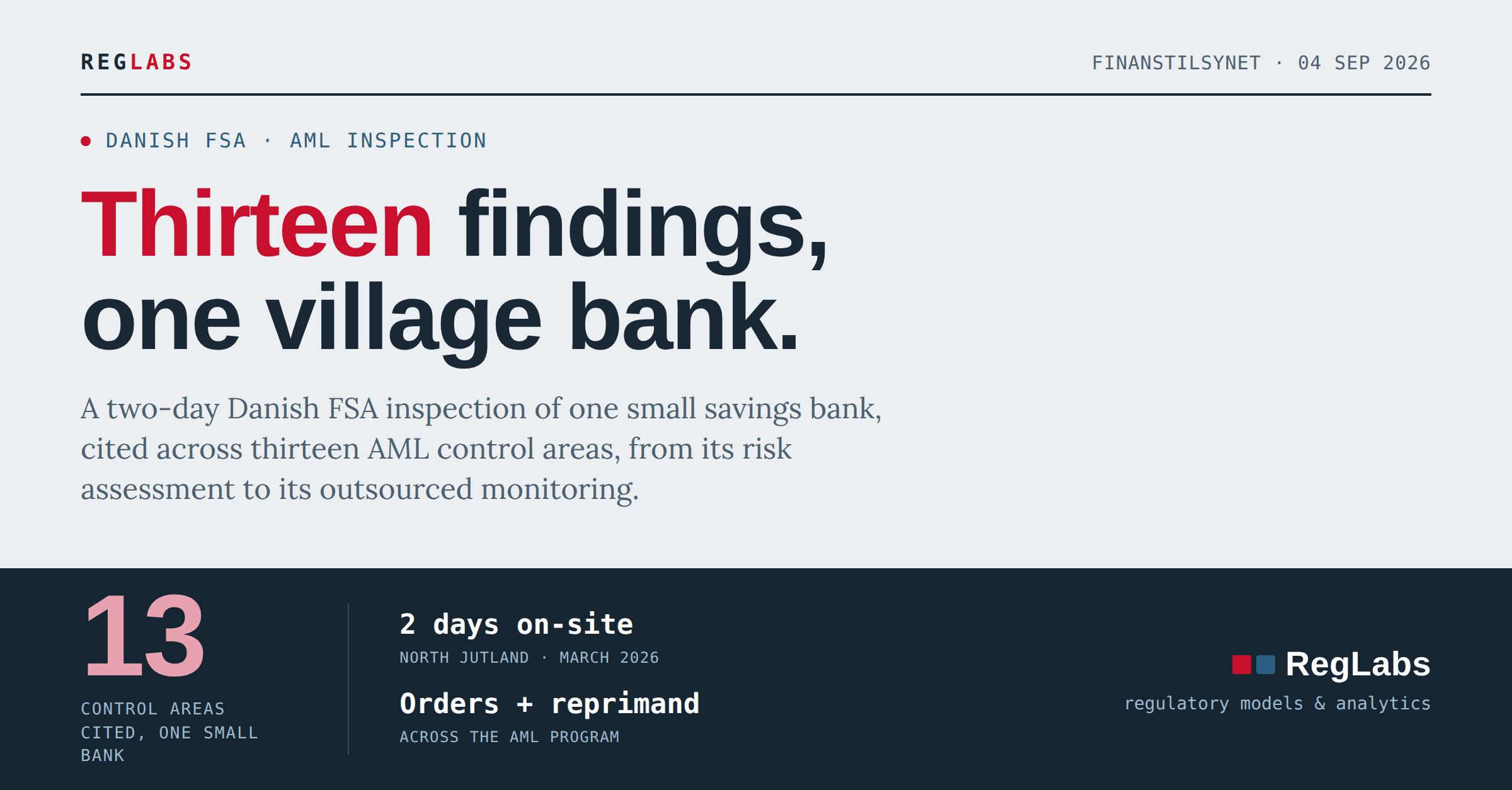
Danish FSA · Finanstilsynet · AML Inspection
What a two-day inspection found
The bank was ordered to revise its risk assessment, rebuild its monitoring, fix its investigations, oversee its outsourced provider, and correct data already filed with the regulator.
Source: Danish FSA Klim Sparekassen inspection, published 4 September 2026; RegLabs enforcement database.
Overview
On 17 and 18 March 2026, inspectors from the Danish Financial Supervisory Authority spent two days inside Klim Sparekassen, a small local savings bank in rural North Jutland, examining how it defends itself against money laundering and terrorist financing. The report, published on 4 September 2026, reads like the file of a much larger institution. It finds fault with the bank's risk assessment, its customer onboarding, its transaction monitoring, its handling of alerts, its notifications to the financial-intelligence unit, its oversight of an outsourced monitoring provider, and even the accuracy of the figures it had reported to the regulator. The bank was ordered to fix essentially all of it.
An inspection like this is not built around a fine, and this one carried none; it produced a set of binding supervisory orders and a reprimand. The output is a mandate to rebuild the bank's financial-crime controls, and the cost lands as remediation work, management time, and reputational exposure in a small community where the savings bank's name is its franchise. What makes the report worth reading is less the outcome than the content: the specific gaps it exposes are the ones that quietly recur across small institutions everywhere.
The reason this small case is worth a large audience's attention is the trend it sits inside. A decade after the Danske Bank scandal routed roughly 200 billion euros of suspicious money through a single Estonian branch, Nordic supervisors reorganised around the conviction that money laundering risk lives everywhere in the system, not just in the big banks. The result is a supervision-first regime that now sends inspectors into the smallest deposit-takers and holds them to the same standard as everyone else. Klim Sparekassen is not an outlier. It is the model working as designed.
And Klim was not inspected in isolation. In the same season, the Danish FSA published reports on two very different institutions: Nordea Denmark, the Danish branch of one of the largest banking groups in the Nordics, and Lunar Bank, a branchless digital challenger. Nordea's inspection, also on anti-money laundering, faulted the quality of customer due diligence on its Trade Finance book, the same weakness, understanding the purpose and nature of a business relationship, that the village savings bank was cited for. Lunar's ranged wider, into IT resilience, compliance resourcing, data quality and the governance of the bank's AI models. Three institutions at opposite ends of the size and business-model spectrum, examined in the same window, and each sent away with binding orders to fix what the inspectors found.
Infringements
The findings begin at the foundation of the regime: the risk assessment. The Danish FSA concluded that the bank's assessment was not sufficiently built on its own business model and did not identify and assess all the relevant risk factors driving its inherent exposure to money laundering and terrorist financing. In particular, it did not adequately capture which countries money was flowing to and from, which countries its customers were connected to, or how those risks could concretely materialise. The bank was ordered to revise the assessment so that it actually describes the business it runs.
The middle of the chain, where the bank is supposed to know its customers and watch their behaviour, was the weakest. The savings bank had not sufficiently obtained or assessed the purpose and intended nature of its business relationships, and for a number of customers, expected cash activity and other key details were simply missing from the system. Worse, when updating customer information it relied solely on what customers entered themselves, rather than independently checking whether that information was accurate. Its transaction monitoring had no scenario to flag when a customer's cash deposits ran far above the expected level, and it was formally reprimanded for not having, before February 2026, any scenario to monitor business customers' transactions to or from unexpected countries. When alerts did fire, they were not investigated or documented sufficiently, case-processing times ran long, and the bank could not always notify the national Money Laundering Secretariat immediately, as the law requires.
Two further findings widen the picture in ways that matter for every modern institution. First, the bank had outsourced its transaction monitoring and then failed to supervise the provider: it had not verified that the outsourcing partner was actually doing the monitoring the contract required, and during the inspection it gave the impression of not even having the system insight needed to check. Second, the bank had reported incorrect information to the FSA and was ordered to correct its filings covering 2024 through the third quarter of 2025. A single small savings bank, in other words, generated supervisory findings across thirteen distinct control areas, from the risk assessment at the top to the accuracy of its regulatory returns at the bottom.
Analysis
The root cause running through the report is not corruption or even negligence in the ordinary sense; it is a small institution applying controls that were never sized to the risk the law says it carries. A community savings bank is, on paper, a low-drama business: local customers, familiar names, modest sums. That very familiarity is the trap. The bank appears to have leaned on relationships and self-reported information in place of documented, testable controls, which works right up until an inspector asks to see the evidence and finds that the risk assessment does not mention the countries its money touches and the monitoring has no rule for unusual cash.
The cash and country gaps are the most telling, because they are exactly where a small bank's real money-laundering risk lives. Physical cash and cross-border flows are the classic laundering channels, and the two monitoring scenarios the bank was missing, a cash-deposit-versus-expected trigger and an unexpected-country trigger for business customers, are precisely the two a risk-based program should build first. Their absence is not a technicality. It means the bank had no systematic way to see the specific patterns most likely to signal that it was being used, which is the whole point of the exercise.
The outsourcing finding is the one that should travel furthest, because it is the most modern. The savings bank did what small institutions everywhere do: it bought its transaction monitoring from a third party. What it did not do was retain the insight and oversight to know whether the service was actually being delivered. The FSA's language is pointed, noting that the bank seemed to lack the system access needed to perform its own control. This is the defining lesson of outsourced compliance: you can delegate the task, but the responsibility, and the liability, stay exactly where they were.
There is also a governance signal in the small stuff. The bank's procedures for investigating alerts did not tell staff how quickly alarms had to be handled or how timely processing was to be ensured, so alerts aged and notifications slipped. And the bank had filed incorrect data with its own regulator. Neither is dramatic on its own, but together they describe a compliance function operating without the tight, documented, time-bound discipline that AML rules assume. The absence of a visible failure, no laundering was proven here, is not evidence that the controls worked.
Finally, it is worth reading the proportionality correctly. The Danish FSA did not need to find that money had actually been laundered to compel a complete rebuild of the bank's financial-crime framework; the control gaps themselves were enough. That is the regime's design: catch the weaknesses through inspection before they are exploited, and use binding orders to close them. For the bank, the remediation programme now ordered is a substantial and public undertaking, and one that many larger institutions would struggle to complete quickly.
The wider wave: Nordea and Lunar
Klim's report is easier to read correctly once you see the two inspections the Danish FSA published beside it. Within roughly two weeks in August 2026, the same regulator released findings on a branch of one of the largest banking groups in the Nordics and on a fast-growing digital challenger. Three institutions, three very different sizes and business models, one supervisory method, and in places the very same findings.
Nordea Denmark: the same gap, at the other end of the scale
Nordea Denmark is the Danish branch of Nordea Bank Abp, the Finland-headquartered group that is one of the largest financial institutions in the Nordic region, offering the full range of lending, payments, investment and advisory services. In January 2026 the Danish FSA examined its anti-money-laundering controls, and in a report published on 19 August 2026 it landed on a single, pointed finding: the quality of customer due diligence on the branch's Trade Finance customers was insufficient.
The specific defect is one Klim's readers will recognise. Nordea had not adequately assessed or obtained information about the purpose and intended nature of its Trade Finance business relationships, which the FSA warned meant the branch might not hold correct information on those customers. That, in turn, risks incorrect risk classification and therefore inadequate ongoing monitoring, because a customer scored on the wrong information is watched with the wrong intensity. The branch was ordered, where relevant, to assess and obtain that information, under Section 11 of the Danish Anti-Money Laundering Act.
The setting sharpens the point. Trade finance, the letters of credit, guarantees and documentary collections that move goods across borders, is one of the classic channels for trade-based money laundering, where mispriced or fictitious shipments disguise the movement of value. Understanding who a trade-finance customer really is, and what the relationship is actually for, is not paperwork; it is the front line of the control. A gap there in a bank of Nordea's scale is precisely the kind of specific, high-risk weakness a modern inspection is built to surface.
And that is the connection worth holding onto. The village savings bank and the branch of a regional banking giant were cited by the same regulator, in the same year, for the same core failure: not establishing the purpose and nature of the customer relationship. Klim's version was broad, spanning its whole customer base and cascading into monitoring, alerts and outsourcing; Nordea's was narrow, confined to one product line. But the obligation is identical, and so is the lesson: knowing your customer is the control everything else depends on, and its absence is a finding whether you are the smallest deposit-taker in Jutland or part of the largest group in the Nordics.
Lunar Bank: growth outrunning the controls
Lunar Bank is the opposite kind of institution: a branchless digital bank serving individuals and small businesses, and one visibly in transition. It sold off virtually its entire loan portfolio in 2024 and now leans on the interest margin between deposits and its bond holdings, plus fees on payments and transactions, while carrying operating deficits and open questions about a sustainable model. The FSA's May 2026 inspection was risk-based, ranging across the bank's most significant risk areas, and the report published on 21 August 2026 issued orders in almost every one of them.
The first cluster is governance under growth pressure. The bank had seen high staff turnover across its board, its executive management, the layer below and the organisation generally, which the FSA flagged as a driver of errors, lost knowledge and deferred work, and it was ordered to strengthen succession planning and to enter new business areas only when it genuinely has the competencies to run them. Alongside that, its compliance function had been understaffed through 2024 and 2025 and simply could not complete its planned work; consultant help was not approved until early 2026. The FSA reprimanded the bank for not fixing the resourcing gap sooner, noting the risk was amplified by the bank's simultaneous growth ambitions. This is Klim's problem in a different guise: controls that have not kept pace with the business they are meant to govern.
The second cluster is operational and data resilience. The FSA found the bank's IT risk management deficient, lacking coherence between its governance documents, its day-to-day operation and its follow-up, and ordered it to make the framework cohere, to feed lessons from tests and incidents back into it, and to bring its IT third parties properly within its overall preparedness, squarely within the scope of the EU's Digital Operational Resilience Act. It also found the bank's data-quality management wanting, and here the consequence was tangible: the FSA assessed that Lunar should raise its solvency requirement by 0.4% of risk-weighted assets because its data could not be relied upon. The overlap with Klim is direct. Klim's failures ran on incomplete, unverified customer data and an unwatched outsourced monitor; Lunar's data and third-party weaknesses are the same theme, scaled to a whole institution, and this time they reached capital.
The third cluster has no precedent in the Klim file, and it is the most forward-looking finding of the three inspections. Lunar has high ambitions for AI and large-language-model tools, and already uses them in customer service and in internal monitoring. But its AI policy set no concrete, measurable frameworks for model monitoring, acceptable error rates or validation, which, the FSA warned, risks the organisation quietly setting per-model targets that exceed the board's own risk appetite. The regulator ordered the board to ensure appropriate management of AI model risk, and to validate AI tools both before deployment and during ongoing use, documenting what the validation actually covers. A small digital bank being told, in a routine inspection, to build a validation regime around its AI is a signal worth sitting with, and it is where the rest of this story is heading.
Practical Insights
Because these gaps are so common in smaller institutions, the fixes are well mapped, and the control expectations RegLabs derives from this case read like a checklist any deposit-taker could run against itself before an inspector arrives. Four of them recur across community-bank AML enforcement, and each is concrete.
A second, closely related pitfall is monitoring that does not cover your real risks. The two scenarios Klim lacked, a cash-deposit-versus-expected trigger and an unexpected-country trigger, are the archetypal missing rules. The practical control is a periodic gap analysis of monitoring scenarios against the risk assessment, so that cash, cross-border and high-risk-jurisdiction activity are each explicitly covered, with thresholds tuned to customer profiles rather than left at defaults. A monitoring system is only as good as the list of things it is actually watching for.
Third is self-reported information taken on trust. The bank relied on what customers entered about themselves without independent verification, which quietly undermines every downstream control that depends on that data. The fix is a validation step: check customer-provided information against independent sources at onboarding and on material change, verify beneficial ownership for corporate clients, and record that the bank itself actively assessed whether the information was accurate and sufficient. This is not a small-bank problem: the same weakness, failing to establish the purpose and nature of a relationship, was the finding in the FSA's parallel anti-money-laundering inspection of Nordea's Trade Finance business. Data quality is not a back-office concern; it is the input to the whole program.
The fourth pitfall is the most contemporary and the most overlooked: outsourced monitoring without oversight. Buying transaction monitoring from a vendor does not discharge the obligation to run it. The control is an outsourcing-oversight framework with genuine teeth: contractual rights to system access and audit, defined performance metrics, and an independent review of the provider's alert generation and investigation quality on a set cadence. If you cannot see into the system well enough to check the vendor's work, you do not have oversight, you have hope. And on the back end, give alert investigation hard timelines and an escalation-on-timeout rule, so that suspicious activity reaches the authorities immediately rather than aging in a queue.
Thematic Review
The first thing the wider data reveals is that Klim's thirteen findings are not idiosyncratic; they are the Danish FSA's greatest hits. Across the regulator's eighty-two catalogued anti-money-laundering actions, the same control areas recur again and again: know-your-customer and onboarding, the business-model risk assessment, customer risk ratings, enhanced due diligence, transaction monitoring, and the timeliness of suspicious-activity reporting. Klim was cited for almost all of them. An institution reading this report is not looking at one bank's bad luck; it is looking at the checklist Danish inspectors bring to every AML visit.
The Danish FSA's recurring AML findings
Control areas cited across the regulator's 82 AML actions · source: RegLabs
Cases carry multiple tags, so these overlap. Terrorist financing is tagged in 68 of the 82 actions, and cash plus cross-border country risk, the two scenarios Klim lacked, are the recurring monitoring gaps.
Source: Danish FSA Klim Sparekassen inspection, published 4 September 2026; RegLabs enforcement database.
The second finding is who the regime actually inspects for money laundering, and it is not the household names. Among the Danish FSA's eighty-two AML actions, the single largest group by firm type is savings banks, with thirty-four, more than payment firms, investment banks, lenders and advisers combined. Small community deposit-takers, in other words, are the front line of Danish AML supervision. The post-Danske-Bank reform did not simply raise the bar for the giants; it pushed the same expectations all the way down to the village level, which is exactly where Klim Sparekassen sits.
Who Denmark inspects for AML
Danish FSA AML actions by firm type · source: RegLabs
Savings banks alone account for more Danish AML actions than payment firms, investment banks, lenders and advisers combined. The post-Danske-Bank reform pushed the same standard all the way down to the smallest local institutions.
Source: Danish FSA Klim Sparekassen inspection, published 4 September 2026; RegLabs enforcement database.
That "same rules, any size" point is not rhetorical, and the Nordea and Lunar inspections above make it plain: the village savings bank and a branch of a regional banking giant were cited for the very same customer-due-diligence weakness, in the same year, by the same regulator. The standard does not scale with the size of the institution.
Set against the rest of the world, the scale of the theme comes into focus. Anti-money-laundering is the single most-enforced compliance topic there is: the RegLabs record holds more than 6,300 catalogued AML actions worldwide, and Denmark is an active supervisor within that global effort rather than a bystander. Approaches differ, with some regimes leading through large, occasional penalties and others, like Denmark, through frequent inspections and binding orders, but the underlying expectations are converging. A firm that benchmarks its AML program only against the headline cases in its home market is watching too narrow a slice of the field.
AML is enforced everywhere
Catalogued AML actions by regulator · more than 6,300 worldwide · source: RegLabs
The DOJ total is largely criminal enforcement; supervisors like FINRA, the OCC and the FCA drive the rest. The point is ubiquity: AML is examined in every major market, and Denmark inspects as actively as far larger jurisdictions.
Source: Danish FSA Klim Sparekassen inspection, published 4 September 2026; RegLabs enforcement database.
That granularity is not confined to anti-money laundering. As the Lunar inspection above shows, the same inspect-the-specifics posture now reaches IT resilience, data quality and, most strikingly, the governance of a bank's AI. It is the clearest sign yet that AI itself is moving onto the supervisory exam.
For firms that want to get ahead of this, the expectations now taking shape reduce to a concrete readiness checklist.
For any institution, the trend to read out of these Danish inspections is that supervisory expectations have become universal and granular at the same time. Universal, because the standard no longer scales down with the firm: a village savings bank is expected to run a business-model risk assessment, cover cash and country risk in its monitoring, validate its data, oversee its vendors and report accurately, exactly like a global bank. And granular, because inspectors are now testing the specific scenarios and the specific evidence, not the existence of a policy binder, and they are extending that same scrutiny to new terrain such as AI governance. The firms that come through the next inspection well will be the ones that treated reports like these as their own examination script.
Run the inspection before the inspector does
See your AML program the way a supervisor would
The Danish FSA found thirteen control gaps in a two-day visit to a small bank, and the same gaps, cash and country monitoring, unvalidated data, unmonitored vendors, aging alerts, recur across the enforcement record, and the exam is now expanding to AI and model governance. They are knowable in advance, which means your controls can be tested against them in advance. RegLabs turns the global supervisory record into a working assessment.
- Automate regulatory review across AML, KYC, customer due diligence, monitoring, outsourcing, reporting and AI-model-governance obligations, mapping every inspection and rule change to the controls it touches.
- Systematise risk assessment by benchmarking your monitoring scenarios, data validation and vendor oversight against the precise gaps regulators are citing, from Copenhagen to Washington.
- Simulate an inspection on financial-crime controls for your own firm, using RegLabs models to surface the scenarios and evidence the Danish FSA, the FCA or a US regulator would ask to see next.
This article is an independent editorial summary for information only and is not legal or compliance advice. The Danish FSA's action was a supervisory inspection resulting in binding orders and a reprimand.