
- Enforcement
- Markets & Trading
- Governance & Accountability
Unconscionable.
ANZ was hired to help the Australian government sell its bonds. Then, in the two hours before pricing, it sold futures hard enough to push the reference price the wrong way, and did not say so. The court had a word for it.
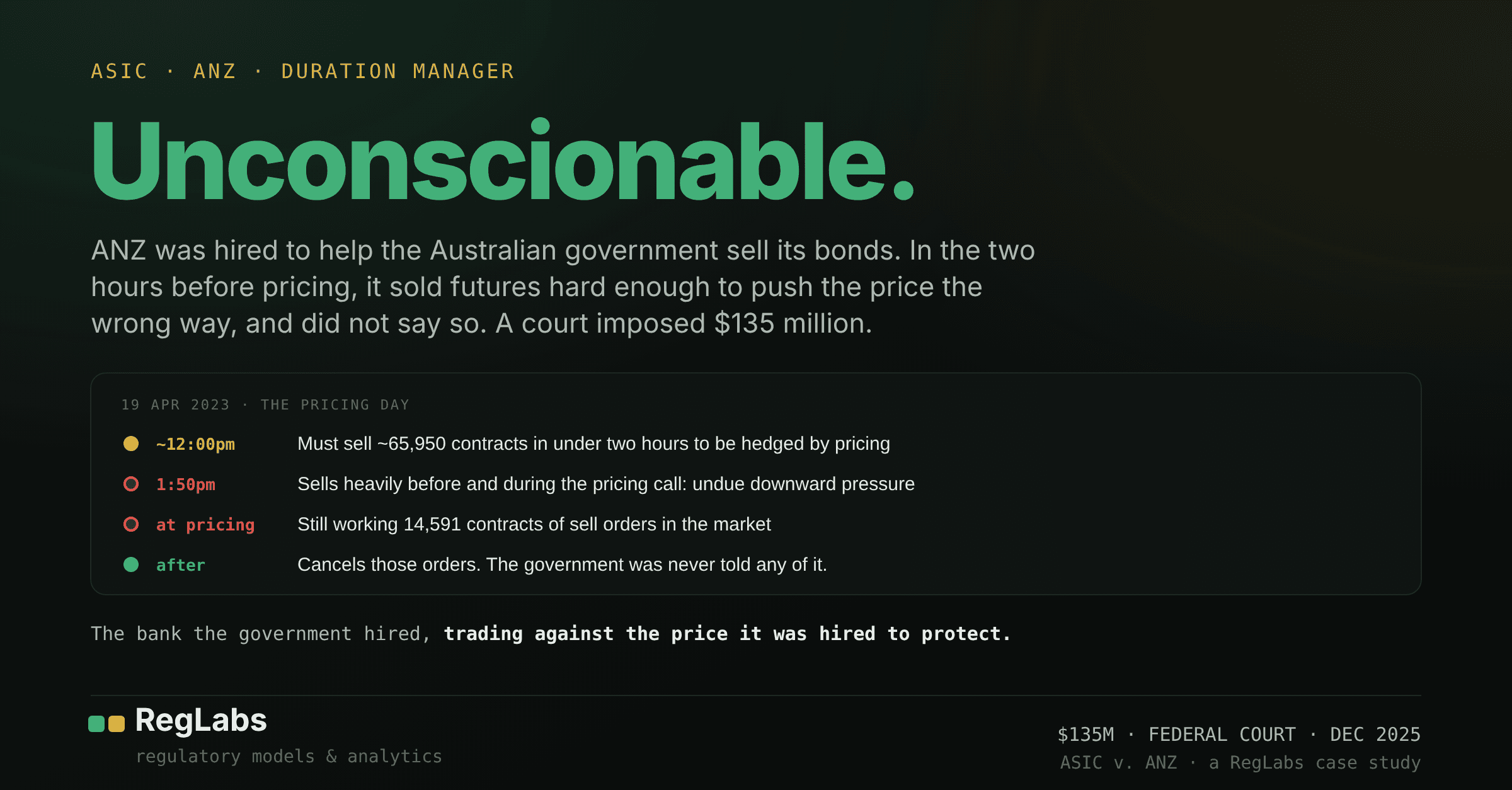
A court calls a bank's trading unconscionable
On 19 December 2025, the Federal Court of Australia declared that ANZ had engaged in unconscionable conduct and misleading or deceptive conduct in its dealings with the Australian Office of Financial Management, the agency that issues the Commonwealth's debt. For the bond-market conduct the Court imposed pecuniary penalties of $135 million, part of a wider set of penalties ASIC secured against the bank.1
The judgment runs along three legal strands, and it is worth separating them at the outset. The first is unconscionable conduct in ANZ's role as duration manager for a government bond issuance. The second is misleading or deceptive conduct, which the Court found on 27 occasions, and false or misleading representations, on 24 occasions, largely in connection with the reports and data ANZ gave the agency. The third, quieter but no less serious, is a set of breaches of ANZ's own financial-services licence obligations: the duties to provide its services efficiently, honestly, and fairly, to take reasonable steps to ensure its people complied with the law, and to ensure they were adequately trained and competent. Taken together, the three strands describe not a single bad trade but a function that was conflicted, opaque, and under-controlled from top to bottom.
The case has two halves in substance. In the first, ANZ traded a large volume of bond futures in the compressed window before and during the pricing call, in a way it knew was highly likely to push the reference price down, to the disadvantage of the very client it was serving, and then described its trading to that client in misleading terms. In the second, over nearly two years, ANZ reported materially false figures to the same agency about its trading turnover, and then confirmed them as accurate.
This study treats the judgment as what it really is: a forensic account of how an inherently conflicted role becomes a legal wrong, and of the controls that were present and did nothing. It walks the duration-manager mandate, the two hours of trading into the pricing window, and the cancelled orders that prove the selling was about the price and not the hedge, and then lifts each failure into the discipline it violated: why a client's general awareness that hedging would occur is not consent to the specific, harmful manner of it; why a role without a documented plan has no benchmark against which any deviation can be judged; why the instinct to make an awkward question go away links the trading and the reporting halves of the case; and why a surveillance function physically present at the event, which watched one trader deal on another's account and saw nothing, is a witness rather than a safeguard. The closing sections place it all in the licence-fitness finding, the Australian counterpart to the failure-to-supervise charges that anchor the rest of this series, and in the forward problem of surveilling a desk against its own conflict.
The duration manager's job
When a government issues a large new line of bonds by syndication, it often appoints a bank as duration manager. Investors buy the new bonds through orders that carry interest-rate risk, expressed in bond futures, known as exchange-for-physical or EFP orders. The duration manager accepts that interest-rate risk from investors and must hedge it, which in practice means selling bond futures in the market. The reference price of those futures, measured at a set pricing time, is what the new bonds are priced against. The role is genuinely useful: it lets the issuer transfer a complex risk to a specialist and get a clean price.
That is the setup, and the conflict is visible from the start. To manage its own risk, the duration manager needs to sell futures. But selling futures pushes their price down. And a lower reference price at pricing means the issuer, the government, raises its money on worse terms, because the new bonds are priced off that number. The bank's hedging interest and the client's pricing interest point in opposite directions at the exact moment that matters most, the moment the reference price is fixed. Everything in the case flows from how ANZ handled that single, structural tension.
It is worth naming, at the outset, what kind of relationship this is, because the legal consequences follow from it. The duration manager is not an arm's-length counterparty haggling at a distance; it is a fiduciary-flavored agent, appointed by the issuer, trusted with a role that exists precisely because the issuer cannot do it itself, and granted access and discretion on the understanding that it will act in the issuer's interest. That is a relationship of trust and dependence, and the law scrutinizes conduct within such relationships far more severely than it scrutinizes a bargain between equals. The entire weight of the "unconscionable" finding rests on this distinction: ANZ was not a stranger who out-traded the government, it was the trusted insider the government had hired, and what a trusted insider may do is governed by a different and stricter standard than what a counterparty may do.
The conflict, built in
This conflict is not a flaw ANZ invented. It is inherent in the role, which is precisely why the role comes with obligations: to manage the conflict, to trade in a measured way, and above all to be transparent with the issuer about hedging intentions. Industry guidance from the Australian Financial Markets Association and from the FICC Markets Standards Board, and ANZ's own policies, all pointed the same direction. The duty was to hold the client's interest alongside the bank's, not to resolve the tension silently in the bank's favor.
The conflict at the center of the role
interest-rate risk
must sell futures to hedge
The role exists on top of a conflict. The obligation is to manage and disclose it, not to trade through it quietly.
Source: Australian Securities and Investments Commission v Australia and New Zealand Banking Group Limited, Federal Court of Australia (judgment dated 19 December 2025), the Treasury Bonds Case.
The existence of the conflict is not, by itself, misconduct. Every duration manager faces it. What the guidance and ANZ's own policies required was a way of discharging the role that kept faith with the client despite the conflict: a plan for the hedging, restraint in how it was executed around the sensitive price-setting window, and candor about what the bank intended to do. The Court's findings are, in essence, a list of each of those requirements going unmet.
There is an important general principle in the way the law treats a conflict of this kind, and it is one that every conflicted business should internalize. The law does not prohibit the conflict, because the conflict is inseparable from a useful service: someone has to take the investors' rate risk, and taking it means selling futures that move the price. What the law prohibits is resolving the conflict silently in your own favor. A conflict that is disclosed and managed is lawful; the identical conflict, resolved without disclosure in the stronger party's interest, is a breach. The entire difference between a legitimate duration manager and ANZ lies not in the existence of the tension, which they share, but in what each does about it, and the thing ANZ failed to do, the thing that would have kept it on the right side of the line, was to tell the client what it intended and then act with restraint. The conflict was permissible. The silence was not.
The appointment, and what the AOFM knew
On 14 April 2023, the AOFM announced it would issue a new line of Treasury bonds maturing in December 2034, by syndication, and appointed four joint lead managers: ANZ, Commonwealth Bank, Deutsche Bank, and National Australia Bank. ANZ was additionally appointed the duration manager. The line launched on the morning of 18 April, to be priced the next day. In its launch announcement, the AOFM noted that the duration manager might be involved in hedging activities before, during, or after pricing.
That last detail matters, because it marks the precise boundary of ANZ's defense and the precise location of its breach. The AOFM knew, in general terms, that the duration manager would hedge, and that the hedging could occur around pricing. What it did not know, and what ANZ did not tell it, was the manner: that ANZ intended to be fully hedged by the moment of pricing if it could, that doing so meant selling a very large volume into the pricing window, and that such selling was highly likely to push down the very reference price the bonds would be set against. General awareness that hedging would happen is not consent to hedging done in the way most damaging to the issuer and least visible to it. The gap between what the AOFM was told, hedging may occur, and what ANZ planned, concentrated selling to be fully hedged by pricing, is the space in which the unconscionable conduct lived.
Two hours to pricing
By the evening of 18 April, ANZ had already begun to pre-hedge, building a short position of nearly 14,000 ten-year bond futures contracts, alongside offsetting long positions in three-year futures, U.S. Treasury futures, and bank-bill futures. The real pressure arrived the following afternoon, when the scale of what remained to be done became clear.
19 April 2023 · the pricing day
The selling was concentrated into the pricing window. The cancellation came once the window had closed.
Source: Australian Securities and Investments Commission v Australia and New Zealand Banking Group Limited, Federal Court of Australia (judgment dated 19 December 2025), the Treasury Bonds Case.
The timing is not incidental; it is the whole case compressed into an afternoon. ANZ did not spread its required selling evenly across the day, or across the days before. It arrived at pricing day with a large residual hedge still to execute and then pushed the bulk of it through in the roughly two hours leading into, and during, the exact moment the reference price was measured. That is the window in which selling has the most effect on the printed price, and the most effect on the price the government would pay.
Downward pressure, and the cancelled orders
Two details turn a risk-management story into a conduct case. The first is concentration. A duration manager has to sell futures, but it does not have to dump them into the two most sensitive hours of the day. ANZ compressed a very large volume of selling into the period shortly before and during the pricing call, when its effect on the reference price would be greatest. Had the same hedge been executed in a measured way over a longer window, the price impact at the moment of pricing would have been far smaller. The manner of execution, not the fact of hedging, is what caused the harm.
The second detail is the cancellation, and it is the one that is hardest to explain innocently. At the pricing call, ANZ still had orders in the market to sell more than 14,000 contracts. Shortly after pricing, it cancelled them. An order placed to achieve a hedge is not cancelled the instant the reference price is set; an order placed to press the price into the measurement is. The arithmetic confirms the point. By the end, ANZ had sold 84,473 contracts, almost exactly matching the 84,374 it would acquire from investor orders, which means the extra sell orders carried through pricing were not needed to end up hedged at all. They were there to weigh on the price during the window, and they were withdrawn the moment that job was done.
The cancelled orders deserve emphasis because they are what the evidence lawyers call the consciousness of the thing: the detail that distinguishes a defensible interpretation from an indefensible one. A duration manager that genuinely needed to sell those 14,591 contracts to complete its hedge would have let them execute; the hedge is not done until the risk is offset, and you do not withdraw the orders that would offset it. That the orders were cancelled the instant the reference price was fixed, and that the final hedged position was reached without them, closes off the innocent reading entirely. The orders were not serving the hedge; they were serving the price. In exactly the way a spoof is revealed by its cancellation, the purpose of ANZ's carried orders is revealed by theirs: an order withdrawn the moment the thing it was pressing against is measured was placed to press, not to trade. The arithmetic, 84,473 sold against 84,374 acquired, is the proof that survives any argument about intent, because it shows the pressure was surplus to the hedge.
What the government wasn't told
The conflict might have been manageable with candor. There was none. ANZ did not tell the AOFM that it intended to be fully hedged by the time of pricing if it could do so at an acceptable price, that it intended to engage in significant hedging up to and during the pricing call, that such trading would, or was highly likely to, push the reference price down at pricing, or that the AOFM might want a say in the indicative timing of the pricing call. The client was making a decision worth a great deal in borrowing costs without the single piece of information that would have let it protect itself, whether by adjusting the timing, the structure, or its expectations.
Then came the reports, and the silence hardened into misrepresentation. In a duration-management report on 20 April, a further written response on 28 April, and an email on 3 May, ANZ described its activities to the AOFM in terms the Court found misleading or deceptive, including by omission. The reports left out the scale of the trading into the pricing window, the fact that ANZ had carried large outstanding sell orders through pricing, and the fact that it had cancelled them immediately afterward. A client that asked, after the fact, what its own agent had done was given an account that concealed the very features that made the conduct harmful. The silence during the trade became an affirmative misrepresentation after it.
The progression from silence to misrepresentation is worth tracing because the two are legally distinct and the second is graver. During the trading, ANZ's failure was non-disclosure: it did not tell the client what it intended, and in a relationship of trust that omission is itself a breach. After the trading, when the client asked what had happened, ANZ had an unambiguous obligation to describe its conduct accurately, and it did not; it gave an account that omitted exactly the features, the concentration, the carried orders, the cancellation, that a truthful account would have centered. A non-disclosure can sometimes be argued as an oversight. A report that answers a direct question while omitting the material facts is a misrepresentation by omission, and it converts a failure to volunteer information into an affirmative act of concealment. The reports are what moved ANZ from a firm that stayed silent about a conflict to a firm that misled its client about what it had done, and the Court found both, on dozens of occasions.
Why the court reached for "unconscionable"
Unconscionable conduct is a high bar in Australian law. It is not mere unfairness, a hard bargain, or a breach of contract. It describes conduct so against conscience, judged against the norms and expectations of the relevant market, that the law will not countenance it. Courts do not apply the label lightly, and rarely to a bank's trading. The Court applied it here, and the reasons are a template for how a conflicted role becomes a legal wrong.
ANZ held a position of trust and advantage. It knew the conflict. It knew the likely effect of its trading on the price its client cared about. It had industry guidance and its own policies telling it to manage the conflict and be transparent. And it chose, instead, to trade through the conflict in the way most favorable to itself, to keep the client uninformed of its intentions, and then to describe the conduct misleadingly afterward. The finding is less about any single trade than about the whole posture: a trusted insider using the access and information its client had granted, in a way that worked against that client, in silence. That combination, trust, advantage, a known conflict, resolved secretly in the stronger party's favor, is what the law means by unconscionable.
The significance of the label reaches beyond this case, and it is why the judgment will be studied. "Unconscionable conduct" is a standard rather than a rule, which means it does not require the regulator to point to a specific prohibited act; it asks whether the overall course of conduct, judged against the conscience of the market, crossed a line. That makes it both harder to predict and harder to defend against than a bright-line prohibition, and its application to a bank's trading signals that courts will reach for it where a conflicted party exploits trust, even in the absence of a rule that names the precise trade. For any firm holding a trusted, conflicted role, the lesson is that compliance cannot be reduced to not breaking enumerated rules; the conduct can satisfy every specific rule and still be unconscionable if, taken as a whole, it uses trust against the person who extended it. The protection against that is not a checklist. It is the posture the standard rewards: manage the conflict openly, act with restraint, and tell the client the truth.
General awareness is not consent to the particular
The hinge of ANZ's defense, and the place the Court rejected it, is a distinction that every conflicted and disclosing business needs to understand: the difference between a client's general awareness that something may happen and that client's informed consent to the specific, harmful way it is done. The AOFM knew, because ANZ's appointment and the launch announcement said so, that the duration manager might hedge before, during, or after pricing. ANZ's position was, in effect, that this general awareness covered what it did. The Court disagreed, and the reason is the whole discipline.1
What the client was told
The duration manager "may be involved in hedging activities before, during, or after pricing." A true, general statement that hedging would occur and could touch the pricing window.
What the client was not told
That ANZ intended to be fully hedged by pricing, meaning a large concentrated sale into the window, highly likely to push down the very reference price the bonds were set against, and that the client might want a say in the timing.
A general disclosure tells the client that a category of thing may happen. Informed consent requires that the client understand the specific thing that will happen and its consequences for them, in enough detail to act on it. The gap between the two is exactly the gap between "the duration manager may hedge around pricing," which is true and was disclosed, and "the duration manager intends to sell a large volume into the pricing window in a way highly likely to lower the price you receive," which is the material fact and was not. A client who knows only the first has been told that hedging exists; a client who knows the second can protect itself, by adjusting the timing, by discussing the approach, by setting expectations. ANZ gave the first and withheld the second, and the first does not consent to the harm contained in the second.
Disclosure has to carry the material fact, not the category
The generalizable principle is that disclosure, to discharge the duty a conflict creates, must convey the specific material fact and its consequence, not merely the general category the fact belongs to. This is one of the most common ways that disclosure fails while appearing to succeed. A firm points to a broad, accurate, general statement, "we may act as principal," "we may have conflicts," "hedging may occur," and treats it as covering a specific, harmful, undisclosed action that falls within the category. But a disclosure that is too general to let the client understand the particular harm is not informed consent to that harm; it is a true statement that happens to be useless for the one decision it should have informed. The test a firm should apply to its own disclosures is concrete: would this disclosure have let the client understand and respond to the specific thing we are actually going to do. ANZ's launch-announcement language would not have let the AOFM understand that a concentrated sale into its pricing window was coming, because it did not say so, and a client cannot consent to what it has not been told. Hiding a specific harm inside a general truth is not disclosure. It is the appearance of disclosure deployed against the person it is supposed to protect.
No plan, no benchmark
Beneath the headline conduct sat an absence so ordinary it is easy to pass over, and it is the one that made every other failure possible: ANZ had no documented pre-hedging plan and no formal written hedging strategy for the transaction. There was no stated expectation, written down in advance, of how the hedge would be executed, over what period, with what limits on activity around the pricing window. That absence sounds procedural. It is in fact the structural reason the conduct could happen and go uncaught, because without a plan there is no benchmark against which the day's trading can be judged, by a supervisor in the moment or by a reviewer afterward.1
Consider what a supervisor watching the trading on 19 April actually had to work with. Concentrated selling into the pricing window is only recognizable as a deviation if there was a stated expectation of measured execution to deviate from. Absent a plan that said "the hedge will be worked evenly over the day, with activity in the final hour before pricing capped at X," a wall of selling into the window is just trading, indistinguishable from legitimate execution, because there is no articulated standard it visibly departs from. The plan is what converts a judgment call into a measurable deviation. Without it, the supervisor in the room has nothing to measure against, the post-trade reviewer has nothing to compare to, and the conduct that should stand out as a breach instead blends into the ordinary noise of a busy pricing day. The missing plan did not just fail to prevent the conduct; it rendered the conduct invisible to the controls that might have caught it.
A plan is a control, because it creates the standard a control needs
This is a generalizable discipline that extends far beyond duration management: a documented plan for a high-stakes, discretionary, conflicted activity is itself a control, and often the foundational one, because it creates the explicit standard that every downstream control, supervision, surveillance, after-the-fact review, needs in order to function. A control works by comparing what happened against what should have happened, and "what should have happened" has to be stated somewhere for the comparison to be possible. Where the activity is discretionary and the discretion is where the risk lives, as in a conflicted trading role, the plan is where the acceptable exercise of that discretion is pinned down in advance, before the pressure of the moment and the pull of the conflict can shape it. ANZ ran a role defined by a conflict, on a day defined by time pressure, with no written statement of how the conflict would be managed in execution, which meant that when the pressure arrived at noon with 65,950 contracts still to sell, there was nothing written down to say that dumping them into the window was not acceptable. The plan that was never written is the control that was never there, and its absence is why the surveillance in the room, examined next, had nothing to catch the conduct against.
Two years of misreported turnover
The second strand of the case is quieter but, in its own way, as telling, because it shows the same instinct, to make a problem go away rather than face it, operating in a back office rather than on a trading desk. As a registered bidder, ANZ reported monthly figures to the AOFM on its turnover in trading government bonds in the secondary market, data the AOFM uses to understand the market. From July 2021 to May 2023, those figures were materially wrong.
FY2021-22 turnover reported to the AOFM
When the AOFM queried a drop, ANZ added figures that should never have been counted, and attested the result.
Source: Australian Securities and Investments Commission v Australia and New Zealand Banking Group Limited, Federal Court of Australia (judgment dated 19 December 2025), the Treasury Bonds Case.
The origin of the error is the damning part. In July 2021, the AOFM queried why ANZ's reported turnover for the prior financial year had fallen by about half, when turnover across all banks had risen slightly. Rather than investigate the real cause, ANZ responded by folding in transactions that did not belong in the figure, including primary-market transactions that the AOFM had expressly instructed it to exclude, and associated internal trades, with the decision to include certain internal trades taken at the level of the head of capital markets. The number went up, the question went away, and the data became false. In August 2022, ANZ confirmed the inflated figure as accurate: it reported total FY22 turnover of A$111,560 million when the true figure was A$79,075 million, an overstatement of 41 percent. Across the period the Court found misleading or deceptive conduct on 27 occasions and false or misleading representations on 24. ANZ did not identify the problem until July 2023, revised its reports that August, and then failed for months to lodge the breach report with ASIC that the law required once it had reasonable grounds to believe a core obligation had been breached.
Make the question go away
The turnover strand looks, at first, like a dry data-quality problem, unrelated to the drama of the trading desk. It is in fact the same failure wearing different clothes, and seeing the link is the key to both. In the trading, ANZ faced a tension, its hedge versus the client's price, and resolved it by quietly doing the thing that served ANZ and not telling the client. In the reporting, ANZ faced a question, why has your turnover halved, and resolved it by quietly manufacturing a number that made the question go away. In both, the instinct was the same: when confronted with an uncomfortable problem, make the discomfort disappear rather than face what caused it. That reflex, not any single bad number or trade, is what the Court was pricing twice.1
The reporting episode is almost a laboratory specimen of the reflex, because the honest path was so clearly available and so clearly not taken. When the AOFM asked why ANZ's turnover had fallen by half while the market rose, there was a real answer to find. Turnover does not halve for no reason, and the right response was to investigate: what changed in our trading, our booking, our data pipeline, that produced this drop. That investigation would have surfaced either a genuine business change worth explaining or a data error worth fixing. Instead, ANZ worked backward from the desired conclusion, the number should be higher, and reached it by including transactions it knew, or should have known, did not belong, primary-market trades the client had expressly said to exclude, and internal trades, a decision taken at a senior level. The goal was not accuracy; the goal was a number that silenced the question, and the data was bent until it produced one. The question went away. The truth did not change, and two years later it caught up.
The honest response to a hard question is an investigation, not an answer
The discipline that both halves of the case point to is cultural before it is procedural: when a client, a counterparty, or a regulator questions something, the organizational reflex has to be to find the truth, not to produce a response that makes the questioner stop asking. These are opposite instincts, and an organization is trained into one or the other by what it rewards. A culture that rewards making problems disappear will, under pressure, manufacture the answer that ends the conversation, and it will do so in the trading room and the back office alike, because the reflex is the same in both. A culture that rewards facing problems will, under the same pressure, investigate, even when the honest answer is unwelcome. ANZ's conduct across both strands reveals which culture it had: confronted twice with an uncomfortable question, it twice chose the answer that made the question go away over the investigation that would have found the truth. The specific controls, the hedging plan, the data-verification process, matter enormously, and the next sections examine them. But beneath the controls sits the reflex, and a firm whose reflex is to silence rather than to find out will defeat its own controls, because the people operating them will be reaching, under pressure, for the comfortable answer rather than the true one.
The room where it happened
Pricing a government bond is a controlled event, and ANZ ran the trading from a segregated room with surveillance managers present for exactly that reason. They did not stop it. According to the judgment, the surveillance managers in the room failed to prevent or detect the conduct. The two senior figures at the center of the trading were ANZ's Head of Rates Trading Australia and its Co-Head of Fixed Income, and the judgment records that during the pricing call one of them traded on the other's account, a basic control breakdown that the people watching did not catch as it happened in front of them.
Nor did anything catch it afterward. Neither the contemporaneous surveillance, nor a later post-trade review by the market-surveillance team, which was itself reviewed by ANZ's compliance team, flagged any concern about the trading or about the misleading statements and omissions in the reports to the AOFM. The conduct passed through three separate opportunities for a control to bite, present-time surveillance, post-trade surveillance, and compliance review, and bit at none of them.
The detail of one senior trader dealing on the other's account, during the pricing call, in a room specifically staffed with surveillance managers, is worth sitting with, because it is the kind of control breakdown that is supposed to be impossible to miss. Trading on another person's account defeats the most basic attribution and accountability controls a trading floor has; it is the sort of thing a surveillance function exists, first and foremost, to catch. That it happened in front of the surveillance managers, at the single most scrutinized event of the mandate, and drew no intervention, tells you that the surveillance presence was not functioning as a control at all. The people were there. The watching was not happening, or was happening without the understanding or the will to act on what it saw.
Present, and inert: a witness is not a safeguard
The ANZ supervision failure is the purest illustration in this entire series of a distinct and widespread control pathology: the control that is present and inert. ANZ did not lack surveillance. It had surveillance managers physically in the room during the pricing call, a post-trade surveillance review afterward, and a compliance review on top of that, three layers of control, each a real function staffed by real people, and the conduct passed through all three untouched. This is not the failure of an absent control. It is the failure of a present one that does not function, and it is far more dangerous, because it produces the appearance of oversight precisely where the oversight is not working.1
The distinction between a control that is present and a control that is effective is one that firms, and the reviews that examine them, persistently blur. A control-inventory review asks whether surveillance exists at the pricing event: yes, there were surveillance managers in the room. It asks whether there is a post-trade review: yes. It asks whether compliance reviews the surveillance: yes. Every answer is affirmative, and every answer is consistent with the conduct running untouched through all of it, because the questions test for presence, not for function. A surveillance manager who is in the room but does not recognize concentrated selling into the pricing window as a problem, because there is no plan it visibly deviates from, is present and inert. A post-trade review that examines the day and flags nothing is present and inert. A compliance review of that review, finding no concern, is present and inert. Three controls, all present, all inert, is not three times the protection of one; it is the appearance of three controls and the protection of none.
Test what a control catches, not that it exists
The discipline this demands is to evaluate controls by what they actually catch, not by whether they are in place, which is a fundamentally different and more demanding exercise than confirming their existence. The questions that would have exposed ANZ's inert controls are of a specific kind: when did this surveillance last flag a conflicted-desk behavior, and if never, would it fire on the behavior we most fear; put a known problem in front of this post-trade review, concentrated selling into a pricing window, a trader on another's account, and confirm that it would be caught; does this control have any articulated standard, such as a hedging plan, against which it can measure a deviation at all. A control that has never caught anything, that has no benchmark to judge against, and that has never been tested with the conduct it exists to detect is a control in name only, and its presence is worse than its absence because it is counted as protection. The deepest lesson of the ANZ supervision finding, and the reason it recurs across this series under different names, is that a firm can staff a room, run a review, and layer a compliance check on top, and still have built nothing but a set of witnesses, people and processes that observe the conduct and do not stop it, because no one tested whether they could.
The licence breach
The third strand of the judgment is the one most likely to be overlooked and the one that generalizes furthest. Beyond the specific conduct and the specific misstatements, the Court declared that ANZ had breached the core obligations attached to its Australian financial services licence: the duty to do all things necessary to ensure the services it provides are provided efficiently, honestly, and fairly, and the duties to take reasonable steps to ensure its representatives complied with the financial-services laws and were adequately trained and competent to provide the services.
This matters because it is not a charge about any one trade. It is a charge about the firm's fitness to hold the role at all. A licence to operate in financial markets is granted on the premise that the holder will conduct itself to a standard; the efficiently-honestly-fairly obligation is the legal expression of that premise. By failing to supervise, to train, to disclose, and to report, ANZ did not merely commit discrete wrongs, it operated its licensed business below the baseline the licence assumes. For any regulated firm, that is the deepest form of the finding: not that a desk did something wrong, but that the institution failed to run itself in the way its permission to operate requires. It is the counterpart, in Australian law, to the failure-to-enforce and failure-to-supervise charges that anchor the other cases in this series, and it carries the same lesson: the regulator holds the firm responsible for the system, not just the act.
The convergence is worth naming explicitly, because it is the thread that ties this series together. The Australian "efficiently, honestly, and fairly" licence obligation, the United States' Section 15(g) duty to enforce MNPI policies and Regulation 166.3 duty to supervise, the United Kingdom's requirement to organize and control one's affairs responsibly with adequate risk-management systems, and New York's "effective controls" standard are, across four jurisdictions and four regulators, the same idea: the firm is accountable for the system it runs, independently of the specific acts of the people inside it. A firm cannot defend itself by isolating the misconduct to a rogue desk or a bad apple, because the obligation attaches to the institution's duty to build and operate a system that would have prevented, detected, or stopped the conduct. ANZ's licence breach is the Australian expression of the principle that governs modern conduct enforcement everywhere: having good people is not a control, and the absence of a system that works is itself the violation, whatever the people did.
Surveilling a desk against its own conflict
The forward-looking question the case poses is how a firm actually builds surveillance that would catch conduct like this, given that the human surveillance it had, present in the room, failed completely. The answer points toward automated, conflict-aware monitoring, and the case is unusually clear about what such monitoring would need to detect, because the conduct left a precise and computable signature.1
Consider the signals the ANZ conduct generated, each of which is a defined, machine-detectable pattern. Concentrated selling by a conflicted desk into the window around a price-setting event is a measurable anomaly: the ratio of a desk's trading volume in the minutes around a fix to its trading outside that window is computable, and a spike is flagable. Orders carried through a measurement and cancelled immediately after it is the same fingerprint that reveals a spoof, and it is detectable by the same logic: orders live at the moment of a fix, cancelled within seconds of it, not needed for the final position. A trader dealing on another's account is an attribution anomaly that a system joining orders to authorized-trader records can catch mechanically. And a report to a client that omits what the trade tape plainly shows is detectable by comparing the narrative of a client report against the underlying trading record, a task that language-capable models are increasingly able to perform. None of these requires a human to be in the room with the insight and the will to intervene in the moment; all of them are patterns a well-designed system computes continuously, and the fact that ANZ's human surveillance missed them while an automated system tuned to the conflict would have flagged them is the forward-looking lesson.
The hard part is still the will to point the control at yourself
But the deeper forward-looking issue is the same one that haunts the whole series, and better technology does not dissolve it. The conduct served ANZ: concentrated selling got it fully hedged on favorable terms, and the inflated turnover figure made an awkward question disappear. A surveillance system capable of catching conflicted-desk conduct is a system capable of catching the firm's own profitable behavior, and a firm has a standing incentive to configure, tune, or staff such a system so that it does not fire on the conduct that benefits the firm, exactly as ANZ's human surveillance, embedded in the business and lacking any plan to measure against, did not fire. The technology raises what is detectable; it does not supply the will to detect. That is why the durable answer is organizational as much as technical: surveillance of a conflicted desk has to be owned and configured by a function genuinely independent of the desk it watches, measured against an explicit, pre-committed standard such as a documented hedging plan, and, increasingly, subject to independent external testing of whether it would actually catch the conduct it exists to catch. ANZ had surveillance in the room and it caught nothing, because it was the business watching itself with no standard to measure against. The next generation of this control is not merely automated; it is automated, independent, benchmarked against a plan, and tested by someone with no stake in the desk's profits.
The broader lesson: a conflicted role lives or dies on disclosure
Pre-hedging is not inherently wrong. A duration manager that must hedge investor risk will move prices; that is unavoidable, and the AOFM knew hedging would occur. What this case marks is the line between managing an inherent conflict and exploiting it. The line is drawn by three things: measured conduct rather than concentrated pressure at the sensitive moment, a documented plan that makes the trading judgeable, and, above all, transparency with the client about what the manager intends to do and why. ANZ crossed the line on all three.
The principle generalizes to every agency and advisory role where the adviser also trades, which is a great many of them. Where your interest and your client's interest diverge at a decision point, the client's only protection is knowing, and knowing in enough detail to act, not merely a general awareness that a conflict exists. Silence, in that position, is not neutral; it converts an inherent conflict into a breach of trust, and a regulator or a court will name it as one. The disciplines that would have kept ANZ on the right side of the line are the ones this study has drawn out: disclose the specific material fact and not just the category, so that general awareness becomes informed consent; write a plan, because without it there is no standard any control can measure the day's trading against; and build surveillance that is independent, benchmarked, and tested, so that a control is something that catches conduct rather than something that merely witnesses it.
The second strand adds the companion lesson, and it is about culture more than controls: when a client or counterparty questions your numbers, the response is to find the truth, not to manufacture a figure that makes the question go away. ANZ reached for the comfortable answer twice, once in the trading and once in the reporting, and the same reflex drove both. That is the deepest and most portable finding. A firm can hold a conflicted role lawfully, and most do, but only if its instinct, under pressure, is to face the tension openly, disclose it specifically, plan for it, watch itself independently, and tell the truth when asked, rather than to resolve each discomfort quietly in its own favor. ANZ had the opposite instinct, and across a trading desk and a back office it produced the same result: a conflict resolved in silence, a question answered with a false number, and a court that, looking at the whole of it, reached for the word unconscionable.
What this case is really about
An inherent conflict, resolved in silence, with surveillance in the room
ANZ did not stumble into an ambiguous situation. The duration-manager role carries a known conflict, governed by known obligations to manage it and disclose. ANZ instead concentrated its selling into the pricing window, carried and then cancelled sell orders around the measurement, kept the issuer uninformed of the manner of its hedging, and misdescribed the trading afterward, while its own surveillance watched one trader deal on another's account and saw nothing, and its own reporting to the same client ran 41 percent high for two years. The Court found unconscionable conduct, misleading conduct on dozens of occasions, and breaches of the firm's licence obligations. The lesson is not that hedging moves prices. It is that a conflicted role without specific disclosure, a documented plan, or effective, independent supervision is a breach waiting to be named.
Where it broke
- Large futures selling concentrated into the pricing window, pressuring the reference price
- Only general disclosure given; the specific, harmful manner of hedging never disclosed
- Sell orders carried through pricing, then cancelled once the price was set
- No documented pre-hedging plan, so no standard any control could measure deviation against
- Surveillance present in the room missed one trader dealing on another's account
- Turnover misreported by 41% for two years, manufactured to make a query go away, then confirmed
What a conflicted role requires
- Disclosure of the specific material fact and its consequence, not just the general category
- A documented pre-hedging plan that creates the standard real-time and post-trade controls need
- Measured execution with explicit limits on activity around price-setting moments
- Surveillance independent of the desk, benchmarked to the plan, and tested on the conduct it must catch
- Reporting with independent preparation and verification, and the reflex to investigate, not manufacture
- Training and competence proven for specialised, conflicted mandates
Five ways RegLabs holds a conflicted role without crossing the line
This case study is an independent analysis prepared by RegLabs for educational and informational purposes, based on the Federal Court of Australia's public judgment in ASIC's proceeding against ANZ (19 December 2025) and ASIC's public materials. It is not legal advice and does not reproduce the judgment in full. All figures and quotations are drawn from the public record; any characterizations are those of RegLabs. Company and regulator names are used for identification and commentary only.