
- Enforcement
- Markets & Trading
- Governance & Accountability
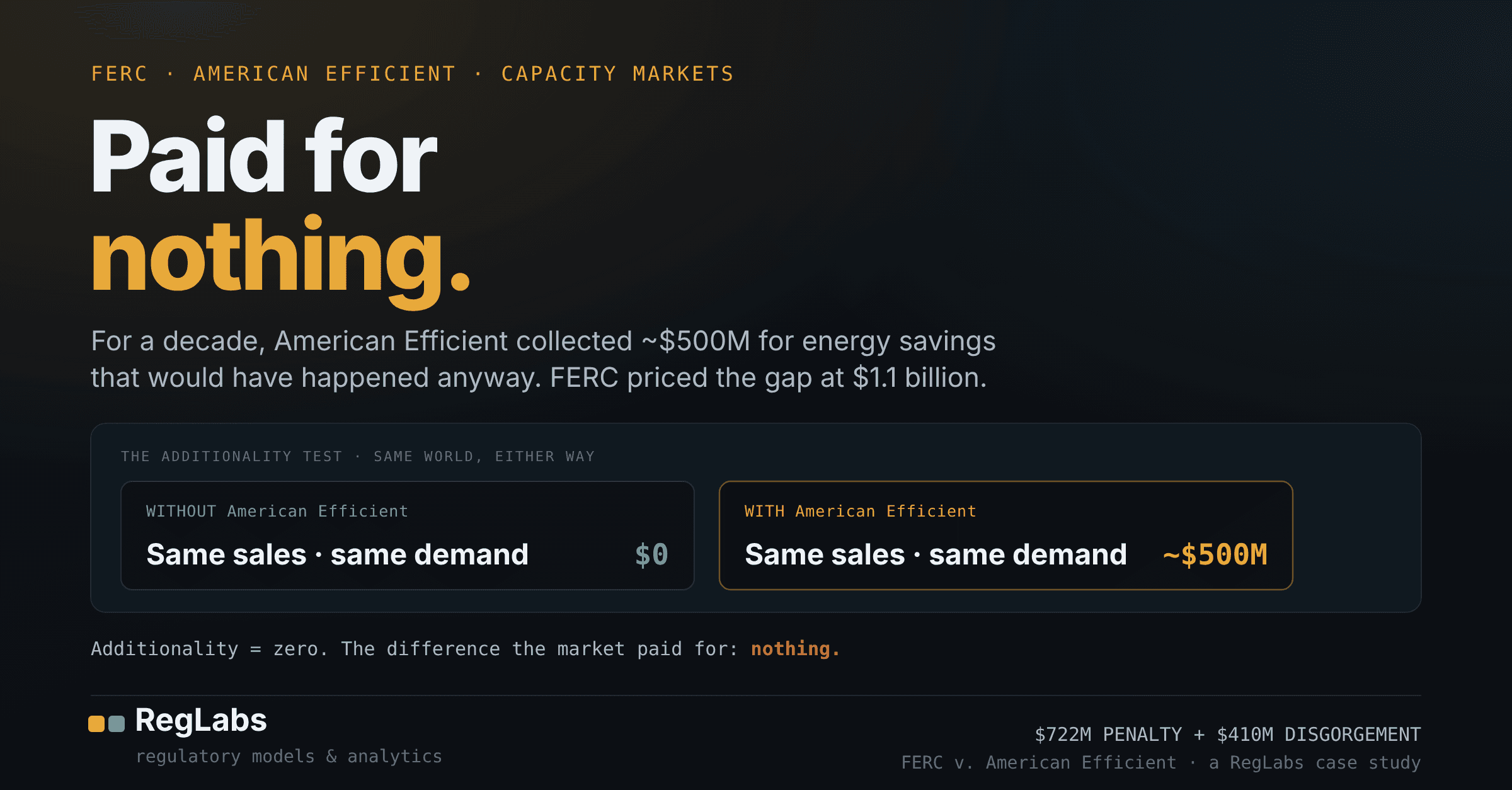
Paid for nothing.
For more than a decade, American Efficient collected roughly half a billion dollars for energy savings that would have happened anyway. FERC just priced the difference at over $1.1 billion.
A billion-dollar penalty for a program that reduced nothing
On 15 April 2026, the Federal Energy Regulatory Commission ordered American Efficient, LLC and its affiliates to pay a $722 million civil penalty plus $409,817,758 in disgorgement of unjust profits, over $1.13 billion in all, jointly and severally with their parent, Modern Energy Group.1 The order issued from a full Commission under Chairman Laura V. Swett, and it closed a proceeding that had been building, through market-monitor referrals and a formal investigation, since 2021.
The Commission did not find a single violation. It found three, each independent of the others. American Efficient violated the PJM capacity-market tariff. It separately violated the MISO capacity-market tariff. And, independent of both, it violated Section 222 of the Federal Power Act and the Commission's Anti-Manipulation Rule, which prohibit fraud and manipulation in the electric markets. Any one of the three would have supported liability. The company managed all three, across more than a decade.
Three independent violations, any one sufficient
The resource was never eligible, and the firm defrauded the market to keep it in. Two separate findings, plus a third for the deception that held them up.
Source: FERC, Order Assessing Civil Penalties , American Efficient, LLC, et al., Docket No. IN24-2-000, 195 FERC ¶ 61,043 (issued 15 April 2026).
Underneath the legal findings is a simple and unusual fact pattern. American Efficient held itself out to PJM and MISO as a legitimate energy efficiency resource, a provider that lowers electricity demand and is paid for the capacity that demand reduction frees up. It was not one. The Commission found that its program produced no measurable energy savings at all. The company bought data on sales of efficient products that were already happening, papered those completed sales as if they were reductions it had caused, and sold the resulting bundle into the capacity markets under the guise of offering actual capacity. Over the relevant period, from 1 January 2014 to the date of the order, it cleared more than 20,750 megawatts and collected about $500 million, money that flowed, through capacity charges, out of the electricity bills of ordinary ratepayers.
This study treats the order as what it really is: a complete anatomy of how an outcome-based market is defrauded, and a specification for the controls that would have stopped it. It walks the mechanism of the scheme and the single concept, additionality, that collapses it; the two independent grounds on which the resource was never eligible; the decade of warnings the firm received and routed around; and the deception that held the revenue in place. Then it lifts each failure into the discipline it violated: why an independent reviewer's rejection is data about your product rather than a public-relations problem to contain, why a firm must empirically test the one question its revenue depends on, why a compliance function that produces no friction is theater, and why a corporate structure built to push value up and leave liability in a shell is itself a governance failure. The closing sections generalize the lesson to every market that pays for a claimed outcome rather than a verified act, which is a growing share of them.
What a capacity market actually pays for
To see why the program was a fraud, you have to see what it was pretending to be. Grid operators run two different kinds of market. An energy market pays resources for actually providing power now. A capacity market pays resources for committing, years in advance, to be available on the worst demand day in the future, so the grid can be sure enough supply will exist when it is most needed. The two capacity markets in this case are run by PJM, a regional transmission organization that serves more than 67 million people from the Mid-Atlantic seaboard to Illinois, and MISO, which covers much of the Midwest and the Gulf South.
A power plant can sell capacity by committing to be available. So, in principle, can an energy efficiency resource, or EER. The logic is sound: if you can reliably cause electricity demand to fall, the grid needs that much less generation standing by, and you are paid as though you had built the equivalent capacity. When a utility runs a genuine EER program, the benefit to the public is real and it is double. First, the consumers who install the efficient products use less electricity and pay lower monthly bills. Second, across the whole region, lower load translates into lower wholesale prices, which lowers bills for everyone. The Commission was explicit that American Efficient's program produced neither of these benefits.
That is because an EER only works on one condition, and the tariffs encode it. The reduction has to be real, and it has to be caused by the resource. The rules require three things in particular: that the program be designed to achieve load reductions that would not otherwise have occurred, that the provider actually hold the ownership or contractual rights to the load-reduction capability it is selling, and that there be a genuine nexus to the end-use customers whose behavior is supposedly changing. A legitimate provider satisfies all three by changing what happens in the world, funding a retrofit, subsidizing a purchase, running a program that makes the efficient choice happen when it otherwise would not. The payment is compensation for having moved the outcome. Remove the movement, and the payment is compensation for nothing.
Why these markets rely on representations
There is a structural feature here worth naming at the outset, because it is the vulnerability the whole case exploits. A capacity market cannot directly observe the thing it is buying. Future availability on a peak day years away is not a physical object a grid operator can inspect at the point of sale; it is a commitment, evidenced by representations and measurement plans, that will only be tested, if ever, on a day that may never arrive. For a generator, that gap is partly closed by the plain fact of a physical plant that exists and can be metered. For an energy efficiency resource, there is no plant. There is only a claim about behavior that did or did not change, somewhere out in a population of consumers the grid operator will never meet. The market is therefore buying, in large part, on the strength of what the seller tells it, which places enormous weight on the honesty of the seller and on the operator's ability to verify. American Efficient is the case study in what happens when the seller is dishonest and the verification is thin, and it is a lesson that generalizes to every market built on representations rather than inspection.
The trick: get paid for sales that were already happening
American Efficient's model did not fund retrofits or subsidize anything a consumer would feel. It ran the logic in reverse. The company, operating through a network it called Program Partners, went to retailers and manufacturers and bought data on energy-efficient products those sellers had already sold, light bulbs being the archetype. For each record it paid a trivial per-unit sum the Commission repeatedly called a "micropayment." It then treated those completed, unprompted sales as if it had thereby acquired the "Environmental Attributes," the rights to the load reduction the products represented, and sold that bundle of attributes into PJM and MISO as capacity.
The company was candid about this internally, in language the Commission quoted back to it. In a July 2018 email to a prospective Program Partner, American Efficient's Head of Origination wrote that "we do not need to prove additionality; these are sales that are already occurring but for which [the partner] is capturing $0." That sentence is the whole case in miniature: a frank acknowledgment that the sales were happening anyway, paired with a plan to monetize them regardless. Later, the company's own then-Policy Director conceded that its programs "did not seek to do" the things a real efficiency program does, such as securing better retail placement for efficient products; American Efficient instead "simply paid the partner for providing the [sales] data."
The consumer who bought the bulb was never part of any of it. They received no discount, no rebate, and crucially no notice that the efficiency attributes of their purchase had been transferred to a company and resold to a grid operator hundreds of miles away. The Commission found that end users received no such notice, that American Efficient told its Program Partners there was "no requirement to do customer notice," and that the company itself admitted end users "often were unaware that their rights had been transferred." Nothing about the transaction caused a single additional efficient product to be sold.
How the money was made
Every dollar entered the chain at step four and five. Nothing was added to the world at step one.
Source: FERC, Order Assessing Civil Penalties , American Efficient, LLC, et al., Docket No. IN24-2-000, 195 FERC ¶ 61,043 (issued 15 April 2026).
The inversion that should have been the tell
It is worth pausing on the direction of the logic, because the inversion is itself the diagnostic. A genuine efficiency program runs forward: it spends money to change behavior, and the changed behavior produces a reduction it can then sell. The spending comes first and causes the saving. American Efficient ran the arrow backward: it found savings that had already occurred, bought the paperwork, and sold it. The spending came last and caused nothing. Any control designed around the economics of a real program, where the key number is how much incentive was delivered to change a decision, would have flagged a program in which the incentive was a micropayment too small to change any decision at all. The triviality of the payment was not an incidental detail; it was proof, on the face of the model, that the model could not be doing what it claimed. A firm or a regulator asking the single question "what, concretely, did this payment cause a consumer to do differently" would have reached the bottom of the case in one step. The answer was nothing, and the company knew it.
Additionality: the one word that collapses the scheme
There is a precise term for what was missing, and it travels far beyond electricity markets. Additionality asks a single question: would the outcome have happened anyway? If the efficient products would have sold with or without American Efficient in the picture, then American Efficient reduced nothing. It simply stood between a sale that was already occurring and a market that would pay for the illusion that it had caused the sale. The company's own Head of Origination, as above, had said the quiet part in writing: it did not need to prove additionality, because the sales were already occurring.
The Commission's record makes the point almost arithmetically. Hold electricity demand up against a counterfactual world in which the company never existed, and the two worlds are identical. The same products sell. The same demand falls, or does not. Total electricity demand in PJM and MISO, the Commission found, was unaffected by American Efficient's program. The only difference between the two worlds is a half-billion dollars moving from ratepayers to a private firm.
This was not a subtle or contested point by the end. When the MISO market monitor interviewed the company in March 2021 and asked, in effect, whether American Efficient's position was that "it doesn't matter under the tariff whether your programs are saving or reducing electric consumption or not," the then-Policy Director answered: "Yeah." MISO's own technical conclusion pointed the same way, finding that the baselines American Efficient used "likely do not reflect any additional load reduction beyond what market trends would already provide." The savings were not merely hard to measure. On the record, there were none to measure.
The additionality test
The difference the market paid for: nothing.
The tariffs require a resource to be designed to achieve reductions. A program that changes no behavior achieves none.
Source: FERC, Order Assessing Civil Penalties , American Efficient, LLC, et al., Docket No. IN24-2-000, 195 FERC ¶ 61,043 (issued 15 April 2026).
Why additionality is so easy to assert and so hard to verify
The reason additionality is the pressure point of the entire case, and of every market like it, is an asymmetry baked into the concept. Proving that something did happen is comparatively easy: you can point to the sale, the installed meter, the signed contract. Proving that something would not have happened anyway requires reasoning about a counterfactual world that does not exist and cannot be observed, which is a genuinely hard analytical task even for an honest participant acting in good faith. That difficulty is exactly what a dishonest participant hides behind. The counterfactual is unobservable, so a claim about it cannot be directly checked; the seller asserts that the reduction was caused, the buyer cannot easily disprove it, and the burden of establishing the negative, that nothing additional occurred, falls on a regulator with limited visibility. American Efficient lived in that gap for a decade, and it only closed when market monitors with technical sophistication reconstructed the baseline and showed that the claimed reductions were indistinguishable from ordinary market trends. The lesson is that in any outcome market, additionality cannot be left as an assertion the seller makes and the buyer trusts. It has to be a documented, independently reviewable showing, built on an explicit baseline, before money changes hands, because the one thing a fraudulent outcome claim and a genuine one have in common is that they look identical on the invoice.
Ineligible, on two independent grounds
Before it ever reached the fraud charge, the Commission found that American Efficient had no right to be in these markets at all. It held that the company violated the PJM and MISO tariffs, and it did so on two separate grounds, each sufficient on its own. The structure matters, because it shows the ineligibility was not a technicality that a better disclosure could have cured. The resource itself did not qualify.
Two independent reasons American Efficient was ineligible
Either ground alone defeats eligibility. The company failed both.
Source: FERC, Order Assessing Civil Penalties , American Efficient, LLC, et al., Docket No. IN24-2-000, 195 FERC ¶ 61,043 (issued 15 April 2026).
The first ground is about rights. To sell a resource's capability into a capacity auction, you must actually hold that capability, through ownership or an equivalent contractual right to control it. American Efficient's contractual theory ran through the "Environmental Attributes" it claimed to acquire by paying retailers for sales data. But the Commission found that buying a record of a sale that already happened does not confer control over any load-reduction capability, and the chain was further undercut by the absence of any notice to, or role for, the end-use customers whose consumption was nominally at issue. The company was selling into the market something it did not own.
The second ground is about design, and it is the more fundamental. The tariffs do not merely ask whether reductions occurred; they require that the resource be designed to achieve reductions that would not otherwise have happened. A program built to monetize sales that were already occurring is, by construction, not designed to achieve anything incremental. It fails the eligibility test at the level of its own blueprint, before a single measurement is taken. This is why the Commission could find a tariff violation independent of, and in addition to, the manipulation it found later: the resource was never qualified to participate, regardless of what the company said about it.
The discipline: eligibility is a property of the design, not the disclosure
The two-ground structure carries a lesson that outlives this tariff. There is a difference between a participant who is eligible but failed to disclose something, and a participant who is not eligible at all, and the two call for completely different responses. A disclosure failure can, in principle, be cured: tell the market the thing you withheld, and the question becomes whether the resource qualifies now that the facts are known. An eligibility failure cannot be cured by any amount of disclosure, because the defect is in the design of the thing being sold, not in what was said about it. American Efficient's deepest problem was of the second kind. Even if it had described its model to PJM with perfect candor, "we buy data on sales we did not influence and resell the attributes," the resource still would not have qualified, because it was not designed to achieve anything incremental and it did not control any capability. For a firm, this distinction is the difference between a problem that transparency fixes and a problem that transparency merely exposes. For a market operator, it is the reason eligibility review has to interrogate the design of a resource and not only the completeness of its filings: a defect that lives in the blueprint will pass any check that only asks whether the forms were filled out.
"Historicals": billing for the past
If selling the attributes of ongoing sales was the core of the scheme, one variation pushed past even that. American Efficient also claimed and monetized what the record calls "historicals": energy-efficient product sales that had occurred before the company had any contract or relationship touching those products at all. It was collecting capacity revenue tied to reductions that had already happened, in the past, with no connection to the company whatsoever at the time they occurred.
The Commission did not reach for understatement. It called the practice "a truly brazen scheme to extract additional dollars from PJM and MISO ratepayers." The logic defeats itself: a capacity resource is a forward commitment to reduce future load, and there is no version of additionality, however generous, under which a firm causes a reduction that took place before it existed in the transaction. The company's own training discussions, the order notes, "did not prevent them from offering logically impossible load reductions from 'historical' EE product sales." This was revenue detached not merely from causation, but from time, and the Commission treated it as a distinct fraudulent scheme in its own right, separate from the sham EER program itself.
The historicals deserve attention beyond their brazenness, because they mark the point where even the pretense of a theory dissolves. The core program at least had a story, however false: we paid for the attributes, so we own the reduction. The historicals have no story available at all. There is no coherent account under which a firm can be compensated, in a forward capacity market, for a behavior change that predated its involvement, because the entire premise of the market is a commitment to deliver something in the future. That the company offered them anyway tells you something about the internal gravity of the scheme: once an organization has normalized being paid for reductions it did not cause, the leap to being paid for reductions that happened before it arrived is small, because the operative principle in both is the same, the paperwork is the product, and the underlying reality is not consulted. Fraud, left unchecked, does not hold a stable line. It expands to the edge of whatever the market will pay, and the historicals are that expansion made visible.
The discount that never was
One misrepresentation runs through the filings for years, and it is worth isolating because it shows the fraud was active, not merely a matter of silence. From 2014 to 2017, American Efficient made at least eight submissions to PJM claiming that its EER program relied on "rebate coupons," "mark-downs," "discounts," and "reducing the retail price to the consumer." It made similar representations to MISO in at least four measurement-and-verification plans and reports, the most recent in January 2018. The picture these filings painted, of a program that lowered what consumers paid, was exactly the picture a legitimate utility EER program would present. It was also false. The Commission found that American Efficient did not itself offer discounts to consumers, and did not require its Program Partners to provide them either.
What happened next is the tell. On 3 February 2017, a redline of a draft report to PJM shows the company's Head of Market Operations deleting the sentence about "reducing the retail price to consumer." The misleading language was removed, but PJM was never told that the representation had changed, or that the earlier filings had been inaccurate. Quietly editing a false statement out of future documents, while leaving the false impression in place, is not a correction. It is the management of a lie.
The confusion the representations created was concrete. When American Efficient's representatives met PJM personnel on 19 July 2017 to walk through the business model, the PJM employee came away describing a program in which the company worked with retailers to offer a 33 percent discount on the price of light bulbs. No such discount existed. The gap between what PJM understood, a program that cut consumer prices, and what American Efficient actually did, buy data on sales it did not influence, is precisely the gap the Commission found had been created and then preserved by material misstatement and omission.
A decade of warnings, and a decision not to poke the bear
The clearest sign that this was not an honest misreading of complex rules is what happened when other grid operators looked closely. They did look, and they acted. American Efficient's response was not to fix the model. It was to keep the problem quiet in the one market that still paid. The chronology below is drawn directly from the order, and it reads less like a series of accidents than like a decade-long decision to keep collecting.
What they were told, and what they did
Disqualification in two markets was treated as a disclosure problem to manage, not a verdict to heed.
Source: FERC, Order Assessing Civil Penalties , American Efficient, LLC, et al., Docket No. IN24-2-000, 195 FERC ¶ 61,043 (issued 15 April 2026).
The ISO-NE episode is instructive because it shows the model failing the moment a sophisticated operator examined it on the merits. In August 2019, ISO New England rejected an attempt by American Efficient's subsidiary Maple to increase its capacity offer roughly twentyfold. In a letter, ISO-NE explained that it had "relied on Maple's statements that its program was substantially similar to state energy efficiency programs," and that "if we had understood this to be Maple's business model, we would not have qualified Maple's resources" for the previous auctions. Maple's participation, ISO-NE concluded, would provide "no discernible benefit, neither an increase in demand reduction nor an increase in reliability." The partial disqualification followed.
MISO reached the same place by a different route in March 2021, when it wholly disqualified American Efficient from the 2021-22 Planning Resource Auction. Its stated reasons were a catalogue of the model's defects: the company had failed to demonstrate the contractual rights to its claimed peak-load reductions, failed to show the reductions came from energy-efficient "installed measures," and relied on baselines that likely captured nothing beyond what market trends would have produced anyway. The PJM market monitor, referring the matter to FERC Enforcement the following month, put it most plainly: energy efficiency depends on an installation or implementation, and American Efficient "had not demonstrated that anyone has installed or implemented anything."
And yet PJM, described in the record as the company's "biggest and most important market," was never told about any of it. The nondisclosure was not an oversight. American Efficient's leadership was worried that disclosure would "poke the bear" and jeopardize its most lucrative participation, so it "elected not to do so" and determined it was "best to focus on maintaining that participation model." Worse than silence, in July 2023 the company affirmatively told PJM that it "operates similarly in MISO's capacity market," in the present tense, more than two years after MISO had thrown it out. The Commission found this a material misrepresentation, and it is the clearest single illustration of a firm managing its disclosures market by market to keep the revenue flowing.
When an independent reviewer says no, that is data
The single most teachable decision in the entire record is the one the company made after it was thrown out of two markets. ISO-NE rejected the model and said plainly it would never have qualified the resource had it understood it. MISO disqualified the resource outright and catalogued exactly why. The PJM market monitor referred the matter to federal enforcement. These were not vague misgivings; they were considered conclusions by sophisticated, independent reviewers whose entire job is to assess exactly this kind of resource. A firm operating in good faith receives a signal like that and treats it as the most valuable information it has: three expert bodies, looking at the same model, independently concluded it did not hold up. American Efficient treated it as a public-relations problem to contain, and the framing it chose, do not "poke the bear," is the whole error in four words.1
The discipline this violates is one that applies to any regulated firm, in any market, and it is worth stating as a principle: an adverse finding by an independent reviewer is primarily information about your product, and only secondarily a reputational event to be managed. The two framings lead to opposite actions. If a rejection is information, the correct response is to ask what the reviewer saw that you did not, to test whether the defect they identified is real, and, if it is, to fix the product or stop selling it, everywhere, because the defect does not respect market boundaries. If a rejection is merely a reputational event, the correct response is to contain it: keep it from spreading to the markets that have not yet noticed, manage the disclosures, and protect the revenue. American Efficient chose the second framing deliberately and explicitly. It understood that the MISO and ISO-NE findings, if they reached PJM, would end its most lucrative participation, and so it worked to keep them from reaching PJM, which is precisely the behavior of a firm that has understood a rejection as a threat to revenue rather than as a verdict on its product.
A defect found in one market is a defect in all of them
The reason the containment strategy is not merely dishonest but incoherent is that the thing the reviewers rejected was the resource itself, not its presentation in a particular market. MISO did not find that American Efficient had filed the wrong form in Indiana; it found that the resource controlled no capability, rested on baselines that captured nothing additional, and reflected no installed measures. Those defects are properties of the model, and the model was the same in PJM as it was in MISO. A rational firm understands that a reviewer who identifies a design defect has identified it for every market the design operates in, and that the only questions are whether the defect is real and what to do about it. American Efficient's leadership understood this too, which is exactly why they feared disclosure: they knew that if PJM applied the same scrutiny MISO had, it would reach the same conclusion. The decision to keep PJM in the dark was therefore not a bet that the model was fine in PJM. It was a bet that PJM would not look, and the entire fraud finding flows from the fact that the firm chose to protect that bet with affirmative misrepresentations rather than to act on what it already knew. The generalizable rule for compliance functions is blunt: when any regulator or independent monitor rejects a product or practice on its merits, the firm must treat that rejection as presumptively applicable everywhere the same product or practice is in use, and carry the burden of proving otherwise, rather than quarantining the bad news in the jurisdiction that happened to deliver it.
What they said, and what they quietly stopped saying
The third and independent violation was manipulation. Under Section 222(a) of the Federal Power Act and the Commission's Anti-Manipulation Rule, which is modeled on the securities antifraud provisions, it is unlawful to use a fraudulent device, scheme, or artifice, or to make a material misstatement or omission, in connection with a jurisdictional electricity transaction. The Commission found American Efficient had done both. It identified two fraudulent schemes, fraudulently holding itself out as a legitimate EER provider, and fraudulently collecting payments for "historicals," and, separately, four distinct material misstatements or omissions to PJM and MISO.
- The false benefit. The company represented, across years of filings, that its program lowered consumer prices through rebates, markdowns, or discounts. It offered none of those, and required none of its partners. When the claim became inconvenient, the language was quietly removed from a draft PJM report in 2017, and the market was never told the representation had changed or that the earlier statements were false.
- The hidden triviality. It omitted the de minimis size of the "micropayments" it made for sales data. That detail mattered: a payment too small to change anyone's purchasing decision is powerful evidence that the program incentivized no additional efficiency at all. Disclosing it would have undercut the whole premise, so it went undisclosed.
- The undisclosed disqualifications. It did not tell PJM about the MISO and ISO-NE disqualifications, while continuing to affirm its good standing. The Commission found American Efficient had a duty to disclose these developments and consciously chose not to.
- The false affirmations. It affirmed that it held the contractual rights the tariffs required, when, for the historicals and more besides, it did not.
Each of these is the same act in a different costume: say the thing the market needs to hear to keep paying, and stay silent on the thing that would make it stop. The Commission's finding that this conduct "clearly circumvents market rules in a deceptive manner that harms the proper functioning of the market" is what separates a merely ineligible resource from a manipulative one. American Efficient was both.
Why omission is treated as gravely as a lie
Two of the four manipulation findings are omissions rather than affirmative falsehoods, and that is worth drawing out, because firms routinely underrate the legal and practical weight of staying silent. The intuition that a lie is worse than a silence is wrong in a market built on disclosure. When a participant has a duty to speak, created by the regulatory framework, by prior representations it has made, or by the materiality of the fact to the market's decision, then withholding the fact is itself the deceptive act, and it is treated as such. American Efficient had made affirmative representations about its good standing and its model; those representations created a duty to update the market when they ceased to be true, which they did the moment MISO and ISO-NE disqualified the resource. The silence that followed was not neutral. It allowed a false impression the firm had created to persist, and persisting in a false impression you created is, in the law of manipulation, indistinguishable from asserting it fresh. The discipline for any regulated firm is that the disclosure obligation is continuous, not a one-time event at filing: a representation that was true when made becomes a misrepresentation the moment the firm learns it is no longer true and says nothing, and the duty to correct runs to every market that relied on the original statement.
They knew
The most damaging material in the order is not external. It is the company describing itself, in its own voice, to itself. These are not the words of a firm that misunderstood a rule. They are the words of people who understood it well enough to be uncomfortable, and kept going.
He did not believe those payments were causing additional energy efficiency.
We do not need to prove additionality; these are sales that are already occurring but for which [the partner] is capturing $0.
At best unethical ... a wealth transfer between ratepayers and Modern.
The resignation is the moral center of the record. The then-Policy Director left in October 2021 because, as she came to understand the business model, she concluded it was "at best unethical" and amounted, "in economic terms," to "a wealth transfer between ratepayers and Modern." Hers was not an outsider's critique. She had been close enough to the operation to have earlier conceded that the programs "did not seek to do" the things a genuine efficiency program does, and that the company "simply paid the partner for providing the data." When the person responsible for policy resigns on the view that the core model is a wealth transfer, and the model continues unchanged, the record of intent is close to complete.
The litigation posture made it worse, not better. The Commission noted that the company's later, more careful account of its business, the version built for the proceeding, was described by one of its own executives as a late-arriving "defensive track" that "even the company's leadership team did not believe." When a firm's own people privately concede that the program causes nothing, that it does not need to prove additionality, that it is a wealth transfer, and that even the defense is not believed internally, the question for a regulator stops being whether there was intent. It becomes how long the intent persisted. Here, the answer was more than a decade.
The dissent that resigns instead of stopping the firm
There is a governance lesson in the resignation that is easy to miss because the resignation looks, at first, like the conscience of the organization asserting itself. It is worth seeing clearly: the person best positioned to understand that the model was a wealth transfer concluded exactly that, and her response was to leave, not to stop the practice. This is not a criticism of the individual, who may have had no power to halt anything; it is a diagnosis of the structure. In a well-governed firm, a policy leader who reaches the conclusion that the core product is unlawful has a channel through which that conclusion forces action, an escalation path to a board or a compliance authority with the standing to suspend the practice pending review. In American Efficient, the only lever available to the person who saw the problem most clearly was her own departure, which removed the one internal critic and left the model running. A conscience that can only express itself by exiting is a conscience the organization has structurally disarmed. The lesson for any firm is that the value of an internal dissenter is realized only if dissent connects to authority; a culture in which the honest answer to "is this lawful" is to quit rather than to stop the firm is a culture that has guaranteed its own worst outcome.
Compliance theater
A firm participating in federal power markets for a decade, clearing tens of thousands of megawatts, might be expected to have a serious compliance function. The Commission found it did not, concluding expressly that American Efficient "did not have an effective compliance program within the meaning of the Penalty Guidelines." The absence was not for want of warnings. The company "received many warnings that its program was deficient but did nothing in response," from the PJM and MISO market monitors, from MISO and ISO-NE directly, and from FERC Enforcement staff, and none of them "led American Efficient to change the way its Program operated."
The specifics are almost comically thin for an operation of this scale and duration. On training, the record contains a single 2018 slide deck, and most of that deck discusses antitrust law, deceptive trade practices under the FTC Act, and record retention, with no substantive treatment of the PJM or MISO tariff provisions that actually governed the business. The company pointed to a "layered review" of its submissions by staff, internal and outside counsel, and senior leadership. But that review, the Commission observed, "was not affected, as it should have been," by the ISO-NE near-total disqualification, nor was the PJM submission process affected by the MISO disqualification. A review process that produces fraudulent statements, and does not change after a market throws you out, is not a control.
There is a deeper absence beneath the procedural one. American Efficient "did not gather data about whether its program was incentivizing sales of EE products," and "did not take steps to test whether its program was achieving that goal." The one empirical question on which the entire legitimacy of the business depended, did our payments cause any additional efficiency, was never asked by the company in a way that could be answered, because asking it honestly would have ended the business. Tellingly, Modern's own Head of Legal personally signed off on the submissions to PJM and MISO. The failure was not buried in a junior function. It ran through the top of the house.
What distinguishes a control from its costume
The Commission's phrase, that the firm had no effective compliance program "within the meaning of the Penalty Guidelines," points at a distinction that matters for every firm, because many have exactly what American Efficient had: the appearance of compliance without its function. A compliance program is not a set of artifacts, a training deck, a review step, a sign-off, a policy binder. It is a capability to produce friction at the point where the business is doing something it should not. The test of whether a compliance function is real is simple and unforgiving: can you point to an occasion when it stopped or changed something the business wanted to do. By that test, American Efficient's apparatus failed completely. It had a review process that reviewed, and signed, fraudulent filings. It had training that covered everything except the rules that governed its actual business. It had legal sign-off at the highest level on the very submissions the Commission found manipulative. Every component existed, and none of them produced any friction at the one point where friction was the entire purpose. This is the defining property of compliance theater: the controls are present as objects and absent as forces. They generate documents, attendance records, and sign-offs, all of which can be shown to an examiner, and they never once impede the conduct they nominally govern. A firm auditing its own program should therefore ask not "do we have these controls" but "when did these controls last say no, and what happened when they did." A control that has never said no, over a decade and half a billion dollars, is not a control. It is set dressing.
The question they could not afford to ask
Of everything in the order, one omission is the quiet key to all the others: American Efficient never tested whether its program did what it claimed. The Commission found, in plain terms, that the company "did not gather data about whether its program was incentivizing sales of EE products" and "did not take steps to test whether its program was achieving that goal." For a business whose entire legal right to exist depended on the answer to a single empirical question, did our payments cause any additional efficiency, this was not an oversight. It was the one experiment the firm could not run, because it already knew what the result would be.1
This is a specific and recurring failure, and it is worth naming as a discipline in its own right, because it is far more common and far more respectable-looking than outright fraud. Call it the unasked question: the empirical test that would validate or destroy a business's core premise, which the business carefully never performs. The premise is load-bearing, so no one wants to put weight on it. The test is feasible, often cheap, sometimes a single well-designed study, so the failure to run it is a choice rather than a limitation. And the avoidance is usually rationalized rather than decided: the data is hard to get, the methodology is contested, the counterfactual is unknowable, we are confident it works, the regulators have not required it. Each rationalization is individually plausible and collectively damning, because the one thing they have in common is that they all preserve the firm's ability to keep claiming the thing it has declined to verify. American Efficient's genuine innovation was not the data-purchasing model; it was the discipline of never looking directly at the number that would have ended it.
Build the test you are most afraid will fail
The forward-looking discipline runs exactly opposite to the firm's behavior. A well-governed business identifies the empirical claim its revenue most depends on, and then builds the standing capability to test that claim honestly, precisely because it is frightening. In an outcome market, that means designing a real additionality study: an explicit baseline, a defensible counterfactual, a measurement of what actually changed against what would have happened anyway, run not once at launch but continuously, because a program that was additional in one year may cease to be as market trends catch up. The governing instinct should be inverted from American Efficient's: the test you least want to run is the test you most need to run, because the reluctance is itself a signal about what the result would be. A firm that is genuinely confident its program works loses nothing by measuring it and gains a defense that no enforcement action can dismantle, documented, independent evidence of causation. A firm that avoids the measurement is, whether it admits it or not, protecting itself from an answer it fears, and a regulator who notices the avoidance will read it exactly that way. The Commission did. The absence of any attempt to test the premise was, in its analysis, not a neutral gap but affirmative evidence that the firm understood the premise would not survive testing.
Modern, and the hollow shell left behind
The penalty did not land only on the entity named in the filings. It reached Modern Energy Group, the multinational finance firm at the top of the structure, and a chain of affiliates in between, jointly and severally. Two features of the record explain why, and together they show that the corporate form was not incidental to the scheme but part of it.
The structure that collected the money
Modern used the entities below it as a tool to extract over $500M, then left the operating company empty. Hence joint and several liability.
Source: FERC, Order Assessing Civil Penalties , American Efficient, LLC, et al., Docket No. IN24-2-000, 195 FERC ¶ 61,043 (issued 15 April 2026).
The first feature is where the money came from. Capacity costs are socialized into the rates consumers pay, so a half-billion dollars collected for capacity that did not exist is, in the Commission's framing, money "siphoned out of the pockets of electric utility ratepayers and into [American Efficient's] own coffers." The harm was not to a counterparty who could look after itself. It was a diffuse transfer from the public, spread across tens of millions of electricity bills, which is exactly the kind of harm these markets and their rules exist to prevent.
The second feature is where the money went, and what was left behind. The Commission found that Modern and its affiliates "engaged in concerted wrongdoing, using American Efficient and its subsidiaries as their tool to extract more than $500 million from PJM and MISO, while leaving American Efficient with virtually no assets." The operating entity, in other words, was built to be judgment-proof: the revenue flowed up to Modern, the liability was meant to stay down at a shell. A private placement memorandum reinforced the point from the other direction, describing Wylan as the contracting entity for the "energy efficiency investments that Modern and its investment vehicles make" and as facilitating investments "on behalf of the Modern Energy funds," language through which Modern held itself out as the party ultimately controlling the enterprise. Joint and several liability is the Commission's answer to that design. A penalty assessed only against an emptied shell would be a penalty against no one; by reaching MIH, Modern, and the sibling subsidiaries, the order attaches the obligation to the entities that actually received and controlled the money.
Judgment-proof by design, and why it did not work
The hollow-shell structure deserves to be examined as a discipline of its own, because the attempt to be judgment-proof is a recurring feature of financial misconduct and the order is a clean illustration of how regulators defeat it. The design is simple and common: place the risky, revenue-generating activity in an operating entity, and sweep the proceeds upward to a parent, so that if the activity is ever found unlawful, the liability attaches to an entity with nothing left to pay. On paper, the operating company bears the legal exposure; in reality, the value has already moved somewhere the judgment cannot reach. American Efficient was configured exactly this way, left, in the Commission's words, "with virtually no assets" while more than $500 million flowed up to Modern and its funds.1
The reason the structure failed is the principle every firm should take from it: liability follows control and benefit, not the org chart. The Commission did not confine itself to the entity that signed the filings. It asked who directed the conduct and who received the money, and it found that Modern and its affiliates had "engaged in concerted wrongdoing," using the subsidiaries "as their tool," with Modern holding itself out in its own offering documents as the party making the investments. Having established that the parent controlled the enterprise and captured its proceeds, the Commission imposed joint and several liability across the chain, which means the full obligation can be collected from any of the liable entities, including the parent that actually holds the money. The careful separation the structure was built to achieve became irrelevant the moment the regulator looked past form to substance, which is precisely what enforcement regimes are designed to do when the form is a device for evading responsibility.
The governance lesson for legitimate groups
It would be a mistake to read this as relevant only to bad actors who deliberately build shells. The deeper lesson reaches every corporate group, because the same structural instinct, push value up, keep liability down, operates in ordinary corporate design without any fraudulent intent, and it creates a governance blind spot even in honest firms. When the entity that runs a risky activity is thinly capitalized and the benefit flows to a parent, the parent has muted economic exposure to the activity's downside, which weakens exactly the oversight the parent is supposed to provide. The structure that externalizes legal liability also, quietly, externalizes the parent's incentive to supervise. A well-governed group resists this by ensuring that accountability for a subsidiary's conduct, and genuine exposure to its risks, sits with the people and the entity that control it and benefit from it, rather than being diffused into a structure where no one with power feels the consequences. The American Efficient order is a reminder that regulators increasingly reason in substance about control and benefit, and that a group which has arranged its affairs so that the people directing the conduct are insulated from its consequences has built a liability, not a shield. Joint and several liability across a controlled group is the standing answer, and firms should assume it will be applied wherever the structure looks like an attempt to separate the money from the responsibility.
Additionality is the integrity test for every outcome market
Strip away the electricity and American Efficient is a case about a far more general design. Any market that pays for a claimed outcome, rather than for a verified action, inherits the same vulnerability. Carbon offsets pay for emissions that would supposedly not have happened. ESG and impact claims pay for change a strategy supposedly caused. Tax credits and subsidies reward behavior that was supposedly induced. Renewable energy certificates, biodiversity credits, and a growing array of environmental-attribute markets all rest on the same foundation. In every one of them, the integrity of the whole market rests on a single question that is easy to ask and hard to verify: would it have happened anyway?
The failure mode is always the same shape. It is far cheaper to document an outcome than to cause one. Where a market pays on documentation, capital flows toward the documentation. The counterfeit and the genuine article look identical on the paperwork, which is precisely why paperwork cannot be the test. Additionality, baseline, and causation are not accounting niceties. They are the only thing standing between an incentive market and a machine for minting claims. American Efficient is what that machine looks like when it runs unchecked for a decade: a program that produced perfect filings and zero reductions, and collected half a billion dollars on the strength of the former.
The four questions that travel to any outcome market
For anyone running or supervising such a program, the American Efficient order is a specification for where to look, and the questions generalize cleanly. The first is the counterfactual: is there a documented, defensible baseline, and does the claimed outcome actually exceed what would have happened without the program. The second is the chain of custody: does the firm actually hold the right it is selling, traced end to end, rather than a paper claim to a right it merely purchased a record of. The third is the end party: do the people whose behavior is supposedly being changed even know a transfer has occurred, because a reduction sold without the knowledge of the person who supposedly caused it is a strong sign that no causation took place. The fourth is the response to challenge: what does the firm do when an independent reviewer says no, does it investigate and fix, or contain and conceal. On every one of these four tests, a decade of warnings had already returned the answer for American Efficient. The order's lasting value is that it put a number on ignoring them, and the number is larger than the proceeds of the fraud.
Paperwork is cheaper than causation, and getting cheaper
The deepest reason this case will keep recurring is an economic asymmetry that technology is widening, not closing. Causing a real outcome, funding a retrofit, changing a consumer's decision, reducing an emission that would otherwise have occurred, is expensive, slow, and uncertain. Documenting a claimed outcome is cheap, fast, and, to a market that pays on documentation, indistinguishable from the real thing. As long as that asymmetry holds, outcome markets will attract capital toward the production of credible-looking claims rather than the production of real effects, and the integrity of each such market will depend entirely on whether verification can keep pace with claim generation. American Efficient exploited the asymmetry with nothing more sophisticated than data purchases and misstatements. The asymmetry is about to get far wider.1
The reason is that the cost of producing convincing documentation is collapsing. The same tools that let any organization generate polished reports, measurement-and-verification plans, baselines, and narratives at near-zero marginal cost apply with full force to the paperwork of outcome markets, which is, after all, mostly documents. A firm inclined to do what American Efficient did can now generate a larger volume of more sophisticated, more internally consistent, more superficially rigorous filings than a market monitor reviewing them by hand can realistically challenge. The counterfeit does not merely look identical to the genuine article on the paperwork; it can now be produced in far greater quantity and with far greater apparent rigor, which shifts the balance of effort decisively toward the claimant and away from the verifier. A verification regime designed for an era when producing a plausible measurement plan was itself costly, and therefore somewhat self-limiting, is structurally unprepared for an era when it is nearly free.
Verification has to move from the document to the counterfactual
The response that the American Efficient order implicitly argues for, and that the widening asymmetry makes urgent, is to move the locus of verification away from the document and toward the underlying reality the document claims to describe. A review that checks whether the filing is complete, internally consistent, and well-supported is exactly the review that cheap, abundant, sophisticated documentation defeats, because those are precisely the qualities such documentation now has in abundance. The review that survives is the one that reconstructs the counterfactual independently, that tests the claimed causation against an external baseline the claimant did not supply, and that treats the quality of the paperwork as close to irrelevant to the question of whether anything real occurred. This is the direction the market monitors in this case were already moving: MISO did not find American Efficient's filings incomplete; it reconstructed the baseline and found that the claimed reductions were indistinguishable from market trends. That is verification aimed at the world rather than at the document, and it is the only kind that holds up when documents are cheap. The forward-looking lesson for every outcome market, and every regulator who oversees one, is that the integrity of the market can no longer rest on the scrutiny of representations, because representations are becoming costless to manufacture. It has to rest on independent measurement of the thing itself, applied before the money is paid, because the one defense a fraudulent outcome claim has never had, and a genuine one always has, is a real effect in the world that an independent party can measure. Everything else is paperwork, and paperwork has never been cheaper to fake.
The order's final contribution, then, is not merely a billion-dollar penalty against one firm. It is a demonstration, worked out in exhaustive detail, of what the failure looks like and what the controls would have been: a documented counterfactual before revenue recognition, a traced chain of custody for every attribute sold, notice to the end parties whose behavior is monetized, honest standing in every market, a compliance function that can halt a product when a regulator says no, and an independent test of the one premise the whole business depends on. American Efficient had none of them, for twelve years, and said so in its own words. The lesson belongs to every market now being built on the promise of an outcome, at the exact moment that promising an outcome has never been easier or cheaper to fake.
What this case is really about
The product was the paperwork, and no one tested the counterfactual
American Efficient did not fail a disclosure. It operated, for twelve years, a revenue model whose central asset was the gap between a sale occurring and a sale being caused. The controls that should have closed that gap, verification of additionality, honest standing in every market, acting on regulator warnings, an empirical test of its own premise, were not weak. They were structurally absent, and the firm's own leadership said so in writing. The Commission found three independent violations and reached the parent because the scheme was designed to extract the money upward and leave the liability in a shell. The lesson is not specific to energy. It is the governing risk of every market that pays for outcomes, at the moment documentation of an outcome has never been cheaper to produce.
Where it broke
- Revenue booked for reductions that would have occurred anyway, with no additionality test at all
- Resource ineligible on two independent grounds: no control of the capability, and not designed to achieve reductions
- Rights sold without being held; "historicals" billed for sales that predated any contract
- A false "discount" claim filed for years, quietly edited out of drafts but never corrected to the market
- Disqualifications in two markets concealed from the third and most lucrative one
- No effective compliance program; one off-topic training deck; a review that signed fraudulent filings
- A judgment-proof structure that swept proceeds up and left the operating entity empty
What outcome markets require
- A documented counterfactual for every claimed reduction before any revenue is recognized
- Verified chain of custody and control for the attribute or right being monetized, end to end
- End-party notice, so the people whose behavior is sold actually know a transfer occurred
- Disclosure of adverse regulator action across every market a firm participates in, not just where convenient
- A compliance function with authority to halt a product, triggered automatically by a regulator's "no"
- A standing, independent test of the one premise the business depends on, run even when it is feared
- Accountability and real risk exposure sitting with the entity that controls and benefits from the conduct
Five ways RegLabs keeps a claim honest before a regulator prices it
This case study is an independent analysis prepared by RegLabs for educational and informational purposes, based on FERC's public Order Assessing Civil Penalties in Docket No. IN24-2-000. It is not legal advice and does not purport to reproduce the order in full. All figures and quotations are drawn from the public record; any characterizations are those of RegLabs. Company and regulator names are used for identification and commentary only.