
- Enforcement
- Markets & Trading
- Governance & Accountability
Hedging a position it never held
One wrong parameter told a firm's auto-hedger the whole book had traded. In seconds it fired large orders to cover a position that did not exist, drained liquidity from Treasury futures and jammed the exchange's match engine. This is how trading algorithms fail, and it is more common than the fines suggest.
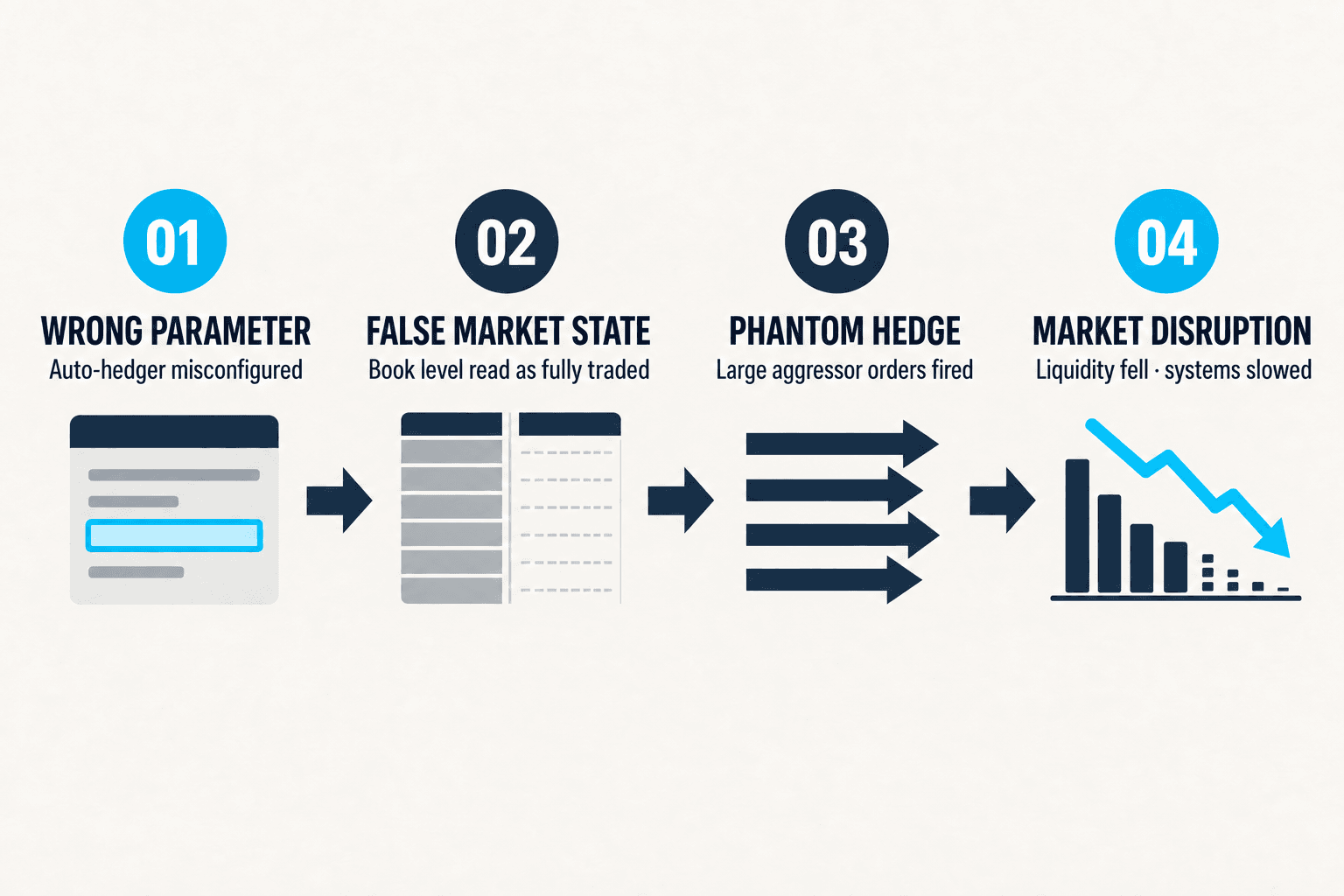
CBOT · Business Conduct Committee · Automated Trading
27 August 2024 · the cascade, in seconds
A single misconfigured setting, in other words, did not just cost the firm money; it briefly degraded the market itself.
Source: Chicago Board of Trade Business Conduct Committee, Spartak Trading LLC (CBOT 24-1822-BC; settlement accepted 24 June 2026).
Overview
On 24 June 2026, a panel of the Chicago Board of Trade's Business Conduct Committee accepted a settlement with Spartak Trading LLC, a US proprietary trading firm, and fined it $80,000. The headline number is small, but the mechanics behind it are the stuff of every risk manager's nightmares. During the Treasury futures roll in late August 2024, an automated trading system Spartak operated used an auto-hedger parameter set to an inappropriate value. When a large fill event hit the market, the hedging system misread it, concluding that the entire first level of the order book had traded in full. On that false belief it entered large aggressor orders to hedge a position it did not actually hold.
What happened next took seconds. A Spartak trader aggressively sold contracts at the same price to offset the phantom position the machine had created, and the combined activity produced a significant decline in liquidity in both the 10-Year and 5-Year futures spreads, volume aberrations at the close of a roll-period trading day, and significant latencies in the exchange's match engine and market data. A single misconfigured setting, in other words, did not just cost the firm money; it briefly degraded the market itself. CBOT found that Spartak had failed to diligently supervise its automated trading system, in breach of its rules and the exchange's advisory notice on automated trading.
The case is worth far more attention than its fine, because it is a clean, public illustration of how trading algorithms actually break. Real-world algo failures are rarely dramatic acts of manipulation; far more often they are a wrong number, an unhandled edge case, an assumption that held until the one morning it did not. This piece uses Spartak to lay out the common ways trading algorithms fail, what the enforcement record shows about where these cases land, and how firms can test their own risk frameworks against these failure modes before an exchange does it for them.
Spartak: fine, trigger, effect and finding
CBOT found that Spartak had failed to diligently supervise its automated trading system, in breach of its rules and the exchange's advisory notice on automated trading.
Source: Chicago Board of Trade Business Conduct Committee, Spartak Trading LLC (CBOT 24-1822-BC; settlement accepted 24 June 2026).
Infringements
The panel found two distinct violations. The first concerns the auto-hedger episode: Spartak violated CBOT Rule 432, which requires diligent supervision, and the exchange's automated-trading advisory (RA2403-5), which requires any party operating an automated trading system to monitor and supervise it while running and to take immediate, reasonable corrective action if it disrupts the market or the exchange's systems. The inappropriate parameter, the resulting phantom hedge, the aggressor orders and the market disruption together amounted to a failure to diligently supervise the automated system.
The second violation is separate and behavioural rather than accidental. Between August 2024 and May 2025, in markets that use a pro-rata matching algorithm, Spartak entered multiple maximum-quantity orders in an effort to capture a greater share of passive fills. Pro-rata matching allocates fills in proportion to displayed size, so posting maximum-size orders games the allocation in the firm's favour, at the expense of other passive participants. The panel treated this as inconsistent with just and equitable principles of trade. It also flagged a latent capital risk: had all of those maximum-quantity orders on one side executed at once, the resulting margin call, in that instant, could have exceeded Spartak's immediately available, liquid, unencumbered assets.
Neither finding required proof that Spartak set out to manipulate anything, and the firm settled without admitting or denying the findings. That is the important point. The exchange sanctioned the firm for the state of its controls and the design of its strategy, not for intent. In automated markets, the rulebook increasingly treats a poorly governed algorithm as a violation in its own right, because at machine speed the gap between a configuration error and a market event is measured in seconds.
How trading algorithms fail
Spartak is a useful anchor because its failure was not one failure but a chain, and each link is a recognisable, recurring failure mode. Start with the trigger: a single parameter set to the wrong value. Auto-hedgers, throttles, size caps and price collars are all governed by parameters, and a parameter that is reasonable in normal conditions can be catastrophic in an edge case such as a large fill during a thin roll period. Most algo incidents begin exactly here, with a value that was never stress-tested against the conditions that eventually arrived.
The second link is a false view of the world. The hedger concluded that the entire first book level had traded when it had not, and acted on that phantom state. Algorithms act on their model of the market, not the market itself, and when the input is misread, stale or hallucinated, the machine will confidently do the wrong thing. The third link is speed and scale: within seconds the system had entered large aggressor orders and a human trader was scrambling to offset them. Automation removes the natural friction that lets a person catch a mistake, so a small error propagates into a large position before anyone can intervene. The fourth link is the market impact: liquidity fell, volume distorted and the match engine lagged. An algorithm does not fail in isolation; it fails into a shared venue, and one participant's runaway logic becomes everyone's latency.
Beyond this specific chain, the enforcement record shows a consistent catalogue of ways algorithms go wrong, and it is worth naming them plainly.
The connective tissue across all of these is governance, not code. Spartak's fine was not for having a bug; every system has bugs. It was for failing to supervise the system diligently: no parameter validation caught the bad value, no real-time monitoring flagged the runaway hedge quickly enough, and no control stopped a strategy that could, in the worst case, have outrun the firm's own capital. The algorithm failed the way algorithms usually fail, and the controls that should have caught it were not there.
Practical Insights
The controls that would have caught Spartak are well established, and the exchange rulebooks now effectively require them. Drawing on the control design RegLabs derives from this case, four are non-negotiable for any firm running automated strategies.
Pitfall 1: parameters nobody validated against the edge case The auto-hedger value was reasonable until the one scenario it was not. The control is formal parameter governance: a version-controlled repository of approved values, defined acceptable ranges by product and market condition, a change-management gate before anything goes live, and, critically, testing against the edge cases (roll periods, large fills, thin books) rather than only calm data. A parameter that has never met a stress scenario is a parameter you do not understand.
The second is pre-trade risk controls with a working kill switch. Every order should pass a pre-trade engine that enforces maximum order size, order-rate limits, position limits and loss limits before it reaches the exchange, and an authorised person or automated trigger must be able to halt a strategy or the whole firm instantly. Spartak's runaway hedge and its maximum-quantity strategy are both exactly what pre-trade limits and a kill switch exist to contain.
The third is real-time monitoring of the algorithm's behaviour, not just its P&L. The exchange advisory requires firms to supervise an automated system while it operates and to take immediate corrective action. In practice that means live dashboards and alerts on order volume, aggressor-to-passive ratios, fill rates, latency and market-impact indicators, so that a system hedging a position it never held is flagged in seconds, not reconstructed after the fact. Detection has to run at the speed the algorithm does.
The fourth is strategy design that respects the market and your own balance sheet. The maximum-quantity finding is a reminder that a strategy can be a violation by design, not by malfunction: gaming a pro-rata matching engine harms other participants, and stacking maximum-size orders created a tail risk that could have exceeded the firm's liquid capital. Strategies should be reviewed for their market impact and their worst-case capital draw before deployment, with a net-capital buffer sized for the position the algorithm could actually build, not the one it usually holds.
Thematic Review
Spartak is one small entry in a large and active enforcement theme. Across the RegLabs record, algorithmic-trading governance failures account for more than 580 catalogued actions and over $6 billion in penalties, spread across the SEC, the CFTC, FINRA and, above all, the exchanges themselves, which police automated trading on their own venues. The Spartak fine sits at the small end by dollars, but the failure mode it represents sits right in the middle of the distribution: a control breakdown around an automated system, handled by the venue where it happened.
Algorithmic-trading enforcement is a broad, venue-heavy theme
Catalogued algorithmic-trading governance actions by regulator (case count) · 580+ worldwide · source: RegLabs
Cboe's total aggregates its BZX, EDGX, EDGA, BYX and C2 venues; NYSE and Nasdaq venues add dozens more. By value the CFTC dominates (roughly $3.7bn, driven by spoofing and disruptive-trading cases), while exchange fines like Spartak's are smaller and far more numerous.
Zoom into the venue where Spartak landed, and the pattern is precise. Across CME Group's catalogued algorithmic-trading cases, the single most common finding is failure to supervise, followed by disruptive trading, wash sales and quote-stuffing or quote-flickering, and the firms on the receiving end are overwhelmingly proprietary trading houses and market makers operating in futures. In other words, the Spartak profile, a prop firm, a supervision failure, a futures product, a disruptive market impact, is not unusual. It is the modal case.
How algorithms actually get firms fined
Schemes cited across CME Group algorithmic-trading cases · source: RegLabs
Cases carry multiple tags, so these overlap. Failure to supervise is the connective finding: whatever the algorithm did, the firm is sanctioned for not governing it. Nearly all of these cases involve futures, and proprietary trading firms are the most common respondents.
The strategic reading is that the fine is the least of it. A parameter error that jams a match engine is one bad configuration away from a genuine loss event, a client harm, or a market-wide dislocation, and the same governance gaps that produce an $80,000 exchange fine are the ones that produce a nine-figure trading loss when the numbers are larger. The firms that stay clear of both are the ones that treat their algorithms as supervised systems with tested parameters, hard pre-trade limits, real-time behavioural monitoring and a kill switch, and that prove those controls work against the specific ways algorithms fail rather than assuming they hold.
Test your framework against how algorithms really break
Surface the parameter error before the market does
Spartak's disruption came from one setting that had never met its edge case. That failure mode, and the others in this piece, are visible across the enforcement record long before they reach your order book. RegLabs turns that record into regulatory models and analytics you can point at your own controls, so the gaps surface in a test rather than in a match engine.
- Automate regulatory review across algorithmic-trading governance, supervision, pre-trade risk and disruptive-trading obligations, mapping every exchange rule and advisory to the controls it demands.
- Systematise risk assessment by benchmarking your parameter governance, pre-trade limits, monitoring and kill-switch design against the precise failure modes regulators keep citing, from bad parameters to match-gaming strategies.
- Simulate an examination on your automated trading for your own firm, using RegLabs models to surface the questions CME, the CFTC, FINRA or the SEC would ask, and to pressure-test your risk framework before an algorithm does.
This article is an independent editorial summary for information only and is not legal or compliance advice. Spartak Trading LLC settled without admitting or denying the findings.