
- Enforcement
- Governance & Accountability
- Markets & Trading
The fee nobody updated
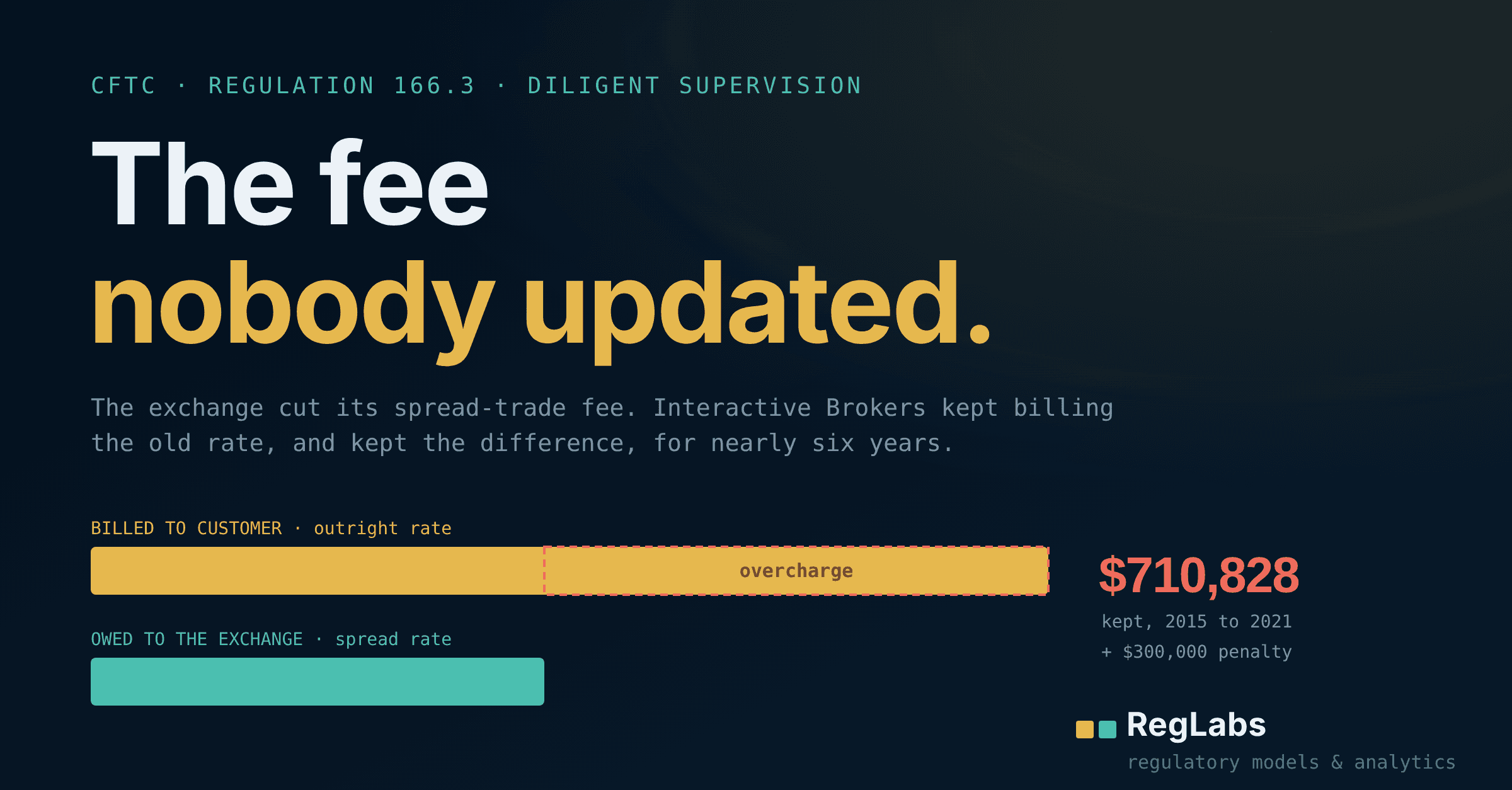
The exchange lowered the fee for spread trades. Interactive Brokers kept billing customers the higher outright rate, paid the exchange the lower one, and pocketed the difference by accident for nearly six years. Nobody caught it until the CFTC asked. Supervision is not just about the trades; it is about the invoice.
CFTC · Regulation 166.3 · Diligent Supervision
The mismatch, per spread trade
The firm paid the exchange the lower spread-trade fee but billed customers the higher outright-trade fee, and the difference accumulated over nearly six years
Source: CFTC Order, In the Matter of Interactive Brokers LLC, 30 June 2022.
Overview
On 30 June 2022 the Commodity Futures Trading Commission settled with Interactive Brokers LLC, one of the largest electronic brokers and futures commission merchants in the world, over a failure that had nothing to do with trading and everything to do with billing. When customers executed certain spread trades in equity index futures and foreign exchange futures on the CME Globex platform, the exchange charged Interactive Brokers a lower fee than it charged for outright trades. Interactive Brokers, however, kept billing its customers the higher outright rate. It paid the exchange the lower amount, charged customers the higher amount, and kept the difference, a total of $710,828.14, without meaning to.
The reason is almost mundane, which is exactly what makes it worth studying. When CME changed the way it assessed fees for these spread trades, Interactive Brokers did not update the fees it charged customers to match. The customer-facing fee table simply drifted out of sync with the exchange's actual schedule and stayed that way. The overcharging on equity index futures spread trades ran back to January 2015 and on foreign exchange futures spread trades to February 2018, and the firm did not catch any of it for nearly six years. It surfaced only when CFTC staff inquired about possible overcharging on E-mini equity index futures spreads. The CFTC charged a single violation, Regulation 166.3, the requirement to supervise diligently, and imposed a $300,000 civil penalty plus disgorgement of the full $710,828.14, credited against the refunds the firm made to affected customers.
No one at the firm designed this to happen, no customer complained loudly enough to trigger it, and the sums per customer were small. That is the point. This is the quiet, compounding kind of failure that a supervision program is supposed to catch and that billing controls, unglamorous and easy to under-resource, routinely miss. It is also a category, not a one-off: across the enforcement record, firms have overcharged customers for years, sometimes decades, because a fee table went stale or a rate was mis-coded and nobody reconciled what they charged against what they should have. This analysis walks through what the CFTC found, why fee-schedule drift is so hard to see, and the parallel cases that show how expensive the same mistake becomes at scale.
Interactive Brokers: overcharge, penalty, rule and cause
The CFTC charged a single violation, Regulation 166.3, the requirement to supervise diligently, and imposed a $300,000 civil penalty plus disgorgement of the full $710,828.14, credited against the refunds the firm made to affected customers.
Source: CFTC Order, In the Matter of Interactive Brokers LLC, 30 June 2022.
Infringements
The charge is a single violation of Regulation 166.3, the CFTC rule requiring every registrant to diligently supervise its business, its employees, and its agents. It is a deliberately broad, standalone obligation: the CFTC does not need to prove an underlying fraud or manipulation, only that the firm failed to maintain and diligently administer a supervisory system reasonably designed to achieve compliance. Here, the CFTC found Interactive Brokers fell short on both halves of that duty. It employed an inadequate supervisory system over the processing of exchange fees, and it failed to perform its supervisory duties diligently, because it neither charged the correct fees nor detected the overcharging for nearly six years.
The specific failures the order identifies are a checklist of back-office supervision gone quiet. Interactive Brokers was required to ensure customers were charged the correct exchange fees for the trades executed on their behalf, and it did not. It failed to update the fees it billed customers when the exchange changed how it assessed them. It did not monitor the officers, employees, and agents responsible for customer billing to confirm that the fees charged were right. And it did not ensure that the employees responsible for updating exchange fees were adequately trained or had sufficient policies, procedures, and resources to do the job. None of these are exotic controls; they are the routine plumbing of a billing function, and each one was missing or ineffective.
The remedy tracks the harm. The CFTC ordered Interactive Brokers to cease and desist from violating Regulation 166.3, to pay a $300,000 civil monetary penalty, and to disgorge the entire $710,828.14 it had collected in excess fees, with a dollar-for-dollar credit for amounts already repaid to harmed customers. The firm had, by the time of the order, transferred the overcharges back to affected current and former customers, and any unclaimed amounts in closed or inactive accounts were to be paid to the U.S. Treasury. The disgorgement makes the point plainly: the overcharge itself was money the firm was never entitled to keep, however inadvertently it was collected.
Analysis
The root cause is a specific, under-appreciated failure mode: reference-data drift. An exchange fee schedule is reference data, and like all reference data it changes, and the systems that depend on it have to change with it. When CME altered how it assessed spread-trade fees, that change had to propagate into the table Interactive Brokers used to bill customers. It did not. The billed rate froze at the old, higher outright figure while the rate the firm actually paid the exchange moved to the new, lower spread figure. Two numbers that were supposed to stay linked quietly came apart, and the gap between them became an overcharge on every affected trade.
What makes this failure so durable is that it is silent in both directions. The firm was paying the exchange correctly, so its own costs looked normal. The customers were each overcharged by small amounts on specific spread trades, not enough to prompt a wave of complaints. There was no error message, no failed reconciliation, no alert, because no reconciliation was running that compared what the firm paid the exchange against what it billed the customer. A discrepancy that nothing is designed to look at can persist indefinitely, and here it persisted for the better part of six years across two product families, only ending when an outside party, the regulator, happened to ask.
That detection story is the most uncomfortable part of the case. The overcharging was not found by an internal control, an audit, a customer escalation, or a periodic billing review. It was found because CFTC staff inquired about possible overcharging on E-mini equity index futures spreads, and the inquiry prompted Interactive Brokers to look, at which point it discovered the equity index issue dating to 2015 and the foreign exchange issue dating to 2018. A supervisory system whose first effective detector is the regulator is, by definition, not reasonably designed. The CFTC's finding is essentially that: the firm should have been able to find this itself, and the mechanism to do so did not exist.
It is worth being clear about what this case is and is not. It is not fraud; the CFTC accepted the overcharging was unintentional. It is not a trading or market-integrity failure; no manipulation, no customer trading harm beyond the fee itself. What it is, is a supervision failure located in the part of the firm that compliance attention often skips: customer billing and the reference data that drives it. Regulation 166.3 reaches that part of the firm as fully as it reaches the trading desk, and the CFTC's willingness to bring a standalone supervision case over an inadvertent fee error signals that billing accuracy is a supervised function, not a clerical afterthought.
The proportionality is instructive too. A $300,000 penalty on a firm of Interactive Brokers' size is modest, and the disgorgement simply returned money that was not the firm's to keep. But the reputational and operational cost of a public CFTC order for overcharging customers, however unintentionally, far exceeds the dollar figure, and the same control gap that produced a $711,000 overcharge here has produced overcharges in the tens and hundreds of millions elsewhere. The size of the number is a function of how long the drift runs and how many customers it touches, not of how hard the control is to build.
Practical Insights
Fee-schedule drift is preventable with controls that are cheap relative to the exposure, and the Interactive Brokers order effectively names them by describing what was missing. Four are worth putting on any billing-supervision agenda.
Pitfall 1: no reconciliation of what you pay against what you charge The single control that would have caught this is a periodic reconciliation between the fees a firm pays the exchange (or any third party) and the fees it bills customers for the same activity, broken out by product and trade type. Where a firm passes through a cost, the pass-through should be tested against the actual cost on a schedule, and any persistent gap flagged and explained. A discrepancy that no control compares can run for years, because nothing is looking.
The second pitfall is treating fee schedules as static instead of as reference data under change management. Exchange fee schedules change, and every change is an event that must propagate into the billing system. The control is a defined process that ingests exchange fee-change notices, maps each change to the affected customer-billing parameters, and confirms the update was applied and tested, with an owner accountable for it. Interactive Brokers was faulted precisely for failing to update customer fees when the exchange changed how it assessed them; a fee change with no downstream workflow is a drift waiting to happen.
Third is periodic billing accuracy audits that do not wait for a complaint. Because customer-level overcharges are individually small, they will not reliably surface through complaints or revenue anomalies. A firm needs an independent, scheduled audit that samples actual customer invoices against the correct, current rate cards, sized to catch systematic errors rather than one-off mistakes. The test to apply is blunt: if the regulator sampled our billing tomorrow, would we already know what they would find? At Interactive Brokers, the honest answer was no for nearly six years.
The fourth point ties back to Regulation 166.3 directly: supervise the billing function like any other supervised activity. That means monitoring the people responsible for customer billing and fee updates, giving them written procedures, training, and resources adequate to the task, and documenting that supervision. The CFTC did not fault Interactive Brokers for a bad trade or a rogue employee; it faulted the firm for a supervisory system over billing that was not reasonably designed and not diligently administered. Billing sits inside the supervision perimeter, and a program that treats it as clerical is carrying an unmonitored liability.
Parallels across the record
The Interactive Brokers order is small, but the failure it describes, a billing system that silently overcharged customers because a rate went stale or was mis-coded and no reconciliation caught it, is one of the most consistent and expensive patterns in the RegLabs enforcement record. The same mistake, run longer or across more accounts, becomes a nine-figure problem. Three cases make the range concrete.
State Street: the fee schedule that was never brought down to cost
The closest conceptual match. The SEC found State Street overcharged some 5,000 registered funds more than $170 million over roughly seventeen years, from 1998 to 2015, for reimbursable expenses, in part by applying an undisclosed markup to SWIFT messaging and, tellingly, by failing to update fee schedules to reflect actual costs as those costs fell. Same mechanism as Interactive Brokers, stretched over a much longer period: a billed rate that stopped tracking the underlying cost, and no control that compared the two. The scale is the difference, not the failure.
Wells Fargo Clearing: the rate that never made it into the system
Wells Fargo Clearing Services and its affiliate overcharged roughly 10,945 advisory accounts more than $26.8 million because agreed, reduced fee rates were simply never entered into the firms' billing systems, an error that ran from 2002 until it was fully addressed in December 2022, in some cases for two decades. Like Interactive Brokers, the defect lived in the gap between what was agreed or owed and what the billing system actually applied, and it survived because nothing systematically checked the one against the other.
Merrill Lynch: the billing code that was wrong
FINRA found Merrill Lynch lacked an adequate supervisory system to ensure advisory customers were billed in line with their contracts, with the overbilling generally caused by improper systems coding for the investment programs; the firm remediated more than $32 million to roughly 94,577 accounts. It is the same story told in software: a billing engine configured wrong, producing systematically incorrect charges that a reasonable supervisory review should have caught long before the total reached eight figures.
Read together, these cases map the arc of a single control gap. Interactive Brokers is the early, contained version, $711,000 over six years, caught by the regulator. State Street and Wells Fargo are what the same drift looks like when it runs for fifteen or twenty years across thousands of accounts, and Merrill Lynch is what it looks like when the error is baked into the code. In every one, the missing control is identical: a reconciliation that compares what the firm charges against what it should charge, run often enough to catch a systematic error before it compounds.
Thematic Review
Two enforcement themes intersect in this small case, and both are large. The first is overcharging itself. Across the RegLabs record, overcharge and overbilling failures span more than 2,300 catalogued actions and roughly $14.3 billion in penalties, reaching from insurance and utility regulators to the securities and derivatives world. Within financial services, the enforcers are led by FINRA, the SEC, and the CFTC, and the recurring fact pattern is strikingly consistent: a fee, markup, or discount that was applied wrong and went undetected, often for years, until a review or a regulator surfaced it.
Overcharging is a broad, cross-regulator theme
Catalogued overcharge and overbilling actions, selected financial regulators (case count) · 2,300+ total worldwide · source: RegLabs
Counts exclude the many state insurance and utility regulators, which add hundreds more. The DOJ total is largely contract and procurement overbilling; in trading and advisory contexts, FINRA and the SEC lead, and the CFTC's smaller docket, like the Interactive Brokers case, tends to run through its diligent-supervision rule.
The second theme is the vehicle: diligent supervision. Regulation 166.3 is the CFTC's version of a catch-all supervision rule, the counterpart to FINRA Rule 3110, and it is one of the most-used tools in the enforcement toolkit precisely because it does not require an underlying fraud. Across the RegLabs record, failure-to-supervise findings appear in more than 2,600 catalogued actions, led by FINRA on volume but with the CFTC carrying by far the highest average penalty, because it deploys Regulation 166.3 against large registrants for exactly this kind of systemic control gap. A billing error becomes a federal enforcement matter not because the error is large but because the supervision around it was inadequate.
Diligent supervision is a heavily used catch-all
Failure-to-supervise actions by regulator (case count) and average penalty · source: RegLabs
More than 2,600 failure-to-supervise actions are catalogued in total. FINRA brings the most by far; the CFTC brings fewer but at a far higher average, reflecting its use of Regulation 166.3 against large registrants. Averages are cumulative and skewed by a handful of very large cases.
The strategic reading is that the least glamorous corner of a firm, the one that calculates what customers are charged, sits fully inside the supervision perimeter, and the control that keeps it honest is the same one missing from every case above: a reconciliation that compares what is charged against what is owed. Firms tend to over-invest supervision in the trading floor, where the manipulation cases live, and under-invest it in billing, where the overcharge cases live. Interactive Brokers is a $711,000 reminder that the invoice is supervised too, and that a fee nobody updated can compound quietly for years before anyone thinks to look, unless something is designed to look for it.
Find the stale fee before the regulator does
Reconcile what you charge against what you owe
Interactive Brokers overcharged customers for nearly six years because a fee table drifted out of sync and no control compared it to reality. That failure mode, and the far larger versions of it, is visible across the enforcement record long before it reaches an invoice. RegLabs turns that record into regulatory models and analytics you can point at your own supervision program, so the stale fee, the mis-coded rate, and the missing reconciliation surface in a review rather than in a disgorgement order.
- Automate regulatory review across diligent-supervision, fees-and-expenses, reference-data and billing-accuracy obligations, mapping every rule and disciplinary decision to the controls it touches.
- Systematise risk assessment by benchmarking your fee-change change management, pay-versus-charge reconciliation and billing audits against the precise failure modes regulators keep citing.
- Simulate an examination on billing supervision for your own firm, using RegLabs models to surface the questions the CFTC, FINRA or the SEC would ask, and to test your controls before an inquiry does.
This article is an independent editorial analysis for information only and is not legal or compliance advice. Interactive Brokers LLC settled without admitting or denying the findings, and the CFTC accepted that the overcharging was unintentional.