
- Enforcement
- Markets & Trading
- Governance & Accountability
Anatomy of an Erroneous Order: A Risk-Controls Dissection for Control-Review Season
As annual market-access reviews get scheduled, this NYSE settlement is worth an hour of any risk team's time. A 1.85 million share order slipped under a broker-dealer's controls because a tool sliced it into pieces first, and the response made things worse. Here is every area that broke, and the review issues RegLabs regulatory analytics raise on each.
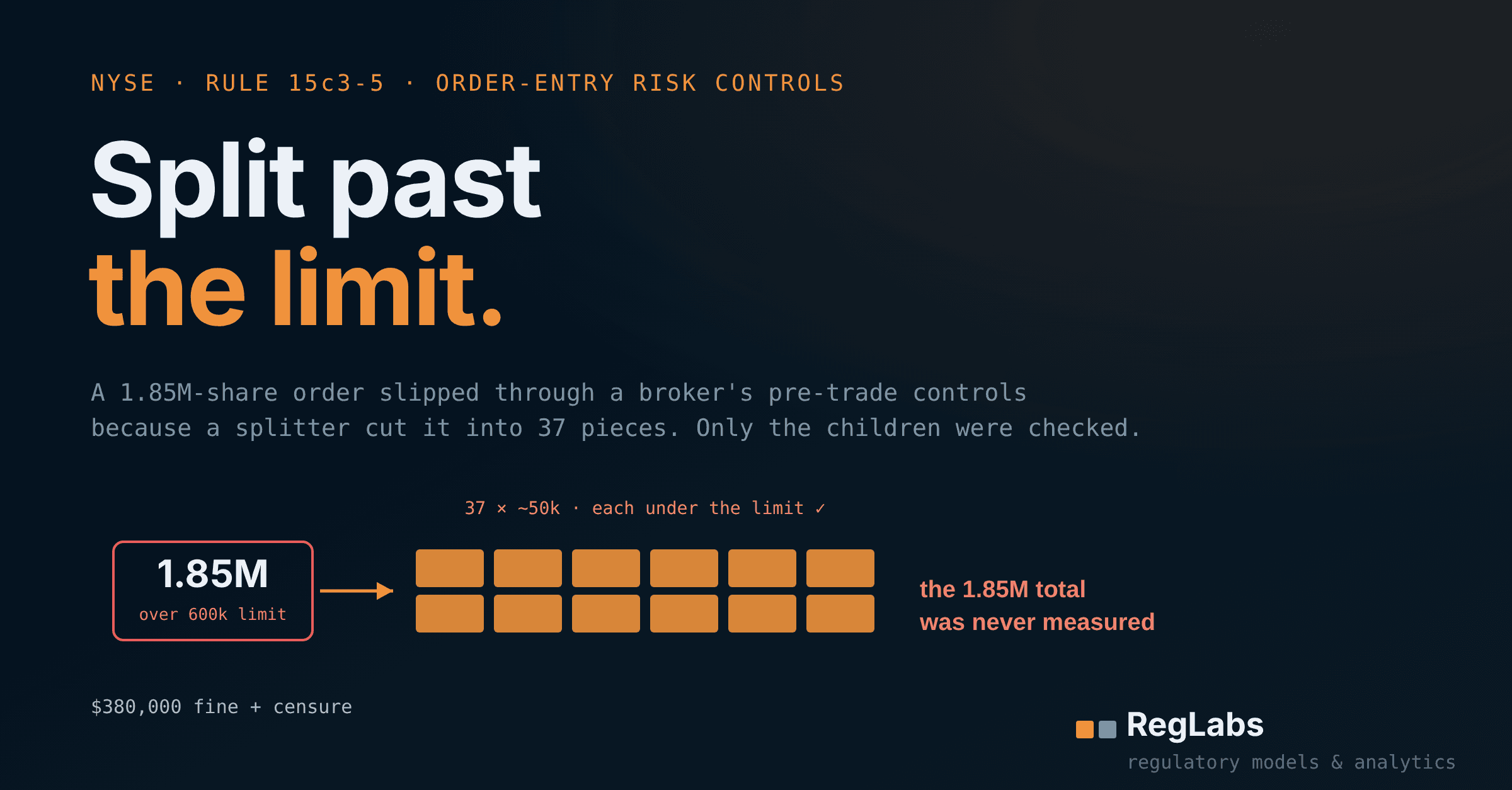
NYSE · SEC Rule 15c3-5 · Market Access Controls
How the order got through the controls
The single-order control checked child orders, not the aggregate parent, so nothing blocked the trade.
Source: NYSE AWC No. 2016-12-00038.
Overview
Every year, broker-dealers with market access have to sit down and do the review that SEC Rule 15c3-5 demands: a documented, honest look at whether their risk-management controls are still reasonably designed to keep erroneous and non-compliant orders out of the market. It is the kind of exercise that is easy to treat as a formality, a re-sign of last year's memo. This NYSE settlement against SG Americas Securities, the US broker-dealer arm of Societe Generale, is the case that argues against doing it that way, because almost everything it found is the kind of gap a real review is supposed to catch and a perfunctory one never will.
The centrepiece is deceptively simple. On 1 October 2015, a programming error in an Excel macro on the firm's Exotics Desk produced an erroneous market-on-close sell order in a stock, roughly 1.85 million shares. The firm's single-order size control at the time was 600,000 shares, so the order should have been stopped. It was not, because an order-splitting tool chopped the parent into 37 child orders of about 50,000 shares each before they reached the 15c3-5 controls, and the controls only checked the children. Thirty-seven small orders sailed through a limit the parent would have failed, and the stock's price fell about 4.28 percent into the close. Then the response compounded it: rather than cancel the order while cancellation was still permitted, the firm placed an offsetting proprietary buy order it knew would net to no change in beneficial ownership, moved the price 4.73 percent the other way, and later transferred the shares so the two trades cancelled out, structured in a way that evaded the firm's own wash-sale detection.
The NYSE censured the firm and fined it $380,000 for violations of Rule 15c3-5, NYSE supervision Rule 3110, and NYSE Rule 2010. But the fine is not why this case belongs on a review-season reading list. It belongs there because the settlement lays out, one by one, a set of failures that map almost perfectly onto the sections of a 15c3-5 review: the design of the controls, their calibration, the annual review itself, the error-handling and cancellation procedures, the offsetting trade and its surveillance, the technology testing, and the escalation and training that should have closed the loop. What follows takes each area of breakdown in turn, explains why it failed, and lays out the issues RegLabs regulatory analytics raise on each before an examiner does. It is longer than our usual case note, on purpose.
Case at a glance
Source: NYSE AWC No. 2016-12-00038.
The NYSE censured the firm and fined it $380,000 for violations of Rule 15c3-5, NYSE supervision Rule 3110, and NYSE Rule 2010.
Infringements
Stripped to the rule text, the case is three findings. First, a violation of SEC Rule 15c3-5 and NYSE Rule 3110: the firm failed to establish, document and maintain a system of risk-management controls reasonably designed to prevent the entry of erroneous orders, and failed to maintain a reasonable system for regularly reviewing the effectiveness of those controls. That single finding folds in three subsections of the rule, the general reasonable-design requirement in 15c3-5(b), the specific erroneous-order requirement in 15c3-5(c)(1)(ii), and the annual-review requirement in 15c3-5(e).
Second, a violation of NYSE Rule 2010, high standards of commercial honour, for executing a trade the firm knew would effectively result in no change in beneficial ownership, the offsetting buy order placed to trade out of the error. Third, a further violation of NYSE Rule 3110 for failing to establish and maintain adequate supervisory systems and procedures around market-on-close and limit-on-close cancellations, error escalation, and malfunctions in trading technology. Read together, those three findings reach the whole lifecycle of the incident: the control that should have blocked the order, the improper way the firm traded out of it, and the supervisory framework that should have governed both.
The RegLabs record tags this single case against fourteen distinct control areas and seven trading schemes, from circumventing limits and fat-finger errors to marking-the-close and wash sales. That breadth is the point. This was not one broken control; it was a chain of them, each of which a review is meant to test. The rest of this analysis takes the seven that matter most for a 15c3-5 review and works through each in turn.
The seven areas of breakdown
The flow below traces how a single macro error became a market-access finding, a wash trade and a supervisory failure. After it, each area the settlement faulted is broken out in turn, with why it failed and, in the amber boxes, the issues RegLabs regulatory analytics raise for review. Taken together they are close to a 15c3-5 examination run by the analytics rather than by hand.
The Societe Generale incident, step by step
How one spreadsheet error became a market-access finding, a wash trade and a supervisory failure · 1 October 2015 · source: NYSE AWC
The flow below traces how a single macro error became a market-access finding, a wash trade and a supervisory failure.
1 Controls that checked the child, not the parent
The defining failure. Order-splitting tools sliced the parent order into child orders below the single-order size control, and the controls applied to the children only. A 1.85 million share order became 37 orders of 50,000, each comfortably under the 600,000 share limit, so the aggregate that should have failed never got tested. Splitting is a legitimate execution technique, but placing it upstream of the risk checks, without aggregating, quietly voids the very control it bypasses. The firm's controls were not weak on paper; they were pointed at the wrong unit of measurement.
- Size and notional checks that bind on child orders but never on the aggregate parent.
- Order-splitting, slicing or routing tools that sit upstream of the 15c3-5 checks.
- The absence of an aggregated size or rate check across a short window.
2 Limits raised, and a missing ADV control
Calibration compounded the design flaw. The firm raised its single-order quantity control from 600,000 to 1,000,000 shares, and it had no average-daily-volume control at all, then or, per the settlement, at the time of the AWC. A flat share limit with no ADV context greatly increased the likelihood of fat-finger errors, especially in lower-priced stocks where a million shares can dwarf a day's trading. Desks were also permitted to set ad hoc thresholds that could exceed the firm-wide limits. A control that can be locally overridden, and that ignores how liquid the instrument actually is, is a control in name.
- A flat share cap with no ADV or percentage-of-volume control calibrated to instrument liquidity.
- Desk-level ad hoc thresholds that can be set above the firm-wide controls.
- Thresholds carrying no documented rationale, approver or re-approval date.
3 The annual review that would have caught it
This is the finding review season exists to prevent. Rule 15c3-5(e) requires a reasonable system for regularly reviewing control effectiveness, and the firm's did not surface the known risk that order-splitting tools bypassed its erroneous-order controls. A review that re-signs last year's parameters without asking whether new or changed tools have opened a gap is not reasonable. The splitting risk was knowable; the review simply did not go looking for it. Even the later remediation, a soft block added in December 2015, still permitted desk-by-desk ad hoc limits that might not conform to the firm-wide controls, which is the same gap wearing a patch.
- A 15c3-5(e) review scoped to confirm controls exist rather than test whether they can be circumvented.
- Order-handling tools added since the last review whose interaction with the controls was never assessed.
- Remediations that were never re-validated to confirm the gap actually closed.
4 No procedure for handling the error
When a trader spotted the erroneous order at about 3:46 pm, cancellation was still permitted under NYSE Rule 123C because it was a legitimate error. The firm had no procedures covering 123C, no rules for cancelling MOC/LOC orders in the case of legitimate error, and no defined process for escalating a trading error. So instead of the clean, permitted fix, supervisors chose to trade out of the error with an offsetting order. The absence of an error-handling procedure did not just leave a gap; it channelled a solvable problem into a much worse one, an offsetting trade the firm knew would net to no change in beneficial ownership.
- No written MOC/LOC legitimate-error cancellation procedure keyed to the Rule 123C timeline.
- No rule making cancellation the first response to a detected error, ahead of trading out of it.
- Supervisors untrained on the error playbook, with no documented decision path.
5 Trading out of the error, into a wash
The offsetting order is the most serious conduct in the case, and the most instructive. The firm placed a 1.85 million share proprietary buy order to offset the agency sell, knowing the trade would net to no change in beneficial ownership, then after the close transferred the shares so the two cancelled out. Because the sell was booked as agency and the buy as principal, the pair looked like two different participants and slipped past the firm's wash-sale surveillance, even though it was the same beneficial owner on both sides. This is where an operational error crossed into a conduct violation, and it shows how a surveillance system keyed to counterparty labels rather than beneficial ownership can be defeated by the booking itself.
- Wash-sale surveillance keyed on the principal-versus-agency label rather than beneficial ownership.
- Error-remediation trades not screened for self-match and market-impact risk before booking.
- No path by which an offsetting error trade would be caught and escalated.
6 Untested tools and technology change
Both erroneous orders in the case traced to technology the firm had not tested adequately. The 2015 order came from a programming error in an Excel macro whose design did not clearly display the final calculated adjustment to the trader before splitting and routing. A later erroneous order, roughly 231,000 shares in another symbol in 2017, came from two separate system malfunctions and also failed to trigger the 15c3-5 controls. The firm's written procedures on software testing were not reasonably designed to ensure that macros used to prepare orders were tested before deployment; where testing happened at all, it missed the defects. Home-grown tools like spreadsheet macros are trading systems too, and they tend to escape the change-management rigour applied to the order gateway.
- Spreadsheet macros and desk-built tools sitting outside the change-management and testing regime.
- Testing that is not risk-based, so tools touching order size, routing or risk logic are not tested hardest.
- Order-preparation tools that do not clearly display the final order to the trader before it is sent.
7 Escalation, training and a decade of repeats
The human layer failed last, and most tellingly. The firm had no supervisory system for how erroneous orders should be escalated, and once the error and the improper offsetting trade became known to management and compliance, the firm did not take appropriate action, and provided no formal training in response to the incident. This sits on top of a striking disciplinary history: NYSE and FINRA had cited the firm for MOC/LOC and related failures repeatedly since 2007, including a $350,000 fine in 2011 for 7,800 improper cancellations and multiple later actions. The most damning line in a review is not that a control failed once, but that the same theme kept recurring and the escalation and training that should have broken the cycle never did.
- No tiered escalation matrix for erroneous orders and limit breaches, with named owners and response times.
- Post-incident training that is not delivered or tracked to completion.
- Prior findings and near-misses left out of the current review scope, so recurring themes persist.
Thematic Review
The reason a single 2015 order still merits a 2026 review-season read is that its failure mode is one of the most heavily enforced in all of market structure. Across the RegLabs record, Market Access Rule and trading-risk-management failures account for more than 1,400 catalogued actions and over $5 billion in penalties, and the enforcers are led by FINRA and the equity exchanges that examine 15c3-5 compliance directly. This is not a niche corner of the rulebook; it is one of the most examined obligations a broker-dealer carries, and the reviews that matter are the annual ones firms run on themselves.
Market Access Rule enforcement is broad and exchange-led
Catalogued market-access and trading-risk actions by regulator (case count) · 1,400+ worldwide · source: RegLabs
Counts exclude the several other Cboe, Nasdaq and NYSE affiliated venues, which add well over a hundred more. SEBI's volume reflects its high-frequency, order-level enforcement model. In the US, FINRA and the exchanges run the bulk of 15c3-5 examinations, and their findings cluster on exactly the areas above.
What that record shows, case after case, is that erroneous-order controls fail in a small number of repeatable ways, and this settlement contains most of them at once: checks applied to the wrong unit, thresholds calibrated without liquidity, tools that circumvent the gateway, an annual review that did not test for circumvention, missing error-handling procedures, untested home-grown technology, and escalation and training that did not learn from prior findings. A review team that walks its own controls against those seven headings is doing precisely what an examiner will do, only earlier and more cheaply.
One order, fourteen control areas
The eight most central of the fourteen control areas RegLabs tags to this single case · relevance scores (0 to 10)
Scores are RegLabs relevance ratings for how central each control area was to the findings, not penalties. The clustering at the top is the tell: a single erroneous order exposed the full stack of 15c3-5 controls at once.
Source: RegLabs enforcement database.
The strategic reading for review season is that the annual 15c3-5 review is not a compliance chore; it is the cheapest examination a firm will ever face, run by the people who know the systems best, before anyone with subpoena power does. The firms that come out of the next cycle clean are the ones whose review interrogates the controls the way an adversary would, aggregating child orders, hunting for tools that sit upstream of the gateway, pressure-testing the error playbook, and pulling last year's findings into this year's scope, rather than re-signing a memo. SG Americas paid $380,000 and a censure to produce that checklist. Reading it is free.
Make this year's 15c3-5 review the one that finds it first
Run your controls against the failure record, not just last year's memo
Every gap in this settlement, from child-order splitting to the missing ADV control to the annual review that never tested for circumvention, is visible across the enforcement record and knowable in advance. RegLabs turns that record into regulatory models and analytics you can point at your own market-access framework, so the weaknesses surface in your review rather than in an examiner's findings.
- Automate regulatory review across Rule 15c3-5 controls, erroneous-order prevention, supervision, technology governance and surveillance, mapping every rule and disciplinary decision to the controls it touches.
- Systematise your annual 15c3-5(e) effectiveness review by benchmarking your size, ADV, splitting and error-handling controls against the precise failure modes regulators keep citing.
- Simulate a market-access examination for your own firm, using RegLabs models to surface the questions FINRA, the NYSE, Nasdaq or Cboe would ask, and to pressure-test your review before an examiner does.
This article is an independent editorial analysis for information only and is not legal or compliance advice. SG Americas Securities, LLC consented to the findings without admitting or denying them.